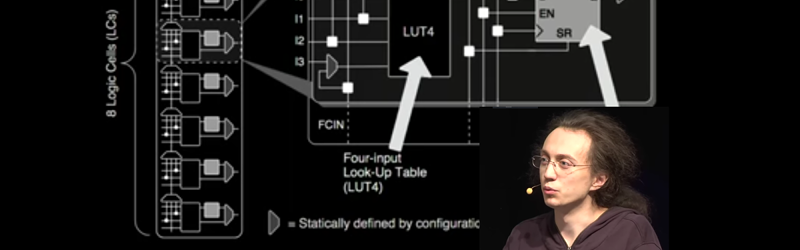
Note: This article is written in original, publication-ready English and is based on real technical material about FPGA architecture, configuration, and reverse-engineering workflows.
Reverse engineering an FPGA sounds a little like trying to understand a city by staring at its streetlights during a thunderstorm. You know there is structure. You know every blinking point means something. But the map is hidden, the wiring is proprietary, and the manufacturer would generally prefer that you admire the skyline rather than redraw the blueprints.
That is exactly why the 34C3 talk “Reverse Engineering FPGAs” landed with such force. Instead of treating FPGA bitstreams like magical confetti generated by vendor tools, the talk framed them as something understandable, documentable, and eventually usable in an open workflow. Suddenly the conversation was not just about chips. It was about freedom, verification, trust, and the hacker instinct to open the black box and politely ignore the sign that says “please do not open the black box.”
At its core, the talk explored how researchers and open-source developers worked from the bottom up to understand the internal makeup of Xilinx 7-series and Lattice iCE40 devices, extracting schematics, mapping configuration bits, and building documentation that makes a free toolchain possible. That might sound niche. It is niche. Delightfully niche. But it is also a major story in modern hardware development, because FPGA reverse engineering sits at the intersection of computer architecture, tooling independence, security research, and plain old technical curiosity.
What the 34C3 talk was really about
The 34C3 presentation was not a stage performance about breaking chips for sport. It was a practical explanation of how reverse engineers can recover knowledge that commercial toolchains keep hidden. The focus was on understanding the fabric of an FPGA from the inside out: logic blocks, routing, memories, I/O features, and the bitstream fields that control them.
That distinction matters. A lot of people hear “reverse engineering” and picture movie nonsense: green text, dramatic music, maybe one person yelling, “I’m in!” In reality, FPGA reverse engineering is slower, more methodical, and much more interesting. It is the disciplined process of asking questions like these:
- Which bits in the configuration file turn on a specific LUT function?
- Which bits enable a routing connection between two wires?
- How are block RAMs, clock resources, and I/O standards represented?
- Can that knowledge be organized into a database that software tools can use?
The answer, as the 34C3 talk made clear, is yes, but only after a mountain of careful experimentation.
Why reverse engineering an FPGA is such a wonderfully stubborn problem
Bitstreams are not source code
An FPGA bitstream is not like a neatly commented C file waiting to be admired. It is a dense configuration artifact that programs the device fabric after manufacturing. Vendor documentation explains broad architecture and supported workflows, but the exact bit-level meaning of many configuration fields has historically remained proprietary.
That means reverse engineers are not starting with a friendly cookbook. They are starting with outputs generated by commercial tools and trying to infer the hidden structure underneath. It is less “read the manual” and more “create a thousand tiny experiments, compare the outputs, and let the chip slowly confess.”
The fabric is huge and heterogeneous
Modern FPGAs are built from more than just simple logic cells. In a Xilinx 7-series part, for example, the configurable logic block includes 6-input LUT technology, dual-LUT modes, distributed memory capability, shift register logic, carry chains, and wide multiplexers. Slices bundle LUTs and flip-flops into repeatable logic resources, but the device also includes memory, clocking, DSP-style resources, and a sea of programmable interconnect.
That sea of routing is where the fun starts and the sanity budget ends. Reverse engineering logic features is hard enough. Reverse engineering routing means figuring out which configuration bits correspond to which programmable interconnect points, and doing so across a large, regular-but-not-too-regular architecture.
One changed bit can mean everything, or almost nothing
If you generate two nearly identical designs and compare their bitstreams, the changed bits may indicate a LUT equation, a clock route, a local mux setting, or some housekeeping field that has nothing to do with the feature you intended to study. Reverse engineering, then, becomes a scientific exercise in isolation. You need controlled experiments, careful minimization, repeatability, and enough samples to separate signal from noise.
In other words, it is not glamorous. It is a lab notebook with caffeine.
Inside the chip: the structures reverse engineers chase
To appreciate the 34C3 talk, you need a basic mental model of what is being mapped. Think of an FPGA as a reconfigurable city with several major neighborhoods:
Logic blocks and LUTs
The LUT is the workhorse of the FPGA world. In AMD’s 7-series architecture, LUTs can act as logic, and in certain slice types they can also serve as distributed RAM or shift-register logic. Reverse engineers care about LUTs because they are small, well-bounded, and perfect for controlled experiments. Change a logic equation, compare the bitstream, repeat until your eyeballs file a complaint.
Flip-flops and carry chains
Basic sequential logic and arithmetic features are also part of the mapping story. Carry logic, in particular, is essential because arithmetic performance depends on dedicated fast paths rather than forcing everything through generic routing. Reverse engineering those features helps explain how synthesis and place-and-route tools target arithmetic structures efficiently.
Routing resources and PIPs
If LUTs are the shops and offices in the city, routing is the road system. Programmable interconnect points, often shortened to PIPs, determine how signals move through the device. Understanding them is central to building an open place-and-route flow. Without routing knowledge, you can describe logic all day and still fail to build a working design.
Block RAM, I/O, and clocking
Serious toolchains cannot stop at simple logic. They need memory blocks, I/O resources, and clock infrastructure. That is why mature reverse-engineering projects branch into separate fuzzers and experiments for clock tiles, block RAM, I/O blocks, and other special resources. Open-source support becomes useful only when the database grows beyond toy examples.
How reverse engineering actually works
The most important practical idea behind FPGA reverse engineering is that you do not have to decap the chip and stare at silicon under a microscope to make progress. Sometimes you can learn an astonishing amount through a black-box differential process.
That process usually looks like this:
- Create many tiny designs that vary in one controlled way.
- Run them through the vendor toolchain to generate bitstreams.
- Compare those bitstreams to see which bits changed.
- Correlate bit changes with feature changes.
- Store the results in a database.
- Repeat until the project becomes both powerful and mildly obsessive.
This is exactly why projects such as Project X-Ray became so influential. Project X-Ray documents Xilinx 7-series architecture with the explicit goal of enabling an open Verilog-to-bitstream toolchain. Its workflow relies on lots of generated designs, “fuzzers,” minitests, and database-building steps. The documentation even describes the overall process as a black-box method in which Vivado generates large numbers of designs and the resulting bitstreams are cross-correlated to determine what different bits do.
That single idea changed the game. Reverse engineering no longer looked like a mysterious art reserved for a tiny priesthood of silicon whisperers. It became an engineering process: automate experiments, gather evidence, build databases, improve tools.
Why Lattice iCE40 became the gateway drug
The Lattice iCE40 family played an outsized role in the open FPGA movement because it was approachable enough for community effort to gain traction. Project IceStorm documented the iCE40 bitstream format and provided tools for analyzing and creating bitstream files. That mattered enormously, because once the bitstream stopped being opaque, the rest of the flow could open up around it.
Then came the supporting cast:
- Yosys for synthesis
- Arachne-pnr, and later nextpnr, for place and route
- IceStorm tools for packing and programming bitstreams
Together, these components created what many developers had wanted for years: a fully open-source path from Verilog to a working FPGA image on real hardware. That was not just convenient. It was culturally important. It meant students, researchers, and independent developers could study the entire flow rather than simply feed RTL into a proprietary machine and hope for the best.
And yes, “hope for the best” is a valid emotional state in hardware development, but it should not be the whole workflow.
Why Xilinx 7-series raised the stakes
If iCE40 was the proof that the wall could be climbed, Xilinx 7-series showed just how tall the wall really was. The architecture is richer, larger, and more demanding. AMD’s own documentation highlights substantial CLB resources, multiple slice types, distributed RAM capability, shift registers, and a broad configuration framework involving JTAG, multi-bitstream management, reconfiguration techniques, and bitstream security features.
That means a successful reverse-engineering effort has to cover far more than simple LUT initialization. It has to understand configuration addressing, tile structure, interconnect, special blocks, and the relationships between physical resources and bitstream fields. Project X-Ray tackled this by building a documentation database and using many targeted fuzzers for CLBs, BRAMs, I/O blocks, clocking resources, and PIPs.
The result was bigger than a neat technical trick. It was a blueprint for how open hardware tooling can emerge even when the original format is undocumented.
Why reverse engineering FPGAs matters beyond hacker bragging rights
Toolchain freedom
The obvious benefit is independence. Open synthesis, place-and-route, and bitstream tools reduce dependence on vendor-specific flows. That helps hobbyists, educators, and researchers, but it also matters in professional settings where reproducibility, automation, or long-term maintainability matter more than polished GUI screenshots.
Trust and design assurance
Another major benefit is verification. Researchers have pointed out that proprietary FPGA CAD flows force designers to trust the netlist-to-bitstream conversion process. If the toolchain is altered or the bitstream is tampered with, the implemented design may diverge from the intended one. Reverse-engineered knowledge makes it easier to inspect, validate, and reason about what is actually loaded onto the device.
Security research
Security experts care because bitstream tampering, reverse engineering, and configuration attacks are not hypothetical. Hardware security discussions now routinely treat reverse engineering and bitstream integrity as real concerns. Better public understanding of FPGA internals does not magically solve those problems, but it does make the threat model more honest. You cannot protect what you insist on not understanding.
Education and innovation
Open documentation also improves teaching. Students can learn what packing, placement, routing, and configuration really mean instead of treating the FPGA flow as a sequence of sacred menu clicks. Once the stack becomes inspectable, innovation gets easier. Researchers can prototype new flows, new verification methods, and new architecture experiments without waiting for vendor permission slips.
The lasting lesson of the 34C3 talk
The real legacy of 34C3: Reverse Engineering FPGAs is not that one conference talk “solved” reverse engineering. It is that the talk captured a turning point. It showed that a community could move from curiosity to methodology, from undocumented outputs to usable databases, and from scattered experiments to practical tooling.
It also reminded the hardware world of something software learned long ago: when tools are open, people build faster, learn deeper, and trust more intelligently. Proprietary formats may protect competitive advantage in the short term, but they also create blind spots. Reverse engineering shines a flashlight into those blind spots, one toggled bit at a time.
Experiences from the bench: what reverse engineering FPGAs feels like
If you have never worked close to this kind of project, it can be hard to appreciate the texture of the experience. FPGA reverse engineering is not a single dramatic breakthrough. It is dozens, then hundreds, of tiny breakthroughs stacked together like bricks. One day you prove that a small cluster of bits controls a LUT initialization pattern. The next day you discover that what looked like a clean routing hypothesis was actually polluted by unrelated configuration noise. Then, after several false starts and a few muttered words that should not be printed in a family article, the pattern sharpens and the tile finally makes sense.
There is a peculiar emotional rhythm to the work. At first, every bitstream looks like static. You flip one logic function, regenerate the file, and a handful of bytes change somewhere deep in the output. Great. Very helpful. You flip another feature and more bits move, but not the ones you expected. So you shrink the test case. Then shrink it again. Then generate a whole batch of deliberately boring designs so the one interesting difference stands out. It is painstaking work, but when the noise falls away and a reliable correspondence appears, it feels less like debugging and more like archaeology.
There is also a strong physical sense to the process, even when most of the work is done in software. You start imagining the chip as geography. Certain tiles become familiar neighborhoods. A route that once seemed abstract begins to feel like a specific corridor through a building you have walked a hundred times. A CLB is no longer just a term in a manual; it becomes a place where you know the likely suspects, the odd exceptions, and the little tricks that make the architecture elegant.
Another common experience is humility. Reverse engineering has a way of punishing overconfidence immediately. The moment you think, “Ah yes, I fully understand this format now,” the next experiment introduces an edge case involving clocking, memory initialization, or an architecture-specific quirk that sends you back to the notebook. But that is part of the fun. The work rewards patience more than ego.
What makes the experience especially satisfying is that progress accumulates in public. A new database entry, a better decoder, a cleaner routing model, a successful open-source place-and-route run on real hardware, these are not private trophies. They become stepping stones for everyone else. A student can learn from them. A researcher can verify against them. A developer can build on them. That shared momentum is why talks like 34C3 still resonate. They capture the feeling that a supposedly sealed system can, with enough curiosity and discipline, become understandable. And once something becomes understandable, it becomes teachable, testable, and improvable. That is a pretty good payoff for staring at mysterious bits until they stop being mysterious.
Conclusion
34C3: Reverse Engineering FPGAs remains a landmark topic because it turned a hidden corner of hardware design into a readable story. It connected architecture, experimentation, security, and open-source tooling in a way that still feels relevant. Whether you care about Xilinx 7-series internals, Lattice iCE40 accessibility, Project X-Ray, Project IceStorm, or the bigger argument for open hardware infrastructure, the message is the same: reverse engineering is not vandalism. In this context, it is documentation by persistence.
And maybe that is the best summary of the whole movement. An FPGA bitstream may begin life as an opaque artifact, but opacity is not destiny. Give a good community enough patience, enough experiments, and enough coffee, and the black box eventually starts giving up its secrets.