Your entryway has a difficult job. It must welcome guests, d somehow look attractive while doing all of that. Fortunately, an entryway redo on a budget does not require custom cabinetry, imported tile, or a chandelier large enough to have its own ZIP code.
With a thoughtful plan, a few practical storage upgrades, and some strategic decorating, even a narrow hallway or awkward corner can become an organized, welcoming entrance. The secret is to spend money where function matters and use creativity everywhere else.
Why a budget entryway makeover is worth doing
The entryway is one of the smallest areas in many homes, but it has an outsized effect on daily life. It is the first interior space you see when you come home and often the last place you pass before leaving. When it works well, shoes stay contained, keys are easy to find, coats have a proper home, and the morning rush becomes slightly less theatrical.
A successful makeover should balance appearance with utility. Design experts commonly recommend combining wall hooks, a mirror, a durable rug, practical seating, and a defined place for small everyday items. These elements can be adapted to almost any layout or budget.
Start with a realistic entryway makeover budget
Before buying baskets because they look charming in a photograph, decide how much you can comfortably spend. Then divide that amount into functional improvements and decorative extras.
A makeover under $100
Focus on cleaning, leftover paint, wall hooks, a secondhand mirror, a washable mat, and a small tray for keys. This level works especially well for renters, apartments, and entryways that already have usable furniture.
A makeover between $100 and $300
Add a slim console, storage bench, shoe cabinet, better lighting, or peel-and-stick wallpaper. Budget makeovers published by major design sites show that leftover paint, affordable furniture, reused materials, and do-it-yourself labor can create a surprisingly polished result for a few hundred dollars or less. over between $300 and $500
This range can cover paint, a quality runner, concealed shoe storage, upgraded lighting, coordinated hardware, and a substantial bench or console. It is still a budget project, but it provides more flexibility for durable pieces that will survive children, pets, wet boots, grocery bags, and the occasional backpack thrown with Olympic enthusiasm.
How to redo an entryway on a budget
1. Empty the area completely
Remove coats, shoes, furniture, rugs, decorations, baskets, and the mysterious collection of reusable shopping bags. Starting with an empty space makes it easier to see the entryway’s actual dimensions and identify what is causing congestion.
Sort everything into four groups: daily essentials, seasonal items, belongings that should live elsewhere, and donations. The goal is not to build enough storage for every coat and shoe you own. The goal is to make room for the items you regularly use.
2. Measure before shopping
Measure the wall width, available floor depth, door swing, outlet locations, trim, and walking path. In a narrow entryway, even a beautiful console can become an expensive obstacle if it extends too far into the room.
Use painter’s tape to outline furniture dimensions on the floor and wall. Open the front door fully and walk through the taped area carrying a bag. If you have to turn sideways like a crab, the furniture is too large.
3. Repair, clean, and refresh the surfaces
Budget decorating looks far more expensive when the basic surfaces are clean. Patch nail holes, tighten loose trim, wipe down doors, clean baseboards, and remove scuff marks before introducing new decor.
Paint remains one of the most affordable ways to change a room. A light neutral can brighten a dark entryway, while a deep accent color can give a small space personality. You can also paint only the door, ceiling, lower half of the wall, or a geometric section behind the coat hooks. Small entryways are often good places for bold color because the limited area keeps the effect controlled. ate a dependable drop zone
Every useful entryway needs a designated landing place for keys, sunglasses, wallets, mail, and headphones. Without one, these objects will form tiny clutter villages on every available surface.
A shallow tray, ceramic bowl, wall-mounted organizer, or small drawer can handle daily essentials. Choose the solution that fits your real habits. If you naturally drop your keys immediately after opening the door, place the tray within arm’s reach rather than on a decorative table six feet away.
Professional organizers frequently recommend creating a simple drop zone that works with the household’s normal routine instead of demanding perfect behavior. the walls before using the floor
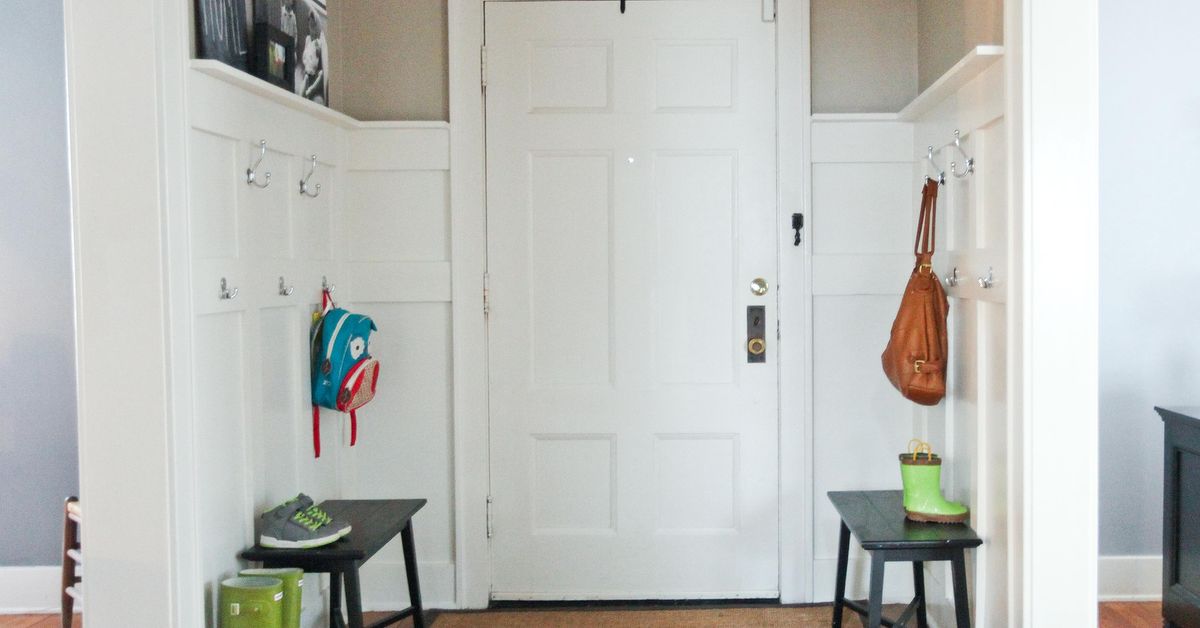
Vertical storage is essential in a small entryway. Wall hooks can hold coats, backpacks, dog leashes, umbrellas, and hats without consuming valuable floor area. Install hooks securely into studs or use appropriate wall anchors based on the expected weight.
Place some hooks lower if children use the space. This gives them a realistic chance of hanging up their own belongings instead of creating a backpack mountain near the door.
A narrow shelf above the hooks can store baskets, seasonal accessories, or lightweight decor. Pegboards, wall-mounted cubbies, and folding hook racks also work well when the layout is tight. trol the shoe population
Shoes are usually the fastest way to make an entryway look chaotic. Keep only frequently worn pairs near the door and move special-event, out-of-season, and rarely used shoes to bedroom closets or other storage.
Depending on the space, use a shoe tray, narrow cabinet, low rack, basket, crate, or bench with storage underneath. Closed cabinets create a calmer appearance, while open shelves make it easier for children and busy adults to put footwear away quickly.
A good system should be slightly easier than leaving shoes on the floor. If opening three doors and lifting a heavy lid is required, the floor will win.
7. Add seating without blocking traffic
A bench makes it easier to put on shoes, set down packages, or help a child wrestle with winter boots. It can also provide concealed storage or space for baskets underneath.
For a tiny entrance, use a narrow bench, storage ottoman, small stool, or folding seat. A secondhand bench can be sanded, painted, and topped with an inexpensive cushion. When floor space is extremely limited, skip seating and use a wall-mounted shelf or compact console instead.
8. Hang a mirror
A mirror is useful for checking your appearance before leaving, but it also reflects light and can make a narrow entrance feel more open. Choose a mirror with a simple frame from a thrift store, discount retailer, or another room in the house.
A large mirror usually creates more visual impact than several small decorative pieces. In a compact space, one strong focal point can feel cleaner and more intentional than a crowded gallery wall. rove the lighting
Good lighting makes an entryway feel safe, clean, and welcoming. Replace weak bulbs with brighter bulbs in an appropriate color temperature, clean dusty shades, or update an old fixture with a simple flush mount or pendant.
Renters can use plug-in sconces, rechargeable wall lights, or a small lamp on a console. Motion-activated lights are also useful inside dark entry closets. Always hire a qualified professional for electrical work that exceeds your experience.
10. Ground the space with a practical rug
An entryway rug should handle dirt, moisture, and repeated foot traffic. Look for a low-pile, washable, or indoor-outdoor style with a nonslip pad. A runner can visually lengthen a narrow hallway and guide the eye into the home. gs that interfere with the door swing. The most beautiful rug in the world becomes less charming when it traps everyone inside the house.
Affordable decorating ideas that look intentional
Shop your own home first
Before purchasing new decor, walk through the house. A small dresser can become an entryway console, a dining bench can provide seating, and an unused bowl can hold keys. A bar cart, narrow desk, floating shelf, or vintage cabinet can also perform entryway duty.
Repurposing furniture is not only economical; it can give the space more character than buying a perfectly matched set. Designers frequently use dressers, credenzas, carts, and vintage furniture to combine personality with concealed storage. rift stores and online resale listings
Search for mirrors, benches, small cabinets, baskets, picture frames, lamps, and coat racks. Ignore unattractive finishes if the shape and dimensions are right. Paint and new hardware can rescue many dated pieces from decorative retirement.
Make simple art
Frame a piece of wallpaper, fabric, wrapping paper, a vintage map, children’s artwork, or a large photograph. One oversized piece usually looks more polished than a collection of tiny objects purchased simply because the wall looked lonely.
Repeat two or three finishes
A budget entryway feels cohesive when materials repeat. For example, combine black hooks, a black mirror frame, and a black light fixture. Pair woven baskets with a natural wood bench and a tan runner. Repetition creates visual order even when the items came from different stores or decades.
Add one living element
A small houseplant, clipped branch, or vase of seasonal greenery can soften an entryway. Choose a plant that suits the available light. In dark spaces, realistic artificial greenery may be more practical than sentencing a sun-loving plant to a slow botanical tragedy.
Three sample budget entryway plans
Plan A: The $75 renter-friendly refresh
- Removable wall hooks or an over-the-door rack
- A secondhand mirror
- A washable doormat
- A narrow floating ledge for keys
- Framed fabric or removable wallpaper as art
- A basket for shoes or reusable bags
This plan avoids permanent construction while giving every daily item a home.
Plan B: The $200 family drop zone
- A used storage bench or low cubby unit
- Heavy-duty hooks at adult and child heights
- Labeled baskets for hats, gloves, and pet supplies
- A boot tray or low shoe rack
- A wall-mounted mail organizer
- Paint for one accent wall
The emphasis is speed. Family members should be able to put things away in seconds, preferably without needing a committee meeting.
Plan C: The $400 polished foyer
- A slim console with drawers or doors
- A large mirror
- A durable runner and rug pad
- An updated ceiling fixture
- Fresh paint
- Matching hooks and hardware
- One large piece of art or a sculptural lamp
This version spends more on pieces that anchor the room while keeping decorative accessories simple.
Budget entryway mistakes to avoid
Buying storage before decluttering
New baskets do not eliminate clutter. They merely give clutter attractive vacation homes. Reduce the number of items first, then purchase storage based on what remains.
Choosing furniture that is too deep
Maintain a comfortable walking path and confirm that the front door can open fully. Slim furniture is generally more useful than bulky pieces in a narrow entrance.
Installing too many open hooks
Hooks are convenient, but overloaded hooks quickly create visual noise. Keep only current, frequently used outerwear near the door and rotate items seasonally. Design and organizing experts often recommend limiting visible belongings and using closed storage where possible. ting every surface
Leave room for real life. A console covered with candles, frames, books, sculptures, and seven decorative beads may look lovely until someone needs to set down a package.
Ignoring maintenance
Choose washable textiles, wipeable paint, durable baskets, and sturdy hooks. Entryways are working spaces, not museum exhibits.
Real-world experiences from budget entryway projects
The following lessons reflect common homeowner experiences and realistic project scenarios rather than one specific renovation.
The most useful improvement is rarely the most glamorous
Many budget projects begin with dreams of wallpaper, dramatic lighting, and a mirror worthy of a boutique hotel. Yet the improvement people appreciate most often turns out to be something ordinary: a hook placed exactly where the work bag lands, a tray that prevents lost keys, or a bench that stops everyone from balancing on one foot while tying shoes.
This is a useful reminder that successful design follows behavior. Watch what happens in the entryway for several days before planning the makeover. Notice where mail accumulates, which coats are worn most often, where shoes are kicked off, and whether people actually use the existing closet. Those patterns reveal what the room needs more accurately than a perfectly styled photograph.
Painting usually takes longer than expected
A small entryway appears easy to paint because it has limited square footage. Unfortunately, it may also contain several doors, corners, trim sections, switches, and areas requiring careful cutting. Preparation can take longer than applying the paint itself.
The experience is usually smoother when homeowners clean the walls, patch damage, label hardware, and gather supplies before opening the paint can. Saving leftover paint for touch-ups is also important. Entryways collect scuffs with impressive efficiency, especially near shoe racks and bag hooks.
Secondhand furniture can solve expensive problems
A homeowner may begin by shopping for a narrow entryway console and discover that the attractive options exceed the entire makeover budget. Looking beyond the official “entryway furniture” category often solves the problem. Small dressers, sewing tables, old school desks, wall cabinets, and compact sideboards can provide equal or better function.
The best secondhand purchase is usually the piece with the correct dimensions and solid construction, not the perfect finish. A scratched wood cabinet can be cleaned and painted. Dated knobs can be changed. An inexpensive piece with doors or drawers may ultimately look calmer than an open designer console because it hides the daily mess.
A storage system must survive a tired Tuesday
Complicated organization systems often work beautifully for the first week. Then someone arrives home carrying groceries, mail, a wet umbrella, and absolutely no enthusiasm for arranging accessories by category.
The systems that last are simple. Shoes go into one cabinet. Keys go into one bowl. Bags go on one hook per person. Mail goes into one tray and is processed regularly. When every action takes only a few seconds, the household is more likely to continue doing it.
One finished wall can transform the whole entrance
When the budget is limited, completing one purposeful wall often creates a better result than spreading small purchases throughout the room. A painted section with hooks, a bench, baskets, and a mirror can visually define the entryway even when the front door opens directly into a living room.
This approach is especially helpful in apartments and open-plan homes without a formal foyer. The wall becomes a visual boundary, signaling that the area has a specific function.
The final styling should be restrained
After repairing, painting, organizing, and installing storage, it is tempting to celebrate by buying several decorative objects. Real-world use usually proves that fewer pieces work better. A lamp, one piece of art, a bowl, and a plant may be enough.
Leaving open space makes the entryway feel larger and allows the functional improvements to remain visible. It also provides room for packages, guest belongings, or seasonal decorations without creating immediate clutter.
The best budget makeover evolves over time
Not every item needs to be purchased during one weekend. Complete the essential work first, live with the new arrangement, and note what is still missing. You may discover that you need another hook but not another basket, or that a stool would be more useful than the console you nearly purchased.
Waiting also creates time to find better secondhand pieces, watch for sales, and avoid impulse purchases. A slowly assembled entryway often feels more personal and collected than a space furnished from one matching product line.
Conclusion: Make the entrance work harder, not the budget
An entryway redo on a budget succeeds when it improves both the appearance of the home and the household’s daily routine. Begin by removing clutter, measuring carefully, and identifying the items that truly need to remain near the door. Then use paint, vertical storage, practical shoe containment, better lighting, and repurposed furniture to create a welcoming space without unnecessary expense.
The finished entryway does not need to resemble a luxury showroom. It needs to help you enter and leave the house without losing your keys, tripping over shoes, or apologizing to guests for the coat avalanche. When the room supports real life and still makes a good first impression, the makeover has done its job.
Research note: This article synthesizes entryway planning, storage, lighting, paint, furniture, and budget-makeover guidance from reputable U.S. home and design publishers, including This Old House, HGTV, Better Homes & Gardens, The Spruce, The Home Depot, Lowe’s, Bob Vila, Real Simple, Apartment Therapy, Family Handyman, Martha Stewart, Houzz, and Emily Henderson Design. itor-note”>Note: Budget examples are planning estimates. Actual costs vary by location, material quality, project size, available tools, and the amount of do-it-yourself work involved.