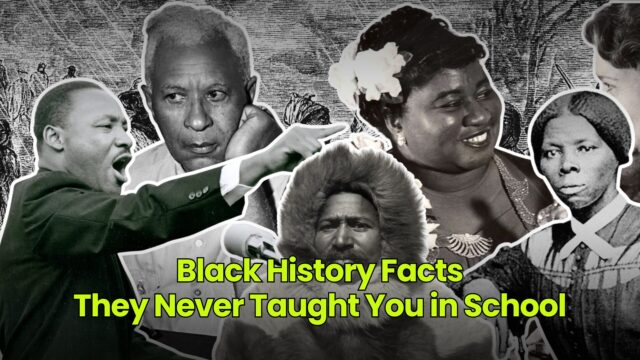
Let’s be honest: a lot of us got the discount version of American history in school. We heard the greatest hits, memorized a few dates, circled the right answers on a multiple-choice test, and somehow walked away thinking Black history mostly lived in one short chapter between slavery and the civil rights movement. That version was not just incomplete. It was wildly unfair.
The truth is bigger, richer, stranger, smarter, and far more American than the tidy timeline many classrooms handed out. Black history is not a side quest in the national story. It is the main road, the bridge, the map, and sometimes the tow truck when democracy breaks down on the shoulder.
So here are some Black history facts they probably never taught you in school, or at least did not teach with enough depth to matter. These are the kinds of facts that make you stop mid-scroll, raise an eyebrow, and wonder how an entire country managed to leave out so much of its own biography.
1. The first Black-owned newspaper in the United States launched in 1827
Long before social media, cable news, or your uncle posting all-caps history takes online, Black Americans were building their own press. In 1827, Freedom’s Journal began publication in New York City as the first Black-owned and operated newspaper in the United States.
That matters for two reasons. First, it blows up the lazy myth that Black Americans were merely waiting to be “given” a voice. They were creating platforms, shaping public debate, and documenting injustice for themselves. Second, it reminds us that journalism was always part of Black resistance. When mainstream papers ignored Black communities or distorted their lives, Black editors stepped in and said, in effect, “Fine, we’ll print the truth ourselves.”
And honestly, that is one of the most American things imaginable: seeing a broken system and building a better one with ink, stubbornness, and deadline pressure.
2. The Green Book was not a quirky travel guide. It was a survival manual
Many people now know the title The Negro Motorist Green Book, but fewer understand what it represented in daily life. During segregation, Black travelers could not safely assume they would be able to find a hotel, restaurant, gas station, restroom, or even a town where stopping would not bring humiliation or danger.
That is where Victor H. Green’s guide became essential. The Green Book listed places where Black travelers could eat, sleep, refuel, and breathe a little easier. We sometimes talk about it today with a nostalgic road-trip glow, but let’s keep it real: nobody needs a special travel guide unless ordinary travel is already hostile.
The deeper fact school often skipped is this: freedom of movement was never equally distributed in America. Black families planning a vacation also had to plan for discrimination, risk, and emergency workarounds. The road was supposed to symbolize freedom. For many Black Americans, it came with a backup plan, a list of safe stops, and a prayer.
3. Central Park was built after a thriving Black community was destroyed
Here is a fact that deserves to be shouted through a megaphone at every expensive brunch near Manhattan real estate: the land that became Central Park was not empty. One of the communities erased to make way for it was Seneca Village, founded in 1825 and recognized as the first free Black community in New York City.
Seneca Village was not a random patch of cabins. It included homes, churches, schools, and significant Black property ownership. For Black New Yorkers in the early 19th century, owning land was not just about comfort. It could help secure voting rights, stability, and a future.
Then came eminent domain, and the community was destroyed so the city could create the park. That does not mean Central Park is not beautiful. It means beauty in America has often been built over buried stories. Once you know that, the landscape looks different. The grass is still green, but the history underneath it is harder to ignore.
4. “Black Wall Street” was real, and its success was one reason it was targeted
The Greenwood District in Tulsa, Oklahoma, was not just a symbol or a nickname invented later for dramatic effect. It was a prosperous Black community with businesses, theaters, doctors, shops, and a strong economic base. It was often called “Black Wall Street” because Black entrepreneurship there was visible, local, and powerful.
That is the part many school lessons used to rush past. The Tulsa Race Massacre of 1921 was not an attack on emptiness. It was an attack on Black wealth, Black ambition, Black institutions, and Black success. Homes and businesses were burned. Lives were destroyed. Families lost property, income, and generational stability in a matter of hours.
When people say Black communities should just “build their own,” history has a dry little cough. Many did. Again and again. The problem was not a lack of effort or talent. The problem was that Black prosperity was often met with organized violence, sabotage, legal indifference, or all three at once.
5. Reconstruction was not a minor footnote. It was a major Black political revolution
In a lot of classrooms, Reconstruction gets treated like the awkward filler episode between the Civil War and Jim Crow. In reality, it was one of the boldest democratic experiments in U.S. history, and Black Americans were at the center of it.
After the Civil War, Black men voted, held office, helped write state constitutions, and served in Congress. Joseph Rainey became the first Black member of the U.S. House of Representatives, and Hiram Revels became the first Black U.S. senator. This was not symbolic representation. It was real governing power, however contested and fragile.
Why does that matter? Because it destroys the myth that Black political leadership suddenly appeared in the 20th century as some modern innovation. Black Americans were already shaping public policy in the 1860s and 1870s. The tragedy is not that they were absent. It is that the gains of Reconstruction were violently rolled back, then poorly remembered.
History class often taught the collapse. It should have spent more time on the achievement.
6. Juneteenth proves emancipation was not instant
One of the biggest simplifications in American history is the idea that the Emancipation Proclamation instantly freed all enslaved people everywhere. It did not. Freedom arrived unevenly, slowly, and often only when Union authority could enforce it.
That is why Juneteenth matters so much. On June 19, 1865, General Order No. 3 announced freedom for enslaved people in Texas, where roughly 250,000 people remained enslaved two and a half years after Lincoln issued the Emancipation Proclamation.
If that makes emancipation sound less like a clean legal moment and more like a long, uneven struggle, good. That is closer to the truth. Paper declarations matter. Enforcement matters too. Black history is full of rights granted on paper and delayed in real life. Juneteenth is a celebration, yes, but it is also a reminder that justice in America has often arrived late, dusty, and arguing with the map.
7. Enslaved labor helped build the White House
Some facts are so blunt they barely need commentary. Enslaved laborers helped build the White House. The presidential residence, one of the country’s most famous symbols of freedom and democracy, was constructed in part by people who were denied both.
Workers who were enslaved cleared land, cut timber, quarried stone, and made bricks. They were often hired out by enslavers, meaning their labor helped create the physical architecture of the federal government while the men themselves had no share in the political ideals being carved into the national identity.
This is one of those facts that rearranges the furniture in your brain. It does not “ruin” American history. It makes it more honest. And honesty, though unpopular at family cookouts and on cable panels, is still a pretty good foundation for civic adulthood.
8. A huge number of cowboys in the American West were Black
Ask Hollywood to describe a cowboy and it will usually hand you a squinting white man, some dust, and a soundtrack that sounds allergic to nuance. Real history is more interesting. Historians have long noted that roughly one in four cowboys was Black.
Black cowboys worked cattle drives, broke horses, rode the range, and shaped western culture in ways movies often erased. Figures like Nat Love, Bose Ikard, and Bill Pickett were not side characters in the story of the West. They were part of the story’s backbone.
So why were they missing from so many textbooks and films? Because American memory is not just about what happened. It is also about who gets framed as iconic. The cowboy became a national symbol, and then the image was whitened for mass consumption. Black history has had this problem for centuries: contribute to the mythology, then get edited out of the poster.
9. Ida B. Wells was doing investigative and data-driven journalism before it was trendy
Ida B. Wells is often introduced as an anti-lynching crusader, which is true but incomplete. She was also a fearless investigative journalist who gathered evidence, challenged false narratives, and treated facts like weapons against propaganda.
After the lynching of friends in Memphis, Wells documented cases, examined the lies used to justify racial terror, and published work that exposed lynching as a tool of control, not justice. She did not rely on vague outrage alone. She relied on names, dates, patterns, and documentation.
In modern language, we would say she combined reporting, analysis, and data journalism. In the language of common sense, we would say she refused to let murder hide behind respectable excuses. If schools taught her only as a courageous activist and skipped the brilliance of her method, they taught only half the lesson. Wells did not just speak truth to power. She documented it, organized it, and published it in a way power could not comfortably dismiss.
10. Black innovation shaped American life even when the credit did not
American invention stories are often told like a parade of lone geniuses in bow ties and waistcoats, with Black innovators entering the script only as occasional guest stars. Reality is messier and better.
Black inventors created, improved, and patented technologies that helped shape daily life, business, transportation, communication, and medicine. Lewis Latimer, for example, made important improvements to electric lighting and also worked on patent drawings related to Alexander Graham Bell’s telephone. Later, patent examiner Henry E. Baker compiled records of Black inventors because their contributions were being overlooked or erased.
That detail matters. You do not build a list unless history is already misplacing people. Black innovation was not rare. Recognition was.
11. Black medicine and science were advancing while segregation tried to block the door
Another classroom omission: Black excellence in medicine and science did not suddenly appear in the modern era. It survived, adapted, and moved forward inside systems designed to restrict it.
Dr. Daniel Hale Williams founded Provident Hospital in Chicago, the first Black-owned and operated hospital in the United States, and became known for performing one of the earliest successful heart surgeries in the 1890s. Decades later, Katherine Johnson helped calculate trajectories that supported some of NASA’s most important missions.
These are not separate feel-good stories. They point to a larger truth: Black achievement often had to clear two hurdles at once, the usual difficulty of the work itself and the extra burden of racism. That is part of why these histories matter. They are not just inspiring. They are diagnostic. They reveal how much talent America nearly wasted.
Why these facts matter now
It is tempting to treat overlooked Black history as a trivia problem. Ah yes, neat facts, surprising details, thank you for playing. But the gaps in what people learn are never random. They shape how we understand power, citizenship, wealth, land, labor, expertise, and belonging.
If you do not know Black communities built wealth, you may believe poverty appeared out of nowhere. If you do not know Black Americans held office during Reconstruction, you may mistake political leadership for a recent exception instead of a long-denied tradition. If you do not know the White House was built with enslaved labor, you may miss how deeply slavery was wired into the national project.
And if you do not know any of that, you are easier to fool in the present.
That is why Black history is not just about the past. It is a user manual for understanding America as it actually is: brilliant, unfinished, contradictory, inventive, and frequently caught hiding its own homework.
What It Feels Like to Learn These Black History Facts Late
There is a particular kind of whiplash that comes from learning Black history as an adult and realizing how much of it was missing from your education. It is not just surprise. It is a mix of curiosity, frustration, embarrassment, and grief. You begin by reading one overlooked story, maybe about Seneca Village or the Green Book, and suddenly the whole country starts looking different. A park is no longer just a park. A road trip is no longer just a road trip. A government building is no longer just architecture. Everything gains a shadow and a backstory.
For many people, the experience feels deeply personal even if the events happened generations ago. You start remembering your school lessons and noticing what was emphasized, what was rushed, and what was left unsaid. You realize that Black history was often presented as seasonal, flattened, and neatly packaged, as if it could be contained in one month, a few famous names, and a heroic speech or two. But once the fuller picture comes into view, that old version feels flimsy.
Another common experience is anger, not because the truth is uncomfortable, but because it was available all along. The records existed. The newspapers existed. The communities existed. The speeches, inventions, political victories, and acts of courage all existed. The problem was never a lack of history. It was a lack of willingness to teach it fully. That realization can make people feel cheated out of a better understanding of their own country.
But there is also something energizing about the discovery. Learning these facts can feel like getting a sharper pair of glasses. Suddenly, Black history is not a supplemental topic. It becomes central to understanding American business, journalism, medicine, politics, travel, urban development, and culture. It changes how you hear public debates about freedom, merit, property, crime, protest, and patriotism. You start recognizing how often old patterns echo into the present.
And maybe that is the most meaningful experience of all. The more honestly you learn this history, the less abstract it becomes. It moves from textbook material into everyday life. It shows up in the streets you walk, the institutions you trust, and the myths you inherited without inspection. That kind of learning can be uncomfortable, but it is also liberating. It replaces a thinner national story with a truer one. And a truer story, even when it stings, gives people something better than comfort. It gives them the chance to understand where they are standing.
Conclusion
Black history is full of invention, reporting, organizing, migration, courage, creativity, political power, and community-building. It is also full of erasure, theft, distortion, and delayed recognition. Both sides of that reality matter.
If schools did not teach these facts clearly, that is not a reason to shrug and move on. It is a reason to keep reading, keep questioning, and keep widening the frame. Because once you start seeing Black history in full color, the old black-and-white version feels less like education and more like a rough draft that should never have gone to print.