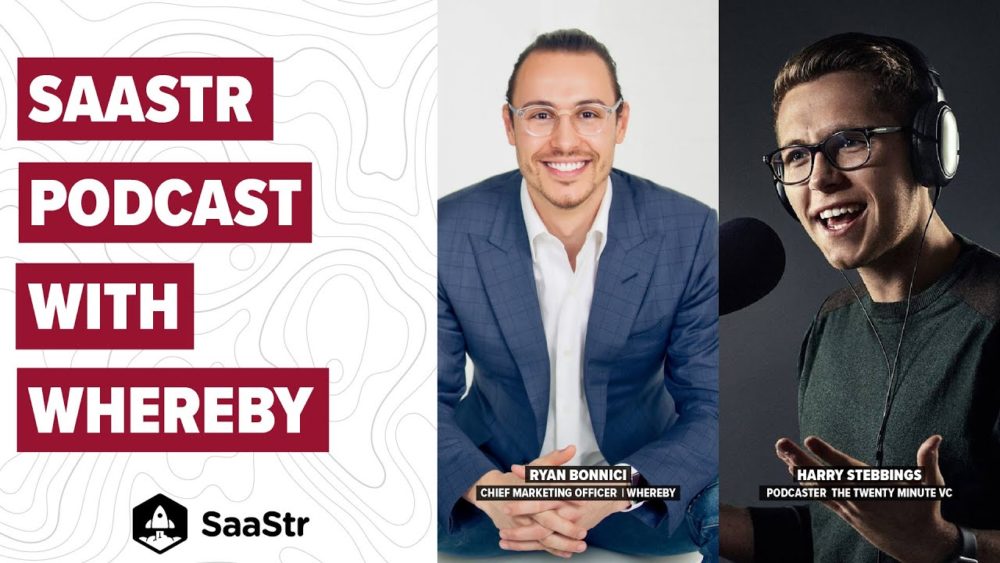
Some podcast episodes age like milk. This one aged more like a cast-iron skillet: still useful, still sturdy, and still capable of cooking up a serious lesson for SaaS marketers. In SaaStr Podcast #426, Harry Stebbings sits down with Ryan Bonnici, then CMO at Whereby, to unpack a question that sounds simple and turns slippery the moment budgets get bigger and dashboards get louder: how do you market at mass scale without losing the plot?
The answer, as Bonnici frames it, is not “buy more ads and pray harder.” It is more disciplined than that. Much more strategic, too. His core idea is that scaled marketing works when a company separates short-term growth from long-term brand building, while making sure the two still talk to each other like grown-ups at Thanksgiving. That sounds obvious, but plenty of companies still behave like they have to pick one side. Either they go full performance-marketing goblin mode and chase every click, or they float into airy brand campaigns that feel beautiful, expensive, and vaguely allergic to revenue.
Whereby’s story makes the episode especially interesting. The company is known for browser-based video meetings, privacy-minded positioning, and a product experience built around ease of use. That meant its marketing challenge was not merely to become louder. It had to become more memorable, more trusted, and more distinct in a crowded market where “video meetings” could easily turn into a beige commodity. In other words, the team had to scale attention and meaning.
This episode is really about that balancing act. It is about team structure, hiring, brand recall, demand generation, and the kind of message architecture that helps a company grow without turning into a generic pile of funnel jargon. So let’s break down the biggest lessons from the conversation, connect them to broader SaaS marketing reality, and translate them into something actually usable.
What This SaaStr Episode Is Really Teaching
At first glance, the episode sounds like a classic marketing operations conversation: build the team, hire the right people, measure the right metrics, and keep the pipeline moving. But under the hood, Bonnici is making a bigger point. Marketing at scale is not just about adding channels. It is about building a coherent growth system.
That system has a few non-negotiables. First, your go-to-market motion should determine your marketing priorities. Second, brand and growth should not be treated as enemies in a cage match. Third, marketers must be hired and managed for business impact, not just tactical fluency. And fourth, brand should be measured with more rigor than a hand-wave and a hopeful smile.
These themes line up with how modern B2B marketing leaders talk about demand generation. Scalable demand gen is not just lead capture with a fresh haircut. It is market education, trust building, audience growth, and conversion design working together. That is why this episode still lands: it is less about a trendy playbook and more about durable principles.
Lesson 1: Your Go-To-Market Model Should Decide What You Build First
One of the strongest ideas from the episode is that there is no universal order for building sales and marketing. Bonnici argues that the right sequence depends on what you sell and how customers buy it.
If you have a product-led or freemium motion, marketing often deserves an earlier seat at the table. You need demand, education, discovery, and product storytelling before a human sales motion can do much heavy lifting. If you are selling a heavy enterprise solution, however, sales may need to get in the market early to test messaging, objections, use cases, and price sensitivity. That is not a contradiction. It is just good strategic hygiene.
What makes this insight especially valuable is the example Bonnici gives from his HubSpot experience: before hiring sales in Japan, the company launched a Japanese blog to start creating inbound demand. That is a wonderfully unglamorous lesson. Before sending people out to “go win the market,” marketing can act as a low-friction testing mechanism. Content, SEO, localization, and audience response can tell you whether a market is warming up, what language resonates, and whether interest is real or just executive fan fiction.
For SaaS companies trying to scale into new regions or new segments, this is gold. Instead of treating marketing as the glitter cannon that arrives after the strategic decisions are already made, use it as an early market sensor. Launch content. Test positioning. Measure branded interest. Watch direct traffic. Run lightweight campaigns. Let the market vote before you build a huge revenue machine around a hunch.
Lesson 2: Great Marketing Hires Talk About Revenue, Not Just Tactics
If the first part of the episode is about structure, the second is about talent. Bonnici describes interviewing a huge volume of candidates and using a remarkably sharp filter: he wants marketers who can explain what business outcome they were hired to improve.
That sounds simple, but it slices through a lot of résumé confetti. A weak marketer says they ran email, paid search, events, or social. A stronger marketer says they improved activation, influenced sourced revenue, increased conversion rates, lowered acquisition cost, or expanded pipeline. One is describing activity. The other is describing impact.
This distinction matters even more at scale because larger teams create more room for ceremonial marketing. You know the type: beautiful decks, very serious terminology, and enough acronyms to summon a storm, yet somehow nobody can explain what changed in the business. Bonnici’s approach is a useful antidote. Ask marketers to connect their channel work to company goals. Then keep asking “why” and “how” until you can tell whether they understand the mechanics or just memorized the buzzwords.
That mindset also helps marketing teams mature internally. When an email marketer thinks in terms of sourced revenue, not just open rates, they work differently. When a content leader thinks about branded demand and pipeline influence, not just publication cadence, priorities get sharper. Marketing at mass scale requires specialists, yes. But it still rewards people who understand the full economic chain.
Lesson 3: Short-Term Growth and Long-Term Brand Need the Same House, Not Separate Planets
The cleanest framework in the episode is Bonnici’s split between short-term marketing and long-term marketing.
Short-term marketing
This is growth marketing: the programs designed to drive leads, signups, activations, and revenue now. It includes paid acquisition, lifecycle email, landing page optimization, conversion-focused content, offers, retargeting, and the many dashboard-friendly tactics that make revenue teams feel warm and safe.
Long-term marketing
This is brand: the compounding layer that builds trust, familiarity, and preference over time. It is what makes someone think of your company directly instead of searching “best tool for X” and opening twelve tabs they will forget five minutes later.
Here is where many companies trip over their own shoelaces. They assume brand is fluffy and performance is practical. But the smartest operators know that performance without brand gets expensive, and brand without performance gets smug. The real advantage appears when the two reinforce each other.
That is exactly the broader marketing consensus now. Brand creates memory, trust, and emotional relevance. Performance creates measurable action. Demand generation sits between them, translating awareness into consideration and consideration into pipeline. The companies that scale best are not the ones that pick a side; they are the ones that design a system where brand lowers friction and growth captures it.
In plain English: the best ad performs better when people already know your name. The best blog converts better when the brand feels credible. The best sales outreach lands better when the market has heard of you. Marketing at scale is not a relay race with one channel passing the baton. It is more like an orchestra. Slightly nerdier, but better dressed.
Lesson 4: Brand Is Measurable, Even If It Refuses to Sit Still
One of the most useful parts of the episode is Bonnici’s view that brand can be measured objectively. He points to direct traffic as one strong signal. If people are typing your URL and coming straight to you, that suggests brand recall. They are not just discovering you through a search result or ad. They already know you exist.
That is a smart starting point, though it works best when paired with other indicators. Direct traffic can be noisy, and attribution is never a perfectly behaved pet. But taken with branded search volume, share of search, return visitor trends, organic conversion rates, and pipeline influence, it becomes part of a powerful signal set.
This matters because brand measurement should not collapse into vanity metrics. Reach is not enough. Impressions are not enough. You want signs that the market remembers you, looks for you by name, trusts your point of view, and converts more efficiently because familiarity is doing part of the work.
That is one reason the episode still feels modern. Bonnici is not pitching brand as magical vibes in a nice blazer. He is arguing for a more disciplined view: measure the compounding effects, then let growth teams harvest them. The strongest brands in SaaS do not just get noticed. They reduce acquisition friction over time.
Lesson 5: Values Can Become Distribution When They Are Attached to Product Behavior
The most memorable example in the episode is Whereby’s tree-planting idea. Bonnici describes a campaign tied to a simple user action: hold meetings on the platform, and trees get planted. That is interesting not because “cause marketing” is new, but because the campaign connects brand values, product usage, and new user acquisition in one motion.
That is the secret sauce. Lots of companies talk about values. Far fewer translate them into a reason to try the product. Whereby’s positioning around privacy, simplicity, and planet-friendly action gave people something more concrete than “we also have video calls.” In a market crowded with similar feature claims, values can make the category feel human again.
And notice how clever the activation logic is. The campaign does not demand that users abandon every other tool overnight. It gives them a low-friction reason to shift a few meetings. That is classic growth thinking wrapped inside a brand story. Not preachy. Not abstract. Just useful and memorable.
This is the kind of idea SaaS marketers should study. Scale does not always come from throwing more money into the same tired channels. Sometimes it comes from creating a message so aligned with product behavior that customers themselves help carry it forward.
How to Market at Mass Scale Without Becoming Forgettable
So what should a SaaS team actually do with all of this?
1. Build around your buying motion
If your product wins through self-serve adoption, invest hard in content, SEO, product education, lifecycle, and brand familiarity. If your deals are complex and sales-led, align messaging with field learning and let marketing create air cover for the sales motion.
2. Hire for business fluency
Whether someone owns email, content, or paid media, they should understand how their work affects revenue, retention, activation, or pipeline. Channel skill is necessary. Commercial understanding is what makes it scalable.
3. Separate horizons, then connect them
Run short-term growth initiatives with clear KPIs. Build brand with a longer lens. But report them together often enough that leadership can see how one strengthens the other.
4. Treat content like infrastructure, not decoration
Content is not just a nice thing your team publishes when everyone feels inspired. It is market education, search visibility, thought leadership, and demand generation infrastructure. The compounding effect is the point.
5. Measure brand with operational seriousness
Track direct traffic, branded search, share of search, assisted conversions, and repeat engagement. Brand is not perfectly measurable, but it is far from unmeasurable.
6. Create campaigns that reflect product truth
The best scalable campaigns do not feel stapled onto the product. They feel native to it. Whereby’s tree idea worked because it connected directly to platform usage and company values.
Whereby’s Real Marketing Advantage
At the center of this episode is a valuable reminder: not every company gets to win by being the biggest spender. Some win by being the clearest story.
Whereby had a product narrative that was already strong: browser-based meetings, no-hassle experience, and a privacy-first angle that made sense in a world increasingly sensitive to data use. That gave marketing something sturdy to amplify. Bonnici’s job was not to invent meaning from scratch. It was to sharpen it, distribute it, and make sure the market could remember it.
That may be the most overlooked lesson in SaaS marketing today. Scale does not rescue weak positioning. It just funds it more aggressively. If your message is fuzzy, you will pay extra to spread the fog. But if your story is clear, a good marketing team can turn that clarity into repeatable growth.
Experience-Inspired Takeaways: What Marketing at Scale Actually Feels Like in the Real World
Here is the part many articles skip: marketing at scale looks elegant in strategy decks and mildly chaotic in real life. Teams do not wake up one morning with a perfect balance of brand and demand. They usually stumble into the need for balance after overcommitting to one side.
A common pattern goes like this. A SaaS company finds one efficient acquisition channel early on, often paid search, outbound, or SEO-led content. That channel works so well that leadership starts treating it like a magical vending machine. More budget goes in, and at first more pipeline comes out. Everyone feels brilliant. Then costs rise, conversion quality softens, competition thickens, and suddenly the team realizes it has demand capture but not much demand creation. The company is harvesting interest that already exists, but it is not doing enough to expand the audience or deepen preference. That is often the moment brand gets invited back into the room.
Another real-world experience is the hiring trap Bonnici hints at. As marketing teams grow, it becomes dangerously easy to hire polished specialists who can speak fluent channel but cannot explain business contribution. The result is a team with plenty of motion and not enough momentum. Meetings multiply. Dashboards get colorful. Yet leadership still asks the same painful question every quarter: “What changed?” The best marketing leaders fix this by making revenue language part of every role, even creative ones. That does not make marketing less creative. It makes creativity more accountable.
There is also the emotional side of scaling a brand in a crowded category. If you work in B2B SaaS long enough, you eventually notice that half the market sounds like it was written by the same committee in the same beige conference room. Every product is seamless, powerful, end-to-end, AI-driven, customer-centric, and somehow also revolutionary. This is exactly why distinct brand building matters. When a company like Whereby ties its message to ease, privacy, and even a tree-planting action, it gives the audience something human to remember. That memory becomes a strategic asset.
And then there is the operational reality of running both long-term and short-term marketing at once. Some weeks the growth team wants more landing pages, more conversion tests, and faster follow-up sequences. The brand side wants better storytelling, stronger creative consistency, and investments that may not pay back this quarter. In healthy organizations, that tension becomes productive. In unhealthy ones, it turns into a civil war with nicer fonts. The experienced teams learn that the answer is not compromise for its own sake. It is role clarity, planning cadence, and shared goals. Brand should make growth cheaper. Growth should prove that brand is not just decorative wallpaper.
That is why this SaaStr episode remains so practical. It reflects the lived experience of modern SaaS marketing: scale is not just a matter of volume. It is a matter of alignment. Alignment between team structure and go-to-market motion. Alignment between message and product truth. Alignment between brand ambition and revenue discipline. When those things line up, marketing stops feeling like a cost center with a Canva subscription and starts acting like a real growth engine.
Final Thoughts
SaaStr Podcast #426: How to Market at Mass Scale with Whereby is ultimately a playbook for marketers who want growth without gimmicks. Ryan Bonnici’s framework is refreshingly clear: let your go-to-market motion shape your team design, hire marketers who understand business impact, split short-term growth from long-term brand, and measure brand with more discipline than most companies do.
The deeper lesson is that scale does not come from doing more random marketing. It comes from building a system where brand creates trust, growth captures demand, content educates the market, and every hire understands the business outcome behind the tactic. Whereby becomes the case study, but the principle travels well. Whether you sell video meetings, workflow software, or the world’s least glamorous B2B platform, the same truth applies: the market remembers the companies that know who they are and know how to prove it.
That is how you market at mass scale. Not by shouting louder than everyone else, but by being clear enough, useful enough, and consistent enough that people come looking for you on purpose.