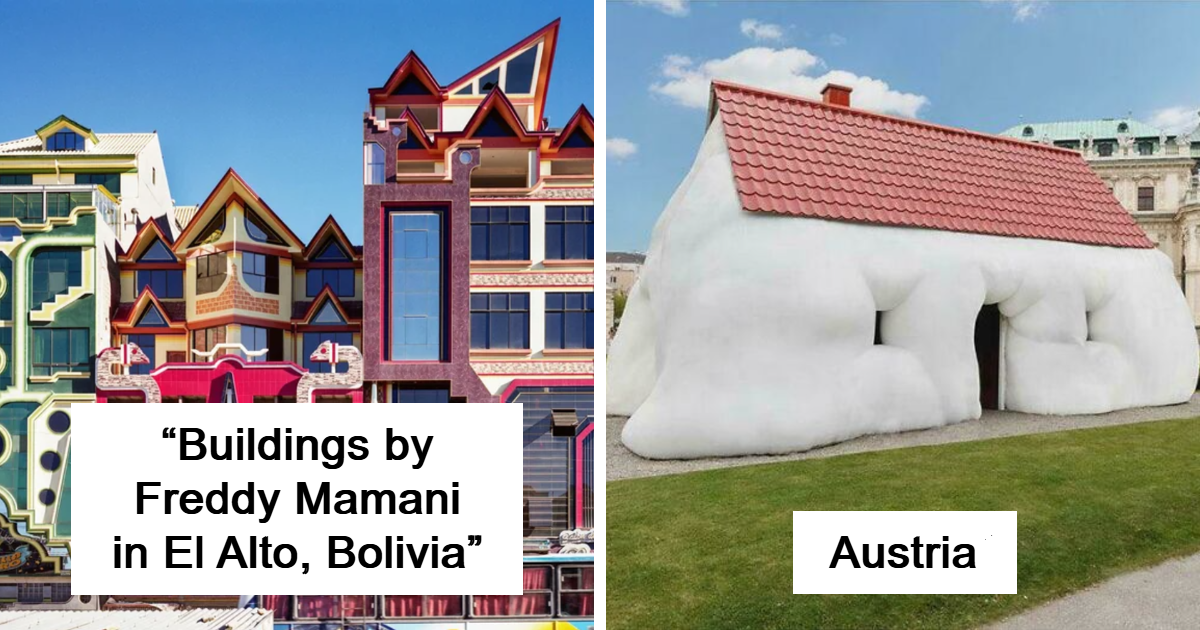
Some buildings politely stand on a street and do their job. Others arrive like a fever dream with plumbing, permits, and a parking lot. They twist, lean, wobble, wear costumes, impersonate household objects, or look as if an architect opened Microsoft Word, clicked “WordArt,” dragged the corner too far, and said, “Perfect. Build it.”
Wildly unusual buildings are not just internet bait. Many are serious experiments in engineering, urban identity, tourism, branding, sustainability, modular living, or pure artistic rebellion. The weirdest architecture in the world often asks a surprisingly useful question: why should a building look normal just because gravity is having a normal day?
From a seven-story basket in Ohio to a fish-shaped office in India, from Frank Gehry’s titanium waves in Bilbao to a Polish shopping center that appears to be melting, these unusual buildings prove that architecture can be functional and completely unhinged at the same time. Let’s walk through 50 strange, funny, brilliant, and reality-bending buildings that make ordinary rectangles look like they gave up before breakfast.
Why Do Unusual Buildings Fascinate Us?
Unusual architecture works because it interrupts autopilot. Most cities are full of right angles, repeated windows, safe facades, and buildings that quietly whisper, “Please approve my zoning application.” Then a giant duck, a lopsided glass museum, or a concrete stack of apartment cubes enters the scene and suddenly everyone has an opinion.
Some of these structures belong to mimetic architecture, meaning the building imitates an object, animal, or product connected to its purpose. Think of a duck-shaped shop, a basket-shaped corporate headquarters, or a fish-shaped fisheries office. Others come from deconstructivism, expressionism, postmodernism, blob architecture, or experimental housing design. Translation: the architect looked at the box and decided the box had personally offended them.
But strange buildings are not automatically bad buildings. The best unusual buildings make people stop, remember, photograph, debate, and sometimes travel across the world just to see them. That is powerful design. A normal office building can hold meetings. A fish-shaped office building can hold meetings and become a landmark.
50 Wildly Unusual Buildings That Make You Question Reality
1. Longaberger Basket Building, Newark, Ohio
This former headquarters of the Longaberger Company looks exactly like a giant picnic basket because subtlety apparently called in sick. The seven-story structure was modeled after the company’s signature market basket, complete with massive handles. It is one of America’s most famous examples of novelty architecture and one of the few office buildings that makes you crave lemonade and potato salad.
2. Kansas City Public Library Community Bookshelf, Missouri
The Central Library’s parking garage is wrapped in enormous book spines, turning a practical structure into a love letter to reading. It is funny, photogenic, and strangely elegant. Instead of hiding a garage, Kansas City dressed it as a bookshelf and gave downtown a permanent literary selfie wall.
3. WonderWorks, Orlando, Florida
WonderWorks looks like a classical building that has crash-landed upside down. The columns, roofline, and windows are inverted, creating the visual effect of a mansion tossed by a cartoon tornado. It is a perfect match for an attraction built around science, illusion, and hands-on curiosity.
4. The Big Duck, Flanders, New York
The Big Duck is exactly what it sounds like: a duck-shaped building originally connected to selling ducks and duck eggs. It became so influential that architects use the phrase “duck architecture” to describe buildings whose shape acts as the sign. That is a serious academic legacy for a giant bird with a beak.
5. National Fisheries Development Board Building, Hyderabad, India
If you run a fisheries department, why not work inside a giant fish? This stainless-steel structure appears to swim above blue supports, with circular windows as eyes and a fin-like awning. It is literal, memorable, and gloriously committed to the bit.
6. Dancing House, Prague, Czech Republic
Designed by Vlado Milunić and Frank Gehry, the Dancing House looks like two figures mid-sway along the Vltava River. Its curved glass tower and leaning concrete partner make the building seem animated, as if Prague accidentally downloaded choreography into its skyline.
7. Krzywy Domek, Sopot, Poland
Also known as the Crooked House, Krzywy Domek looks like a building reflected in a funhouse mirror. Its warped facade was inspired by fairy-tale illustrations, which explains why it seems ready to wobble, giggle, and sell you coffee.
8. Cube Houses, Rotterdam, Netherlands
Piet Blom’s Cube Houses tilt ordinary cubes at sharp angles, creating a cluster of yellow geometric treehouses. They are residential, practical in theory, and visually similar to a video game level designed by a genius with no fear of neck strain.
9. Habitat 67, Montreal, Canada
Moshe Safdie’s Habitat 67 is a modular housing icon made from stacked concrete units. It looks chaotic at first, but the arrangement creates terraces, light, and individuality within a dense residential complex. It is what happens when apartments play Jenga and win.
10. Waldspirale, Darmstadt, Germany
Friedensreich Hundertwasser’s Waldspirale curls upward with a planted roof, colorful facade, and windows that refuse to match. The building feels less constructed than grown, as if a forest decided to become an apartment complex with artistic opinions.
11. Kunsthaus Graz, Austria
Nicknamed the “Friendly Alien,” Kunsthaus Graz is a biomorphic blue art museum sitting among historic buildings. Its bulbous form and nozzle-like skylights make it look like a sea creature, spaceship, or extremely confident bean.
12. Guggenheim Museum Bilbao, Spain
Frank Gehry’s titanium-clad museum is famous for its swirling forms and shimmering skin. It does not just house art; it behaves like art. The building helped turn Bilbao into a global architecture destination and made the phrase “Bilbao effect” part of urban design vocabulary.
13. Casa Batlló, Barcelona, Spain
Antoni Gaudí’s Casa Batlló looks like a dragon, a coral reef, and a dream had a meeting and approved the same facade. Its bone-like balconies, colorful tiles, and rippling surfaces make straight lines seem terribly underdressed.
14. Casa Milà, Barcelona, Spain
Also called La Pedrera, this Gaudí masterpiece rolls across its corner like carved stone waves. The rooftop chimneys look like masked warriors guarding the city from boring apartments.
15. Atomium, Brussels, Belgium
The Atomium resembles a giant iron crystal magnified billions of times. Built for Expo 58, it is part monument, part museum, and part science-class hallucination.
16. Lotus Temple, New Delhi, India
The Lotus Temple opens like a massive white flower. Its petal-shaped forms create a calm, sculptural landmark that proves unusual architecture can be peaceful instead of chaotic.
17. Capital Gate, Abu Dhabi, United Arab Emirates
Capital Gate leans dramatically, as if it is politely eavesdropping on the next block. Its engineered tilt makes it one of the world’s most recognizable leaning towers.
18. CCTV Headquarters, Beijing, China
OMA’s CCTV Headquarters loops upward and across itself, forming a continuous angular structure. People have compared it to a giant pair of pants, which is not the official design concept but is very difficult to unsee.
19. Marina Bay Sands, Singapore
Three towers hold up a massive sky park that looks like a ship landed on top of a skyscraper trio. It is luxury hospitality with the energy of a magic trick.
20. The Interlace, Singapore
Instead of stacking apartments vertically, The Interlace lays residential blocks horizontally in a dramatic hexagonal arrangement. It looks like a city-sized game of architectural Tetris.
21. Turning Torso, Malmö, Sweden
Santiago Calatrava’s Turning Torso twists as it rises, giving the impression of a skyscraper stretching after a long nap. It brought sculptural movement into high-rise residential design.
22. Markthal, Rotterdam, Netherlands
Markthal combines apartments, shops, and a food hall under a giant arch. Inside, a huge colorful artwork covers the ceiling, so buying vegetables can feel like grocery shopping inside a cathedral of snacks.
23. Heydar Aliyev Center, Baku, Azerbaijan
Designed by Zaha Hadid Architects, this cultural center flows in white curves with almost no visible hard edges. It looks poured rather than built.
24. Galaxy SOHO, Beijing, China
Another Zaha Hadid project, Galaxy SOHO is a complex of smooth, connected volumes that feels futuristic and fluid. It is what a shopping and office complex might look like if designed by wind.
25. Walt Disney Concert Hall, Los Angeles, California
Frank Gehry’s concert hall gleams with folded metal forms. It looks like music frozen mid-crescendo, which is exactly the kind of architectural drama Los Angeles can pull off without apologizing.
26. Museum of Pop Culture, Seattle, Washington
MoPOP looks like melted guitars, folded metal, and pop culture chaos turned into a building. It is loud, shiny, and entirely appropriate for a museum devoted to music, science fiction, and creative rebellion.
27. Lou Ruvo Center for Brain Health, Las Vegas, Nevada
This Gehry-designed medical center combines a calmer clinical wing with a wild stainless-steel event space. It looks like one half is doing paperwork while the other half is throwing a disco inside a crumpled sculpture.
28. Binoculars Building, Venice, California
Created with Claes Oldenburg and Coosje van Bruggen, the building features a giant pair of binoculars at the entrance. It is both sculpture and doorway, which makes every visitor feel mildly observed.
29. The Flintstone House, Hillsborough, California
This bulbous, colorful home looks like it rolled out of Bedrock and parked in the Bay Area. Its domed forms and playful landscaping have made it a cult favorite of strange house fans.
30. Casa do Penedo, Fafe, Portugal
Built between huge boulders, Casa do Penedo looks like a Stone Age cottage with a roof. It is rugged, strange, and possibly where a very stylish caveperson would spend the weekend.
31. Tianzi Hotel, Hebei, China
This hotel is shaped like three traditional Chinese figures representing good fortune, prosperity, and longevity. It is not shy. It is a building that introduces itself from several blocks away.
32. Piano House, Huainan, China
The Piano House pairs a giant transparent violin with a piano-shaped main building. It is dramatic, musical, and ideal for anyone who has ever wanted real estate to come with sheet music.
33. Elephant Building, Bangkok, Thailand
Bangkok’s Elephant Building uses towers and connecting forms to resemble an elephant. It is part office, part residential complex, and part skyline mascot.
34. Robot Building, Bangkok, Thailand
The Robot Building looks like a friendly machine made of stacked blocks and antenna-like details. It captures an era when technology-inspired architecture had more charm and fewer glass rectangles.
35. Mr. Toilet House, Suwon, South Korea
Yes, it is shaped like a toilet. Yes, it is real. Built by sanitation advocate Sim Jae-duck, the structure turned bathroom humor into public conversation about hygiene and sanitation.
36. Nakagin Capsule Tower, Tokyo, Japan
The former Nakagin Capsule Tower was a landmark of Metabolist architecture, made of replaceable living capsules attached to concrete cores. Though dismantled, its influence survives as one of the boldest experiments in modular urban living.
37. Sagrada Família, Barcelona, Spain
Gaudí’s basilica looks less like a church and more like a mountain range learning to pray. Its towers, facades, and organic details turn stone into sacred movement.
38. National Library of Belarus, Minsk
This faceted geometric building resembles a giant diamond or futuristic dice. It proves that even libraries can dress like they are attending a science-fiction gala.
39. Metropol Parasol, Seville, Spain
Also called Las Setas, or “the mushrooms,” Metropol Parasol spreads wooden forms over a public square. It is part shade structure, part viewpoint, and part urban mushroom colony.
40. Muralla Roja, Calpe, Spain
Ricardo Bofill’s Muralla Roja is a maze of saturated pinks, reds, blues, stairways, and geometric courtyards. It looks like an Escher drawing moved to the Mediterranean and discovered excellent lighting.
41. Hallgrímskirkja, Reykjavík, Iceland
This church rises like basalt columns turned into sacred architecture. Its vertical rhythm feels volcanic, icy, and monumental all at once.
42. Kunsthaus Wien, Vienna, Austria
Another Hundertwasser creation, Kunsthaus Wien rejects straight lines, uniform windows, and dull surfaces. It is the architectural equivalent of refusing to wear a gray suit to a meeting about joy.
43. Hundertwasserhaus, Vienna, Austria
This residential building mixes uneven floors, trees, bright colors, and irregular forms. It is playful, ecological, and proudly allergic to monotony.
44. Dynamic Tower, Dubai, United Arab Emirates
Often discussed as a rotating skyscraper concept, the Dynamic Tower belongs more to the dream category than completed reality. Still, the idea of floors moving independently has become a symbol of how far futuristic building concepts can stretch imagination.
45. The Basket-Shaped Shops of Roadside America
Across the United States, novelty roadside architecture has produced coffee pots, oranges, shoes, hot dogs, and other oversized objects. These buildings were designed to stop passing motorists, proving that advertising is more effective when it can hold a cash register.
46. Lucy the Elephant, Margate, New Jersey
Lucy the Elephant is a massive elephant-shaped structure from the 19th century. She has served many roles over time and remains one of America’s great survivors of architectural whimsy.
47. The Sheep and Dog Building, Tirau, New Zealand
Tirau is known for corrugated iron buildings shaped like animals, including a sheep and a dog. It is charming, absurd, and exactly the kind of place where the buildings appear to have wandered in from a farm.
48. The Sheep Building, Tirau, New Zealand
Yes, the sheep deserves its own moment. A building shaped like livestock is already unusual; a town embracing multiple animal-shaped structures is a full architectural personality.
49. The Dancing Towers, Hamburg, Germany
These twin towers lean and angle like they are moving together. They bring a sense of performance to the skyline, which is fitting for a location tied to entertainment and nightlife.
50. The Basket, Fish, Duck, and Book Buildings as a Group
The final spot belongs to the entire family of buildings that look like the thing they represent. They are funny because they are literal, but they endure because they are unforgettable. A plain office can disappear from memory. A giant fish with windows for eyes? That rents space in your brain forever.
What These Reality-Bending Buildings Teach Us About Design
The strangest buildings in the world are not strange in the same way. Some are jokes with foundations. Some are cultural landmarks. Some are deeply technical achievements wearing a clown nose. Some are serious responses to urban density, climate, tourism, or identity. The one thing they share is courage.
A weird building takes a risk before the first brick is laid. It risks ridicule, cost overruns, engineering headaches, public complaints, and the eternal possibility that someone on the internet will say it looks like a printer error. But when the risk works, the building becomes a destination. People remember it, photograph it, argue about it, and use it as a shortcut for the city itself.
That is why unusual buildings are so valuable for SEO, travel content, architecture blogs, and visual storytelling. They naturally inspire curiosity. Searchers want to know where they are, who designed them, why they exist, whether they are real, and whether anyone had a normal meeting before approving them. In a world flooded with forgettable images, unusual architecture gives readers something to stare at.
Experience: What It Feels Like To Encounter Wildly Unusual Buildings In Real Life
Seeing a wildly unusual building online is fun, but meeting one in person is different. A photo lets you laugh from a safe distance. Real life makes the building bigger, stranger, and more convincing. You turn a corner expecting another normal block, and suddenly there is a giant basket, a crooked facade, a blue alien museum, or a tower leaning with suspicious confidence. Your brain pauses like a laptop with too many tabs open.
The first reaction is usually delight. People smile before they analyze. That is the magic of unusual architecture: it reaches the emotional part of the mind before the academic part can put on glasses and start saying things like “contextual relationship” and “urban morphology.” A fish-shaped office does not need a lecture to be understood. It announces itself instantly. You know what it is, and then you start asking why it exists.
Walking around these buildings also reveals how much work hides behind the weirdness. From a distance, the structure may seem like a gag. Up close, you notice materials, seams, windows, supports, drainage, entrances, stairways, and all the practical problems that had to be solved so the joke would not collapse. The Longaberger Basket Building is funny, but its widening upper floors and huge handles created real engineering challenges. The Guggenheim Bilbao looks fluid, but its curves required advanced modeling. Habitat 67 seems random, yet its modular system was carefully arranged to give residents light, air, and private terraces.
There is also a social experience. People behave differently around strange buildings. They point more. They take photos from ridiculous angles. They ask strangers to move two steps left. They compare the building to animals, food, cartoons, kitchen tools, software glitches, or dreams they had after eating too late. In front of normal buildings, people check directions. In front of unusual buildings, they become critics, comedians, and photographers.
These places are especially memorable because they turn architecture into a story. You do not simply say, “I visited a museum.” You say, “I visited the blue alien museum in Austria.” You do not say, “I saw a library garage.” You say, “I saw a parking garage disguised as a giant bookshelf.” The building gives you a ready-made anecdote, and that anecdote travels farther than the structure itself.
Unusual buildings can also change how you see ordinary places afterward. Once you have watched architecture bend, dance, lean, bloom, wobble, or impersonate a duck, the average glass box starts looking less inevitable. You realize cities are full of choices. Someone chose every boring facade, but someone also chose the giant fish. That is oddly encouraging. It means the built world is not fixed. It can be practical and playful. It can hold people, offices, books, art, food, and jokes. It can make room for wonder without asking wonder to sit quietly in the corner.
In the end, the best strange buildings do not make reality disappear. They make reality more interesting. They remind us that architecture is not only shelter or investment or skyline branding. It is also imagination made heavy enough to cast a shadow.
Conclusion
Wildly unusual buildings may look like mistakes, memes, magic tricks, or Microsoft Word experiments gone gloriously rogue, but many of them are serious achievements. They challenge expectations, create landmarks, attract travelers, and prove that design does not have to whisper when it can sing, dance, lean, or dress as a basket.
From novelty architecture to world-class museums, these 50 unusual buildings show that the built environment is at its best when it leaves room for surprise. Some structures are elegant. Some are ridiculous. Some are both before lunch. But every one of them gives people something increasingly rare: a reason to look up.
Note: This article is an original, rewritten synthesis based on real unusual buildings, architecture history, and publicly available design information. It avoids copied source text and is prepared for web publishing without unnecessary reference placeholders.