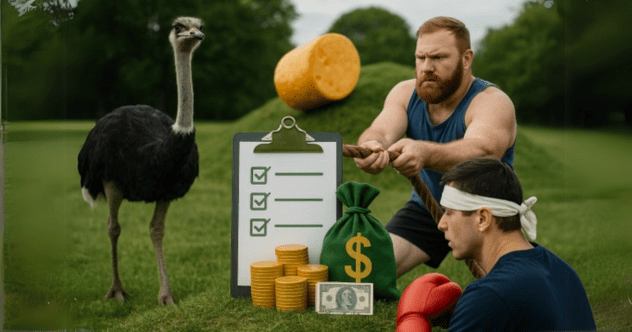
Football spreads, basketball totals, and baseball moneylines are perfectly respectable. They are also about as surprising as finding overpriced nachos at a stadium. Far beyond the major leagues, sportsbooks occasionally offer markets on competitions involving flying robots, flying beanbags, flying darts, violently accelerated hand baskets, and heroic quantities of hot dogs.
Welcome to the wonderfully strange world of bizarre sports betting.
The unusual sports in this guide are real organized competitions rather than novelty bets invented during somebody’s unusually long lunch break. Several have professional leagues, official rules, television coverage, statistical databases, and recognizable stars. Betting availability, however, depends on the event, sportsbook, and local regulations. A market offered in New Jersey may be absent in another state, while an internationally popular competition may appear only at certain times of the year.
This guide explains ten of the weirdest sports you can actually bet on, how their wagering markets work, and why researching them requires considerably more effort than checking whether an NFL quarterback practiced on Wednesday.
Before Betting on a Bizarre Sport
Unusual betting markets are entertaining, but they can be harder to price accurately. A sportsbook may publish only a basic match-winner market because there is not enough betting volume to support dozens of props. Odds may also move sharply after relatively small wagers.
Confirm That the Market Is Regulated
Use a sportsbook licensed where you are physically located. Sports-betting rules vary across the United States, and individual regulators can approve or reject particular competitions. The presence of a sport on one operator’s national website does not automatically mean it is available in every state.
Learn the Settlement Rules
Before wagering, check what happens after a tie, postponement, disqualification, injury, equipment failure, or shortened contest. A drone crashing into a gate may be obvious. Whether your bet is graded as a loss, a void, or something requiring an official ruling may not be.
Expect Smaller Markets
Niche sports usually attract less money than the NFL or NBA. That can produce lower wagering limits, wider margins, fewer live-betting options, and more dramatic line movement. In other words, your carefully researched price can disappear faster than a plate of hot dogs near Joey Chestnut.
The 10 Weirdest Sports You Can Actually Bet On
1. Competitive Hot Dog Eating
Competitive eating is the rare sport in which “conditioning” can involve practicing with gallons of water and an alarming number of buns. The Nathan’s Famous Hot Dog Eating Contest, held around the Fourth of July, is the most recognizable event. Major sportsbooks have offered legal markets on the competition in selected states, including odds on the men’s and women’s winners and totals for the number of hot dogs and buns consumed.
Researching competitive eating involves more than choosing the contestant who looks hungriest. Bettors examine previous contest totals, qualifying performances, weather, health reports, rule changes, and whether a dominant eater is participating. Hot or humid conditions can affect pace, while an athlete returning from an absence may create uncertainty in both the odds and expected total.
The most common bets include outright winner, head-to-head matchups, winning margin, and over/under consumption totals. It is ridiculous, intensely athletic, strangely tactical, and one of the few sporting events where dropping lunch can lead to an official reversal.
2. Professional Cornhole
Cornhole has successfully evolved from a backyard barbecue activity into a professional sport with rankings, televised competitions, standardized equipment, and athletes who can repeatedly place a bag exactly where they want it. DraftKings has hosted a dedicated cornhole betting section, while American Cornhole League events have appeared across ESPN platforms.
Typical betting options include match winner, game handicap, total points, and tournament futures. Some events also generate live markets as players move through a series.
The deceptive part is how easy the sport looks. Elite players use different bag materials, throwing styles, board positions, and blocking tactics. One player may favor a flat slide shot, while another uses an arcing throw that drops directly into the hole. Board conditions and bag speed can also influence scoring.
Never base a cornhole wager on which competitor appears to be somebody’s cheerful uncle. At the professional level, that cheerful uncle may be capable of landing four consecutive bags in the hole without disturbing his sunglasses.
3. Drone Racing
Drone racing resembles a video game that escaped from the television and began flying around a warehouse at highway speeds. Pilots wear first-person-view goggles and control small racing drones through illuminated gates, tunnels, and technical courses.
The Drone Racing League entered an official sports-betting agreement with DraftKings, creating regulated wagering opportunities in selected jurisdictions. The partnership was notable because it helped establish drone racing as a legitimate betting product rather than merely an impressive hobby for people with excellent reflexes and forgiving electronics budgets.
Available markets may include race winner, heat winner, head-to-head pilot matchups, and championship futures. Bettors should research qualifying times, course layout, pilot consistency, mechanical reliability, and performance on similar tracks.
The fastest pilot is not automatically the safest selection. Aggressive racers may post spectacular times but face a greater risk of clipping a gate or crashing. Consistent pilots can offer value when a course rewards precision more than raw speed.
4. Power Slap
Power Slap is exactly what its name suggests: competitors take turns delivering open-handed strikes while their opponents stand in place and reconsider every decision that led them there. Matches are organized into rounds, with judging criteria and knockout possibilities creating a format that sportsbooks can price similarly to combat sports.
Official Power Slap channels have promoted event betting, although availability depends heavily on the operator and location. Markets can include fight winner, method of victory, total rounds, and whether the match reaches the judges.
Useful information includes striker accuracy, defensive durability, knockout history, fouling tendencies, weight-class changes, and coin-toss rules governing who strikes first. The opening strike can be especially important because the recipient must remain capable of delivering a response.
This is not a sport to handicap using traditional boxing logic alone. There is no footwork, distance management, or jab. There is mostly tension, technique, neck strength, and the uncomfortable realization that somebody is about to be slapped with professional intent.
5. Jai Alai
Jai alai may be the most visually spectacular sport on this list. Players use a curved basket called a cesta to catch and hurl a hard ball against a front wall at extremely high speed. The ball rebounds through a three-walled court while players attempt catches that seem incompatible with ordinary human survival instincts.
Jai alai also has a long relationship with wagering. Modern World Jai-Alai League competitions have been available through major betting platforms in the United States and Canada, including selected DraftKings, FanDuel, BetRivers, and Hard Rock Bet markets.
Bets may cover match winners, team results, individual games, points, and traditional pari-mutuel formats. Newcomers should first learn the event structure because rotation systems and scoring rules can differ from familiar head-to-head sports.
Player form, serving performance, catching consistency, court familiarity, and team combinations all matter. So does understanding the official format before betting, unless your preferred strategy is shouting, “I like the person with the biggest basket!”
6. Professional Darts
Darts may be common in bars, but professional darts feels like a different species. Packed arenas, walk-on music, elaborate costumes in the crowd, and players calculating checkout combinations at remarkable speed have transformed the sport into major entertainment.
BetMGM and other regulated sportsbooks offer dedicated darts odds, while prominent Professional Darts Corporation competitions have longstanding relationships with betting brands.
The betting menu can be surprisingly deep: match winner, handicap, total legs, most 180s, highest checkout, correct score, and individual leg markets. Live betting is also popular because momentum can shift rapidly when one player suddenly finds the treble-20 repeatedly.
Important statistics include three-dart average, checkout percentage, first-nine average, 180 frequency, and performance under pressure. Format matters enormously. A short best-of-legs match produces more variance than a long set-based contest, giving underdogs a more realistic chance of causing an upset.
7. Table Tennis
Table tennis does not seem particularly bizarre until you discover how much of it exists. Professional matches can take place across multiple international tours throughout the day, offering a nearly continuous stream of betting opportunities.
DraftKings has published specific guidance covering table tennis wagering, confirming that the sport can be available through its U.S. sportsbook in approved jurisdictions.
Common markets include match winner, game handicap, total games, correct score, individual-game winner, and live point or set markets. Because games are short, odds can change with every miniature momentum swing.
Bettors should analyze playing style, handedness, recent schedule, service effectiveness, and performance against defensive or attacking opponents. Fatigue deserves special attention when a player competes repeatedly over a short period.
Table tennis is also a warning against reckless live betting. A 7-3 lead can become 8-8 before you have finished unlocking your phone. The ball is tiny, the margins are smaller, and emotional decision-making is usually the largest object in the room.
8. Chess
Chess is a mental competition involving no running, jumping, tackling, or obvious reason for the competitors to require matching athletic jackets. Nevertheless, major tournaments attract global audiences, prize pools, player ratings, detailed computer analysis, and occasional betting markets.
Markets are more commonly found through international or specialty operators than through every regulated U.S. sportsbook. When offered, bettors may wager on match winners, tournament champions, game results, total draws, or whether a player advances to the next stage. Chess coverage has also discussed betting odds for elite competitions such as the Candidates Tournament.
Ratings provide a useful starting point, but they are not a complete prediction system. Time control, opening preparation, color allocation, recent form, tournament incentives, and a player’s ability to recover after a loss can all influence results.
Draw probability is especially important. Betting on a strong favorite to win a single classical game can be dangerous because elite players are exceptionally skilled at turning slightly unpleasant positions into several hours of sophisticated nothingness.
9. Kabaddi
Kabaddi looks like a playground game redesigned by defensive coordinators. A raider enters the opposing half, attempts to tag defenders, and then tries to return safely while the entire defense works to tackle and trap the raider.
The sport is hugely popular in South Asia, particularly through professional leagues and international competitions. Betting availability is more common at sportsbooks serving international markets, although selected events may appear on broader sports menus depending on the operator and jurisdiction.
Typical bets include match winner, point spread, total points, halftime result, and player performance markets. Useful statistics include raid success rate, tackle success rate, bonus points, all-outs, and the effectiveness of individual defensive combinations.
Kabaddi rewards careful attention to momentum. A single successful raid can eliminate multiple defenders, change the lineup, and create a scoring surge. New bettors should watch several matches before wagering because the sport moves quickly and includes tactical situations that are not obvious from the final score alone.
10. Competitive Axe Throwing
Competitive axe throwing answers the question, “What if darts were heavier, sharper, and considerably less welcome near drywall?” Organized leagues use standardized targets, scoring zones, safety rules, certified venues, rankings, and championship tournaments.
The World Axe Throwing League oversees structured competitions across hundreds of venues and publishes official rules governing scoring and equipment. Betting markets are not consistently available through mainstream U.S. sportsbooks, but championship odds and specialty event markets have appeared through selected operators and betting platforms. Bettors should confirm that any offering is legal and officially settled in their jurisdiction.
Potential markets include match winner, round winner, total points, and tournament champion. Relevant factors include hit percentage, bullseye rate, clutch-throw performance, discipline, and proficiency with different approved axe categories.
The challenge is data quality. Compared with major sports, public statistics may be limited, and competitors may arrive from different qualifying systems. This is precisely why a familiar name should not automatically be treated like the Kansas City Chiefs of throwing sharpened hardware.
How to Analyze Weird Sports Betting Markets
Start With the Rules, Not the Odds
In familiar sports, most bettors already understand how a winner is determined. That assumption becomes dangerous in unusual competitions. Learn the scoring system, match length, advancement procedure, tiebreakers, and disqualification rules before comparing prices.
Separate Entertainment From Probability
The most memorable competitor is not necessarily the most likely winner. Popular athletes can attract casual wagers that shorten their odds. This creates the possibility that a less famous but statistically consistent opponent offers better value.
Watch the Actual Competition
Statistics without context can be misleading. A drone pilot’s average time might come from easier courses. A darts player’s scoring average could be strong despite poor finishing. A competitive eater’s previous total may have been affected by weather. Watching recent events can reveal details that a spreadsheet politely refuses to explain.
Use Smaller Stakes
Information is thinner and pricing can be less stable in niche markets. Treat strange sports as entertainment rather than an emergency investment opportunity. A modest wager can make cornhole exciting without forcing you to explain to your family why the monthly budget now depends on a bag sliding up a wooden board.
Avoid Chasing Live-Betting Losses
Fast sports such as table tennis, darts, and jai alai can produce constant live odds. That speed may encourage repeated impulsive wagers. Set a limit before the event and do not increase your stake merely because the previous point, leg, or slap went badly.
A Practical Experience With Bizarre Sports Betting
The first experience many bettors have with unusual sports markets begins with curiosity. You open a sportsbook to check an NBA game and notice a category you have never seen before. Perhaps it is cornhole. Perhaps it is table tennis from a league you cannot pronounce. Perhaps two people are preparing to slap each other while an oddsmaker calmly asks whether the contest will last more than two and a half rounds.
The natural reaction is to assume the strange sport must be easier to predict. It has fewer players, fewer statistics, and fewer tactical layersor so it appears. After a little research, the opposite becomes clear.
Consider professional darts. A beginner may select the player with the higher world ranking and feel well prepared. Then the favorite records a stronger scoring average but misses several doubles, losing the match despite repeatedly reaching a finish first. The experience teaches an immediate lesson: scoring and finishing are separate skills, and averages cannot explain every pressure situation.
Table tennis provides a different kind of education. Matches move so quickly that a bettor can feel compelled to react to every point. A player loses the opening game, and the live price suddenly looks attractive. The bettor places another wager. The player loses the next game. The price becomes even more “attractive.” Within minutes, what began as analysis becomes an increasingly expensive argument with a small white ball.
Slower markets create their own surprises. In cornhole, a viewer may underestimate how significantly bag material and board conditions affect play. One competitor builds a lead using controlled blocking shots. The opponent adjusts, pushes multiple bags into the hole, and changes the match in a single round. What initially resembled a picnic activity starts looking like positional strategy with fabric projectiles.
Drone racing emphasizes the difference between speed and reliability. The fastest pilot may dominate qualifying but crash while taking an aggressive line through a narrow gate. A slightly slower competitor survives every heat and advances. Bettors familiar with motorsports will recognize the principle: finishing first requires finishing.
Competitive eating may produce the strangest viewing experience. Instead of tracking yards, rebounds, or goals, you watch an official count partially consumed hot dogs while commentators discuss pace. A totals bet turns every bite into a statistical event. At some point, you may wonder whether cheering for another hot dog represents personal growth or a cry for help.
The common lesson is that weird sports are not automatically easy sports. Their athletes specialize for years, their rules contain meaningful details, and their betting markets still include a sportsbook margin. Limited information can sometimes create pricing mistakes, but it can just as easily leave the bettor confidently uninformed.
The best experience comes from treating these markets as a reason to learn something new. Watch the sport first. Understand what separates elite competitors from average ones. Keep wagers small, record the results, and resist the temptation to invent expertise after one successful bet.
A winning wager on jai alai or drone racing makes for a much better story than another routine football moneyline. A losing wager should remain a story toonot the beginning of a desperate seven-leg parlay involving darts, kabaddi, and a man holding an axe.
Conclusion: Strange Sports, Real Skill, Real Risk
The world of sports betting extends far beyond packed football stadiums and nationally televised basketball games. Competitive eating, professional cornhole, drone racing, Power Slap, jai alai, darts, table tennis, chess, kabaddi, and axe throwing all demonstrate that people can turn nearly any measurable contest into an organized sport.
They also show why betting research matters. Unusual competitions have specialized rules, tactical details, and performance data that casual observers may overlook. The weirdness of a sport does not make its outcome random, but it does not make the market easy to beat either.
Check local laws, use licensed operators, understand the settlement rules, and keep wagers proportionate to your entertainment budget. The objective is to enjoy discovering a new competitionnot to become financially dependent on somebody’s ability to throw a beanbag, swallow a hot dog, or remain conscious after a professional slap.