A swimming pool filter is not the most glamorous piece of backyard equipment. Nobody invites the neighbors over to admire a beautifully sized cartridge tank. Yet the filter quietly determines whether your pool looks like a sparkling resort or a suspicious outdoor soup.
Selecting the correct pool filter size involves more than matching a product label to the number of gallons in your pool. You must consider water volume, desired turnover time, the pump’s actual flow rate, plumbing limitations, filter type, environmental conditions, and expected swimmer load. Get those factors right, and the system can circulate water efficiently, capture debris, and operate for longer periods between cleanings. Get them wrong, and you may face cloudy water, rising pressure, short cleaning cycles, wasted electricity, or damaged equipment.
This guide explains how to size a swimming pool filter step by step, with practical formulas and examples for sand, cartridge, and diatomaceous earth filters.
Why Pool Filter Size Matters
The filter removes suspended material as the pump pushes water through the circulation system. Depending on the filter medium, it may capture leaves, pollen, dust, hair, dead algae, insects, and other particles that would otherwise remain in the water.
A filter that is too small may technically work, but it will become dirty quickly. As debris accumulates, resistance increases, system pressure rises, and flow falls. You may find yourself backwashing a sand or DE filter every few days or repeatedly removing and rinsing an undersized cartridge.
An oversized filter generally causes fewer problems. It provides more filtration area, greater debris-holding capacity, lower operating pressure, and longer intervals between cleanings. The main disadvantages are the higher purchase price and the additional equipment-pad space it requires.
In practical residential applications, it is usually better to choose a filter with reasonable extra capacity than one that barely meets the calculated minimum.
Understand the Three Numbers That Control Filter Sizing
Three measurements form the foundation of pool filter sizing:
- Pool volume: The total number of gallons in the pool.
- Required flow rate: The gallons per minute needed to circulate that volume within the chosen turnover period.
- Actual system flow: The water the pump can really move after accounting for pipes, fittings, elevation, valves, heaters, and other resistance.
A filter must be compatible with all three. Its rated flow should meet or exceed the system’s expected flow, while its filtration area should be large enough to hold debris without becoming a full-time maintenance hobby.
Step 1: Calculate Your Pool’s Water Volume
Do not estimate pool volume by glancing at the water and announcing, “That looks like about 20,000 gallons.” Pool equipment is expensive, and eyeballs are not calibrated measuring instruments.
Rectangular Pool with a Constant Depth
Use this formula:
Length × Width × Depth × 7.5 = Pool volume in gallons
For a 30-foot-long, 15-foot-wide pool with a constant depth of 5 feet:
30 × 15 × 5 × 7.5 = 16,875 gallons
Rectangular Pool with a Shallow and Deep End
First calculate the average depth:
(Shallow depth + Deep depth) ÷ 2 = Average depth
Suppose a 32-by-16-foot pool is 3 feet deep at one end and 8 feet deep at the other:
(3 + 8) ÷ 2 = 5.5 feet
Then calculate the volume:
32 × 16 × 5.5 × 7.5 = 21,120 gallons
This average-depth method works best when the bottom slopes gradually. If the pool has a sharp drop-off, calculate the shallow and deep sections separately and add their volumes.
Round Pool
Use either of these formulas:
Diameter × Diameter × Average depth × 5.9 = Gallons
or
3.14 × Radius² × Average depth × 7.5 = Gallons
A 24-foot round pool with a 4-foot water depth contains approximately:
24 × 24 × 4 × 5.9 = 13,594 gallons
Oval Pool
Use:
Long diameter × Short diameter × Average depth × 5.9 = Gallons
For irregular pools, divide the shape into rectangles, circles, or other manageable sections. Calculate each section separately, then add the results. One cubic foot of water contains approximately 7.5 gallons, which is the conversion used in standard pool-volume formulas.
Step 2: Choose a Target Turnover Time
Turnover time is the theoretical period required to move a volume of water equal to the pool’s total capacity through the circulation system.
An eight-hour turnover is a common starting point for residential pool equipment calculations. Some systems are designed around six-hour, ten-hour, or twelve-hour turnover periods. Commercial pools and spas may be governed by local health codes with much faster required turnover rates, so commercial projects should always follow the applicable state and local regulations.
It is important to understand what turnover does not mean. Completing one theoretical turnover does not guarantee that every individual drop of water has passed through the filter. Pool circulation involves mixing, and some water may circulate more than once while other areas move more slowly.
Turnover is therefore a sizing tool, not a magical promise that every water molecule has received a tiny inspection sticker.
Step 3: Calculate the Required Flow Rate
Once you know the pool volume and desired turnover time, calculate the minimum flow in gallons per minute.
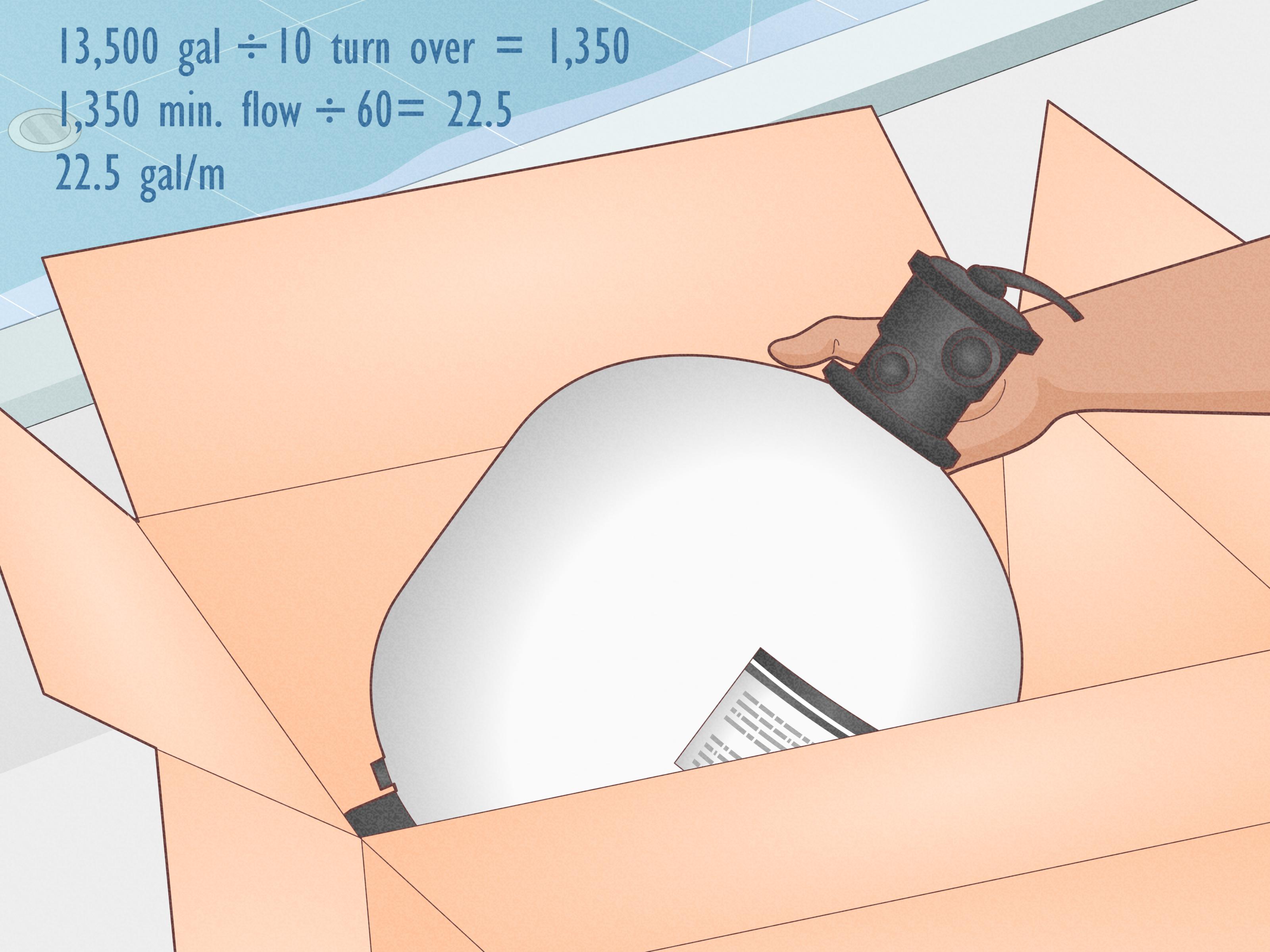
Pool volume ÷ Turnover hours ÷ 60 = Required GPM
Example: A 20,000-Gallon Pool
For an eight-hour turnover:
20,000 ÷ 8 ÷ 60 = 41.7 GPM
The circulation system must therefore deliver approximately 42 gallons per minute to achieve one theoretical turnover in eight hours.
Example: A 30,000-Gallon Pool
For an eight-hour turnover:
30,000 ÷ 8 ÷ 60 = 62.5 GPM
For a six-hour turnover:
30,000 ÷ 6 ÷ 60 = 83.3 GPM
Reducing turnover time requires a higher flow rate. However, higher flow is not automatically better. Excessive velocity can increase energy consumption, noise, pressure loss, and wear. It may also exceed the maximum ratings of the filter, heater, chlorinator, plumbing, or other components.
Industry sizing examples commonly calculate required GPM by dividing the pool volume by the desired turnover time and then by 60 minutes.
Step 4: Determine the Pump’s Actual Flow
A pump’s horsepower does not tell you exactly how many gallons per minute it will deliver. The actual output depends on total dynamic head, commonly abbreviated as TDH.
Total dynamic head represents the resistance created by the complete circulation system, including:
- Pipe length and diameter
- Elbows, tees, check valves, and diverter valves
- Elevation changes
- The filter itself
- Pool heaters and heat pumps
- Saltwater chlorine generators
- Waterfalls, spas, cleaners, and other features
As system resistance increases, the pump delivers less water. That means a pump advertised at 100 GPM under one test condition might deliver substantially less when installed on a real pool with long plumbing runs and several pieces of equipment.
Consult the pump’s performance curve and find the expected flow at your estimated TDH. Variable-speed pumps make this process easier because their speed can be adjusted to produce the required flow rather than forcing the system to operate at maximum power all day.
When accurate sizing matters, a pool professional can measure or calculate TDH and verify the operating flow. Manufacturer sizing tools also emphasize TDH because pipe resistance directly affects pump performance.
Step 5: Match the Filter’s Rated Flow to the System
The filter’s maximum design flow rate must not be lower than the pump’s expected output. If your pump can deliver 70 GPM under normal operating conditions, do not install a filter rated for a maximum of 50 GPM.
A useful rule is:
Filter design flow rate ≥ Maximum expected system flow
Do not size the filter only for the low speed you expect to use every day. Consider higher-speed operations such as vacuuming, operating a spa spillway, heating the pool, running water features, or priming the system.
The rest of the equipment must also support the selected flow. A giant filter cannot correct a system restricted by undersized pipes, a small heater bypass, or a narrow valve. The filter, pump, plumbing, heater, sanitizer, and water features must function as one coordinated system.
Step 6: Choose the Right Filter Type
Pool filters are generally divided into three categories: sand, cartridge, and diatomaceous earth. Each uses a different sizing method and offers a different balance of water clarity, maintenance, cost, and water consumption.
Sand Filters
Sand filters pass pool water through a bed of specially graded media. Dirt becomes trapped between the media particles, and the filter is cleaned by reversing the water flow in a process called backwashing.
Sand filters are popular because they are durable, straightforward, and relatively forgiving. They are often a good fit for pools that receive large debris loads or for owners who prefer quick backwashing instead of manually cleaning cartridges.
They do, however, consume water during backwashing. They may also capture smaller particles less efficiently than cartridge or DE systems, although alternative filter media and supplemental products can affect performance.
Sand filters are typically described by tank diameter, filter-bed area, design flow, and turnover capacity. Compare the manufacturer’s flow rating with the pool’s required GPM and the pump’s actual output. For example, manufacturer tables may list filter area, sand quantity, flow rate, and the number of gallons supported at eight-, ten-, or twelve-hour turnover periods.
For a typical residential pool, moving up one tank size can provide longer filtration cycles and reduce the frequency of backwashing.
Cartridge Filters
Cartridge filters use pleated fabric elements that provide a large surface area inside a relatively compact tank. They do not require routine backwashing. Instead, the cartridges are removed and cleaned with a hose when pressure rises or flow declines.
Their advantages include:
- Lower water waste
- Good fine-particle filtration
- Efficient operation at relatively low flow rates
- No backwash line or multiport valve in many installations
Cartridge filters are rated by square feet of filtration area. Manufacturers may also list a recommended flow rate and turnover capacity. Some product specifications show a recommended operating flow below the theoretical maximum, reinforcing the benefit of generous surface area rather than pushing the filter to its limit.
A commonly used residential guideline is approximately 100 square feet of cartridge area per 10,000 gallons as a starting point. However, a larger cartridge filter is often preferable when the pool is surrounded by vegetation, used heavily, operated throughout the year, or maintained in a dusty climate.
For example, a lightly used 15,000-gallon pool might function with a 150-square-foot filter, but a 200- or 250-square-foot unit may deliver longer cleaning intervals and lower pressure. Large pools often benefit from multi-cartridge tanks with 300 to 500 square feet or more.
Diatomaceous Earth Filters
DE filters use grids or flexible elements coated with diatomaceous earth powder. They are known for capturing very fine particles and producing excellent water clarity.
The trade-offs include more involved maintenance, the need to add fresh DE after cleaning or backwashing, and local rules governing the disposal of DE-laden wastewater. Owners must also follow the manufacturer’s instructions carefully because operating a DE filter without the correct media can damage the internal elements.
DE filters are generally sized by square feet of filtration area and maximum flow rate. As with other filter types, choosing more area than the bare minimum usually produces longer operating cycles and less frequent cleaning.
How Much Should You Oversize a Pool Filter?
There is no universal oversizing percentage that applies to every installation. However, selecting the next model above the calculated minimum is often a sensible approach.
Consider additional capacity when the pool:
- Is surrounded by trees, flowers, grass, or dusty landscaping
- Receives frequent windblown debris
- Is used by many swimmers
- Operates year-round
- Has a variable-speed pump
- Experiences recurring pollen or algae problems
- Is vacuumed through the main filtration system
- Must remain clear with minimal maintenance
A larger filter generally offers more debris capacity. It does not force additional water through the system and will not overpower the pump. The pump determines flow according to its speed and the resistance in the system.
Extreme oversizing may be unnecessary when equipment-pad space and budget are limited, but modest oversizing is rarely regretted. Pool owners complain about cleaning filters too often. Almost nobody angrily announces that their filter went too long between cleanings.
A Complete Pool Filter Sizing Example
Consider a rectangular pool measuring 36 feet long and 18 feet wide. The shallow end is 3.5 feet deep, while the deep end is 7.5 feet.
1. Calculate Average Depth
(3.5 + 7.5) ÷ 2 = 5.5 feet
2. Calculate Pool Volume
36 × 18 × 5.5 × 7.5 = 26,730 gallons
3. Calculate Required Flow for an Eight-Hour Turnover
26,730 ÷ 8 ÷ 60 = 55.7 GPM
The basic target is approximately 56 GPM.
4. Check the Pump Curve
Suppose the selected variable-speed pump can deliver 60 GPM at the system’s estimated TDH during normal filtration and 75 GPM at a higher cleaning speed.
5. Select the Filter
The filter should be rated to handle at least 75 GPM, because that is the highest expected operating flow. Instead of selecting a product barely rated at 75 GPM, the owner could choose a model rated for 90 or 100 GPM with greater filtration area.
If choosing a cartridge filter, a model in the 300- to 400-square-foot range could provide comfortable capacity for the pool’s volume and debris load. The final choice should be confirmed using the specific manufacturer’s performance table rather than a generic rule alone.
Special Conditions That Affect Filter Size
Heavy Landscaping
Leaves may be captured by the skimmer basket, but smaller material reaches the filter. Pollen, flower fragments, soil, and organic dust can quickly load a small filter. Increase filtration area when the pool sits beneath trees or beside a garden that appears determined to move into the water.
High Swimmer Load
Swimmers introduce sunscreen, body oils, hair, fibers, and other contaminants. A family pool used occasionally has different demands from a rental property or a backyard that hosts half the neighborhood every weekend.
Hot, Sunny Weather
Warm water and intense sunlight can increase sanitizer demand and encourage algae when circulation or water chemistry is inadequate. A larger filter cannot replace proper chlorine levels, but it can provide greater debris-holding capacity during demanding conditions.
Variable-Speed Pumps
Variable-speed pumps are often operated at lower flow rates for longer periods. This approach can improve circulation while reducing electricity use. The filter should still be sized for the pump’s highest programmed speed and any operating modes that demand additional flow.
Water Features and Attached Spas
Spillways, waterfalls, deck jets, bubblers, and spa jets may significantly increase required flow. In some systems, water features operate on separate pumps. In others, the primary circulation pump handles everything. Make sure the filter’s rating is compatible with every mode that routes water through it.
Common Pool Filter Sizing Mistakes
Choosing by Pump Horsepower Alone
Horsepower does not equal flow. Pumps with the same horsepower can produce different GPM depending on design, speed, and system resistance. Use the manufacturer’s pump curve and TDH, not the motor label alone.
Trusting a “Pools Up to” Claim Without Reading the Details
A filter advertised for pools “up to 30,000 gallons” may achieve that rating using a long turnover period under ideal test conditions. Check the listed GPM, filter area, and turnover assumptions.
Ignoring Maximum Flow Rate
A filter can have adequate turnover capacity but still be incompatible with a high-output pump. Never exceed the manufacturer’s maximum design flow.
Selecting the Smallest Acceptable Filter
The smallest unit may cost less initially, but frequent cleaning and elevated pressure can quickly erase the feeling of victory. Purchase price is only one part of lifetime cost.
Assuming a Bigger Pump Fixes Cloudy Water
Cloudy water may result from poor chemistry, algae, inadequate circulation, damaged filter media, or particles too fine for the current system. Installing a larger pump without evaluating the filter and plumbing may create more pressure rather than clearer water.
Confusing Filtration with Sanitation
A filter removes particles. It does not replace chlorine or another approved sanitizer. Clear-looking water can still contain harmful microorganisms, while properly sanitized water may remain cloudy because of suspended debris. Filtration, circulation, sanitation, and water balance must work together.
How to Know Whether Your Existing Filter Is Undersized
Possible warning signs include:
- Pressure rises soon after every cleaning
- Cartridges require unusually frequent washing
- Sand or DE filters need constant backwashing
- Return-jet flow weakens rapidly
- The water remains cloudy despite balanced chemistry
- The pump struggles to maintain adequate circulation
- Debris returns to the pool because internal components are overloaded or damaged
These symptoms do not automatically prove that the filter is too small. Clogged baskets, blocked plumbing, damaged cartridges, channeled sand, torn DE grids, air leaks, algae, and incorrect valve positions can create similar problems. Troubleshoot the entire system before replacing equipment.
Practical Experience: Lessons Learned from Real-World Filter Selection
Pool filter sizing looks wonderfully neat on paper. Measure the pool, calculate the gallons, divide by eight hours, choose a filter, and celebrate. Real equipment pads are less cooperative. They contain aging pipes, mystery valves, inherited repairs, and at least one fitting installed in a location that makes no logical or emotional sense.
One of the most valuable lessons is that calculated GPM should be treated as the beginning of the selection process, not the final answer. A 20,000-gallon pool may need about 42 GPM for an eight-hour turnover, but the filter should not be selected only because its specification sheet says 42 GPM. That leaves no comfortable margin for a higher pump speed, a dirty filter, a heater, or additional circulation demands.
In practice, owners tend to be happier after choosing the next larger filter model. A larger cartridge filter can transform cleaning from a frequent chore into an occasional maintenance task. More pleated area means debris is spread across a greater surface, so pressure generally rises more slowly. The pump may also operate under more favorable conditions because water is not being forced through a small, heavily loaded element.
The same principle applies to sand filters. A small tank may meet the mathematical turnover requirement, yet require frequent backwashing during pollen season or after a storm. Moving up one tank diameter can provide a deeper or wider media bed with greater debris capacity. The improvement may not look dramatic in the product photographs, but it becomes noticeable when the owner is not standing beside the waste line every weekend.
Environmental conditions are often underestimated. Two identical pools can have very different filtration demands. One may sit in an enclosed, screened yard with minimal debris. The other may be exposed to pine needles, flowering trees, windblown dust, enthusiastic children, and a dog that views the shallow end as a personal bathtub. Selecting the same minimum-size filter for both pools ignores how the systems will actually be used.
Equipment accessibility matters as well. Before purchasing a large filter, measure the equipment pad, gate openings, overhead clearance, plumbing connection height, and the space needed to open the tank. Cartridge filters require enough vertical clearance to remove the elements. Split-tank or clamp-style units need room for safe disassembly. A filter that technically fits but cannot be opened without removing nearby plumbing is not a clever installation; it is a future argument.
Another practical lesson is to record the clean starting pressure immediately after installation or a thorough cleaning. Every pool system has its own normal pressure. A reading of 12 PSI may be healthy for one installation and abnormal for another. The owner should note the clean pressure and follow the manufacturer’s guidance for deciding when cleaning or backwashing is required.
Owners should also resist increasing pump speed merely to make the pressure gauge look more impressive. Higher pressure does not mean better filtration. It often means the system is experiencing more resistance. With a variable-speed pump, slow and steady circulation can be both effective and economical, provided the flow remains adequate for skimming, sanitation equipment, heating, and turnover goals.
Finally, the best filter is not always the one with the finest theoretical particle removal. A DE filter may offer exceptional clarity, but an owner unwilling to handle DE powder or perform the required maintenance may be better served by a large cartridge filter. A sand filter may not capture particles as finely, but its durability and simple backwashing routine may suit a busy household perfectly.
Correct sizing is therefore a combination of mathematics and lifestyle. Calculate the required flow, respect equipment ratings, allow extra filtration area, and choose a maintenance routine you will actually follow. The most advanced filter in the world cannot help much if everyone avoids cleaning it until it resembles an archaeological discovery.
Final Pool Filter Selection Checklist
- Measure the pool and calculate its volume in gallons.
- Select an appropriate turnover target, commonly eight hours for initial residential calculations.
- Calculate the required flow rate in GPM.
- Estimate or measure total dynamic head.
- Use the pump curve to determine actual system flow.
- Check the highest flow expected in every operating mode.
- Choose a filter whose design flow meets or exceeds that maximum.
- Compare filtration area and debris capacity, not just gallon claims.
- Increase filter size for heavy debris, frequent use, or demanding climates.
- Confirm plumbing size, physical clearance, and maintenance access.
- Follow the manufacturer’s installation and operating instructions.
- Consult a qualified pool professional when the system includes complex plumbing, spas, heaters, or large water features.
Conclusion
To select the correct swimming pool filter size, begin with accurate pool volume, calculate the flow needed for the desired turnover period, and determine how much water the pump can actually move against system resistance. Then choose a filter with a flow rating above the highest expected pump output and enough filtration area to handle real-world debris.
Sand, cartridge, and DE filters can all provide excellent results when properly sized and maintained. The best choice depends on your desired water clarity, maintenance preferences, local water restrictions, equipment layout, and budget. When two models appear suitable, the larger filter is often the wiser long-term investment. It may cost more on installation day, but the reward is lower pressure, fewer cleaning sessions, and more time enjoying the pool rather than negotiating with its equipment.