“`
There are families that ease gently into parenthood, one baby sock and one bedtime story at a time. Then there are families like mine, where the universe apparently looked at our home and said, “You know what this place needs? A full cast, backup singers, and triplets.”
Our family story began with one boy, then twin boys, and thenbecause parenting had not yet tested every corner of our patience, laundry system, and snack budgetthree little girls arrived together. Six kids. Three boys. Three girls. One house full of shoes, giggles, crumbs, missing hairbrushes, and the kind of love that makes every exhausting day feel strangely beautiful.
This is life with triplets and six kids: loud, tender, hilarious, unpredictable, and surprisingly photogenic when nobody has yogurt on their shirt. As a parent, I started documenting our days because childhood moves fast. With triplets, it does not just move fastit sprints through the hallway wearing someone else’s socks. Photography became my way of saving the moments I knew I would someday miss: the matching grins, the fierce independence, the sibling pileups, the tiny hands, the big feelings, and the ordinary chaos that somehow turns into memory.
The Beautiful Shock Of Raising Triplets
Finding out you are having triplets is not a small announcement. It is not “We need another crib.” It is “We may need a spreadsheet, a second refrigerator, and emotional support coffee.” Triplets bring wonder before they even arrive. They also bring practical questions: How do we feed three babies? How do we help older siblings adjust? How do we keep everyone safe, seen, loved, and reasonably clean?
Multiple births are rare compared with single births, and triplets are rarer still. That rarity makes people curious. Strangers smile, stare, count heads, and say the sentence every parent of multiples knows by heart: “You have your hands full.” They are right, of course. My hands are full. So is my heart. So is the laundry basket. Again. Somehow always again.
But raising triplets is not only about numbers. It is about watching three children grow side by side while still becoming entirely different people. One may be bold and theatrical, one quiet and observant, one determined to negotiate dessert like a tiny attorney. They share a birthday, a history, and a bond, but they do not share one personality. That distinction matters. Triplets may arrive as a set, but they deserve to be raised as individuals.
Routines Save The Day, But Flexibility Saves The Parent
In a large family, routine is not boring. Routine is oxygen. With six kids, a casual morning can turn into a documentary about missing shoes. A predictable rhythm helps everyone know what comes next: breakfast, school bags, playtime, meals, baths, stories, bedtime, and the sacred parental silence that begins approximately seven minutes after the last child asks for water.
Experts often emphasize consistency because children feel safer when family expectations are predictable. In our home, routines help reduce arguments and confusion. When the triplets were little, synchronizing meals, naps, and bedtime was less a parenting preference and more a survival strategy. If one baby ate, the others usually ate. If one child needed a nap, we gently moved the whole tiny team toward rest. Otherwise, the day became a three-part opera titled Someone Is Always Tired.
Still, large-family life teaches you not to worship perfection. A routine should serve the family, not become a household dictator with a clipboard. Some days the schedule works beautifully. Other days someone spills cereal into a shoe, a child refuses pants, and the best you can do is laugh, adjust, and declare the morning “educational.”
The Sibling Bond: Best Friends, Rivals, Teammates, Witnesses
One of the greatest joys of raising six kids is watching sibling relationships unfold. There is a built-in community here. The children always have someone to play with, argue with, build forts with, blame for the missing marker, and comfort after a hard day. The triplets have a bond that is especially fascinating. They often seem to understand one another with a glance, yet they can also fight over the same toy with the passion of people defending national treasure.
Sibling rivalry is normal, especially in a busy home where attention, space, and snacks are all high-value resources. The goal is not to eliminate every disagreement. That would require magic, and possibly a referee whistle. The goal is to teach repair: how to listen, apologize, take turns, and respect each child’s space.
In our house, fairness does not always mean everyone gets the exact same thing. It means each child gets what they need. One child may need quiet time. Another may need help naming a feeling. Another may need a reminder that “I licked it first” is not a legal ownership system. Helping kids feel seen as individuals makes the whole sibling group stronger.
Why I Photograph The Messy, Magical Middle
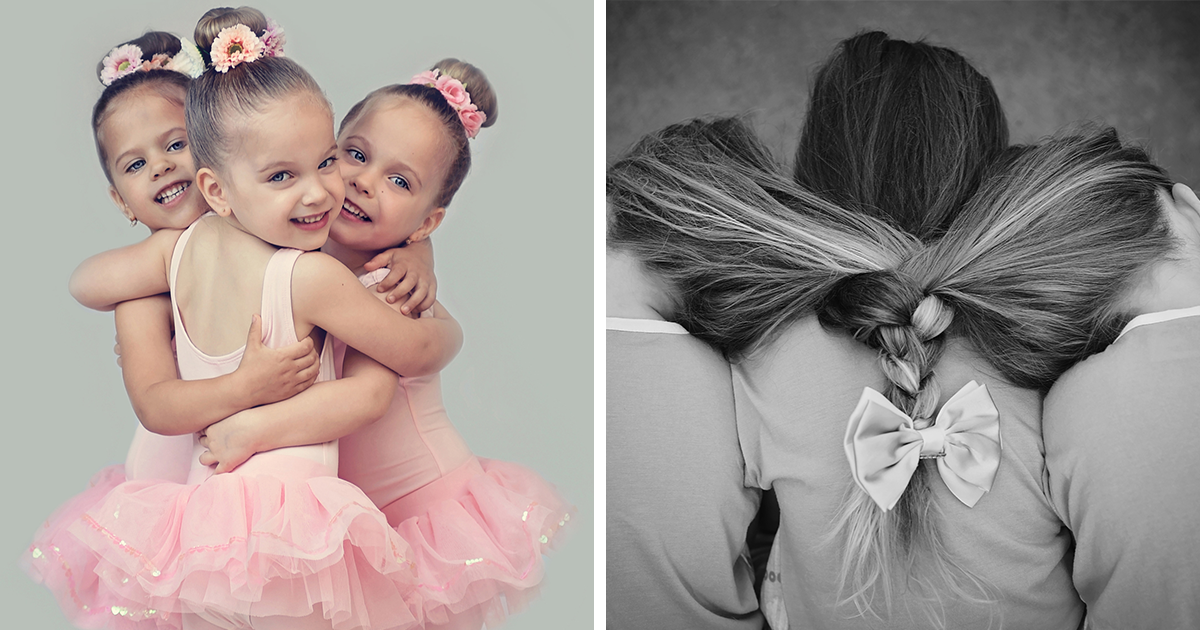
When people imagine family photography, they often picture matching outfits, golden sunlight, and children smiling like they have never once screamed over a broken cracker. Those photos are lovely. But the images I treasure most are often the in-between moments: three little girls holding hands, a brother helping with shoes, a toddler face covered in cake, six children squeezed onto a couch that was clearly not consulted.
Documenting childhood is not about proving that life is perfect. It is about preserving the truth that it was full. A photograph can hold a feeling long after the details fade. It can remind a child, “You belonged here. You were loved here. You were part of something wonderfully loud.”
As a parent, photography also helps me slow down. When I lift the camera, I notice light on a cheek, a shared laugh, the way one child reaches for another without thinking. The camera teaches me to see beauty in the ordinary. It catches the seconds I might otherwise rush past while wiping counters, signing forms, and wondering why nobody can locate the left shoe.
Raising Individuals Inside A Crowd
One challenge of parenting triplets is making sure the children are not always treated as a single unit. It is easy for people to say “the triplets” and forget that each child has her own preferences, fears, humor, and dreams. Even as a parent, I have to remind myself to create individual space inside the group rhythm.
That can look simple: choosing different colors, giving each child one-on-one time, asking separate questions, celebrating separate achievements, and allowing different clothing choices even when matching outfits would make a photo look adorable. Yes, matching dresses are cute. So is letting one child wear rain boots, one wear sparkles, and one arrive dressed like she has a meeting with a unicorn.
The same is true for the older boys. In a home where triplets naturally attract attention, older siblings need to know they are not background characters. Their stories matter too. A big brother who helps, teaches, comforts, or makes everyone laugh deserves more than “You are such a good helper.” He deserves time to be a child, not a junior staff member in the family circus.
The Logistics: Laundry, Meals, Sleep, And The Great Snack Economy
Life with six kids is a masterclass in logistics. Laundry is not a chore; it is a renewable resource. Groceries disappear with suspicious speed. Shoes migrate. Water bottles multiply and vanish. Someone is always hungry, even if dinner ended six minutes ago.
Meal planning helps. So do labeled bins, shared calendars, simple rules, and accepting that a large family home will look lived in because it is intensely, gloriously lived in. I have learned to prepare easy meals, keep backup snacks, and never underestimate the emotional power of a clean kitchen at night. A reset space can make the next morning feel possible.
Sleep is another major pillar. When children are young, safe sleep and healthy bedtime routines matter deeply. As they grow, bedtime remains important for everyone’s mood, including mine. A tired child is basically a tiny storm cloud with feet. A tired parent is not much better. We do our best to protect rest, even when bedtime includes six different versions of “one more thing.”
What Six Kids Taught Me About Joy
Before having a large family, I thought joy would look tidy. I imagined smiling children, peaceful dinners, and maybe a house that smelled faintly of muffins. Sometimes joy does look like that. More often, it looks like children laughing too loudly in the hallway, a baby reaching for a sibling, a group hug that turns into a wrestling match, or everyone dancing in the kitchen while dinner almost burns.
Joy is not the absence of stress. It is the small sparkle that survives inside the stress. It is the triplet who insists on kissing everyone goodnight in a specific order. It is the brother who pretends to be annoyed but saves the last cookie for his sister. It is the child who says, “Remember when we all slept in the living room?” and you realize the chaotic night you barely survived became one of their favorite memories.
Parenting six kids has stretched me in every direction. It has made me more patient, less attached to perfection, better at laughing, and deeply suspicious of silence. Silence in a house full of children is not peace. It is an investigation waiting to happen.
How To Document A Big Family Without Losing Your Mind
Parents often avoid taking photos because they are waiting for the perfect scene. My advice: do not wait. Take the picture while the house is imperfect, the hair is wild, and the toddler is holding a spoon for reasons no one understands. These are the real moments.
Photograph connection, not performance
The best family images often happen when children are not trying too hard. Ask them to whisper a secret, run toward you, hug their sibling, tell a joke, or make the baby laugh. Genuine expressions beat stiff smiles every time.
Include the parent behind the camera
Many parents, especially mothers, become the invisible family historian. They appear in thousands of memories but only as the person who took the photo. Hand the camera to someone else. Use a timer. Take the messy selfie. Your children will someday want proof that you were there too, not just operating the snack table.
Tell the whole story
Photograph birthdays and holidays, but also the regular Tuesday stuff: breakfast faces, homework piles, muddy shoes, backyard games, bedtime books, and the way the kids crowd around the smallest chair in the room. Childhood is mostly made of ordinary days. That is exactly why ordinary days deserve to be saved.
The Honest Hard Parts
It would be dishonest to write about life with triplets and six kids as if every day were a sunlit montage. Some days are hard. Some days the noise feels too big, the needs come too fast, and the parent in charge runs on cold coffee and determination. There are appointments, school events, sibling disagreements, bills, clutter, and moments when everyone needs something at once.
Parental stress is real, and large-family life can magnify it. Support matters. That support may come from a partner, grandparents, friends, neighbors, school communities, other parents of multiples, or a professional when the load becomes too heavy. Asking for help is not failure. It is family maintenance.
I have learned to value micro-breaks: five quiet minutes, a short walk, a hot shower, a text to a friend, or simply stepping outside and breathing before returning to the beautiful indoor weather system known as my children. Parents need care too. A well-supported parent has more patience, more humor, and more capacity to notice the good stuff happening right in the middle of the mess.
Experiences From The Heart Of Triplet Life
If I had to describe daily life with triplets in one scene, it would be this: three little girls trying to tell me three different stories at the same time while one brother asks where his socks are, another needs help with something urgent, and the third announces that someone has drawn on the wall. Somewhere in that moment, I am holding a camera, a hair tie, and half a banana. This is not the calm life, but it is a deeply alive one.
One of the sweetest experiences has been watching the triplets discover their shared world. When they were small, they often moved like a tiny flock. If one found something interesting, the others appeared immediately. If one laughed, the others joined before knowing why. That kind of shared delight is contagious. It makes the room feel brighter.
Birthdays are another adventure. A triplet birthday is a festival of fairness. Three cakes? One cake? Three themes? One theme with three dramatic subcommittees? We have learned that the birthday does not need to be identical to be loving. One child may want pink frosting, another may want chocolate, another may care only about balloons. The magic is in honoring each child while celebrating the bond they share.
There are also moments of unexpected tenderness between all six kids. I have seen an older brother gently zip a coat without being asked. I have watched the triplets cheer for one another over tiny victories that would sound ordinary to anyone else: tying a shoe, writing a name, climbing a step, being brave at the doctor. In a big family, encouragement can become part of the household language.
Of course, there are also negotiations. Many negotiations. Who gets the front seat later? Who touched whose pencil? Why is that blanket suddenly the most important blanket in the known universe? Parenting multiple children means becoming a translator of feelings. Often, the argument is not really about the pencil. It is about attention, tiredness, hunger, or the ancient sibling belief that justice must be immediate and preferably loud.
Photography helps me see these experiences with softer eyes. A meltdown may not be something I photograph in the moment, but later I may capture the repair: two children sitting close again, a hand on a shoulder, the return of peace after emotional weather. Those images matter because family life is not only about happy scenes. It is about learning how to come back to one another.
The longer I parent six children, the more I understand that childhood documentation is a love letter to the future. One day the house will be quieter. The shoes will stay where they belong. The laundry pile will shrink. I may even drink hot coffee while it is still hot, though that sounds almost suspiciously luxurious. When that day comes, I know I will look back at these photos and miss the noise. I will miss the triplets running in three directions, the boys making everyone laugh, the crowded couch, the messy table, the little voices calling “Mom!” from every room.
So I keep documenting. Not because every day is perfect, but because every day is ours. Life with triplets and six kids is not easy, polished, or predictable. It is better than that. It is real. It is full of tiny miracles wearing mismatched socks. And somehow, even on the hardest days, I would not trade this beautiful chaos for anything.
Conclusion
Raising triplets inside a family of six children is a life of movement, emotion, and constant discovery. It asks for patience, planning, humor, and a willingness to let go of perfect expectations. It gives back something extraordinary: built-in friendships, unforgettable stories, and a home filled with connection.
Documenting that life has taught me to pay attention. The best memories are not always staged. They happen while children are laughing, learning, arguing, forgiving, growing, and becoming themselves. In the end, the joy of raising six kids is not found in having everything under control. It is found in loving the people in front of you, one ordinary, noisy, beautiful moment at a time.