The Bayeux Tapestry is usually introduced as one of the greatest treasures of medieval Europe: a long, dramatic embroidered account of the Norman Conquest, packed with kings, oaths, ships, horses, soldiers, banners, swords, Latin captions, and enough political tension to make a modern election night look relaxing. But look a little closer, and the tapestry also reveals something that tends to make museum visitors blink twice: there are a surprising number of penises in it.
No, this is not a prank invented by bored art-history students during finals week. Scholars have seriously counted them, debated them, and argued about whether one suspicious object is anatomy or a scabbard. The most widely repeated tally is 93: 88 belonging to horses and five connected to human figures. More recently, some medievalists have suggested there may be a 94th. That means one of the world’s most famous historical artworks is also, depending on your counting method, a medieval needlework catalog of male anatomy.
Before we start giggling into our chain mail, it is worth asking a better question: why are they there? The answer takes us into medieval humor, political propaganda, masculinity, social shame, animal symbolism, and the strange brilliance of a textile that has survived nearly a thousand years while still finding new ways to surprise us.
The Bayeux Tapestry: A Very Serious Artwork With Very Unserious Details
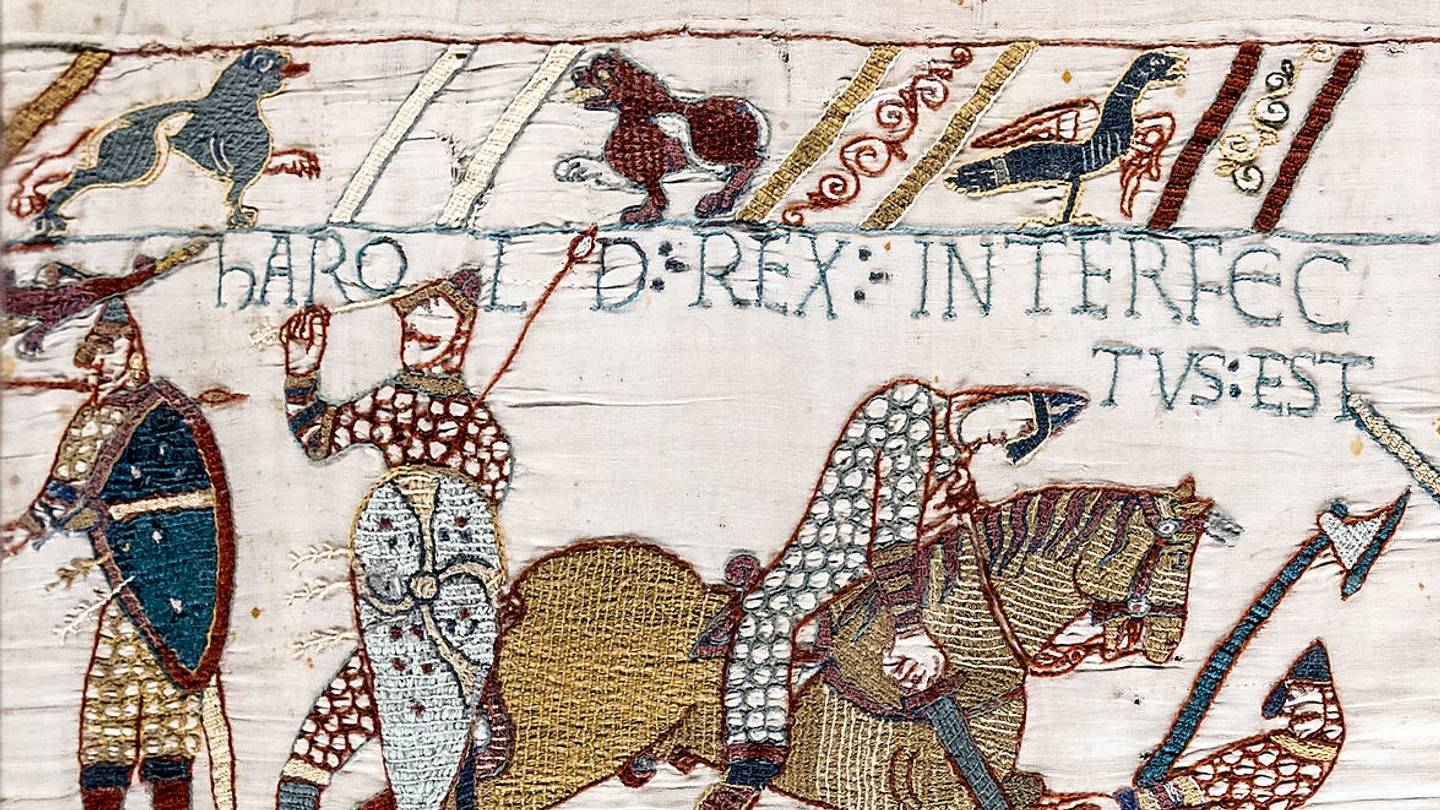
The Bayeux Tapestry is not technically a tapestry. It is an embroidery, made with wool thread stitched onto linen. It stretches about 70 meters, or roughly 230 feet, and tells the story of the events leading up to the Norman Conquest of England in 1066. Its central drama follows William, Duke of Normandy, and Harold Godwinson, the English nobleman who became King Harold II and died at the Battle of Hastings.
Across its long surface, the artwork shows diplomatic missions, feasts, shipbuilding, sea crossings, military preparation, battle scenes, and the famous appearance of Halley’s Comet. Medieval Latin captions guide viewers through the story, but they do not explain everything. In fact, the tapestry is famous partly because it refuses to behave like a simple illustrated textbook. It is part history, part political message, part visual puzzle, and part medieval gossip column stitched by people who absolutely knew how to make a border interesting.
The main strip of the embroidery contains the official narrative: kings die, oaths are sworn, armies march, and power changes hands. The upper and lower borders, however, often behave like the margins of a medieval manuscript after the illustrator had too much coffee. There are animals, fables, hunting scenes, mythical creatures, nude figures, and odd little episodes that seem to comment on the main story in sly and sometimes rude ways.
That is where the penises become more than a funny footnote. They are part of a visual language.
So, How Many Are There?
The commonly cited number is 93. According to the count popularized by historian George Garnett, 88 belong to horses, while five are associated with human figures. Most viewers probably notice the horses first. The Bayeux Tapestry is full of them: charging, waiting, being led, falling, and carrying aristocratic men into the machinery of conquest. Since medieval artists often showed animals with practical anatomical detail, some of the horse anatomy may simply reflect observational accuracy.
But “just anatomy” does not explain everything. Some horses are shown more prominently than others. Certain details appear exaggerated, carefully positioned, or attached to characters whose political importance matters. In other words, the embroidery may not be saying, “Here is a horse.” It may be saying, “Here is a powerful man represented through a powerful horse, and yes, please notice the symbolism before the next cavalry charge.”
The human examples are even more intriguing because they appear mostly in the borders, where medieval artists often placed comic, moral, or satirical material. These figures are not random decoration. They belong to the same visual world as the fables, beasts, and marginal scenes that frame the conquest narrative. They may hint at shame, disorder, lust, humiliation, or the collapse of proper social behavior.
Then comes the possible 94th. A recent debate centers on an ambiguous object beneath the tunic of a running figure in the border. One interpretation says it is another penis. Another says it is a sword scabbard or similar object. The disagreement is surprisingly serious because medieval art depends on pattern recognition. Scholars compare color, position, shape, and repeated visual conventions across the whole embroidery. The debate is funny, yes, but it also shows how carefully historians read even the smallest stitched detail.
Why Would Medieval Artists Include This?
Modern audiences sometimes assume medieval art was always solemn, religious, and allergic to jokes. That is a charming myth, but it collapses the moment you open a medieval manuscript and find a rabbit attacking a knight, a monk doodling rude creatures, or a marginal figure behaving badly in ways that would not pass a school hallway poster review.
Medieval visual culture often used the body to make moral and social points. Exposed anatomy could signal shame, foolishness, wildness, uncontrolled desire, low status, or disorder. It could also be comic. Sometimes it was both. Medieval humor did not separate the serious and the ridiculous as neatly as we often do today. A work could discuss kingship and betrayal while also using rude imagery to sharpen the message. Apparently, the Middle Ages believed in multitasking.
In the Bayeux Tapestry, the rude details do not float in empty space. They appear in a story about contested authority. Harold may have sworn an oath to support William’s claim to the English throne; after Edward the Confessor’s death, Harold accepted the crown; William invaded; and Harold was killed at Hastings. The tapestry presents this sequence in a way that favors the Norman argument. If the borders include images of exposure, animal force, and bodily comedy, those details may reinforce ideas about broken promises, unstable power, masculine competition, and public disgrace.
Horses, Power, and Medieval Masculinity
To understand the 88 equine examples, remember that horses in the Bayeux Tapestry are not background furniture. They are vehicles of aristocratic identity. In the 11th century, mounted warriors represented elite military power. A knight on a horse was not merely a man commuting to battle; he was a symbol of status, wealth, training, and violence managed through hierarchy.
That makes the horses’ bodies symbolically useful. A large, energetic horse can communicate the strength of the rider or owner. When a horse connected with Duke William is shown with especially noticeable anatomy, scholars have read it as more than biological realism. It may underline William’s potency, authority, and readiness for conquest. In modern marketing terms, it is medieval brand positioning, just with more hooves and fewer focus groups.
Harold’s horse imagery may also matter. If the tapestry uses horse anatomy to comment on human power, then the animal details become part of the political argument. The embroidery is not simply recording who rode what. It is staging a visual contest between rival men, rival claims, and rival futures for England.
This does not mean every horse in the tapestry carries a hidden message. Some may be ordinary anatomical stitching. But when details cluster around major figures or appear in unusually emphasized ways, they invite interpretation. Medieval artists often worked through repetition and variation. The eye learns the pattern, then notices when something breaks it.
The Borders Are Not Just Decoration
The upper and lower borders of the Bayeux Tapestry are essential to the artwork’s meaning. They contain animals, hunting scenes, fable-like episodes, and strange human figures. Some scenes seem playful. Others are unsettling. Many appear to comment indirectly on the main action.
This style of visual storytelling was familiar in medieval art. Margins could be witty, symbolic, moralizing, or subversive. They gave artists room to explore themes that might be too awkward to place directly in the central narrative. A border could whisper what the main scene could not say out loud.
In the Bayeux Tapestry, that whisper often sounds like: power is messy, men behave badly, and conquest is not as tidy as official history would like. The nude or exposed figures may represent humiliation or moral failure. The animals may echo fables about betrayal, foolishness, or predation. The result is a layered artwork that rewards slow looking.
That is one reason the penis count matters. It is easy to treat the number as a punchline, and honestly, the punchline is doing excellent work. But the count also reminds us that the embroidery is packed with purposeful detail. The makers were not filling space randomly. They were building a visual argument.
Is the Bayeux Tapestry Propaganda?
Many historians describe the Bayeux Tapestry as a form of Norman propaganda, though not in the flat, poster-like sense of the word. It does not simply shout, “William was right!” Instead, it arranges events so that William’s invasion appears justified. Harold’s oath, the death of Edward the Confessor, the coronation, the comet, the preparations for war, and the battle all unfold in a sequence that helps explain Norman rule as legitimate.
The likely commissioner was Bishop Odo of Bayeux, William’s half-brother, though the exact origin and production circumstances remain debated. Many scholars believe the embroidery was probably made in England, possibly by highly skilled needleworkers familiar with Anglo-Saxon artistic traditions. That combination is fascinating: an artwork supporting Norman power may have been stitched by English hands after England’s defeat.
Seen from that angle, the rude details become even more interesting. Are they part of the official Norman message? Are they English humor sneaking through? Are they moral commentary understood by both sides? We cannot know with certainty, which is both frustrating and delightful. The tapestry is a historical document that winks at us but refuses to explain the joke.
The 94th Penis Debate: Scholarship With a Raised Eyebrow
The recent claim of a possible 94th example shows how alive Bayeux Tapestry scholarship remains. The disputed detail appears on a figure in the border. Some scholars argue that its position and form match other depictions of male anatomy in the embroidery. Others argue that the detail is more likely a scabbard or accessory, especially because of its color and placement.
This may sound like the world’s most specialized argument, and, well, it is. But it also illustrates how art historians work. They do not merely glance at an image and announce vibes. They compare visual patterns, materials, restoration history, iconography, and context. A single ambiguous shape can raise questions about medieval clothing, weapons, humor, repair work, and artistic intention.
Whether the final count is 93 or 94, the debate proves that the Bayeux Tapestry still has secrets. Nearly a millennium after its creation, people are still zooming in, arguing, laughing, and learning. That is a pretty good career for a piece of linen.
Why This Topic Keeps Going Viral
The phrase “penises in the Bayeux Tapestry” travels quickly online because it combines two things people rarely expect to meet: a respected medieval masterpiece and a surprisingly cheeky detail. It is the art-history equivalent of discovering that your dignified grandfather once played drums in a garage band.
But the viral appeal also has a useful side. It brings people into the artwork. A person who might never search for “Norman Conquest visual culture” may absolutely click on a headline about medieval anatomy. Once there, they discover a complex object involving war, succession, embroidery, political legitimacy, Latin captions, gender, violence, animals, and symbolism.
That is not dumbing down history. That is opening the door with a very strange key.
The Bayeux Tapestry deserves both respect and curiosity. It is serious enough to shape how we imagine 1066, and weird enough to remind us that the past was full of real people with jokes, anxieties, rivalries, and bodies. Medieval people were not museum mannequins. They laughed, mocked, warned, exaggerated, and stitched meaning into places where modern viewers least expect it.
Specific Examples of Meaning in the Tapestry
1. William’s Horse as a Symbol of Authority
One famous interpretation focuses on the horse associated with Duke William before the Battle of Hastings. Its exaggerated anatomy has been read as a signal of strength and masculine power. In a story about who deserves to rule England, even the horse becomes political messaging with a mane.
2. Harold and the Problem of the Oath
Harold’s oath scene is central to the Norman case. The tapestry shows him swearing on relics, but it does not spell out the exact promise. That ambiguity matters. If the borders include imagery of shame or disorder nearby, they may help frame Harold as a man whose actions lead to chaos.
3. The Human Figures in the Margins
The exposed human figures in the borders seem less like anatomical observation and more like commentary. They belong to a world of ridicule, bodily humor, and moral warning. Their placement outside the main narrative lets the tapestry speak in two voices: official history in the center, sharp commentary around the edges.
4. Animals and Fables
Many medieval viewers would have recognized animal imagery as morally charged. Foxes, birds, beasts, and hunting scenes could suggest deception, appetite, vulnerability, or predation. The borders may therefore act like a symbolic soundtrack to the main story. Think of it as the medieval version of dramatic background music, except with more creatures and fewer violins.
What Modern Readers Can Learn From the Rude Details
The surprising number of penises in the Bayeux Tapestry teaches a larger lesson about looking carefully. Famous artworks often become flattened by reputation. We hear “masterpiece,” and we imagine something distant, polished, and untouchable. But the closer we look, the more human it becomes.
The Bayeux Tapestry is not just an artifact behind glass. It is a crowded, noisy, stitched world. It contains ambition, fear, loyalty, betrayal, violence, ceremony, food, ships, animals, and jokes that still land after nearly a thousand years. Its rude details do not make it less important. They make it more alive.
They also remind us that medieval symbolism was rarely one-dimensional. A horse could be a horse, a status symbol, a military tool, and a coded comment on masculinity all at once. A border figure could be comic and moralizing. A tiny stitched shape could launch a debate among scholars because meaning in medieval art often hides in plain sight.
Experience Section: What It Feels Like to Notice the Bayeux Tapestry’s Strangest Details
Encountering the Bayeux Tapestry, whether in person, through a museum-quality digital image, or in a detailed art-history discussion, can feel like watching a medieval movie that forgot to pause for modern politeness. At first, the eye follows the grand story. Edward the Confessor appears. Harold travels. William prepares. Ships are built. Men feast, argue, ride, and fight. The embroidery moves like a storyboard, scene after scene, with the confidence of a director who knows the ending is going to be bloody.
Then the margins start calling for attention.
You notice an animal. Then another. Then a strange little figure. Then something that makes you lean closer and think, “Wait, did they really stitch that?” This is the moment the Bayeux Tapestry stops being merely famous and becomes personal. It feels less like a dusty masterpiece and more like a conversation with the people who made it. They are not speaking directly, of course, but they are leaving clues. Some are noble. Some are comic. Some are rude enough to make a museum audio guide suddenly seem underprepared.
The experience is especially interesting because it changes how you think about medieval people. Many modern viewers unconsciously imagine the Middle Ages as stiff, gloomy, and humorless. The Bayeux Tapestry disagrees. It shows that medieval artists could be observant, witty, symbolic, and bold. They understood that bodies could communicate power and shame. They knew animals could carry meaning. They knew borders could do more than decorate. They also knew that a serious political story becomes more memorable when the edges are full of visual surprises.
Looking at the tapestry’s anatomical details also creates a useful kind of discomfort. It forces modern viewers to ask whether they are laughing at the past or learning from it. The best answer is probably both, as long as the laughter does not stop the learning. The humor opens the door, but the interpretation keeps you in the room. Once you start asking why these details exist, the tapestry becomes richer. The count of 93 or 94 is not merely trivia; it is an invitation to examine how medieval art used masculinity, exposure, and animal symbolism to talk about authority.
There is also something wonderfully humbling about the debate itself. In a world full of high-speed takes, scholars are still arguing carefully over a small stitched detail from the 11th century. Is it anatomy? Is it a scabbard? Is the color significant? Does it match other examples? Has restoration changed how we see it? These questions may sound amusing, but they represent a serious method: slow looking. The tapestry rewards patience. It asks viewers to notice before judging.
For writers, students, museum visitors, and history lovers, that is the real experience-related lesson. The Bayeux Tapestry proves that history is not always hidden in grand speeches or royal documents. Sometimes it is in a border. Sometimes it is in an animal. Sometimes it is in a detail so unexpected that it makes people laugh first and think second. And honestly, thinking second is still thinking.
The next time someone describes medieval art as boring, the Bayeux Tapestry is ready with a 230-foot rebuttal. It has war, politics, betrayal, horses, prophecy, embroidery, propaganda, and one of the strangest scholarly counting projects in art history. Not bad for linen and wool.
Conclusion: The Bayeux Tapestry Is Stranger, Smarter, and Funnier Than You Think
The surprising number of penises in the medieval Bayeux Tapestry is more than an amusing historical oddity. It is a reminder that medieval art was layered, symbolic, and often unexpectedly funny. The famous embroidery does not only tell the story of the Norman Conquest; it comments on power, masculinity, shame, legitimacy, and human behavior through details both grand and tiny.
Whether the correct count is 93 or 94, the real takeaway is that the Bayeux Tapestry still has the power to surprise. Its borders are not decorative leftovers. Its horses are not merely transportation. Its rude details are not accidents to be politely ignored. They are part of a sophisticated visual world where politics and humor share the same thread.
Nearly a thousand years later, the tapestry remains one of the most fascinating works of medieval art because it refuses to be simple. It is historic, dramatic, beautiful, strange, and occasionally very cheeky. In other words, it is exactly the kind of masterpiece that keeps history alive.