Long-term market returns are a little like old family recipes: everyone swears by them, nobody follows them exactly, and somehow they still explain a lot about what shows up on the table. In investing, the latest long-term return data does not tell us what the market will do next Tuesday at 10:17 a.m. It does something more useful. It shows what has historically rewarded patience, what has merely looked exciting, and what has quietly done the heavy lifting while louder assets stole the spotlight.
And right now, those numbers are especially interesting. Recent returns have been strong, particularly for U.S. stocks, but the bigger story is not that the market had another good year. It is that today’s backdrop looks very different from the one investors got used to during the ultra-low-rate era. Bonds are offering real competition again. Inflation has cooled from its hottest stretch. International markets have re-entered the chat. And valuations are high enough to remind everyone that even great businesses can become expensive dinner guests.
So let’s take a closer look at the latest long-term market returns, what they say about stocks, bonds, inflation, and diversification, and why investors should probably stop treating one hot calendar year like a personality test.
What the Latest Returns Are Actually Telling Us
If you only glanced at the scoreboard, 2025 looked pretty friendly. U.S. stocks delivered another strong year, with gains in the high teens. Technology and communication services were again major drivers, while international stocks finally managed to outpace the U.S. in many broad comparisons. Emerging markets had a notably strong year as well. Meanwhile, bonds did something they had not done in a while: they reminded investors that they still know how to help.
That matters because many people still think of the market through a 2022 lens, when both stocks and bonds had a rough time together and the classic 60/40 portfolio got publicly roasted like it had insulted the internet. But the longer record says that one ugly year does not rewrite the whole playbook. In fact, the updated data shows that balanced portfolios still have a strong long-run case, especially when starting bond yields are higher.
The broader lesson is simple: the latest market returns were good, but they were not evenly good. Leadership remained concentrated. Some sectors did the financial equivalent of carrying the piano up the stairs, while others mostly supervised. That unevenness matters because it affects what future long-term returns may look like from here.
Long-Term Market Returns Have a Very Good Memory
One of the easiest mistakes investors make is assuming the market’s recent behavior is normal forever. It is not. The market is more like a dramatic actor than a dependable accountant. It overreacts, underreacts, steals scenes, and then eventually hands the script back to long-term averages.
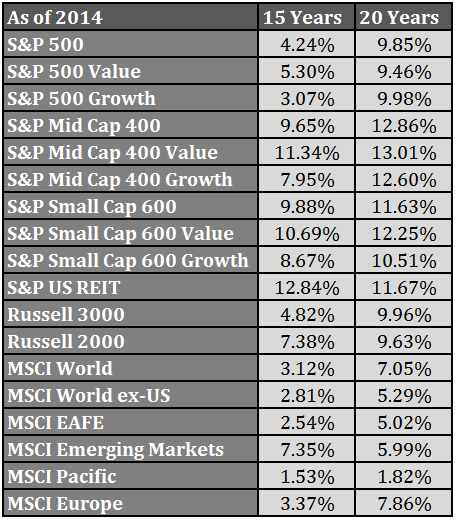
Over long stretches, U.S. stocks have still been remarkably productive. Recent rolling return data shows how powerful time can be. Over the past 20 years, the S&P 500’s average annual return has stayed around the low double digits, even with a housing crash, a pandemic, inflation spikes, and enough headlines to raise anyone’s blood pressure. Shorter windows have been even stronger, which is great for recent investors but also a giant neon sign saying, “Do not assume this pace lasts forever.”
That is why long-term data matters more than hot takes. When you zoom out, stocks have historically offered the highest returns, bonds have produced lower but steadier gains, and blended portfolios have usually landed somewhere in between with fewer stomach-churning drops. In other words, the old hierarchy still holds. Risk has usually been paid, but not on a polite schedule.
A good way to think about it is this: one-year returns tell you how noisy the market is, but 10-, 20-, and 30-year returns tell you what the market tends to reward. Those are very different conversations. One is gossip. The other is biography.
Stocks Still Lead, but the Ride Is Not Exactly Spa-Like
The updated long-term comparisons make the same point they always make, only with fresh numbers and a sharper haircut: stocks have been the strongest long-run return engine, but they earn that title by being wildly unchill in the short run.
That tradeoff is worth understanding. Historically, stocks have delivered the best annual average return over long periods, but they also come with deeper drawdowns and much wider ranges of outcomes over one-year periods. In plain English, they usually win the marathon, but they have a habit of tripping over traffic cones in the middle miles.
This is why time horizon is everything. Over rolling one-year periods, stock returns have been all over the map, from thrilling to horrifying. Over rolling 10- and 20-year periods, that range narrows dramatically. Time does not eliminate risk, but it has historically made equity investing look far less chaotic than the day-to-day experience suggests.
That is also why panic-selling after sharp declines has such a bad long-term reputation. The biggest market gains often come wrapped in periods that felt terrible while they were happening. Investors who insist on only feeling comfortable usually end up paying for comfort with lower long-term returns.
Bonds Are Back in the Conversation, and Not Just as Decorative Furniture
For years, bonds had a hard time impressing anyone. Yields were low, return expectations were modest, and cash sometimes looked more appealing. That backdrop has changed. Higher starting yields have materially improved long-term bond math, which is a sentence that will never trend on social media but matters a lot for real portfolios.
Today’s bond market is more useful than it looked a few years ago for two reasons. First, yields are meaningfully higher than the levels investors got used to during the post-financial-crisis era. Second, starting yields have historically been one of the strongest predictors of future bond returns. That means bonds now offer a better mix of income, total return potential, and diversification value than they did when investors were squeezing nickels out of near-zero rates.
In practice, this changes the portfolio conversation. A 60/40 portfolio does not need bonds to outperform stocks. It needs them to provide ballast, income, and decent long-run compounding when equity markets get dramatic. With yields higher, that job gets easier. Bonds may never be the life of the party, but they can once again pay for snacks.
Inflation Is the Editor of Every Return Story
Nominal returns get the headlines. Real returns do the actual work. If an investment gains 8% while inflation eats 3%, your purchasing power did not gain 8%. It gained something closer to 5%, and that difference matters more over decades than most people realize.
The good news is that inflation cooled in 2025 compared with the ugly peaks of the previous few years. That helped both stocks and bonds. It also made the year’s gains more meaningful in real terms. But inflation has not disappeared, and long-term return forecasting still has to account for it. That is why many firms are now projecting more modest U.S. equity returns over the next decade even after several strong years. High starting valuations and still-elevated inflation assumptions can shrink the room for upside.
Global historical data tells the same story from another angle. Equities have continued to beat inflation, bonds, and cash over very long periods, but the gap between nominal and real returns remains a huge deal. Investors who ignore inflation are basically grading a race without noticing half the runners are carrying backpacks.
Valuations Matter More When Everyone Is Feeling Brilliant
There is a reason long-term return estimates have become more cautious even after strong market performance: valuations are doing a lot of talking. The U.S. market entered 2026 at a higher forward price-to-earnings multiple than its long-term average. That does not mean the market is doomed. It means expectations are expensive.
When valuations are rich, future returns can still be positive. They just tend to be less forgiving. Earnings growth has to show up. Margins have to hold. Investor enthusiasm has to avoid wandering into full costume and calling itself destiny. This is especially true when market leadership is highly concentrated in a small group of giant companies.
That concentration is one of the most important features of the current market. A handful of mega-cap stocks have become such a large share of the index that broad-market returns can look diversified while behaving a little less so under the hood. This does not automatically mean a bubble. It does mean investors should think carefully before confusing index ownership with perfect balance.
Diversification Is Not Boring. It Is Just Better Dressed Than Hype.
The latest return data makes a strong case for diversification, partly because recent winners have been so dominant. U.S. large-cap stocks have had an excellent run. But when one area of the market becomes crowded, expensive, and heavily concentrated, the argument for spreading risk gets stronger, not weaker.
That is where international stocks, bonds, and even cash become more interesting. Several long-term outlooks now suggest that international developed equities may offer better forward returns than U.S. large caps over the next decade. Not because America forgot how to innovate, but because valuation starting points matter. If one market begins from a cheaper base, it does not need superhero-level optimism to produce solid results.
Diversification also helps emotionally, which is rarely listed in the glossy brochure but should be. Investors are much more likely to stick with a plan when no single asset class controls their mood, their sleep, and their entire opinion of civilization. A diversified portfolio will not always lead, but it can keep investors from making their worst decisions at the worst possible times.
What the Next Decade May Look Like
This is where things get interesting. The latest major market outlooks are not predicting disaster. They are predicting moderation. That is an important difference. Future long-term returns for U.S. equities are still expected to be positive, just lower than what investors enjoyed during the unusually strong recent stretch. Bonds, meanwhile, are expected to offer better forward returns than they did through much of the 2010s, thanks largely to higher starting yields.
That combination changes the investing landscape. It suggests the next decade may look less like a one-asset parade and more like a broader contest. U.S. stocks can still do well. International stocks may have a stronger case than they have in years. Bonds may actually contribute something besides moral support. Cash will likely remain useful for short-term needs, but it still looks less compelling than risk assets for long-run wealth building.
If that sounds less exciting than a market forecast built entirely around moonshots and acronyms, good. Boring forecasts are often healthier. They tend to assume the future will contain both growth and disappointment, which is honestly one of the market’s favorite combinations.
What Investors Should Take Away
1. Recent returns were strong, but starting points matter
Strong trailing returns are great. They are not a coupon for equally strong future returns.
2. Stocks still dominate over long periods
They remain the most powerful long-run growth engine, but only for investors who can tolerate their occasional theatrical breakdowns.
3. Bonds look more useful now
Higher yields have restored some long-term return potential and strengthened the case for fixed income in diversified portfolios.
4. Inflation still matters
The real question is not “What did I earn?” but “What did my purchasing power keep?”
5. Diversification deserves more respect
Especially in a market where concentration risk is high and leadership can change faster than a group chat opinion.
Experience: What Living Through Long-Term Market Returns Actually Feels Like
On paper, long-term market returns look clean and sensible. You can put them in charts, summarize them in tidy averages, and point to 20-year growth curves that climb like a staircase built by optimistic engineers. In real life, though, living through those returns feels nothing like a straight line. It feels more like carrying a grocery bag with a broken handle: technically manageable, emotionally annoying, and always one awkward moment away from disaster.
Most investors do not experience “the market” as an annualized figure. They experience it as headlines, account balances, sudden drops, unexpected rallies, and the weird emotional whiplash of seeing the same portfolio look brilliant in January, doomed in April, and respectable again by December. That is why long-term investing is often less about intelligence and more about behavior. The math matters, of course, but the ability to sit still while the math takes the scenic route matters just as much.
Think about how a typical decade feels while you are actually inside it. One year, stocks are flying and everyone suddenly becomes a philosopher of innovation. The next year, bonds are falling, inflation is rising, and people start acting as if capitalism has entered its awkward phase permanently. Then a year later, the same portfolio that looked broken begins to recover, and the narrative changes again. Long-term returns are built from those contradictory moments. They are not made in calm. They are made in noise.
There is also the experience of boredom, which does not get enough credit in finance. Truly long-term investing often feels uneventful right up until it feels terrifying. Rebalancing is not glamorous. Holding diversified funds while one corner of the market becomes the star of every conversation can feel like bringing a sensible lunch to a carnival. But that discipline is often what keeps long-term investors from chasing yesterday’s winner at tomorrow’s price.
And then there is perspective, which usually arrives late and acts like it was invited early. Investors who stay in the market long enough eventually notice a pattern: the periods that felt most convincing in the moment were often not the ones that mattered most. The giant up years, the scary down years, the inflation scares, the concentration booms, the rate shocks, the recovery rallies, all of them eventually become part of one longer narrative. The portfolio keeps moving. The averages keep forming. The emotional spikes flatten into history.
That may be the most useful experience-based lesson from long-term market returns. Success rarely feels smooth while it is happening. It feels uncertain, repetitive, and occasionally ridiculous. But over time, discipline has a way of looking smarter than excitement. The investor who keeps contributing, rebalancing, and refusing to turn every market swing into a personal crisis often ends up with the most powerful advantage of all: enough time for compounding to stop being theoretical and start being obvious.
Conclusion
A closer look at the latest long-term market returns shows a market that is still rewarding patience, but with a different mix of opportunities than investors saw a few years ago. Stocks remain the long-run growth leader. Bonds have regained relevance. Inflation still edits the final score. Valuations deserve respect. And diversification looks less like caution and more like common sense.
If there is one takeaway worth keeping, it is this: long-term returns are not built by correctly predicting every twist in the market. They are built by understanding what has historically mattered most and then behaving like that knowledge is more important than the latest burst of market theater. Which, to be fair, it usually is.