Note: This article is written for web publishing in standard American English and synthesizes real-world bench power supply testing practices, common Amazon product specifications, electronics safety guidance, and practical experience with low-cost lab supplies.
A bench power supply is one of those tools that makes you feel like a real electronics wizard. One minute you are poking at an LED, the next you are calmly dialing in 12 volts like you run a tiny power company from your desk. The good news is that Amazon is packed with inexpensive variable DC bench power supplies promising big numbers, bright displays, USB ports, memory buttons, overcurrent protection, and enough confidence to make a beginner think, “Why would anyone spend hundreds of dollars?”
The better question is: what do you actually get when you buy a cheap bench power supply sold on Amazon? To find out, let’s walk through the kind of real-world testing that matters: voltage accuracy, current limiting, ripple and noise, load regulation, thermal behavior, build quality, and day-to-day usability. The goal is not to dunk on budget tools. Cheap equipment can be incredibly useful. But electricity is one of those hobbies where “close enough” can become “why is my microcontroller hot enough to toast a bagel?” rather quickly.
What Is a Bench Power Supply?
A bench power supply is an adjustable DC power source used to power circuits, prototypes, motors, LEDs, radios, sensors, battery chargers, and repair projects. Instead of hunting for wall adapters or half-dead batteries, you set the voltage and current limit you need. A typical affordable model sold on Amazon may offer an output range of 0–30 volts and 0–5 or 0–10 amps. Many modern budget units are switching power supplies, which means they are compact, lightweight, efficient, and sometimes a little noisier than traditional linear supplies.
The two most important modes are constant voltage and constant current. In constant voltage mode, the power supply tries to hold the voltage you set while the device draws the current it needs. In constant current mode, the supply limits current and lowers voltage as needed to protect the device under test. This is why a current limit is not just a feature; it is the difference between a controlled experiment and an accidental smoke machine.
The Cheap Amazon Bench Power Supply Category
Search for “variable DC power supply 30V 10A” on Amazon and you will see a familiar pattern. Many models look similar: compact black or gray metal cases, four-digit LED displays, encoder knobs, front banana jacks, cooling fans, USB charging ports, and claims of 300 watts of output power. Brand names vary, but the formula is often the same. These units are usually priced low enough to tempt beginners, hobbyists, students, automotive tinkerers, and repair shops that need a secondary supply.
Common features include adjustable voltage and current, output on/off control, overcurrent protection, short-circuit protection, coarse and fine adjustment, memory presets, and sometimes a USB-A or USB-C charging output. On paper, that sounds like a miniature lab instrument. In practice, the experience depends heavily on internal design, calibration, filtering, thermal management, and how honest the power rating is under continuous load.
First Impression: Small, Light, and Surprisingly Capable
The first thing you notice about a cheap switching bench supply is how light it feels. A classic linear bench power supply often has a transformer that gives it the personality of a small brick. Many Amazon budget supplies feel almost portable by comparison. That is not automatically bad. Switching designs can deliver useful power in a compact box. However, weight can also hint at smaller heatsinks, lighter wiring, and less output filtering.
The front panel usually makes a good first impression. A bright display shows voltage, current, and sometimes power. The knobs may click through digits or allow fast adjustment. Banana jacks accept test leads. The output button is especially important because it lets you set voltage and current before energizing your circuit. Without an output button, connecting a sensitive board can feel like plugging in a toaster while blindfolded.
Safety Inspection Before Powering Up
Before testing performance, the first test is visual safety. Check the power cord, plug, fuse holder, case screws, ventilation slots, and front terminals. A bench supply connects to AC mains power, so this is not the place for heroic optimism. The case should be solid, the ground pin should be present, the cord should not feel flimsy, and the terminals should not wobble like a loose tooth.
If a unit has a certification mark such as UL, ETL, or another recognized safety label, that is a positive sign, but buyers should understand that online listings can be messy. A logo in a product photo is not the same as verified compliance. At minimum, inspect the supply carefully, use it on a grounded outlet, keep vents clear, and avoid leaving an unknown budget supply running unattended at high load. Electricity is useful. Unsupervised mystery electricity is less charming.
Test Setup: How to Evaluate a Budget Bench Power Supply
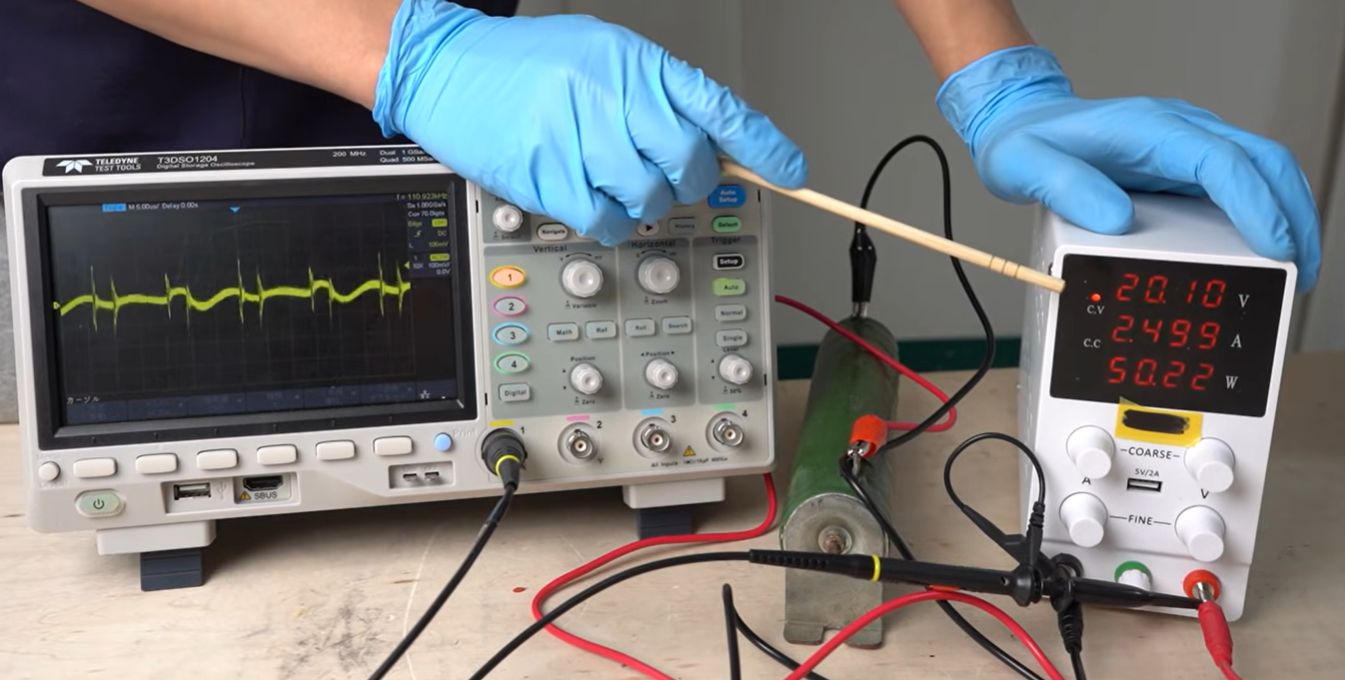
To test a cheap bench power supply properly, you need more than curiosity and a sacrificial LED. A reasonable test setup includes a calibrated digital multimeter, a dummy load or electronic load, suitable silicone test leads, an oscilloscope for ripple and noise, and a thermometer or thermal camera. A ceramic power resistor can work for simple load testing, but remember that high-power resistors get hot enough to ruin your afternoon and possibly your desk.
Basic Test Checklist
- Measure voltage accuracy at common settings such as 3.3V, 5V, 12V, and 24V.
- Check current limiting by shorting through a meter or using an electronic load safely.
- Observe constant voltage and constant current transitions.
- Measure output ripple and noise with proper oscilloscope technique.
- Test load regulation from light load to heavier load.
- Monitor fan noise and case temperature over time.
- Confirm whether overcurrent protection behaves predictably.
Voltage Accuracy: Does the Display Tell the Truth?
The front display on a cheap bench supply is useful, but it should not be treated like a precision laboratory reference. Testing begins by setting the supply to common voltages and measuring the actual output with a decent multimeter. At 5 volts, a good budget supply may land very close to the display value, perhaps within a few tens of millivolts. That is perfectly acceptable for many hobby projects.
At higher voltages, the display can still be reasonably accurate, but small offsets are common. For powering LEDs, motors, Arduino boards through regulators, relays, and basic repair projects, this level of performance may be fine. For precision analog circuits, sensor calibration, RF testing, or low-noise audio work, “pretty close” may not be close enough. Cheap supplies are usually best treated as practical workbench tools, not metrology instruments wearing a discount sticker.
Current Limiting: The Feature That Saves Components
Current limiting is where a bench power supply earns its keep. Suppose you are powering a new circuit that should draw 80 mA. Set the voltage to 5V and the current limit to 120 mA. If the board has a solder bridge, reversed capacitor, or tiny gremlin hiding under an IC, the supply should enter constant current mode instead of dumping as much current as possible into the mistake.
Cheap supplies often do provide workable current limiting, but the adjustment may not be elegant at very low currents. Some models are easy to set at 1 amp or 5 amps but clumsy when trying to dial in 20 mA for a delicate LED test. The display resolution may suggest precision, but the actual control loop and calibration decide how well the current limit behaves. For beginner electronics, the current limit is still a huge advantage over random wall adapters, which generally have all the emotional restraint of a raccoon in a snack cabinet.
Ripple and Noise: The Budget Supply’s Biggest Weakness
Ripple and noise are unwanted AC fluctuations riding on the DC output. A perfect DC power supply would output a flat line. Real power supplies output a line with some wiggle, spikes, or high-frequency hash. Switching power supplies are efficient because they rapidly switch current through inductors and capacitors, but that switching action can create noise if filtering is limited.
This is where some cheap Amazon bench power supplies reveal their price. A budget unit may power a motor or LED strip just fine while producing ripple that would annoy a sensitive amplifier, radio receiver, ADC circuit, or precision sensor. Reports and teardown-style tests of inexpensive switching bench supplies have shown that output noise can be far higher than what you would expect from a quality lab-grade supply. One publicly tested cheap unit showed roughly 200 mV peak-to-peak noise under certain conditions, which is not “clean lab power” by any stretch. That does not make the supply useless, but it means you need to understand the job before trusting it.
How to Measure Ripple Correctly
Measuring ripple is trickier than it looks. If you use a long oscilloscope ground lead, you may accidentally create an antenna and measure noise that your test setup collected from the air. A better approach is to use a short ground spring, coax connection, AC coupling when appropriate, and a bandwidth limit such as 20 MHz when comparing typical power supply ripple. The exact method matters because bad probing can make a decent supply look terrible or a terrible supply look merely dramatic.
For hobby testing, the practical lesson is simple: if your project is digital, motor-driven, or not very sensitive, a cheap supply may be acceptable. If your project involves audio preamps, RF circuits, low-level sensors, precision references, or ADC measurements, add extra filtering or use a better low-noise supply.
Load Regulation: What Happens When the Circuit Gets Hungry?
Load regulation describes how well the power supply holds its output voltage as current demand changes. Set the supply to 12V with no load, then connect a load drawing 1 amp, 3 amps, or more. A strong supply keeps the voltage nearly steady. A weaker or overly optimistic one may sag noticeably.
Many cheap 30V 10A units claim 300 watts, but continuous high-power performance is where skepticism becomes a virtue. A small supply may technically reach high current at lower voltages, but running near the advertised maximum for long periods can expose thermal limits, voltage droop, fan noise, and optimistic marketing. In real use, it is wise to leave headroom. If you need 10 amps all day, buy a supply rated comfortably above that, not one that treats 10 amps like a personal dare.
Thermal Performance and Fan Noise
During a load test, heat tells the truth. A compact switching supply may start cool, then warm quickly as current rises. The fan may turn on immediately, cycle with temperature, or whine constantly like a tiny appliance with unresolved issues. Fan noise is not always a dealbreaker, but it matters if you work in a quiet room or record video at your bench.
Thermal testing should include at least 20 to 30 minutes at a moderate load. Watch the output voltage, case temperature, exhaust air, and any unusual smells. A faint warm electronics smell from a new device can happen. A hot plastic smell, buzzing transformer noise, or sudden display flicker is a sign to stop testing and reassess. Cheap tools should make projects easier, not audition for a fire safety brochure.
Build Quality: Clean Enough, But Not Premium
Many low-cost supplies are surprisingly tidy inside, with compact switching modules, control boards, fans, aluminum plates or heatsinks, and organized wiring. Others may show rushed assembly, minimal output filtering, thin wiring, crowded boards, or questionable strain relief. Because several visually similar products may come from different production batches or factories, two units with nearly identical listings may not be identical inside.
Good signs include a grounded metal case, secure connectors, proper fusing, isolation slots on the PCB, neat soldering, adequate heatsinking, and components rated with headroom. Warning signs include loose screws, missing ground connections, scorched areas, sloppy solder blobs, rattling parts, and ventilation blocked by labels or packaging foam. If something rattles inside when you unpack it, do not “just see what happens.” That is how electronics testing turns into percussion.
Real-World Uses Where a Cheap Bench Supply Makes Sense
A cheap bench power supply can be a great value for many everyday tasks. It is useful for powering Arduino, Raspberry Pi accessories, ESP32 boards, LED strips, relays, small DC motors, fans, automotive modules, battery-powered gadgets, and repair projects. It is also handy for diagnosing whether a device is dead or simply suffering from a bad battery compartment or failed wall adapter.
For beginners, the biggest benefit is learning. You can observe current draw, set safe limits, experiment with LEDs and resistors, test motors at different voltages, and understand how circuits behave under controlled power. That educational value is enormous. Even an imperfect cheap supply teaches better habits than guessing with random chargers from the junk drawer.
Where You Should Be Careful
There are also situations where a cheap bench power supply is not the best choice. Avoid using an unknown budget supply for expensive prototypes without current limiting and external verification. Be cautious with lithium battery charging unless the supply has the correct charging behavior and you fully understand the risks. Do not assume the USB port is clean or isolated just because it exists. And do not use a noisy switching supply as the only power source for precision measurements unless you have tested its ripple under your exact load conditions.
Also remember that current capability is not the same as safety. A 10-amp supply can melt small wires, destroy PCB traces, and make connectors dangerously hot. Use properly rated leads, secure connections, and fuses when appropriate. Thin alligator clips included in the box may be fine for light work, but they are often not suitable for high-current testing.
Cheap Bench Power Supply vs. Expensive Bench Power Supply
A higher-end bench supply from a serious test equipment brand usually offers better calibration, lower ripple, better transient response, stronger protection features, quieter operation, remote sensing, programmable control, data logging, and verified safety compliance. It may also provide more confidence when powering expensive devices. That confidence costs money.
A budget Amazon supply competes on price and convenience. It may give you adjustable DC power, current limiting, and a readable display for the cost of a nice dinner. For a hobbyist, student, or occasional repair user, that can be enough. The key is to avoid pretending it is something it is not. It is a useful bench companion, not a precision instrument with a lab coat.
Practical Testing Results: What I Would Look For
If I were judging a cheap 30V 10A Amazon bench supply, I would not expect perfection. I would expect the voltage display to be reasonably close to a multimeter, current limiting to work predictably, the output button to behave safely, the fan to keep temperatures under control, and the unit to survive moderate loads without voltage collapse. I would also expect ripple to be higher than premium supplies, especially under switching-heavy loads.
A “pass” for this category means the supply is safe-looking, stable enough for ordinary electronics work, honest enough at common voltage settings, and not dangerously hot under realistic use. A “fail” means unstable output, poor current limiting, excessive voltage overshoot, bad grounding, alarming internal build quality, or thermal behavior that makes the case feel like it is preparing for reentry.
Buying Tips for an Amazon Bench Power Supply
Choose Features That Actually Matter
Look for an output on/off button, adjustable current limiting, clear displays, proper banana terminals, a grounded AC cord, decent user reviews with real photos, and a return policy. Memory presets are convenient, but they are not more important than stable output and safe construction.
Do Not Buy Only by Wattage
A 300-watt claim sounds impressive, but continuous performance matters more. Check whether users report voltage sag, fan noise, overheating, or failures under load. If you mainly work with 3.3V, 5V, and 12V circuits, display accuracy and low-current control may matter more than maximum wattage.
Budget for Better Leads
The included leads are often the weakest part of the package. Good silicone banana leads, insulated clips, and proper adapters make testing safer and more pleasant. Cheap stiff leads have a talent for pulling lightweight projects off the bench, usually when the project contains your last working microcontroller.
of Hands-On Experience: Living With a Cheap Bench Power Supply
Using a cheap bench power supply in daily hobby work is a little like owning an economy car with a surprisingly large trunk. It may not impress professional engineers, but it gets you to the grocery store, the hardware store, and occasionally out of a jam. The first pleasant surprise is convenience. Once you have a bench supply, you stop digging through old wall adapters and squinting at tiny labels that say things like “9V DC maybe, polarity unknown, good luck.” You simply set the voltage, set the current limit, connect the leads, and get to work.
For basic digital electronics, a budget supply is genuinely useful. Powering an ESP32 board at 5V, testing a relay module at 12V, checking an LED strip, or spinning a small fan is simple. The current display becomes a diagnostic tool. If a board normally draws 90 mA and suddenly draws 700 mA, something is wrong. That instant feedback teaches you to think like a troubleshooter. Instead of waiting for smoke, you can spot trouble early. Smoke is dramatic, yes, but it is a poor debugging interface.
The current limit is the habit-builder. A beginner may initially set the current limit too high because the project “probably needs power.” After one or two close calls, you learn to start low and increase gradually. This is especially helpful when repairing unknown devices. Bring the voltage up slowly, watch the current, and look for heat. A shorted capacitor, reversed diode, or damaged IC often announces itself through current draw before it announces itself through smell.
The biggest frustration is usually noise and confidence. A cheap supply might behave perfectly with motors and LEDs, then cause weird readings on a sensitive analog circuit. You may see an ADC value wander, hear buzz in an audio experiment, or notice scope traces that look fuzzier than expected. At that point, the supply is not necessarily broken; it is simply showing the limits of a budget switching design. Adding local decoupling capacitors, ferrite beads, LC filters, or a low-noise regulator near the circuit can help. For serious analog work, a better supply may save time.
Another experience is learning not to trust the front panel blindly. The display is useful, but a multimeter is the referee. Before connecting anything expensive, measure the output. Check polarity. Confirm the current limit. Press the output button only after the setup makes sense. This ritual takes seconds and prevents many sad little disasters.
Long-term, a cheap bench supply often becomes the “rough work” supply. It powers motors, lights, fans, prototypes, and repairs. If you later buy a premium low-noise supply, the cheap one still remains useful as a second channel or utility source. That is probably the fairest verdict: a good budget Amazon bench power supply is not a forever instrument for every task, but it can be a valuable first tool if you test it, respect its limits, and avoid believing every shiny number printed in the listing.
Final Verdict: Is a Cheap Amazon Bench Power Supply Worth It?
Yes, a cheap bench power supply sold on Amazon can be worth buying, especially for beginners, students, makers, repair hobbyists, and anyone who needs adjustable DC power without spending laboratory-instrument money. The best units in this category are compact, convenient, and capable enough for everyday electronics work. They make testing easier, reduce dependency on random adapters, and introduce good habits like current limiting.
However, cheap does not mean magic. Expect compromises in ripple, calibration, low-current precision, build consistency, fan noise, and continuous high-load performance. Test the supply before trusting it. Use a multimeter. Learn proper ripple measurement. Keep current limits conservative. Avoid using a noisy budget supply for sensitive circuits unless you add filtering or verify the output under load.
In the end, a cheap Amazon bench power supply is a useful tool when treated like a practical budget tool. It is not a precision lab supply. It is not a miracle box. But for many benches, it is the affordable little power brick that gets projects movingand occasionally reminds you that electrons are tiny, invisible, and deeply committed to finding your mistakes.