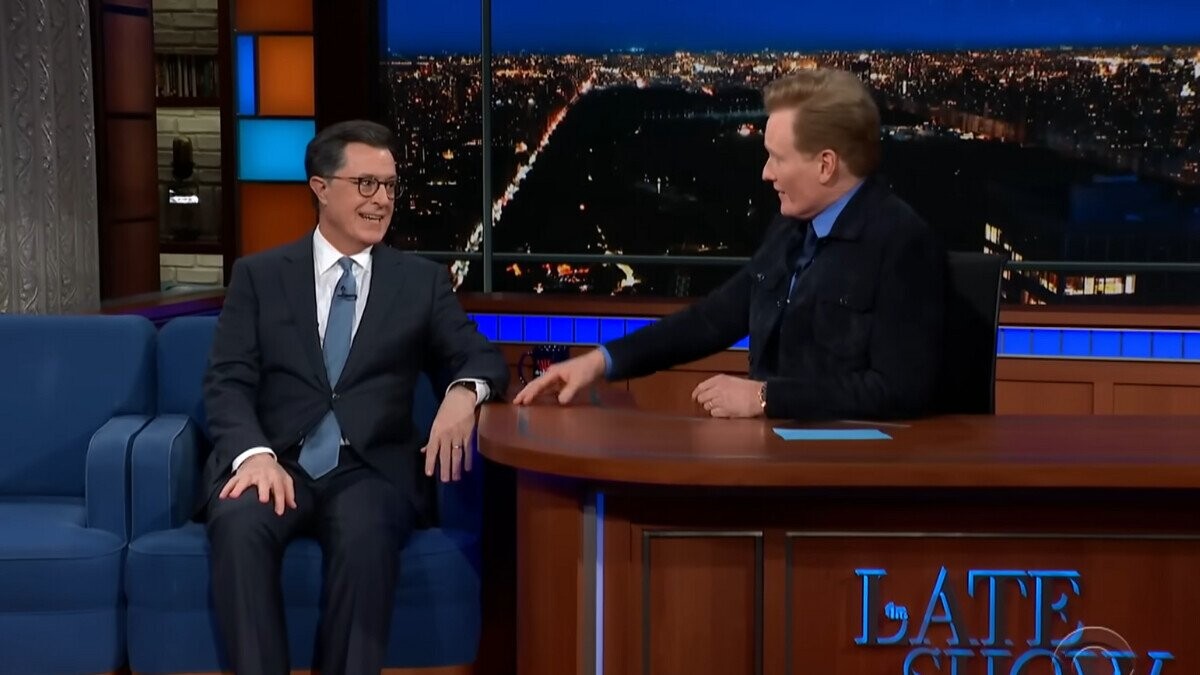
Late-night television has always loved a dramatic entrance. A curtain parts, a band hits the first note, a host jogs out, and America pretends it is still awake enough to process jokes about Congress. But during what many fans now see as late-night’s last stand, one entrance has been missing. As Stephen Colbert’s Late Show heads toward its final bow, Jimmy Kimmel and Seth Meyers spar with political pressure, Jon Stewart returns to his old desk like comedy’s emergency flare, and the old guard gathers in various combinations, fans keep asking one very specific, very ginger question: where the hell is Conan O’Brien?
It is a fair question, even if it sounds like something screamed by a man standing outside a closed Blockbuster in 2026. Conan O’Brien is not just another former talk-show host. He is one of the defining figures of modern late-night comedy: the tall, pale, self-deprecating chaos goblin who turned awkwardness into an art form, made remote segments feel like field anthropology conducted by a malfunctioning giraffe, and built a fanbase so loyal it could probably still organize a peaceful coup using only old Late Night clips and Triumph the Insult Comic Dog quotes.
So when late-night comedy started looking less like a television genre and more like a house party where the landlord has arrived with a bulldozer, fans naturally looked for Conan. Not because he owes anyone a statement. Not because he needs to rejoin the nightly treadmill. But because Conan represents something that feels increasingly endangered: comedy that is silly, smart, stubborn, and allergic to being managed by nervous executives holding spreadsheets like medieval shields.
Why the “Where Is Conan?” Question Hit a Nerve
The question became louder after CBS announced that The Late Show with Stephen Colbert would end in May 2026, retiring the franchise rather than replacing Colbert with another host. CBS called the move a financial decision made against a difficult late-night backdrop. Many viewers, however, noticed the awkward timing: Colbert had been one of President Donald Trump’s most persistent critics, and the cancellation came amid a tense media climate involving Paramount, CBS, political scrutiny, and broader anxiety about corporate caution.
In ordinary times, a TV cancellation is just TV business. Shows end. Ratings shift. Ad dollars move. Executives discover the phrase “challenging marketplace” and repeat it until a publicist gently removes the microphone. But this did not feel ordinary to fans. Colbert was not merely losing a time slot; a major broadcast platform for nightly political satire was disappearing. For decades, late-night television functioned as America’s after-hours pressure valve. It translated the day’s chaos into jokes, sighs, desk pieces, celebrity interviews, and occasionally a raccoon in a tiny hat.
That is why fans scanned the reaction list like anxious wedding guests checking whether the favorite cousin RSVP’d. David Letterman spoke out. Jon Stewart spoke out. Seth Meyers, Jimmy Fallon, Jimmy Kimmel, John Oliver, and other comedy figures appeared in the conversation. Conan, at least at first, seemed quieter. For longtime viewers, that silence felt strange. Conan and Colbert are not identical comedians, but they share a lineage: smart writing, absurdity, deep respect for the craft, and a belief that comedy can puncture power without becoming a cable-news panel with better suits.
So, Where Is Conan O’Brien?
The practical answer is simple: Conan O’Brien is not missing. He is no longer a nightly late-night host. He left his TBS show Conan in 2021 after a nearly three-decade run across NBC and cable, including Late Night with Conan O’Brien, The Tonight Show with Conan O’Brien, and Conan. Since then, he has built a second act that many entertainers would trade a yacht, a streaming deal, and three public apologies to have.
Conan now lives in the post-desk universe. He hosts the podcast Conan O’Brien Needs a Friend, a format that allows him to be looser, weirder, more conversational, and, crucially, free from the nightly grind of monologues, network notes, and the ancient television ritual of pretending every celebrity’s new movie is “so fun.” He also stars in the travel series Conan O’Brien Must Go, where his international fan interactions turn into comic anthropology: Conan meets people, humiliates himself, learns something, humiliates himself again, and somehow leaves everyone happier.
He has also returned to major live-event hosting. His Oscars work reminded viewers that Conan can still command a giant room without losing the oddball rhythm that made him famous. He is not absent from comedy. He is simply operating from a different platform. The desk is gone, but the voice remains.
Conan Did Not Disappear From the Fight
One reason the fan question needs updating is that Conan has not stayed silent about pressure on late-night hosts. When Jimmy Kimmel’s show became the center of a free-speech controversy and political backlash, Conan publicly criticized the effort to silence late-night criticism. That matters. He may not have appeared every night in a suit behind a desk, but when the issue became larger than one show, he did use his voice.
This is classic Conan in a quieter form. He has never been the most predictable political flamethrower in late night. Colbert’s style is prosecutorial. Stewart’s is exasperated civic autopsy. Kimmel mixes moral outrage with regular-guy sarcasm. Seth Meyers approaches politics like a smart kid who found a loophole in the school handbook. Conan’s default mode is different. He often attacks pomposity by refusing to become pompous himself.
That does not mean he is apolitical. It means his comedy has usually worked by making authority look ridiculous rather than by delivering a nightly thesis. His secret weapon has always been the pratfall with a brain. Conan can undercut a dictator, a network executive, or his own Harvard education by acting like a man who just lost a fight with a revolving door. In a media age addicted to certainty, that kind of foolishness can be surprisingly radical.
Why Fans Expected the Red-Haired Cavalry
Fans expected Conan because he is part of the late-night family tree. He inherited David Letterman’s old Late Night slot in 1993, survived brutal early reviews, and slowly turned the show into a cult factory for comedy nerds. His version of late night was never merely about celebrity interviews. It was about bits that seemed too strange to exist on network television: old-timey baseball, absurd characters, desk-drive adventures, fake moral panics, and remotes that proved Conan’s best scene partner was often an ordinary person who had no idea what to do with him.
Then came the Tonight Show disaster, which turned Conan from cult favorite into folk hero. When network politics pushed him out, fans did not simply sympathize; they mobilized. “Team Coco” became a rallying cry because viewers saw in Conan a rare combination of integrity, vulnerability, and total willingness to look like an idiot for the joke. That history is why fans still expect him to show up when late-night television is in trouble. He has been through the machine. He knows what happens when television executives panic and start making decisions with the grace of a Roomba trapped under a couch.
There is also emotional symbolism at work. Colbert’s cancellation feels to many viewers like another chapter in the slow dismantling of appointment-viewing comedy. Conan’s presence would not magically reverse the economics of broadcast television, but it would feel like a reunion of survivors. It would say: the format may be changing, but the people who built this world still recognize each other.
Late-Night’s Real Crisis Is Bigger Than One Host
The bigger story is not simply “Conan did or did not post.” It is that late-night television itself is being squeezed from every direction. Linear TV audiences are older and smaller. Advertising is fragmented. Younger viewers encounter comedy through YouTube clips, TikTok edits, podcasts, Instagram reels, and whatever platform currently looks like it was designed by a committee of caffeinated raccoons. The classic modelfive nights a week, one host, one desk, one network, one monologueis no longer the automatic center of comedy culture.
At the same time, political satire has become more charged. A joke that once would have created a one-day argument can now trigger pressure campaigns, affiliate revolts, regulatory attention, and corporate meetings where everyone says “brand safety” until the word “brand” loses all meaning. Late-night hosts are not just comedians anymore; they are nodes in a national argument about speech, power, media ownership, and whether rich people can survive being roasted after 11:35 p.m.
This is why Conan’s career pivot looks less like retirement and more like prophecy. He moved away from the nightly desk before the old structure fully cracked. He went where comedians increasingly need to go: direct relationships with audiences, flexible formats, global distribution, podcasts, specials, live events, and projects that do not depend entirely on whether a network affiliate in one market is having a bad political morning.
Conan’s Comedy Was Built for the Post-Late-Night Era
Some hosts are defined by the desk. Conan never was. The desk was useful, but it was never the whole machine. His best work often happened away from it: remotes with staff members, travel specials, awkward encounters with fans, and improvised exchanges where he seemed delighted to discover he had no control over the room. That looseness translates beautifully to podcasting and streaming.
On Conan O’Brien Needs a Friend, the joke is not just the guest interview. It is Conan’s ongoing comic self-examination: his neediness, competitiveness, vanity, insecurity, and alarming comfort with making every conversation more elaborate than necessary. The podcast feels like late night with the scaffolding removed. No band cue. No commercial toss. No fake urgency. Just Conan, a guest, and the terrifying possibility that he will suddenly begin doing an accent that should require a municipal permit.
Conan O’Brien Must Go extends the same spirit globally. Instead of presenting himself as a polished ambassador of American comedy, Conan arrives as a cheerful cultural hazard. He is respectful but ridiculous, curious but intrusive, intelligent but always willing to become the punchline. In an era when audiences distrust overly produced celebrity content, that vulnerability is valuable. Conan’s brand is not coolness. It is anti-coolness weaponized into warmth.
Could Conan Still Join Colbert’s Farewell?
Yes, and fans should not rule it out. The end of The Late Show is not a small television footnote; it is a cultural event. Conan’s history with Letterman, NBC, TBS, Colbert, and the broader late-night ecosystem makes him a natural figure for any farewell stretch. Even a brief appearance would carry weight. He could deliver a sincere tribute, perform a ridiculous bit, or simply walk onstage, stare into the camera, and say, “I leave television for five minutes and this is what you people do?”
But whether he appears or not, the obsession with his whereabouts reveals something tender about the audience. Viewers are not just asking for a cameo. They are asking whether the comedians who shaped their sense of the world still see what is happening. They want reassurance that the old late-night tribe has not scattered completely. They want the guy who survived the most public late-night heartbreak of his generation to show up at the bedside of another wounded institution and crack a joke loud enough to wake the patient.
The Better Question: What Does Conan Represent Now?
Conan represents the bridge between old late night and whatever comes next. He is proof that a host can leave the desk without losing the audience. He is proof that weirdness ages better than slickness. He is proof that the relationship between comedian and fan does not have to be mediated by one network, one studio, or one time slot.
That is why “Where is Conan?” is both a literal and symbolic question. Literally, he is making podcasts, travel shows, award-show appearances, and comedy projects that reach audiences outside the old broadcast structure. Symbolically, he is standing in the future that late night is being forced to enter. He is not fighting to preserve the exact shape of the old format. He is demonstrating how its spirit can survive after the format bends, breaks, or gets replaced by something with a worse name and a monthly subscription fee.
Late-night’s last stand may not be a final battle where every host returns to the same stage, Avengers-style, while Paul Shaffer plays everyone into combat. It may be more complicated than that. The stand may happen across podcasts, streaming shows, live specials, YouTube clips, newsletters, theaters, and platforms not yet invented by interns in fleece vests. If that is the case, Conan is not missing the war. He may simply be fighting from the hill everyone else is slowly climbing toward.
Experience: Watching Late-Night’s Last Stand as a Fan
For many longtime viewers, watching this moment unfold feels oddly personal. Late-night shows were never just programs. They were routines. They were the glowing rectangle at the end of a long day, the place where bad news could be processed with a laugh before sleep. You did not have to agree with every joke or love every guest. The comfort came from the rhythm: monologue, desk, bit, interview, musical act, goodnight. It was television’s version of leaving a porch light on.
That is why the current late-night anxiety lands with such emotional force. When fans ask where Conan O’Brien is, they are often asking from a place of memory. They remember staying up too late in high school and discovering that comedy could be strange, literate, and proudly uncool. They remember Conan making celebrities seem less polished and ordinary people seem funnier than celebrities. They remember the feeling that late night could be a secret club for insomniacs, students, writers, weirdos, and anyone who suspected the normal world was badly overrated.
There is also a generational experience here. Older viewers watched Johnny Carson or Letterman define the form. Gen X and millennials watched Conan mutate it. Younger audiences may know him first through podcast clips, travel segments, or viral YouTube bits. In that sense, Conan has become one of the few late-night figures who belongs to multiple eras without seeming trapped in any of them. He can be nostalgia and current comedy at the same time, which is a neat trick for a man whose hair has been behaving like breaking news since 1993.
The experience of following late night now is more fragmented. Instead of watching one full episode, fans often see a monologue clip in the morning, a podcast quote at lunch, a TikTok remix at night, and an angry political reaction somewhere in between. The shared national viewing room has splintered into millions of tiny rooms. That can feel freeing, but it can also feel lonely. A big collective late-night momentlike Colbert’s farewell or a host standing up to political pressurereminds people of what it felt like when comedy had a central campfire.
Conan’s absence from a specific stage, then, becomes a screen onto which fans project their hopes. They want one more gathering. One more absurd bit. One more reminder that smart silliness can survive corporate fear and political intimidation. They want Conan to arrive not because he can save late night by himself, but because his presence would make the ending feel less like a cancellation and more like a wake where the funniest person in the room finally gets up to speak.
And maybe that is the most Conan thing about the whole situation. The man built a career out of awkward entrances, impossible expectations, and turning discomfort into comedy. Whether he appears at Colbert’s farewell, posts another statement, or keeps building his strange empire beyond the desk, fans will keep looking for him because he still represents a promise: comedy does not have to be tidy to matter. Sometimes the silliest voice in the room is the one that helps everyone understand how serious the moment really is.
Conclusion: Conan Isn’t GoneHe’s Already in the Next Version of Late Night
So, where the hell is Conan O’Brien? He is not hiding under the old Late Night desk, although emotionally, many of us would support that limited series. He is outside the traditional late-night machine, doing what more comedians may need to do as television changes: building direct, flexible, personality-driven comedy that can survive without a nightly network slot.
Fans miss him in the late-night scrum because Conan still feels like family. But his career after late night may be the clearest answer to the genre’s crisis. The desk can disappear. The franchise can end. The time slot can be handed to something cheaper, safer, or less politically combustible. But the comic voicethe odd, humane, rebellious, deeply silly voicecan travel. Conan O’Brien proved that before the rest of late night was forced to learn it.
If late-night television is having its last stand, Conan may not be absent from the battlefield. He may be standing just beyond it, waving from the future, holding a microphone, wearing an expression that says he has already made three jokes too many and is considering a fourth.