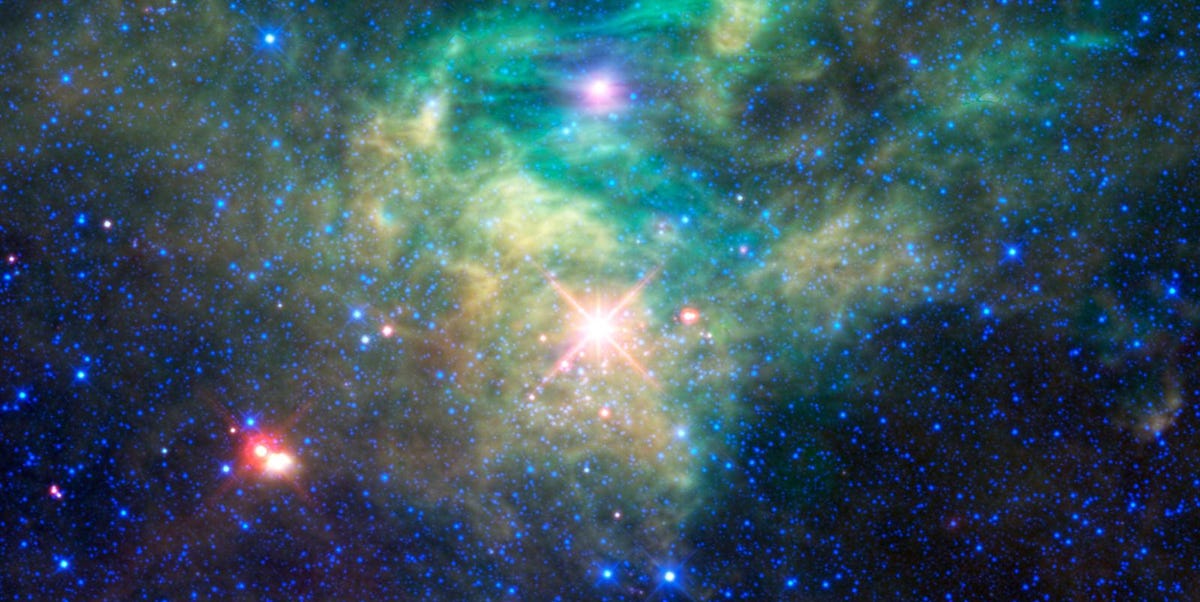
Look up on a clear night and the sky appears to be sprinkled with tiny, peaceful lights. In reality, those innocent-looking dots are enormous nuclear furnaces, some large enough to swallow the Sun thousands of times over. Space has a flair for dramatic scale.
Stars are among the most important objects in the universe. They illuminate galaxies, manufacture many of the chemical elements found in planets and people, and provide the energy that makes life on Earth possible. Yet no two stars are exactly alike. They differ in mass, temperature, color, brightness, age, and ultimate fate.
This guide explains what stars are, how they form, why they shine, how astronomers classify them, and what happens when their fuel runs low. No advanced physics degree is required. Curiosity and a willingness to feel temporarily tiny will do nicely.
What Is a Star?
A star is a massive, luminous sphere of extremely hot material held together by its own gravity. Although stars are often described as balls of gas, much of their matter exists as plasma. Plasma forms when temperatures become so high that electrons separate from atomic nuclei, creating a electrically charged soup of particles.
Most stars consist primarily of hydrogen and helium, the two lightest chemical elements. They also contain smaller quantities of oxygen, carbon, iron, neon, and other elements. Astronomers casually call elements heavier than hydrogen and helium “metals,” which means that oxygen is a metal in astronomy. Chemists may wish to file a formal complaint.
The Sun Is a Star
Our Sun is the closest star to Earth, located about 93 million miles away. It looks much larger and brighter than the stars visible at night simply because it is dramatically closer. The next-nearest star system is more than four light-years away.
The Sun is a fairly ordinary main-sequence star classified as a G-type star. Its ordinary status should not be confused with insignificance. Almost every natural energy source used on Earth can be traced directly or indirectly to sunlight, including wind, fossil fuels, plant growth, and the snacks currently hiding in your kitchen.
What Makes Stars Shine?
Stars shine because nuclear fusion occurs deep inside their cores. Fusion combines lightweight atomic nuclei into heavier ones while releasing tremendous amounts of energy.
In a star like the Sun, hydrogen nuclei eventually combine to produce helium. A small amount of mass is converted into energy during this process, following Albert Einstein’s famous equation, E = mc2. Because the speed of light is an enormous number, converting even a little mass produces a staggering quantity of energy.
Gravity Versus Pressure
A stable star performs a cosmic balancing act known as hydrostatic equilibrium. Gravity pulls the star’s material inward, attempting to crush it. Meanwhile, heat and radiation generated by fusion create outward pressure.
As long as these forces remain balanced, the star maintains a relatively stable size. It is similar to an endless tug-of-war in which neither team wins for millions or billions of years.
How Energy Reaches Space
Energy created in a star’s core does not immediately escape. It must travel through layers of dense plasma before reaching the visible surface, or photosphere. Depending on the region, energy moves through radiation, convection, or both.
After leaving the surface, starlight crosses space at approximately 186,000 miles per second. Light from the Sun takes a little over eight minutes to reach Earth. Light from distant stars may travel for hundreds, thousands, or even billions of years before entering a telescope or landing on someone’s retina during a camping trip.
How Are Stars Born?
Stars form inside enormous, cold clouds of gas and dust called molecular clouds or nebulae. These clouds may contain enough material to produce hundreds or thousands of stars.
Step 1: A Cloud Begins to Collapse
A section of a molecular cloud can become unstable because of turbulence, a collision between clouds, or a shock wave from a nearby exploding star. Gravity begins pulling the material together, creating increasingly dense clumps.
Step 2: A Protostar Forms
As a clump contracts, it spins faster and grows hotter. Material accumulates near the center, forming a protostar surrounded by a rotating disk of gas and dust. That disk may later produce planets, moons, asteroids, and comets.
A protostar is not yet a full-fledged main-sequence star because sustained hydrogen fusion has not begun in its core. It glows largely because gravitational contraction heats the material.
Step 3: Fusion Switches On
When the core becomes sufficiently dense and hot, hydrogen fusion begins. Outward pressure increases, the collapse slows, and the young star enters the longest, most stable phase of its life: the main sequence.
The newborn star may continue clearing away nearby material with radiation and powerful stellar winds. The result can be a star surrounded by planets assembled from leftoverswhich is a rather undignified description of our entire solar system.
How Do Astronomers Classify Stars?
Astronomers organize stars using their temperature, color, spectrum, luminosity, mass, and evolutionary stage. Classification turns a sky full of glowing dots into a readable record of stellar physics.
Stellar Color and Temperature
A star’s color provides an important clue about its surface temperature. Contrary to everyday associations, blue stars are hotter than red stars. A metal stove may glow red before becoming white-hot, and stellar colors follow the same general physics.
Cooler stars appear red or orange. Medium-temperature stars may look yellow or white, while the hottest stars appear blue-white. The Sun’s visible surface is approximately 10,000 degrees Fahrenheit, while its core reaches roughly 27 million degrees Fahrenheit.
The OBAFGKM Spectral Classes
The primary sequence of stellar spectral classes is:
O, B, A, F, G, K, M
O-type stars are the hottest and typically appear blue. M-type stars are cooler and appear reddish. The Sun is classified as G2. Each letter class is divided into numerical subclasses, usually from 0 to 9.
Students often memorize the letters with phrases such as “Oh, Be A Fine Girl/Guy, Kiss Me.” Astronomy has been using this line for decades and apparently has no intention of hiring a new copywriter.
The Hertzsprung-Russell Diagram
The Hertzsprung-Russell diagram, commonly called the H-R diagram, plots stars according to luminosity and surface temperature. Most stars fall along a broad diagonal band called the main sequence.
Giants and supergiants occupy other regions because they are extremely luminous despite sometimes having relatively cool surfaces. White dwarfs are hot but faint because they are so small.
The H-R diagram helps astronomers understand how stars change over time. It is less like a static filing cabinet and more like a map of different stages in stellar lives.
Major Types of Stars
Main-Sequence Stars
Main-sequence stars fuse hydrogen into helium in their cores. They account for the great majority of stars and range from small red dwarfs to massive blue stars. The Sun has spent billions of years in this stage and will remain there for several billion more.
Red Dwarfs
Red dwarfs are small, cool, faint main-sequence stars. They consume fuel slowly and can remain stable for extraordinarily long periods. Because the universe is not old enough for the smallest red dwarfs to have completed their predicted lifetimes, astronomers have never observed one reaching its natural end.
Red dwarfs are also extremely common. However, their low brightness means that none can be seen from Earth with the unaided eye.
Red Giants and Supergiants
A red giant forms when a star exhausts much of the hydrogen in its core. The core contracts while the outer layers expand and cool, making the star larger and redder.
More massive stars can become enormous supergiants. Betelgeuse in Orion is a famous red supergiant. Its huge size does not mean it is elderly by human standards; massive stars evolve rapidly and may reach their final stages after only a few million years.
White Dwarfs
A white dwarf is the dense remnant left after a lower-mass star sheds its outer layers. It no longer performs sustained fusion but remains hot because of stored thermal energy. A white dwarf may contain a mass comparable to the Sun compressed into an object roughly the size of Earth.
Neutron Stars
When certain massive stars explode, their cores can collapse into neutron stars. These remnants pack more mass than the Sun into a sphere roughly the size of a city. Some rotate rapidly and emit beams of radiation. When those beams sweep across Earth, astronomers detect regular pulses and call the object a pulsar.
Brown Dwarfs
Brown dwarfs occupy the fuzzy border between planets and stars. They are more massive than giant planets but generally lack enough mass to sustain ordinary hydrogen fusion. For that reason, they are often nicknamed “failed stars,” although “overachieving planets” seems equally defensible.
The Life Cycle of a Star
A star’s initial mass is the most important factor determining how it develops. Massive stars contain more fuel, but they burn through it much faster. In the stellar world, having a large fuel tank encourages enthusiastic speeding.
The Fate of a Sun-Like Star
A star similar to the Sun spends most of its existence on the main sequence. When core hydrogen becomes scarce, it expands into a red giant. Fusion may continue in shells around the core, and helium can fuse into carbon and oxygen.
Eventually, the star releases its outer layers, producing a glowing cloud called a planetary nebula. Despite the name, planetary nebulae have nothing to do with planets. Early astronomers thought some looked planetlike through small telescopes, and the confusing label survived.
The exposed core becomes a white dwarf. Over an unimaginably long period, it cools and fades. A fully cooled theoretical remnant is called a black dwarf, but the universe is not yet old enough for any to exist.
The Fate of a Massive Star
Massive stars can fuse increasingly heavy elements in a series of stages. The process eventually produces iron in the core. Fusing iron does not provide the energy needed to support the star, so the balance between pressure and gravity suddenly fails.
The core collapses, and the outer material rebounds in a tremendous supernova explosion. The remnant may become a neutron star or, if the collapsing core is massive enough, a stellar-mass black hole.
Supernovae distribute newly created elements into space. Those materials may become part of future stars, planets, oceans, buildings, and living organisms. The calcium in bones, oxygen in blood, and iron in cookware all belong to a cosmic recycling system with extremely ambitious delivery distances.
Why Do Stars Twinkle?
Stars appear to twinkle because their light passes through moving layers of Earth’s atmosphere. Variations in air temperature and density continually bend the incoming light in slightly different directions, making a star seem to shift in brightness and position.
Stars are so distant that they appear almost pointlike, so atmospheric distortion is especially noticeable. Planets usually present a tiny disk rather than a single point, causing the distortions to average out. This is why planets often shine more steadily than stars.
In space, stars do not twinkle. Space telescopes avoid atmospheric turbulence, while large ground-based observatories use adaptive optics to correct much of the distortion.
How Do Astronomers Study Stars?
Astronomers cannot scoop up a sample of Betelgeuse and carry it back to a laboratory. Instead, they analyze the light stars send across space.
Spectroscopy
A spectroscope separates starlight into its component wavelengths. Dark and bright lines in a spectrum act like chemical fingerprints, revealing which elements are present. Spectra also provide information about temperature, pressure, magnetic fields, and motion.
The Doppler effect causes spectral lines to shift when a star moves toward or away from Earth. These shifts allow astronomers to measure radial velocity and detect unseen stellar companions or orbiting planets.
Brightness and Distance
A star’s apparent brightness depends on both its true luminosity and its distance from Earth. A modest nearby star can look brighter than a powerful but remote one.
For relatively nearby stars, astronomers can estimate distance using parallaxthe slight apparent shift in a star’s position as Earth travels around the Sun. More distant measurements rely on methods such as variable stars, supernovae, and other calibrated indicators.
Observing Star Systems
Many stars belong to binary or multiple-star systems. By studying their orbits, astronomers can calculate stellar masses, one of the most important measurements in astrophysics.
Stars also reveal planets. A planet may slightly dim its star while passing in front of it, or cause the star to wobble through gravitational attraction. Understanding the host star is essential because its radiation, age, temperature, and activity shape conditions on surrounding worlds.
Why Are Stars Important?
Stars are not merely decorative lights. They are engines of cosmic change.
They produce energy, help form many chemical elements, influence the development of galaxies, and create environments in which planets can emerge. The Sun drives Earth’s climate and supports photosynthesis, making nearly every food chain possible.
Stars have also shaped human history. People used them for navigation, calendars, agriculture, storytelling, religion, and scientific discovery. Modern studies of stars have improved our understanding of gravity, atomic physics, nuclear reactions, space weather, and the expansion of the universe.
Common Questions About Stars
Are All the Stars We See in the Milky Way?
Individual stars visible to the unaided eye are members of the Milky Way. Other galaxies contain vast numbers of stars, but most are too distant to be distinguished individually without powerful instruments.
How Many Stars Are There?
The Milky Way contains more than 100 billion stars, and the observable universe contains an enormous number of galaxies. Estimates for the total stellar population can reach roughly a septillion, or a 1 followed by 24 zeros. At that point, “a lot” becomes a surprisingly efficient scientific summary.
Can a Star Fall from the Sky?
A “shooting star” is not a star. It is usually a small piece of rock or dust entering Earth’s atmosphere and producing a bright streak of light. The proper term is meteor.
Will the Sun Become a Black Hole?
No. The Sun does not have enough mass to collapse into a black hole. It is expected to become a red giant and later end as a white dwarf.
Are Constellations Real Groups of Stars?
Usually not. Stars that appear close together in a constellation may be separated by enormous distances. The familiar pattern exists because of our viewing angle from Earth. From another part of the galaxy, Orion would need a serious redesign.
Experiences That Make the Science of Stars Feel Real
Reading about stars provides useful facts, but observing the night sky turns those facts into something memorable. A beginner does not need an observatory, an expensive telescope, or the ability to pronounce “spectrophotometry” without taking a breath. A dark location, comfortable clothing, and a little patience can produce an excellent introduction.
Spend Time Under a Dark Sky
The first powerful experience is simply moving away from city lights. In a bright urban area, only the Moon, planets, and brighter stars may be visible. Under a dark rural sky, thousands of stars emerge, and the Milky Way can appear as a pale, textured band stretching overhead.
Allow at least 20 minutes for your eyes to adjust. Avoid looking at a bright phone screen because one glance can undo much of that adaptation. A red-filtered flashlight or a dim red screen is less disruptive.
Once your vision adjusts, notice that stars are not uniformly scattered. Some regions appear crowded, while dark lanes mark clouds of interstellar dust blocking the light behind them. The galaxy stops looking like a smooth decoration and begins to resemble a complex three-dimensional environment.
Compare Stellar Colors
Choose two bright stars with noticeably different colors. During Northern Hemisphere winter, compare bluish-white Rigel with orange-red Betelgeuse in Orion. Their colors are not cosmetic differences; they indicate different surface temperatures and evolutionary stages.
Slightly defocusing binoculars can make stellar colors easier to notice. The enlarged disks are optical effects, not photographs of the actual stellar surfaces, but they help reveal subtle color contrasts.
Watch a Star Cluster
Binoculars pointed toward the Pleiades can reveal a compact family of hot, young stars. The experience makes star formation more concrete because many cluster members were born from the same molecular cloud at roughly the same time.
Open clusters also demonstrate how misleading distance can be. Two stars may appear side by side even when one lies much farther away. The night sky looks flat, but every point occupies a different position in three-dimensional space.
Follow the Sky Through the Seasons
Observing the same patch of sky over several months reveals that constellations rise earlier each night and change with the seasons. The stars are not circling Earth once per year; the seasonal shift results from Earth moving around the Sun.
Keeping a simple observation journal can make these changes obvious. Record the date, time, weather, visible constellations, Moon phase, and unusual sights. Sketches are useful even when they look less like astronomy and more like spilled pepper.
Look Back in Time
The most striking experience may be realizing that stargazing is a form of time travel. When you see Sirius, you receive light that began its journey more than eight years earlier. Light from Betelgeuse has traveled for centuries. The Andromeda Galaxy, visible to the unaided eye under good conditions, appears as it was roughly 2.5 million years ago.
This delay transforms the night sky into a historical record. You never see a distant star exactly as it is “now.” You see an earlier version delivered by light. Standing beneath that record can turn an ordinary backyard into a front-row seat for the history of the universe.
Conclusion
Stars are immense spheres of hot plasma powered by nuclear fusion and held together by gravity. They are born in cold clouds, spend most of their lives balancing inward gravity against outward pressure, and eventually change or die according to their mass.
Some end quietly as white dwarfs. Others explode as supernovae and leave neutron stars or black holes behind. Along the way, stars produce and distribute many of the elements required for planets and life.
The next time the night sky looks calm, remember what is really happening. Every point of light is a distant physical world with a temperature, composition, history, and future. The stars may appear silent, but their light carries one of the longest and most spectacular stories nature has ever written.