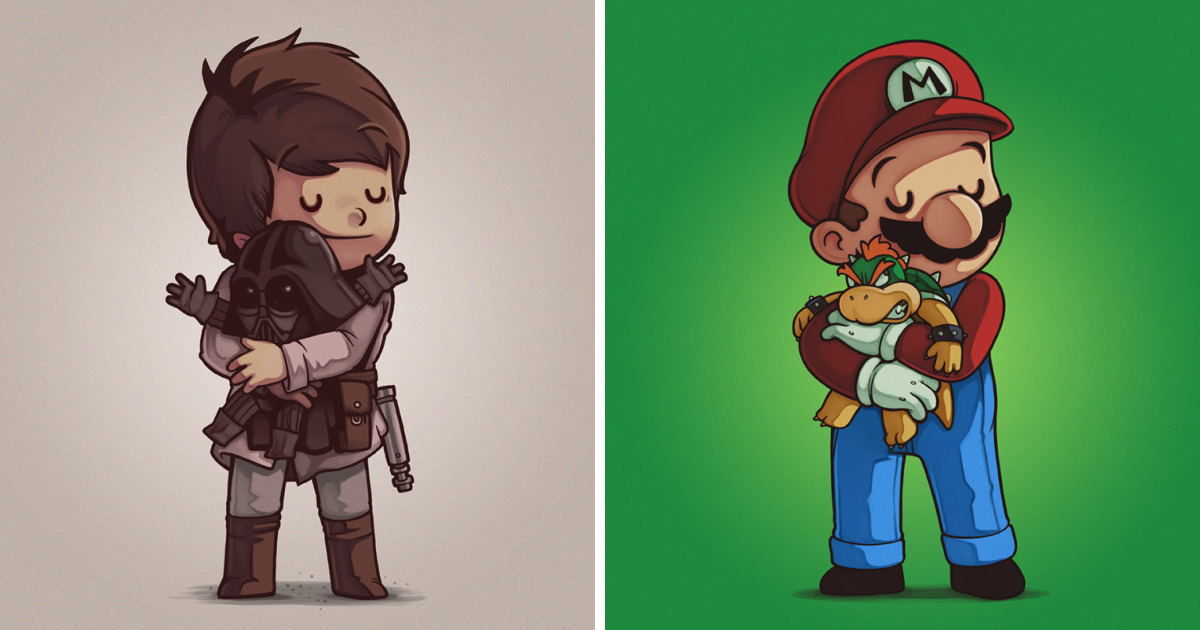
Every hero gets a parade, a theme song, and at least one dramatic slow-motion entrance. Villains? They get thunder, unpaid emotional baggage, and a chair that looks suspiciously uncomfortable. So I decided to correct the balance of the universe in the most chaotic way possible: by spending months drawing villains cuddling.
Yes, cuddling. Not plotting. Not glaring from a balcony. Not whispering ominous things near a candle. Cuddling. Wrapped in blankets. Holding teacups. Sitting with their enormous capes folded politely like laundry. The result was a strange, funny, surprisingly tender art project that asked one simple question: what happens when the scariest person in the story is allowed to be soft for five minutes?
The answer is more interesting than “aww.” Drawing villains in affectionate, vulnerable, or cozy scenes turns familiar storytelling inside out. It gives artists a playground for humor, empathy, character design, fan art, and emotional contrast. It also reveals why audiences are so fascinated by antagonists in the first place. A villain is not only “the bad one.” A good villain is a walking pressure cooker of desire, fear, style, philosophy, and terrible decision-making. Add a blanket burrito, and suddenly the whole character becomes funnier, sadder, and oddly more human.
Why Villains Make Such Great Subjects for Cozy Art
Villains are visual gold. They often have sharper silhouettes, richer color palettes, exaggerated costumes, and more dramatic expressions than the hero. The hero may wear practical boots. The villain arrives in a floor-length coat, glowing eyes, and a collar tall enough to qualify as architecture. For artists, that is not a problem. That is a buffet.
But the real magic comes from contrast. A villain cuddling a cat, hugging another misunderstood monster, or napping under a star-patterned blanket creates instant visual tension. The viewer recognizes the character’s usual role, then sees them doing the emotional opposite. That gap between expectation and image is where the comedy lives. It is also where the tenderness sneaks in wearing fuzzy socks.
Great character art often depends on contradiction. The tiny knight with giant courage. The cheerful baker with a secret past. The terrifying villain with a favorite mug. When an artist draws a villain cuddling, the joke is not simply that “evil is cute now.” The joke is that fictional characters, like people, contain more than one emotional note. Even the ones who seem composed entirely of eyeliner and bad choices can be reimagined through warmth.
The Psychology Behind Loving Fictional Villains
People do not love villains because they want real-world cruelty. Most fans are perfectly capable of separating fiction from reality. In stories, villains create a safe space to explore danger, ambition, anger, vanity, revenge, loneliness, and power without endorsing those things in real life. Fiction acts like a padded room for uncomfortable emotions: you can look at them, laugh at them, learn from them, and then close the book or turn off the screen.
That is why a villain can feel magnetic. They often say the quiet part loudly. They want things intensely. They refuse to be polite about their wounds. They make the plot move. A hero may hesitate for three chapters, but a villain has already bought the volcano lair, embroidered the monogrammed cape, and scheduled the dramatic reveal for Thursday.
When artists soften villains through cuddly drawings, they are not necessarily forgiving the character’s actions. They are exploring the emotional architecture underneath. What would this person look like without the armor? What does loneliness do to a face? What happens when a character who is always reaching for control is drawn in a pose of rest?
This is where villain fan art becomes more than a joke. It becomes a study in empathy, boundaries, and imagination. You can understand a character without excusing them. You can find them fascinating without declaring them innocent. You can put them in a blanket without handing them a moral pardon.
Villain Cuddle Art Is Not the Same as Excusing Villains
There is an important difference between humanizing a villain and turning them into a blameless cinnamon roll. Humanizing says, “This character has feelings, history, and complexity.” Excusing says, “Nothing they did matters because they looked sad once.” The first makes storytelling richer. The second can flatten a sharp character into emotional pudding.
A strong cuddly villain illustration keeps the contradiction alive. The character can be soft in one moment and still responsible for their choices. In fact, that tension makes the artwork more interesting. A villain holding a plush toy is funny. A villain holding a plush toy while still looking like they might write a threatening letter to the moon is even better.
That balance matters in fan culture. Viewers often enjoy “comfort characters” who are not morally perfect. Sometimes a flawed character becomes comforting because they are dramatic, wounded, stylish, funny, or emotionally expressive. The key is not to erase the harm inside the story. The key is to explore why the character resonates while keeping a clear line between fictional affection and real-world ethics.
What Months of Drawing Cuddly Villains Teaches About Art
Spending months on one theme sounds repetitive until you actually try it. Then you realize a single idea can become a full creative gym. Drawing villains cuddling forced me to practice expression, body language, composition, prop design, humor, and storytelling in every piece. A cuddle is not just two characters touching shoulders. It has weight, awkwardness, temperature, trust, and timing.
Some villains looked natural in soft scenes right away. The brooding ones practically arrived with their own emotional rainclouds. Give them a blanket and a window seat, and they become instant melancholic wallpaper. Others were harder. Some characters are so stiff, proud, or theatrical that drawing them cuddling felt like trying to fold a dining table. That challenge became part of the fun.
The project also made me think more carefully about hands. Hands are where cuddles either become believable or turn into a visual accident report. A protective hand on a shoulder tells one story. A stiff hand hovering three inches away tells another. A villain who has no idea how to accept affection may hold a pillow like it owes them money. That tiny detail can say more than a paragraph of dialogue.
Facial Expressions Became the Secret Ingredient
Villains are famous for smirks, scowls, and magnificent eyebrow work. But cozy villain art needs micro-expressions: embarrassment, suspicion, reluctant comfort, sleepy annoyance, soft confusion. The most satisfying drawings were not the ones where a villain suddenly became sweet. They were the ones where the villain looked emotionally ambushed by kindness.
One of my favorite approaches was the “I am tolerating this” expression. The character is clearly enjoying the hug, but every muscle in their face is filing a formal complaint. That is comedy, but it is also character truth. Many antagonists are built around control. A cuddle scene removes control and replaces it with trust. For a villain, that may be more terrifying than any final battle.
Why Cozy Villain Art Works So Well Online
Online audiences love fast emotional contrast. A single image must often communicate the joke, the mood, and the character twist in seconds. Villain cuddle art is perfect for that environment because the concept is immediately readable. “Scary character, soft situation” is a visual punchline that does not need a ten-slide explanation.
It is also highly shareable because it invites comments. People tag friends. They argue over which villain deserves a blanket. They confess that their favorite fictional menace probably needs therapy, a nap, and maybe soup. The art becomes a social object, not just an image. It gives fans permission to play with the characters emotionally.
That playfulness is central to fan art. Fan artists often transform familiar characters by changing the mood, setting, genre, or emotional focus. A terrifying antagonist in a domestic scene is not merely a copy of the original. It is a new interpretation, a remix of tone and meaning. Of course, artists should still be aware that fan art can involve copyright and trademark concerns, especially when sold commercially. But creatively, the act of reimagining characters is one of fandom’s most energetic traditions.
Specific Examples of Villain Cuddle Concepts That Work
Some cozy villain concepts are almost guaranteed to land because they mix personality with softness. A grandiose villain wrapped in a blanket like royalty turns arrogance into a visual gag. A cold, calculating antagonist holding a hot chocolate with two marshmallows creates instant contrast. A monster gently protecting a tiny sleeping creature changes the viewer’s emotional temperature in one second.
Public-domain and folklore-inspired villains are especially fun for this kind of project. A dragon curled protectively around a pile of pillows. A wicked queen sharing tea with her mirror. A gloomy vampire hiding from sunrise under an aggressively cheerful quilt. A sea witch knitting sweaters for eels. These ideas borrow from archetypes rather than relying only on modern copyrighted characters, which gives artists more freedom to build original designs.
Modern pop-culture-inspired villain archetypes also offer endless possibilities. The stylish mastermind can be drawn losing a battle against a sleepy pet. The space tyrant can be shown awkwardly accepting a group hug from tiny alien children. The mad scientist can fall asleep at a desk while a robot tucks a blanket around their shoulders. The dark sorcerer can cuddle a cursed plushie that looks equally disappointed in everyone.
The trick is to keep the villain recognizable through shape language and attitude, even when the scene is gentle. A cozy villain should not look like a completely different person. Their posture, costume details, facial habits, and props should still carry their identity. Softness works best when it interrupts the character; it should not erase them.
The Creative Process: From Rough Sketch to Emotional Punchline
Step 1: Choose the Villain’s Emotional Problem
Before sketching, decide what emotional tension the drawing explores. Is the villain lonely? Exhausted? Secretly affectionate? Too proud to admit they want comfort? This question guides the pose. A villain who wants affection but fears weakness will sit differently from one who demands attention like a dramatic housecat.
Step 2: Build the Scene Around Contrast
Contrast can come from setting, props, color, or body language. Put a sharp-edged character in a round, soft chair. Place a dark cape against pastel pillows. Give a fearsome figure a tiny mug. Let the background do half the joke. Cozy details should feel slightly too gentle for the character, like the room itself is trying to rehabilitate them through throw blankets.
Step 3: Keep the Silhouette Strong
Even in a cuddle pile, the viewer should understand the character shape quickly. Villains often rely on strong silhouettes: spikes, capes, horns, angular shoulders, dramatic hair, or elegant posture. Do not bury all of that under softness. Let the cape spill over the couch. Let the horns poke out of the blanket. Let the villain remain visually villainous while emotionally off duty.
Step 4: Use Humor as a Doorway to Feeling
Humor makes the image approachable. Once viewers laugh, they are more willing to feel something. A villain grumbling while being hugged is funny, but it can also suggest fear of vulnerability. A villain pretending not to care while carefully protecting someone else’s nap can be adorable and revealing at the same time.
What This Theme Says About Empathy
Drawing villains cuddling is not about making evil cute. It is about practicing imaginative empathy. Stories help people rehearse other perspectives. Art does something similar through visual choices. When an artist changes a villain’s context, the viewer is invited to ask new questions: Who is allowed to be tender? Who is denied comfort? What makes someone seem monstrous? What happens when the “monster” looks tired?
Those questions are powerful because they extend beyond fandom. We live in a world that often sorts people too quickly into heroes and villains, winners and failures, lovable and unlovable. Fiction lets us examine those categories safely. A drawing cannot solve moral complexity, but it can loosen our grip on one-dimensional thinking.
At the same time, empathy needs boundaries. Loving a fictional villain should not mean copying their worldview or ignoring the damage they cause within the story. The healthiest fan interpretations hold both truths: this character is compelling, and this character is wrong. This character deserves analysis, not automatic absolution. This character may need love, but they also need consequences, preferably delivered by someone with excellent posture and a firm moral compass.
Why “Villains Need Love Too” Became Such a Sticky Idea
The phrase works because it sounds silly and sincere at the same time. “Villains need love too” is funny because villains are not usually introduced as emotionally undernourished blanket enthusiasts. But it is sincere because many iconic antagonists are shaped by rejection, obsession, pride, grief, envy, or fear. They may respond terribly, but their emotional roots are recognizable.
That recognition is the hook. Audiences may not relate to building a doom machine, but they understand wanting attention. They may not relate to cursing a kingdom, but they understand feeling excluded. They may not relate to monologuing in a tower, but they understand rehearsing an argument in the shower and winning spectacularly.
By drawing villains in cuddle scenes, the artist turns emotional subtext into visual text. The villain does not need a speech explaining that they are lonely. The blanket, the posture, the awkward lean into affection, and the grumpy blush do the talking. This is why the concept can feel both meme-worthy and meaningful.
Experience Section: What I Learned From Months of Drawing Villains Cuddle
After months of drawing villains cuddling, I learned that softness is harder to draw than sharpness. A dramatic glare is simple compared with a believable hug. Sharpness is clear: point the eyebrow down, angle the shoulders, add a cape, and let the shadows do their little villain internship. Softness requires trust. It asks the artist to understand where weight falls, where tension remains, and where a character might resist comfort even while secretly needing it.
The first week was mostly comedy. I drew villains buried under blankets, villains scowling at plush animals, villains being hugged by characters far too cheerful for their emotional immune systems. The drawings made me laugh, which kept the project moving. But after a while, I noticed that the funniest pieces were also the most emotionally specific. A villain who simply smiles in a cuddle scene is cute. A villain who looks suspicious, confused, and one second away from saying “this changes nothing” is a story.
I also learned that audiences bring their own feelings to villain art. Some people responded to the humor. Others saw loneliness. Some wanted redemption. Some wanted the villain to stay terrible but take a nap. The comments reminded me that fan art is not a final answer; it is an invitation. Viewers complete the emotional equation with their own history of favorite characters, comfort shows, old heartbreaks, and questionable taste in fictional people with dramatic cheekbones.
The project changed how I sketch body language. I became more interested in guarded poses: crossed arms slowly uncrossing, shoulders dropping, a hand gripping fabric because the character does not know what to do with kindness. I began using props as emotional translators. A blanket could mean safety. A teacup could mean routine. A sleepy pet could mean trust. A pillow could mean, “This villain has been awake for three days planning something unnecessary and needs supervision.”
There were frustrating days too. Some sketches looked too sweet and lost the villain’s bite. Others looked too stiff and missed the tenderness. The best solution was usually to put the original personality back into the cozy scene. A vain villain would cuddle elegantly. A chaotic villain would cuddle like a raccoon in a laundry basket. A proud villain would accept affection only under protest, possibly with a signed disclaimer.
By the end, I understood the title in a new way. “Villains need love too” is not a demand that every antagonist be forgiven. It is a creative dare. Can you draw someone difficult without sanding off their edges? Can you make softness interesting instead of bland? Can you show affection as something complicated, funny, awkward, and revealing? Months later, my answer is yes. Also, capes are terrible in cuddle piles. Nobody warns you about that.
Conclusion: The Soft Side of the Dark Side
Villain cuddle art works because it flips expectation without losing character. It turns menace into humor, isolation into tenderness, and familiar archetypes into fresh visual stories. More importantly, it reminds us that fictional villains are not interesting only because they are bad. They are interesting because they are intense, wounded, stylish, contradictory, and deeply inconvenient at parties.
Drawing them cuddling does not erase their flaws. It spotlights them from a different angle. A villain in a soft scene can still be vain, stubborn, dramatic, dangerous, lonely, ridiculous, and oddly lovable. That is the sweet spot: not redemption by blanket, but complexity by contrast.
In the end, heroes may get the medals, but villains get the better capes. And sometimes, after months of drawing them, you realize they also deserve a couch, a warm drink, a tired sigh, and one carefully supervised cuddle. For artistic purposes, of course.
Note: This article is original, written in standard American English, and designed for web publication. It discusses fictional villains, fan art, empathy, and creative practice without encouraging harmful behavior or copying protected works.