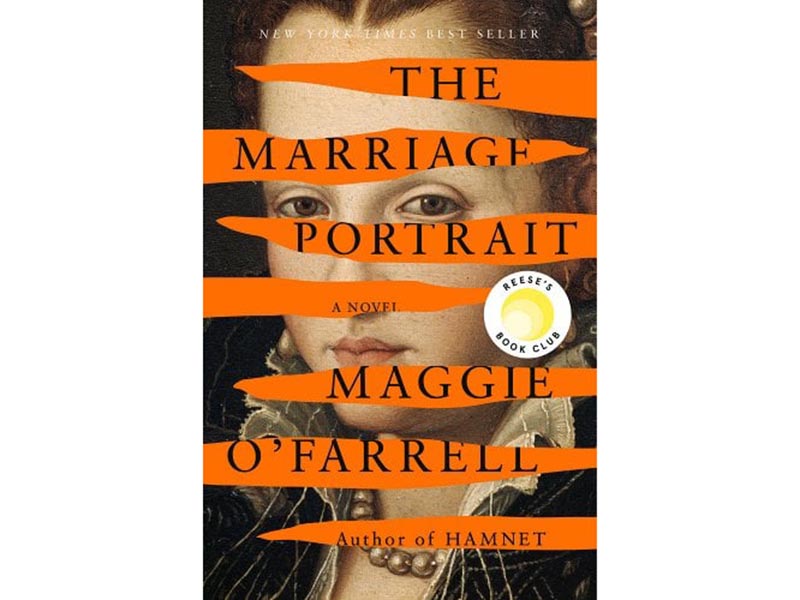
Note: This article is written for web publication in standard American English, based on real book, review, publishing, and historical information, without inserting source links into the body content.
The Marriage Portrait by Maggie O’Farrell is the kind of historical novel that enters the room wearing silk, pearls, and a look that says, “Something terrible is about to happen.” Published in 2022, this richly atmospheric work of literary historical fiction reimagines the life of Lucrezia de’ Medici, a teenage duchess in Renaissance Italy whose marriage to Alfonso II d’Este becomes less a fairy tale than a velvet-lined trap.
At first glance, the title sounds elegant and calm. A portrait. A marriage. Perhaps a tasteful frame over a fireplace. But O’Farrell is not here to give readers a decorative wall hanging. She gives us a psychological thriller in brocade, a coming-of-age story inside a political cage, and a portrait of a young woman trying to remain fully alive in a world determined to turn her into property.
For readers who loved Hamnet, O’Farrell’s award-winning novel about Shakespeare’s family, The Marriage Portrait offers a familiar strength: the author takes a historical figure with limited surviving personal record and restores emotional depth, texture, imagination, and urgency. The result is not a dry museum tour. It is more like being locked overnight in a Renaissance palace where every tapestry might be listening.
What Is The Marriage Portrait About?
The Marriage Portrait centers on Lucrezia de’ Medici, daughter of Cosimo I de’ Medici, ruler of Florence, and Eleonora di Toledo. In history, Lucrezia married Alfonso II d’Este, Duke of Ferrara, Modena, and Reggio. She died as a teenager, and rumors later swirled that her husband may have played a role in her death. O’Farrell takes this historical uncertainty and builds a suspenseful, intimate novel around one terrifying question: what if Lucrezia realized her husband intended to kill her?
The story begins with a chilling sense of danger. Lucrezia is away from the safety of her childhood home, dining with Alfonso in a remote villa. The setting is elegant, but the mood is sharp enough to cut fruit. She senses that her husband’s tenderness may be a performance and that the marriage designed to elevate her family could become the instrument of her destruction.
From there, the novel moves between past and present. We see Lucrezia as a child in Florence: observant, artistic, restless, and different from the carefully trained daughters around her. We follow her into marriage after the death of her older sister, who had originally been intended for Alfonso. Suddenly, Lucrezia becomes the replacement bride, a young girl moved like a chess piece across a board controlled by powerful men.
Why Lucrezia de’ Medici Makes Such a Powerful Heroine
Lucrezia is compelling because she is not written as a modern teenager wearing Renaissance sleeves. O’Farrell gives her intelligence, fear, imagination, and limits. She is brave, but not magically free. She sees more than people expect her to see, yet she is surrounded by structures designed to make her obedience look natural.
Her artistic talent becomes one of the novel’s most important symbols. In a court where women are examined, arranged, praised, and traded, Lucrezia wants to be the one who looks back. Painting gives her a way to study the world instead of merely being studied by it. That reversal matters. A portrait may seem passive, but in this novel, the act of seeing becomes a form of resistance.
O’Farrell also avoids turning Lucrezia into a simple “strong female character” slogan. Lucrezia’s strength is quieter and more interesting. She notices animal behavior. She reads faces. She understands that beauty can be bait, silence can be strategy, and survival sometimes begins with pretending not to know what you know.
Renaissance Italy: Beautiful, Dangerous, and Terrible at Boundaries
The world of The Marriage Portrait is Renaissance Italy at its most dazzling and dangerous. Palaces gleam. Clothing rustles. Servants move through corridors. Marriages seal alliances. Every family has a strategy, and every strategy requires someone young to smile politely while being sacrificed to it.
O’Farrell’s Ferrara and Florence are not just backdrops. They are systems of pressure. The Medici court represents power, wealth, ceremony, and artistic refinement. The Este court adds another layer of calculation, with Alfonso’s need for an heir creating an atmosphere of urgency around Lucrezia’s body. In this world, a young duchess is not simply a wife. She is a political promise expected to produce continuity.
That is what gives the novel its claustrophobic force. The rooms are large, but the choices are small. Lucrezia may live in luxury, but luxury does not equal freedom. In fact, O’Farrell shows how gold leaf can become another kind of lock.
Main Themes in The Marriage Portrait
Marriage as a Political Contract
The title makes marriage sound personal, but the novel repeatedly shows that Lucrezia’s marriage is public property. It is negotiated by families, shaped by dynastic ambition, and watched by courtiers. Love is not the foundation; usefulness is. That makes the emotional stakes even sharper because Lucrezia must navigate a relationship where affection, performance, duty, and danger blur together.
Art, Identity, and the Right to Be Seen
Portraiture runs through the novel not only as an artistic practice but as a metaphor. Who gets to define Lucrezia? Her father? Her husband? The painter? History? Rumor? O’Farrell’s answer is bold: fiction can reopen the frame. By giving Lucrezia interior life, the novel challenges the coldness of official records.
Power and Female Vulnerability
The book is especially effective in showing how power hides behind manners. Alfonso does not need to behave like a cartoon villain for the reader to feel the threat. His authority is built into law, custom, rank, and expectation. Lucrezia’s danger comes not only from one man but from a culture that gives him nearly absolute control over her future.
Survival Through Attention
Lucrezia survives, or attempts to survive, by paying attention. She notices shifts in mood, tone, expression, and setting. In a modern thriller, a character might check security cameras. Lucrezia has glances, pauses, servants’ whispers, and the uneasy behavior of animals. Her intelligence is sensory, emotional, and instinctive.
Maggie O’Farrell’s Writing Style
O’Farrell’s prose is lush without becoming sleepy. That is not easy. Many historical novels get so distracted by embroidery, tableware, and candlelight that the reader feels trapped in an antique store with homework. O’Farrell uses detail differently. Her descriptions create pressure. A dress can feel heavy. A room can feel watchful. A meal can feel like a test.
Her sentences often slow the reader down, not to show off, but to make danger more intimate. The novel’s suspense does not rely on constant action. Instead, it builds through atmosphere and psychological unease. We know from early on that Lucrezia’s life is at risk, so every polite exchange becomes suspicious. Compliments come with teeth.
The structure also helps. By moving between Lucrezia’s earlier life and the immediate threat of her marriage, O’Farrell lets readers understand how a bright, unusual child becomes a young duchess cornered by history. The result is both literary and page-turning, which is a rare combination. It is the bookish equivalent of a velvet glove holding a dagger.
Historical Inspiration: Fact, Rumor, and Imagination
The real Lucrezia de’ Medici lived a short life. She was connected to two powerful Italian families: the Medici of Florence and the Este of Ferrara. Her marriage to Alfonso II d’Este served political purposes, and her death as a teenager became surrounded by speculation. Historians have generally treated illness as the likely cause, while literary tradition helped keep the darker rumor alive.
One major influence behind the cultural afterlife of Lucrezia’s story is Robert Browning’s dramatic monologue “My Last Duchess,” in which a controlling duke speaks chillingly about a former wife. O’Farrell does not simply retell Browning. Instead, she shifts the center of gravity. The duke no longer gets the final word. Lucrezia does.
This is where The Marriage Portrait becomes more than a historical reimagining. It becomes an argument about whose stories survive. Official history often records marriages, births, deaths, titles, and alliances. Fiction asks what those facts felt like from inside a beating heart.
Reception and Why Readers Still Talk About It
The Marriage Portrait quickly attracted attention from readers, critics, and book clubs. It became a New York Times bestseller, was selected by Reese’s Book Club, and earned recognition from major literary prize circles, including the Women’s Prize for Fiction. Reviewers often praised its vivid atmosphere, suspenseful structure, and portrait of a young woman caught in the machinery of dynastic power.
Its popularity makes sense. The novel sits at a satisfying crossroads: it has the elegance of literary fiction, the tension of a psychological thriller, the richness of historical fiction, and the emotional pull of a survival story. Readers who enjoy court intrigue, feminist retellings, Renaissance history, and beautifully written suspense will find plenty to admire.
It also arrived at a moment when many readers were hungry for historical novels that do not merely decorate the past but interrogate it. The Marriage Portrait asks uncomfortable questions about marriage, ownership, youth, gender, and power. Then it wraps those questions in silk so the reader does not notice the blade until it is already gleaming.
Who Should Read The Marriage Portrait?
This novel is ideal for readers who enjoy historical fiction with emotional depth. If you like books that combine real history with imaginative reconstruction, this is a strong choice. It will especially appeal to fans of Maggie O’Farrell’s Hamnet, readers of literary thrillers, and anyone fascinated by Renaissance Italy.
Book clubs will find a banquet of discussion topics here: Was Lucrezia doomed by her society or by specific individuals? Does the novel change how we think about portraits and historical memory? How does O’Farrell balance fact and invention? And most importantly, how many red flags can one duke wave before someone politely suggests that Lucrezia pack a bag?
Readers who prefer fast, dialogue-driven plots may find the novel’s descriptive passages slower than a modern thriller. But those who enjoy atmosphere, symbolism, and psychological tension will likely appreciate the pacing. This is not a book that sprints. It stalks.
Analysis: The Portrait as a Trap and a Weapon
The genius of the title lies in its double meaning. A marriage portrait is supposed to celebrate union, status, beauty, and permanence. It is an object made for public admiration. But in O’Farrell’s novel, the portrait also suggests confinement. Lucrezia is being framed by others before she has finished becoming herself.
At the same time, the idea of portraiture becomes a weapon against erasure. The novel itself is a portrait, but unlike the formal images of noblewomen that survive in galleries, this one moves from the inside outward. It gives Lucrezia memory, appetite, anger, fear, imagination, and strategy. It refuses to let her remain a mysterious dead girl attached to a famous husband.
That is why the book lingers. O’Farrell is not merely asking whether Alfonso is dangerous. She is asking how many systems must cooperate before a girl’s life becomes disposable. Family ambition, political alliance, court etiquette, reproductive expectation, and historical silence all become part of the same frame.
Experiences Related to The Marriage Portrait
Reading The Marriage Portrait can feel like visiting an art museum after someone has whispered that one of the paintings knows a secret. You begin by admiring the surface: the colors, the fabrics, the palaces, the polished manners. Then, slowly, the beauty becomes unsettling. You start noticing how often women in old portraits are posed rather than revealed. Their faces are calm because the painter wanted calm, not necessarily because their lives contained any.
One experience many readers may recognize is the feeling of being underestimated. Lucrezia is young, sheltered, and surrounded by people who assume they understand her value better than she does. That may be a Renaissance problem, but it has a modern echo. Anyone who has been told to be quiet in a room where decisions about their future are being made will understand the quiet fury beneath this novel.
The book also speaks to the experience of reading family expectations as a kind of weather. Lucrezia does not live in a world where she can simply announce, “Actually, I have different plans.” Her life is shaped by alliances, duty, inheritance, and reputation. Many modern readers are freer than Lucrezia, thankfully, but the emotional pressure of fulfilling a role chosen by others still feels familiar. The setting is historical; the anxiety is not.
Another relatable experience is the way art becomes a private room. Lucrezia’s interest in painting offers her a space where she can observe, interpret, and create. For readers, that may resemble writing in a notebook, taking photographs, playing music, designing, cooking, gardening, or making anything that says, “Here is how I see the world.” Creativity does not always overthrow power, but it can protect a self from disappearing.
There is also a strong book-club experience built into the novel. This is the kind of story that makes people argue gently over coffee. Some readers focus on the suspense. Others focus on the history. Some admire the prose; others want to discuss the ending immediately, possibly before everyone has finished reading, which is how book-club chaos begins. The best discussions often come from the novel’s refusal to be only one thing. It is romance without comfort, history without dust, suspense without cheap tricks, and feminist fiction without turning Lucrezia into a superhero.
Finally, The Marriage Portrait offers the experience of looking again. After reading it, a portrait in a museum may not feel quite so still. A marriage alliance in a history book may no longer seem like a neat line between two noble houses. A young woman’s name in an archive may feel less like a footnote and more like a locked door. O’Farrell’s novel gives readers the pleasure of entering that door imaginatively, while reminding us that beauty and danger have often shared the same frame.
Conclusion
The Marriage Portrait is a beautifully written, deeply tense, and emotionally intelligent novel about a young woman trapped inside the machinery of power. Maggie O’Farrell transforms the brief life of Lucrezia de’ Medici into a vivid act of literary restoration, giving voice to a figure history remembered mostly through marriage, rumor, and death.
What makes the novel memorable is not only its Renaissance setting or its palace intrigue, though both are deliciously compelling. Its real power lies in the way it asks readers to reconsider who gets framed, who gets watched, who gets believed, and who gets to survive the story told about them.
Elegant, suspenseful, and quietly furious, The Marriage Portrait proves that historical fiction can do more than revisit the past. It can reopen it, relight it, and ask why some lives were turned into portraits while others were allowed to hold the brush.