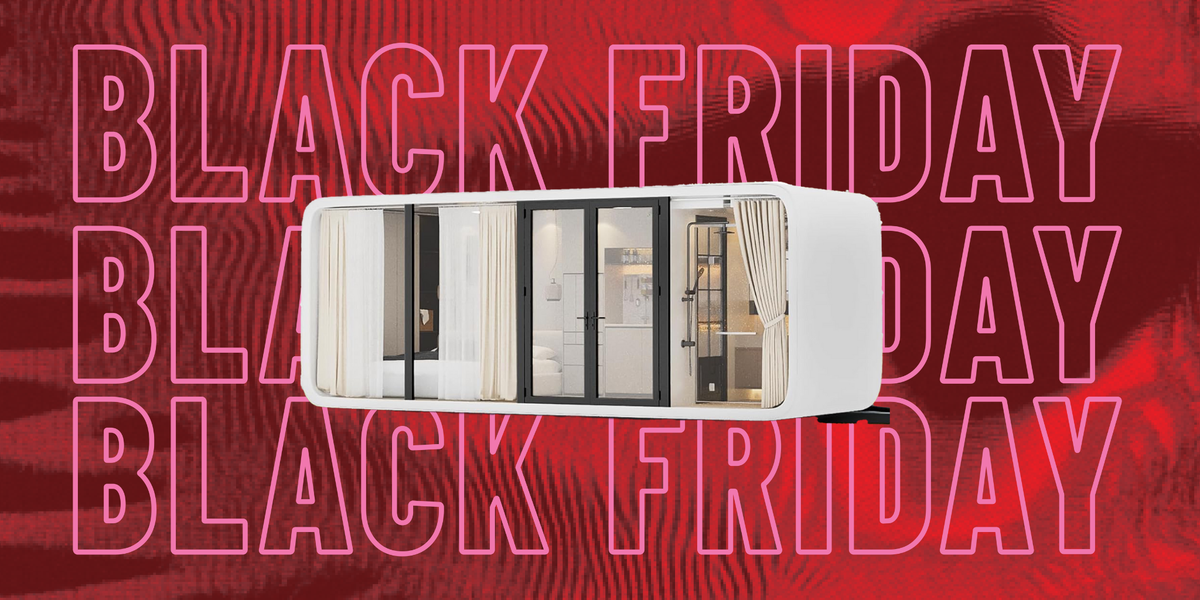
There are impulse buys, and then there is the “I just bought a house on Amazon” level of impulse buy. Somewhere between ordering paper towels and wondering why your cart contains twelve kinds of storage bins, Amazon has quietly become a surprisingly interesting place to browse prefab tiny homes, backyard offices, foldable cabins, and modular guest houses. The latest head-turner is a customizable, mobile cabin reportedly marked down by $10,000 through an on-page coupon, bringing one modern prefab steel-framed tiny house into the “wait, that costs less than a kitchen remodel?” conversation.
The cabin in question is a modern prefab steel-framed tiny house with a compact footprint, flexible layout options, a bedroom, kitchen, bathroom, balcony, large windows, and optional trailer-style mobility depending on the configuration. It has been described as a 19-foot model with a contemporary profile, warm exterior accents, and enough built-in practicality to make it tempting as a guest suite, backyard office, weekend retreat, rental unit, or extremely dramatic upgrade from the spare room currently filled with mystery boxes.
But before anyone clicks “Add to Cart” with the confidence of someone buying socks, it is worth slowing down. A prefab cabin is not a toaster. It may arrive through an online marketplace, but it still involves land, permits, utilities, installation, zoning, transportation, weather resistance, and the very real question of whether your city will look at your charming tiny home and say, “Cute, but no.” This guide breaks down what makes Amazon’s customizable mobile cabin appealing, what the $10,000 discount actually means in context, and what smart buyers should check before turning a backyard dream into a backyard situation.
Why This Amazon Mobile Cabin Is Getting Attention
The main attraction is obvious: a modern prefab cabin with a reported $10,000 discount is not exactly something you scroll past casually. Many traditional home additions, detached guest houses, and in-law suites can cost tens of thousandsor far moreonce labor, permits, materials, and utilities are included. By comparison, a prefab tiny home sold online looks fast, neat, and almost suspiciously convenient, like a house wearing a Prime badge and whispering, “I can be there soon.”
This particular cabin stands out because it combines several hot housing trends in one package: tiny living, modular construction, backyard ADUs, flexible guest space, remote-work offices, and mobile design. It is marketed as customizable, meaning buyers may be able to adjust layout, size, color, finishes, window placement, and interior configuration depending on seller options. That flexibility matters because tiny homes live or die by layout. In a small space, moving one wall, adding storage, or choosing better window placement can be the difference between “cozy retreat” and “luxury hallway.”
The cabin also leans into modern design. Large windows invite natural light. A balcony adds personality. A steel frame suggests durability. A kitchen and bathroom make it feel more like a true living unit than a shed with ambition. The mobile or towable element adds another layer of appeal, especially for people who imagine using it as a vacation cabin, seasonal escape, or relocatable dwelling. Of course, “mobile” should always be verified with the seller: road legality, towing requirements, trailer specifications, weight, and transportation rules are not details to leave to vibes.
What Features Come With the Customizable Prefab Cabin?
Based on reported product details, the cabin includes the essentials buyers expect from a tiny home rather than a basic backyard shed. That typically means a sleeping area, bathroom, kitchen space, windows, insulation, and a structural frame designed for repeated use. The layout is compact, but the goal is not to mimic a full-size house. The goal is to create a small, functional, attractive living space that does not require a full-scale construction project from scratch.
Modern Steel-Framed Construction
The steel-framed design is a major selling point. Steel is often used in prefab and modular structures because it offers strength, stability, and resistance to common structural problems when properly engineered and protected. Many prefab tiny homes listed on Amazon advertise galvanized or alloy steel frames, composite wall panels, double-pane or tempered glass windows, and weather-resistant exterior materials. Those claims should be checked carefully on the exact listing, but they explain why these homes are being marketed as more durable than a simple cabin kit.
Custom Layout and Finishes
Customization is the fun part, and also the part where buyers need to pay attention. Some Amazon tiny homes are sold with a base configuration, while upgrades may add cost. Options can include room count, kitchen layout, bathroom fixtures, flooring, wall colors, exterior finishes, storage, window placement, doors, and even furniture packages. A buyer looking for a backyard office may prioritize insulation, outlets, lighting, and a quiet layout. A buyer planning a guest suite may care more about bathroom comfort, privacy, and a real sleeping zone. A buyer hoping to use it as a rental should think like a guest: where does the suitcase go, where does the coffee maker sit, and how fast can someone find the bathroom at 2 a.m.?
Kitchen, Bathroom, Bedroom, and Balcony
The big difference between a prefab cabin and a true tiny home is livability. A cabin with a bathroom, kitchen, and bedroom can serve as a more complete guest space than a garden shed or studio pod. The balcony is not strictly necessary, but it adds charm and outdoor usability. In a small home, outdoor space acts like a bonus room. A tiny balcony with two chairs can become a morning coffee spot, reading nook, or place to dramatically look into the distance while pretending not to check email.
Is $10,000 Off Actually a Good Deal?
A $10,000 discount sounds huge because, well, it is. But the better question is: $10,000 off what? The reported sale places the modern prefab steel-framed cabin around the under-$30,000 range after coupon, depending on listing details and timing. That can be attractive when compared with custom-built guest houses, detached in-law suites, or many ADU projects, which often climb much higher once labor, utility hookups, site preparation, and permits enter the chat.
However, the sticker price is only the beginning. Buyers should budget for delivery details, foundation or pad preparation, anchoring, stairs or access points, electrical connection, plumbing, sewer or septic, HVAC adjustments, skirting, local inspections, and possibly professional installation. If the seller provides on-site assembly, that is a major convenience, but buyers should confirm exactly what “assembly” includes. Does it include crane placement? Utility hookups? Foundation work? Final inspection support? Or does it mean the structure is assembled, then you handle everything that makes it legally usable?
That distinction is important. A prefab cabin may be cheaper than a conventional addition, but it is not magically exempt from real-world costs. Think of the discount as a strong starting advantage, not a complete project budget.
Popular Ways to Use a Mobile Cabin
One reason this Amazon cabin has gone viral is that it solves a problem many homeowners recognize: they need more space, but they do not necessarily want to remodel the entire house. A customizable mobile cabin can be adapted for several uses, provided local rules allow it.
Backyard Guest House
For families who host relatives, college kids, or friends who “just need a place for a few weeks” and somehow stay through three seasons, a tiny guest house can create privacy without turning the living room into a permanent campground. A separate bathroom and kitchenette make the setup more comfortable for everyone.
Home Office or Creative Studio
Remote workers have learned that a home office is not always a room. Sometimes it is a corner near the laundry, a kitchen table under siege, or a bedroom desk where productivity goes to nap. A backyard prefab cabin can become a dedicated workspace, art studio, podcast room, therapy office, tutoring space, or writing retreat. Add good lighting, strong Wi-Fi, insulation, and sound control, and suddenly “going to work” means walking across the yard.
Weekend Cabin or Vacation Retreat
For buyers with land, a mobile cabin can become a compact getaway. The appeal is easy to understand: a small footprint, fast setup, and fewer design decisions than a custom build. Still, rural land adds its own checklist. Water access, septic approval, road access, snow load, wind rating, fire risk, and emergency services matter. A beautiful cabin is less relaxing when the driveway becomes a mud documentary every time it rains.
Potential Rental Unit
Some buyers may imagine short-term rental income or long-term tenant use. That can work in some areas, but rental rules are often strict. Many cities regulate ADUs, short-term rentals, occupancy, parking, separate addresses, and safety inspections. Before planning rental income, check local law and insurance requirements. A cabin that is legal as a backyard office may not be legal as a dwelling or rental unit.
The Big Checklist Before Buying a Tiny Home on Amazon
Online listings make prefab homes look simple, but the smartest buyers treat them like construction projects. Before ordering, gather documents, ask questions, and avoid assuming that a product photo equals a finished, legal home.
1. Contact the Seller Before Purchase
Ask for stamped engineering drawings, product specifications, wind and snow ratings, insulation values, electrical and plumbing details, total weight, dimensions, foundation requirements, warranty information, customization costs, delivery terms, and installation scope. If the seller asks you to leave the marketplace and pay through an outside channel, treat that as a serious red flag. Keep communication and payment protected through the platform whenever possible.
2. Call Your Local Building Department
This step is not glamorous, but neither is being told to remove a house after it arrives. Ask whether the structure can be used as an ADU, guest house, temporary structure, office, tiny home on wheels, manufactured home, modular home, or accessory building. The classification matters. It affects permits, inspections, occupancy, utility connections, taxes, insurance, and resale value.
3. Confirm Utility Hookups
A cabin with a kitchen and bathroom still needs water, power, and wastewater service. Utility connection can be a major cost, especially if the unit is far from the main house. Electrical trenching, sewer lines, water lines, septic upgrades, gas lines, internet access, and panel capacity should be reviewed with licensed professionals.
4. Check Foundation and Site Prep
Even a mobile or prefab cabin needs a safe place to sit. Depending on the unit and local code, that may mean a concrete slab, piers, gravel pad, anchors, trailer-rated parking pad, or engineered foundation. Drainage matters too. A tiny house placed in a low spot can become a tiny boat, and nobody ordered that model.
5. Review Insurance and Financing
Traditional mortgages may not apply to tiny homes, especially movable ones. Some buyers use personal loans, RV loans, home equity options, or cash. Insurance can also vary depending on whether the cabin is classified as an ADU, manufactured home, RV-style tiny home, or accessory structure. Ask insurers before buying, not after the delivery truck leaves.
How It Compares With Other Amazon Tiny Homes
Amazon now features a surprisingly wide range of prefab tiny homes, from under-$10,000 foldable container-style units to two-story cabins, A-frame kits, modular office pods, and larger steel-framed houses. Some models focus on ultra-low price. Others emphasize luxury finishes, multiple bedrooms, solar options, large windows, or quick assembly.
The customizable mobile cabin with the $10,000 discount sits in an interesting middle zone. It is more polished than the cheapest fold-out units, but still far below many professionally built ADUs. Its strongest selling points are flexibility, modern styling, essential amenities, and the possibility of mobility. For buyers who want something more substantial than a shed but less expensive than a full custom guest house, it makes sense to investigate.
The weakness is uncertainty. Amazon listings can vary widely by seller, product quality, documentation, code compliance, and after-sale support. A stylish product page does not guarantee a smooth permitting experience. That is why the smartest approach is not “buy now, figure it out later.” It is “verify now, buy confidently later.” Less exciting? Absolutely. Less likely to end with a very expensive lawn ornament? Also yes.
Design Tips for Making a Small Cabin Feel Bigger
A tiny home does not have to feel cramped. The best compact spaces use light, storage, proportion, and multi-purpose furniture to create comfort. Large windows are already a major advantage in this Amazon cabin because natural light reduces the boxed-in feeling that small structures can develop.
Choose lighter interior colors if the seller allows finish customization. Add wall-mounted storage instead of bulky cabinets. Use a daybed, sleeper sofa, or platform bed with drawers. Keep the kitchen simple: a two-burner cooktop, compact refrigerator, deep sink, and slim pantry can handle most needs without devouring the floor plan. In the bathroom, choose functional fixtures over oversized ones. A tiny home bathroom should feel clean and efficient, not like a plumbing showroom got trapped in an elevator.
Outdoor space matters too. A balcony, porch, gravel patio, or deck can extend the usable living area. Add weatherproof chairs, string lights, planters, and a small table, and the cabin instantly feels more intentional. Landscaping also helps the unit blend into the property instead of looking like it landed there during a very organized storm.
Who Should Consider This Amazon Cabin?
This customizable mobile cabin is best for buyers who already have a realistic location in mind, understand that local approval matters, and want flexible extra space without building from scratch. It may be especially appealing to homeowners with a large backyard, families needing a guest suite, remote workers craving separation, landowners planning a weekend retreat, or design lovers who want a compact modern cabin with personality.
It is not ideal for buyers who need guaranteed code approval, expect a complete turnkey home at the listing price, have no land, live in a strict HOA community, or want to tow the cabin frequently without confirming road requirements. It is also not a shortcut around housing laws. Tiny homes may be small, but the paperwork can be full-size.
Real-World Experience: What Living With a Mobile Cabin Might Actually Feel Like
Imagine the cabin finally arrives. The delivery alone becomes a neighborhood event. Someone walking a dog slows down. A neighbor pretends to check the mail for twelve minutes. Your family gathers outside as if a spaceship has landed, except the spaceship has a bathroom and better windows than your first apartment.
The first few days are exciting because every small decision feels satisfying. You test the lights. You open and close every window. You stand on the balcony with a cup of coffee even if the view is mostly the fence and Larry next door watering one tomato plant with the seriousness of a NASA launch. The space feels fresh, new, and full of possibility.
Then the practical side appears. You discover that small spaces reward discipline. A mug left on the counter becomes “visual clutter.” A jacket on a chair becomes “the laundry zone.” Two pairs of shoes by the door become “a storage crisis.” Tiny home living teaches you that every object needs a home, and if it does not have one, it becomes the mayor of the floor.
For a guest suite, the experience can be fantastic. Visitors get privacy. You get your living room back. Nobody has to whisper around a sleeper sofa at midnight. Add a small coffee station, fresh towels, blackout shades, and a foldable luggage rack, and the cabin feels like a boutique stay. The trick is to think through tiny luxuries: hooks by the door, outlets near the bed, a mirror with good lighting, a shelf in the shower, and enough storage that guests do not have to live out of a suitcase like glamorous raccoons.
As a home office, the cabin may be even better. The psychological separation is powerful. Walking outside to work creates a boundary that many remote workers miss. You can design the interior around focus: a real desk, ergonomic chair, acoustic panels, plants, task lighting, and hidden cable management. When the workday ends, you leave the cabin and return home. No commute, no traffic, no office microwave crimes.
As a weekend retreat, the cabin becomes a lesson in simplicity. You bring only what matters. A small kitchen encourages easy meals. A compact bedroom encourages early nights. A porch or balcony encourages actual sitting, which modern life has somehow turned into a rare and advanced skill. The best tiny cabin experiences are not about pretending you have a mansion. They are about realizing how little you need when the layout works and the setting feels right.
There are challenges, of course. Weather reveals weaknesses quickly. Poor insulation, bad sealing, or weak ventilation can turn a cute cabin into a seasonal complaint box. Utility planning matters every day. Water pressure, hot water capacity, heating, cooling, drainage, and electrical load are not glamorous, but they determine whether the cabin feels livable or like an expensive camping experiment.
Maintenance is also part of the experience. You will check seals, clean gutters or roof edges, inspect stairs, monitor moisture, protect exterior finishes, and keep pests from treating the cabin like a luxury resort. If it is mobile, you will also need to think about tires, chassis, anchors, leveling, transport rules, and safe storage. Mobility sounds romantic until you realize romance still needs torque ratings.
Still, when planned well, a mobile cabin can be deeply satisfying. It offers flexibility in a housing market where flexibility often feels rare. It can give families breathing room, workers quiet, guests privacy, and landowners a faster path to usable space. The Amazon discount makes the idea more tempting, but the real value comes from preparation. The right buyer will not just ask, “How much is it?” They will ask, “Where will it go, how will it connect, what is legal, and how will we actually use it?”
That is the difference between buying a tiny cabin and building a tiny lifestyle that works.
Final Verdict: A Tempting Deal, With Homework Attached
Amazon’s customizable, mobile cabin for $10,000 off is one of those listings that makes the internet fun again. It is stylish, compact, flexible, and surprisingly practical on paper. With a bedroom, kitchen, bathroom, balcony, customizable features, and optional mobility, it offers far more potential than a basic shed or kit cabin.
But the best way to approach it is with excitement and caution in equal amounts. The discount may be real, the design may be appealing, and the possibilities may be broadbut permits, utilities, foundations, weather ratings, financing, insurance, and seller documentation are the details that determine whether this becomes a smart purchase or a very memorable mistake.
If you are looking for a backyard office, guest space, compact retreat, or flexible tiny home, this Amazon prefab cabin deserves a close look. Just do the grown-up stuff first: call the building department, ask the seller hard questions, price the hookups, review the warranty, and make sure your dream cabin has permission to exist somewhere other than your shopping cart.