Note: This article is written in original language and based on real public information about Belgrade’s LIQUID3 project, urban photobioreactors, microalgae, air pollution, and nature-based city design.
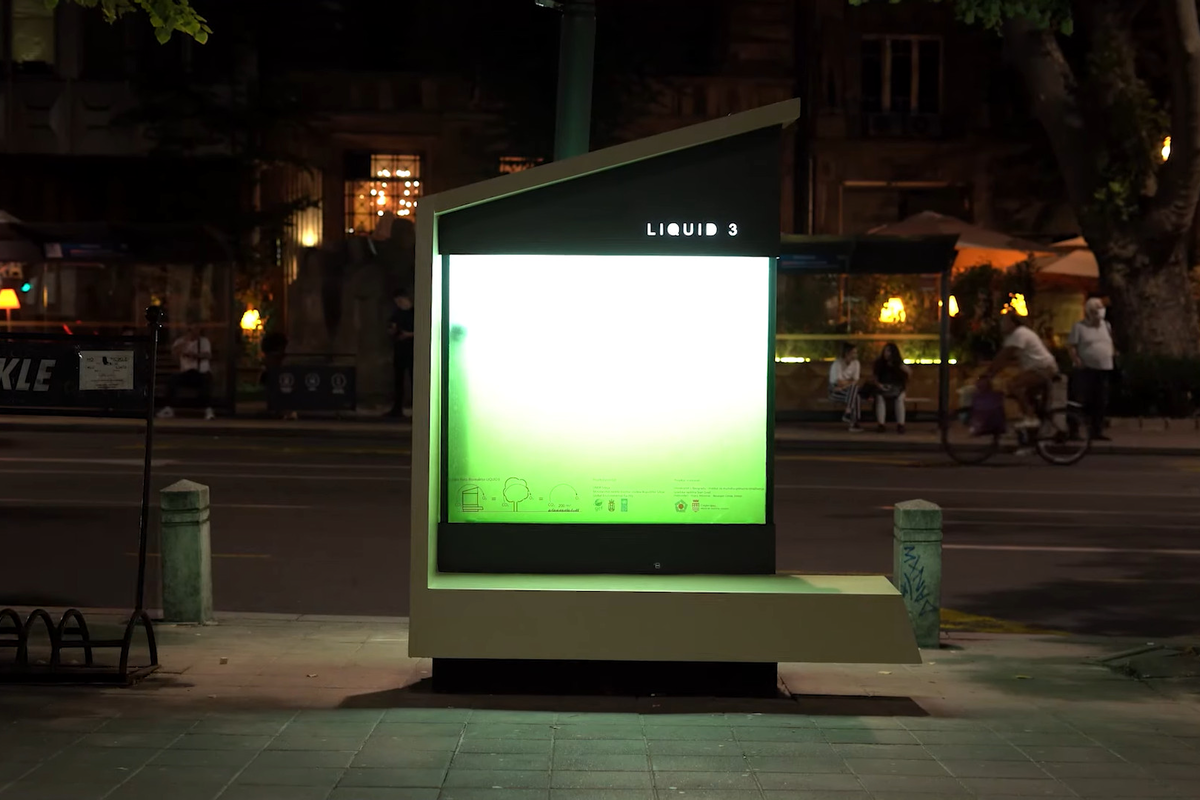
At first glance, Belgrade’s “liquid tree” looks like something a movie prop department might build when asked to design “eco-friendly cyberpunk, but make it municipal.” A glowing green tank sits on a city sidewalk, full of water and microalgae, quietly bubbling away while people walk past, charge their phones, sit on its bench, and wonder whether the future has arrived wearing pond slime.
Officially, the device is called LIQUID3, Serbia’s first urban photobioreactor. Unofficially, the internet grabbed the phrase “liquid tree,” ran around the block with it, and came back with a full basket of opinions. Some people praised it as clever green technology for polluted cities. Others called it dystopian, unnatural, or a depressing substitute for the simple miracle of planting an actual tree. Somewhere in the middle, algae continued doing what algae have done for billions of years: photosynthesizing without checking the comment section.
So what is the truth behind the furore? Is Belgrade replacing forests with aquariums? Is this a serious air-purifying tool or an expensive sidewalk lava lamp? The answer is more interesting than either extreme. LIQUID3 is not a magic cure for urban pollution, and it is not a villain twirling a mechanical mustache while cutting down oaks. It is a compact, experimental, nature-inspired system designed for places where normal greenery is hard to install, maintain, or protect.
What Is the Belgrade Liquid Tree?
The liquid tree of Belgrade is an urban photobioreactor, meaning it uses light, water, carbon dioxide, and living microalgae to perform photosynthesis inside a controlled container. The most famous unit was installed in front of the Stari Grad Municipality in Makedonska Street, a busy part of Belgrade where traffic, buildings, and paved surfaces leave little room for conventional planting.
The system contains around 600 liters of water mixed with microalgae. A small pump pushes air through the tank, exposing the algae to carbon dioxide and other airborne pollutants. Under light, the algae absorb carbon dioxide, produce oxygen, and generate biomass. That biomass can later be removed and potentially reused, including as a biofertilizer. In other words, the green soup is not just sitting there looking mysterious. It is alive, working, andunlike many office printersactually doing the job it was designed to do.
LIQUID3 is also designed as street furniture. It includes a bench, lighting, and mobile phone charging points, with solar energy helping power some of its functions. That matters because the project is not only about air purification. It is also about making green infrastructure fit into crowded urban spaces where a city cannot simply snap its fingers and produce a mature tree canopy.
How Does a Liquid Tree Work?
The basic science is familiar: photosynthesis. Plants, algae, and some bacteria use light energy to turn carbon dioxide and water into oxygen and organic matter. Trees perform this process through leaves. LIQUID3 performs it through microalgae suspended in water.
The Role of Microalgae
Microalgae are tiny photosynthetic organisms found naturally in ponds, lakes, rivers, and oceans. They are among the planet’s oldest and most productive life forms. They do not have trunks, branches, squirrels, or inspirational quotes carved into them, but they are extremely efficient at growing quickly and absorbing carbon dioxide under the right conditions.
In a photobioreactor, algae can be kept in a controlled environment where light, airflow, nutrients, and temperature can be managed. This helps the system keep operating in locations that may be hostile to ordinary street trees, including areas with heavy traffic, sealed pavement, limited soil depth, and high concentrations of dust or exhaust.
Air, Bubbles, Light, and Biomass
LIQUID3 works by drawing air into the tank through a pump. The air is broken into small bubbles, increasing contact between the polluted air and the algae-rich water. The algae use carbon dioxide as part of photosynthesis, releasing oxygen and growing into biomass. Over time, that biomass must be harvested so the system remains balanced.
This is one of the reasons the device should be seen as infrastructure, not a decorative novelty. It needs maintenance. The water quality must be monitored. The algae must remain healthy. Temperature matters. The equipment must keep working. A liquid tree is not a “set it and forget it” gadget. It is closer to a small biological machinepart aquarium, part bench, part environmental experiment.
Why Belgrade Tried It in the First Place
Belgrade did not wake up one morning and decide to make sidewalks look like a science museum because someone was bored. The city, like many urban areas in the Balkans and beyond, has faced serious air pollution challenges, especially from particulate matter, traffic emissions, heating, industrial activity, and regional energy systems.
Fine particulate matter, often called PM2.5, is especially concerning because the particles are small enough to penetrate deep into the lungs and may enter the bloodstream. Air pollution is not just a gloomy skyline problem; it is a public health problem linked to respiratory disease, heart strain, premature death, missed school days, and the depressing experience of checking the air quality index before deciding whether breathing outdoors is a good idea.
In dense city centers, the obvious solutionplant more treesis absolutely right but not always easy. Trees need soil volume, root space, water, protection from vehicles, maintenance, and years to mature. In narrow streets or heavily paved districts, planting a healthy tree may require redesigning utilities, sidewalks, drainage, and traffic flow. That does not mean cities should give up on trees. It means they may also test additional tools.
The Claim That Started the Argument
Much of the controversy comes from one word: replace. Project descriptions have compared the performance of a LIQUID3 unit to the air-purifying or oxygen-producing function of a mature tree or a large area of lawn. In some coverage, the device has been described as equivalent to one adult tree or about 200 square meters of lawn; in other early descriptions, comparisons used two young trees or a larger lawn area. Those figures depend on what is being compared: oxygen production, carbon dioxide fixation, surface area, installation footprint, or lab-tested performance.
The internet, being the internet, compressed all of that nuance into: “They want to replace trees with tanks.” Cue outrage, dramatic music, and probably a few memes involving sad squirrels.
The project team has repeatedly emphasized a more modest goal: LIQUID3 is intended to complement urban greenery, not replace forests, parks, street trees, or any other living landscape that provides shade, habitat, beauty, stormwater control, and psychological relief. That distinction matters. A photobioreactor can imitate one function of a treephotosynthesisbut it cannot imitate the full ecological role of a tree.
What Liquid Trees Can Do Well
Liquid trees make the most sense when they are judged as specialized urban tools. They are compact, visible, quickly installed, and potentially useful in hardscape zones where conventional planting is difficult. Their strongest argument is not “forget trees.” It is “what can we do in the awkward places where trees cannot thrive?”
They Use Very Little Ground Space
A mature tree needs space above and below ground. Roots need room. Branches need clearance. Soil needs oxygen and water. A photobioreactor can sit on a much smaller footprint, making it attractive for transit stops, plazas, traffic islands, dense sidewalks, courtyards, and other sealed spaces where tree planting would require major reconstruction.
They Work Through Algae, Not Filters Alone
Many urban air purifiers rely on mechanical filtration. LIQUID3 uses living organisms. The algae absorb carbon dioxide and produce oxygen through photosynthesis. Some claims also focus on the ability of algae systems to interact with particulate matter and heavy metals. The exact performance in real street conditions depends on airflow, pollution concentration, maintenance, light, temperature, and design details.
They Produce Biomass
Because algae grow, the system creates biomass that can be harvested. That material may have secondary uses, including fertilizer applications. This gives the device a circular-economy flavor: polluted air goes in, oxygen and biomass come out. It is not a miracle loop, but it is more useful than a bench that only collects pigeons and forgotten coffee cups.
They Attract Attention
Attention is underrated. A green tank glowing on a sidewalk gets people talking about air quality, carbon dioxide, urban heat, trees, and public design. Even criticism can be useful if it forces cities to explain what a project does and what it does not do. LIQUID3 became famous partly because it looked strange. In public communication, strange can be powerful.
What Liquid Trees Cannot Do
The backlash against liquid trees is not completely irrational. Some of it comes from a legitimate fear: cities love shiny pilot projects, and shiny pilot projects can become excuses for avoiding harder, less glamorous work. A city cannot bench-and-bubble its way out of pollution while ignoring traffic policy, heating systems, industrial emissions, building efficiency, public transit, and large-scale urban greening.
They Do Not Provide Real Tree Shade
A street tree cools the city by shading pavement, lowering surface temperatures, releasing water vapor, and creating a more comfortable walking environment. A tank of algae cannot form a canopy over a boulevard. It cannot make a hot sidewalk feel like a leafy summer street. It may include a small shaded bench, but that is not the same as an avenue of mature lindens or plane trees.
They Do Not Create Habitat
Trees support birds, insects, fungi, microorganisms, and urban biodiversity. They connect ecological corridors. They provide nesting, food, and shelter. A photobioreactor is alive, but it is not a miniature forest. No sparrow is going to build a meaningful life inside a sealed algae tank, and no bee is writing a thank-you note to a USB charging port.
They Need Maintenance and Energy
A healthy tree needs care, especially in cities, but a photobioreactor also requires regular technical attention. Pumps, lights, solar panels, water chemistry, algae concentration, temperature control, cleaning, and biomass removal all matter. If maintenance fails, the device can stop functioning or become an expensive green aquarium with civic branding.
They Do Not Solve Pollution at the Source
The best air pollution strategy is still to reduce emissions before they enter the air. Cleaner heating, better transit, lower vehicle dependence, industrial controls, energy transition, building upgrades, and pedestrian-first planning are all more important than any single sidewalk device. Liquid trees can help at the margins, but they are not permission slips for dirty systems to keep coughing into the sky.
Why the Furore Was So Loud
The anger around Belgrade’s liquid trees says as much about public trust as it does about algae. Many people are tired of watching cities cut down mature trees, pave public space, overheat neighborhoods, and then unveil “innovative” replacements that feel like technological bandages over planning wounds.
When residents hear the phrase “liquid tree,” they may not hear “microalgae-based air purifier for locations with limited planting capacity.” They hear “we are replacing nature with a gadget.” That emotional reaction is understandable. Urban trees are not only infrastructure; they are memory, shade, beauty, and local identity. A grandmother may not say, “Let’s meet under the carbon-fixing photobioreactor.” She says, “Meet me by the big tree.” Language matters.
The visual design also fueled the debate. A green-lit tank in a city street looks futuristic, and futuristic objects often trigger suspicion. The device can seem sterile compared with soil, bark, leaves, birdsong, and seasonal change. Even when the science is sensible, the symbolism can feel cold. In cities, symbolism is not decoration. It affects whether people accept or reject public projects.
The Better Way to Understand LIQUID3
The fairest way to understand LIQUID3 is as an addition to the urban sustainability toolbox. It is not a tree. It is not a forest. It is not a climate policy. It is a compact biological air-purifying device that borrows one powerful trick from nature and adapts it to places where roots cannot easily go.
That makes it useful, but limited. The best city would not choose between liquid trees and real trees. It would plant real trees wherever possible, protect old trees with the seriousness usually reserved for parking spaces, redesign streets to allow soil and water to support canopies, and use photobioreactors only in the leftover hard places: tight squares, transit corridors, underground-adjacent plazas, polluted intersections, rooftops, and sealed courtyards.
Think of it like an elevator in a building. Stairs are still good. Ramps are still good. Elevators solve a specific access problem. Nobody says, “Because elevators exist, legs are obsolete.” Likewise, a liquid tree does not make trees obsolete. It solves a specific design problem: bringing photosynthetic activity into dense urban spots where ordinary planting may fail or take decades to mature.
Could Liquid Trees Work in Other Cities?
Potentially, yesbut success would depend on climate, maintenance budgets, public acceptance, and honest performance monitoring. Cities with serious air pollution and limited planting space may find photobioreactors worth testing. Dense neighborhoods, bus terminals, industrial districts, and concrete-heavy plazas could all be candidates.
However, copying the device without copying the discipline behind it would be a mistake. A liquid tree should come with clear data: how much air passes through it, how much carbon dioxide is fixed, how often biomass is harvested, what pollutants are reduced, how much energy it consumes, how much maintenance costs, and how it performs across seasons. Without measurement, “green innovation” becomes a charming phrase that can hide a lot of expensive fog.
Public communication also matters. Cities should avoid saying liquid trees “replace” trees unless they define the comparison very carefully. A better message is simpler: “This system provides algae-based air purification in places where planting a tree is not practical. It does not replace parks or street trees.” That sentence may not go viral, but it also will not make half the internet imagine a dystopian war against oak leaves.
Lessons for Urban Sustainability
The Belgrade liquid tree debate offers several useful lessons for cities everywhere. First, people care deeply about urban nature. That is good news. The outrage, even when exaggerated, shows that trees are emotionally and culturally important. City leaders should treat mature trees as civic assets, not decorative extras.
Second, innovation needs humility. New green technology should not arrive with superhero marketing. It should arrive with data, maintenance plans, public explanation, and a clear statement of limitations. The more honest the claims, the more trust the project earns.
Third, nature-based technology can be both real and weird. Algae are not artificial simply because they live in a tank. Humans have long used controlled biological systems: compost bins, wastewater treatment plants, hydroponic farms, green roofs, fermentation tanks, and aquaponics. A photobioreactor is part of that family. It is biology wearing engineering shoes.
Finally, cities need layered solutions. No single intervention fixes urban pollution. Cleaner air requires reducing emissions, expanding green space, improving public transport, modernizing heating, enforcing environmental standards, designing walkable neighborhoods, and protecting vulnerable residents. Liquid trees may play a role, but they belong in the supporting cast, not the starring role.
Street-Level Experiences: What the Liquid Tree Debate Feels Like in Real Life
Imagine approaching a liquid tree on an ordinary city day. Traffic moves nearby, brakes sigh at the intersection, delivery vans idle for a little too long, and pedestrians weave around one another with the universal urban expression of “I have somewhere to be.” Then, suddenly, there it is: a transparent tank glowing green, bubbles rising through water, a bench attached, a solar panel above, and a few people slowing down because the sidewalk has unexpectedly turned into biology class.
The first experience is usually curiosity. People look at it longer than they would look at a normal bench. Some smile. Some frown. Some take photos. A child may ask whether fish live inside. An adult may ask why the city did not just plant a tree. Both questions are fair. The liquid tree succeeds immediately at one thing: it interrupts autopilot. In a city, that is not nothing. Most infrastructure disappears into the background until it breaks. LIQUID3 refuses to disappear. It says, “Hello, please consider algae.”
The second experience is uncertainty. A mature tree is easy to understand. You stand beneath it and feel shade. You see leaves move. You hear birds. You recognize life. A photobioreactor asks for more trust. The work happens inside a tank, through microscopic organisms and invisible gas exchange. Its benefits are not as instantly felt as a cool patch of shade on a hot afternoon. That gap between visible object and invisible function helps explain why people argue about it. If the public cannot feel the benefit, the city must explain it clearly.
The third experience is comparison. No matter how impressive the technology is, people compare it to trees because the name invites the comparison. A real tree gives shade, seasonal beauty, habitat, stormwater benefits, and emotional comfort. A liquid tree gives compact photosynthesis, symbolic innovation, and potential air-purifying performance in a hardscape location. They are not the same experience. The mistake is forcing them into a duel. The better question is: where would each one be most useful?
In a narrow, underground-utility-packed sidewalk where a tree pit would fail, a liquid tree may be a clever compromise. In a schoolyard with space for soil, children, and shade, plant actual trees and let the algae wait its turn. In a bus stop surrounded by traffic, a photobioreactor could become part of a larger design that includes shade structures, low-emission buses, permeable pavement, and nearby planting. The experience improves when the device is not treated as a miracle, but as one piece of a more humane street.
The most valuable lesson from encountering a liquid tree is not that algae are better than trees. They are not. The lesson is that cities are running out of excuses. If a city can install a glowing microalgae bioreactor, it can also protect mature trees, redesign hostile sidewalks, reduce car dependence, and take air pollution seriously. The little green tank should not be a substitute for ambition. It should be a provocation: if even algae can show up for urban air, perhaps planners, politicians, and residents can too.
Conclusion: The Liquid Tree Is Not the Enemy of Trees
The liquid trees of Belgrade became controversial because they touched a nerve. People do not want a future where living urban nature is replaced by machines, tanks, screens, and clever slogans. That fear deserves respect. But LIQUID3 is not best understood as a tree killer. It is a compact urban photobioreactor using microalgae to bring photosynthesis into places where conventional planting is difficult.
The real question is not whether cities should choose between algae and trees. They should choose both wisely. Plant trees wherever trees can thrive. Protect mature canopies like public treasure. Use green roofs, rain gardens, parks, and permeable streets to rebuild urban ecosystems. Then, in the stubborn gaps where roots cannot go, test tools like LIQUID3 with honest data and transparent goals.
Belgrade’s liquid tree is strange, useful, imperfect, photogenic, and wildly misunderstood. In other words, it is exactly the kind of invention cities should debate carefully rather than worship or mock. The future of clean urban air will not be made from one green tank, but it may include a fewquietly bubbling away while the real trees grow taller beside them.