Open source DMR radio sounds like the kind of phrase that escaped from a ham shack, bumped into a Linux server, and decided to start a club. But behind the geeky wording is a serious and fascinating movement: radio operators, software developers, hardware experimenters, and digital voice fans trying to make Digital Mobile Radio more flexible, more transparent, and more fun.
DMR, short for Digital Mobile Radio, is already popular in amateur radio because it offers clear digital voice, efficient spectrum use, worldwide talkgroups, affordable handheld radios, and a level of tinkering that can keep a person happily occupied long after the coffee has gone cold. Add open source software, community firmware, Raspberry Pi hotspots, and software-defined radio experiments, and suddenly DMR becomes more than “press button, talk to repeater.” It becomes a playground for learning how modern radio communication actually works.
Still, open source DMR radio is not as simple as downloading an app and shouting “CQ” into the nearest USB port. DMR is an open standard in many ways, but the common voice codec used in most real-world DMR systems relies on proprietary AMBE technology. That one detail creates a fascinating tension: the network tools, hotspot software, firmware interfaces, dashboards, and experimental SDR work can be open source, while some voice-processing pieces remain locked behind licensing and hardware limitations. In other words, DMR is open enough to invite experimenters in, but not open enough to let everyone rearrange the furniture without asking.
What Is DMR Radio?
DMR is a digital two-way radio standard originally designed for professional land-mobile radio users such as businesses, utilities, transportation teams, and public-service organizations. In amateur radio, it became popular because it delivers digital voice in a practical, relatively low-cost package. A basic DMR handheld can talk through local repeaters, connect through personal hotspots, and access regional or worldwide talkgroups.
The magic trick is two-slot TDMA, or Time Division Multiple Access. A DMR Tier II or Tier III system uses a 12.5 kHz channel and divides it into two alternating time slots. That means one repeater can carry two separate voice paths at the same time. For amateur operators, this often means one slot might carry local or regional talkgroups while another handles wider-area or worldwide traffic. It is a bit like having two checkout lanes inside one radio channelexcept nobody is buying gum at the register.
DMR systems also use forward error correction, digital signaling, talkgroups, radio IDs, color codes, time slots, and codeplugs. Those terms can sound intimidating at first, but they form the basic grammar of DMR. A talkgroup is like a virtual room. A radio ID identifies the operator. A color code helps separate repeaters using the same technical format. A time slot determines which half of the TDMA channel your call uses. A codeplug is the programming file that tells the radio what to do. If analog FM is a bicycle, DMR is a bicycle with a dashboard, GPS, gear computer, and a manual that appears to have been written by a committee of caffeinated engineers.
Why Open Source Matters in DMR
Open source matters because radio has always been about learning, experimenting, repairing, improving, and sharing knowledge. Amateur radio operators are not merely consumers of communication tools; many are builders. They want to understand what happens between microphone and antenna. They want to modify firmware, inspect protocols, run their own infrastructure, and contribute improvements back to the community.
In the DMR world, open source has already made a major impact through projects such as MMDVM, MMDVMHost, Pi-Star, OpenGD77, GNU Radio experiments, and related digital voice tools. These projects have allowed operators to build personal hotspots, run repeaters, link networks, experiment with signal processing, and customize radio behavior in ways that commercial software often does not allow.
Open source also helps preserve knowledge. If a vendor disappears, changes its product line, or stops supporting a device, community-driven software may keep useful equipment alive. That matters in amateur radio, where half the fun is getting one more decade out of hardware that someone else declared “obsolete” right after the warranty expired.
The Open Source DMR Ecosystem
MMDVM: The Foundation Under Many Hotspots
MMDVM stands for Multi-Mode Digital Voice Modem. It is one of the most important open source projects in modern digital amateur radio. MMDVM firmware and related software support several digital voice modes, including DMR, D-STAR, YSF, P25, NXDN, POCSAG, and FM. In practical terms, MMDVM is the engine behind many personal hotspots and digital repeaters.
A typical hotspot combines a small computer such as a Raspberry Pi with an MMDVM modem board. The radio operator uses a low-power handheld DMR radio to talk to the hotspot, and the hotspot connects that traffic to a digital network through the internet. This setup lets an operator use DMR even if no local DMR repeater is nearby. It also gives experimenters a compact lab for learning about digital voice without needing to build a mountaintop repeater site or ask a tower owner for the keys.
Pi-Star: Making Hotspots Friendlier
Pi-Star is a popular software image built for Raspberry Pi-based digital voice hotspots. It wraps complex services into a web-based dashboard that ordinary operators can configure without manually editing every service file. Pi-Star supports DMR and several other digital voice modes, and it can be used for anything from a simple personal hotspot to more advanced multimode repeater setups.
For many hams, Pi-Star is the first step into open source DMR infrastructure. It teaches the relationship between radio frequency settings, DMR IDs, talkgroups, network masters, gateways, and modem calibration. It also teaches patience, especially when the hotspot refuses to behave because the frequency offset is wrong by just enough to ruin your afternoon.
OpenGD77: Community Firmware for DMR Radios
OpenGD77 is another major example of open source energy in DMR. It is community firmware designed for several amateur-friendly DMR radios, including models from Radioddity, Baofeng, TYT, Retevis, and related platforms. The project focuses on making DMR radios more useful for amateur radio operators rather than simply copying commercial radio workflows.
OpenGD77 improves usability in areas that matter to hams, such as easier contact handling, better hotspot-style operation, more practical menus, and features designed around amateur operating habits. However, it also shows the limits of open source DMR. Some DMR functionality depends on proprietary AMBE voice components or closed manufacturer code. As a result, OpenGD77 is open source in spirit and in much of its implementation, but it must still work around the realities of commercial DMR chipsets and voice technology.
The AMBE Challenge: The Not-So-Open Part
The biggest technical and philosophical challenge for open source DMR radio is the voice codec. Most DMR systems use AMBE-based voice coding. AMBE is widely used in commercial digital voice systems, but it is not a fully open, royalty-free codec in the same spirit as many open source projects. This creates a practical barrier for anyone trying to build a completely open DMR transceiver from scratch.
In receive-only or experimental environments, developers can study DMR framing, modulation, synchronization, and network behavior. But transmitting voice that works with existing DMR repeaters and networks usually requires compatibility with the expected AMBE voice stream. That is why many open source DMR projects focus on surrounding infrastructure: modems, hotspot control, dashboards, gateways, firmware interfaces, programming tools, and SDR research.
Some open digital voice projects, such as M17, take a different path by using Codec 2, a low-bitrate open source speech codec designed for radio communication. M17 is not DMR, but it is important because it shows what a truly open amateur digital voice system can look like when the codec, protocol, and software are designed around openness from the start. DMR has the network size and installed base; M17 has the open-source purity. Naturally, radio people argue about both, because arguing politely over technical tradeoffs is practically a secondary allocation.
Open Source DMR and Software-Defined Radio
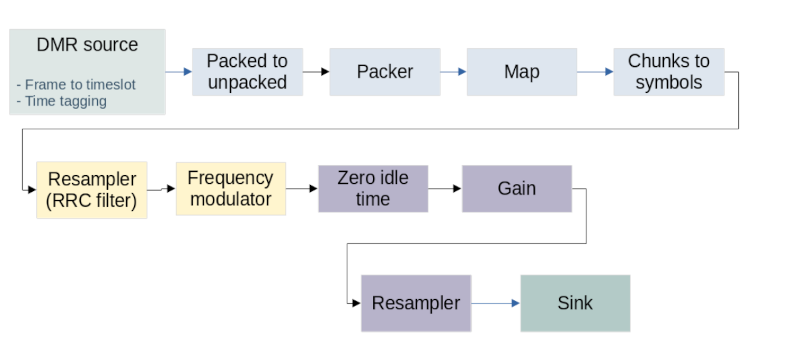
Software-defined radio, or SDR, brings another layer of excitement to open source DMR. Instead of relying entirely on fixed-purpose radio hardware, SDR uses software to process signals that traditional radios handle with dedicated circuits. With tools such as GNU Radio, developers can build and test signal-processing blocks, demodulators, decoders, and experimental transmit chains.
Recent open-source DMR experiments have explored receiver and transmitter implementations using SDR hardware and open software. These projects are not necessarily ready to replace a commercial handheld radio in daily use, but they are extremely valuable for education. They help developers understand how DMR signals are structured, how 4FSK modulation behaves, how timing recovery works, and where practical interoperability issues appear.
For learners, SDR-based DMR research is like removing the hood from a car engine. You may not want to rebuild the engine before driving to the grocery store, but seeing the moving parts helps you understand why the machine behaves the way it does.
DMR Networks, Talkgroups, and Radio IDs
Open source DMR radio is not just about firmware and signal processing. It also connects to a larger operating ecosystem. Amateur DMR users typically register for a digital radio ID through RadioID.net. This ID is programmed into the radio and used by networks to identify the operator. Without it, a DMR radio may still make local RF noise, but it will not be a well-behaved citizen on major networks.
BrandMeister is one of the best-known global DMR networks. It supports talkgroups, repeaters, hotspots, dashboards, and routing features that let operators communicate across cities, countries, and continents. Other DMR networks exist as well, and each may have its own policies, talkgroup structures, and operating expectations.
This is where DMR becomes both powerful and confusing. A new operator must understand frequency, offset, color code, time slot, talkgroup, contact list, receive group, zone, channel, radio ID, and network behavior. That is a lot of vocabulary for a device with a push-to-talk button. But once the pieces click, DMR becomes remarkably flexible.
Legal and Operating Considerations in the United States
In the United States, amateur radio operation must follow FCC Part 97 rules. One important rule is that amateur stations may not transmit messages encoded for the purpose of obscuring their meaning, except where specifically allowed. This is why encryption features found in some commercial DMR radios are generally not used on amateur radio frequencies.
This matters for open source DMR because developers must think not only about what is technically possible, but also about what is legal and appropriate for amateur use. A radio may support privacy or encryption in a commercial context, but amateur firmware and codeplugs should avoid enabling features that conflict with ham-radio rules. The amateur service is built around identification, self-training, technical investigation, and noncommercial communication. Secret squirrel mode may sound exciting, but on ham bands it is usually the wrong tree to climb.
Benefits of Open Source DMR Radio
Better Learning
Open source projects let operators study real code, real configurations, and real network behavior. Instead of treating DMR as a black box, users can learn how digital voice systems are assembled.
Lower Cost
Affordable hotspots, community firmware, and used commercial radios make DMR accessible. Open source software reduces the need for expensive proprietary infrastructure in many amateur applications.
Customization
Community firmware can improve menus, contact handling, scanning behavior, hotspot operation, and other features that commercial vendors may not prioritize for amateur users.
Longer Hardware Life
Open source support can keep radios, modem boards, and hotspot platforms useful long after official support slows down. That is good for wallets, workshops, and the noble ham tradition of never throwing away a cable because “it might be useful someday.”
Community Innovation
Open source DMR development encourages collaboration among radio operators, embedded developers, network maintainers, and SDR researchers. The result is a living ecosystem rather than a sealed appliance.
Limitations and Challenges
Open source DMR radio is powerful, but it is not perfect. The AMBE codec remains a major limitation for fully open voice compatibility. Hardware support varies by radio model and revision. Firmware flashing can carry risk, especially if the wrong file is used. Hotspot setup can be confusing for beginners. Network policies differ. Audio quality depends on radio calibration, BER, internet stability, microphone gain, and whether the operator is speaking into the correct side of the handheld. Yes, that last one happens.
Another challenge is documentation. Open source communities often produce excellent tools, but the documentation can be scattered across forums, GitHub repositories, wikis, videos, and archived posts. A beginner may need to piece together information from several places before understanding the full workflow. This is not a deal-breaker, but it does mean patience is part of the equipment list.
How to Get Started with Open Source DMR Radio
The easiest starting point is a DMR handheld, a registered DMR ID, and access to a local repeater or personal hotspot. Many operators begin with a budget-friendly radio and then learn codeplug programming. A codeplug should include local repeaters, simplex channels, common talkgroups, zones, and contacts. It is wise to start small. A clean codeplug with five useful channels is better than a giant imported monster file that makes the radio feel like it is haunted.
Next, explore a hotspot. A Raspberry Pi-based hotspot running Pi-Star or similar software can teach you how networks, masters, talkgroups, and modem calibration work. Once you understand that, open source firmware such as OpenGD77 may become interesting if your radio is supported. More advanced users can study MMDVMHost, build repeater controllers, experiment with SDR reception, or compare DMR with open digital voice systems such as M17.
For best results, keep good notes. Record your radio model, firmware version, DMR ID, hotspot frequency, offset settings, network password requirements, and working talkgroups. DMR troubleshooting is much easier when you can compare what changed instead of staring at the radio and hoping guilt will make it confess.
The Future of Open Source DMR Radio
The future of open source DMR radio will likely move in two directions at once. First, existing DMR infrastructure will continue improving through better hotspot software, firmware updates, dashboards, gateways, and network tools. This path supports the large installed base of DMR radios and repeaters already in use.
Second, fully open digital voice systems such as M17 will keep pushing the amateur radio community toward protocols and codecs that are open from end to end. This does not mean DMR disappears. Instead, DMR and open alternatives may coexist. DMR offers compatibility, large networks, and affordable equipment. M17 and Codec 2 offer a cleaner open-source philosophy. Many operators will experiment with both because, frankly, hams are not famous for owning only one radio.
Open source DMR radio, then, is not a single product. It is a movement around transparency, learning, control, and experimentation inside a digital voice ecosystem that still contains proprietary pieces. That tension is exactly what makes the topic interesting.
Personal Experiences and Practical Lessons with Open Source DMR Radio
Working with open source DMR radio feels less like buying a finished gadget and more like joining a workshop where everyone brought a different screwdriver. The first lesson is that DMR rewards curiosity. A person who only wants to turn on a radio and talk may find DMR programming a little fussy at first. But someone who enjoys learning systems will quickly discover that every setting has a purpose.
One of the most common beginner experiences is the “silent radio mystery.” The radio powers on, the display looks correct, the repeater frequency is entered, and yet nothing happens. Then the operator discovers that the color code is wrong, the time slot is wrong, the talkgroup is not active, the receive group is missing, or the hotspot needs a frequency offset adjustment. Analog FM usually fails loudly; DMR often fails politely and says nothing at all. That silence can be frustrating, but it also teaches careful configuration.
A hotspot is often the best classroom. With a small MMDVM board and Pi-Star dashboard, the operator can see live activity, BER readings, network connections, and mode status. Suddenly the invisible parts of DMR become visible. If the BER is high, the problem may be frequency calibration. If the network does not connect, the issue may be a password, server setting, or internet connection. If the radio keys up but no audio routes, the talkgroup or slot may be wrong. Each problem becomes a lesson rather than a wall.
OpenGD77-style firmware also changes the experience. Many commercial DMR radios are designed for business users who receive a programmed radio from a fleet manager. Amateur operators, however, constantly change repeaters, talkgroups, zones, contacts, and hotspot settings. Community firmware often feels more natural for ham use because it understands that operators like to experiment. It can make a radio feel less like a locked corporate tool and more like a station accessory.
The biggest practical lesson is to respect backups. Before flashing firmware, save the original codeplug, read the installation notes, confirm the exact hardware version, and keep recovery files available. Firmware experiments are fun right up to the moment a radio becomes an expensive paperweight with an antenna. Most recoverable mistakes are manageable, but only if the operator prepared before clicking the exciting button.
Another experience is community support. DMR operators often learn from forums, local clubs, repeater trustees, GitHub issues, wikis, and late-night conversations with people who have already made the same mistakes. This is one of the best parts of open source radio. The knowledge is social. Someone adjusts a hotspot, documents a fix, improves a script, updates a contact generator, or explains a confusing menu, and the entire community benefits.
There is also a mindset shift. Open source DMR is not about chasing perfection. It is about understanding tradeoffs. DMR gives access to large networks and affordable radios, but it carries proprietary codec baggage. M17 offers a more open future, but it does not yet match DMR’s installed base everywhere. MMDVM makes multimode hotspots practical, but configuration still matters. Pi-Star simplifies setup, but it does not eliminate the need to learn basic radio behavior. The sweet spot is accepting DMR as both useful and imperfect.
After spending time with open source DMR tools, many operators become better radio users overall. They learn signal quality, network routing, digital IDs, audio levels, antenna placement, and disciplined troubleshooting. They also learn humility, usually from a tiny setting buried in a menu that ruins everything until discovered. That is not a bug in the hobby. That is the hobby.
Conclusion
Open source DMR radio sits at the crossroads of amateur radio tradition and modern digital communication. It combines RF engineering, embedded firmware, internet-linked networks, software-defined radio, and community problem-solving. While DMR is not completely open from microphone to speaker because of proprietary voice codec realities, the open source ecosystem around it has made digital voice more accessible, more educational, and more customizable.
For beginners, open source DMR offers an affordable way to explore global radio communication. For experienced operators, it offers a deeper technical playground. For developers, it presents a meaningful challenge: how to build better tools around an established standard while pushing the broader hobby toward more open digital voice systems.
The best way to understand open source DMR radio is to try it carefully. Program a simple codeplug. Register a DMR ID. Listen before transmitting. Build or configure a hotspot. Read the documentation twice. Back up everything. Then enjoy the strange satisfaction of making a small handheld radio talk through a tiny computer to a global network of people who also think this is a perfectly reasonable way to spend a weekend.