Finding a mysterious winged insect near your window can turn an ordinary afternoon into an emergency meeting with your search engine. Is it an ant? A termite? A tiny contractor preparing an unauthorized home renovation?
Knowing how to identify a termite matters because these insects often remain hidden while feeding on wood and other cellulose-based materials. They do not usually stroll across the kitchen counter announcing their arrival. Instead, they travel through soil, shelter tubes, wall cavities, and wooden structures where damage can develop without obvious surface clues.
Fortunately, termites have several recognizable physical features. Their wings, antennae, waist, color, behavior, droppings, and damage patterns can help distinguish them from flying ants, carpenter ants, and wood-boring beetles. This guide explains what termites look like, how the major types differ, where to search for them, and when a suspicious insect deserves a professional inspection.
What Does a Termite Look Like?
A termite’s appearance depends on its species and role within the colony. A mature colony may contain workers, soldiers, winged reproductive termites, a queen, and a king. These castes can look so different that they might appear to belong to separate insect families.
Most homeowners encounter winged reproductive termites, commonly called swarmers or alates. Workers and soldiers generally remain concealed within wood, soil, mud tubes, or the colony itself.
The Basic Physical Features of a Termite
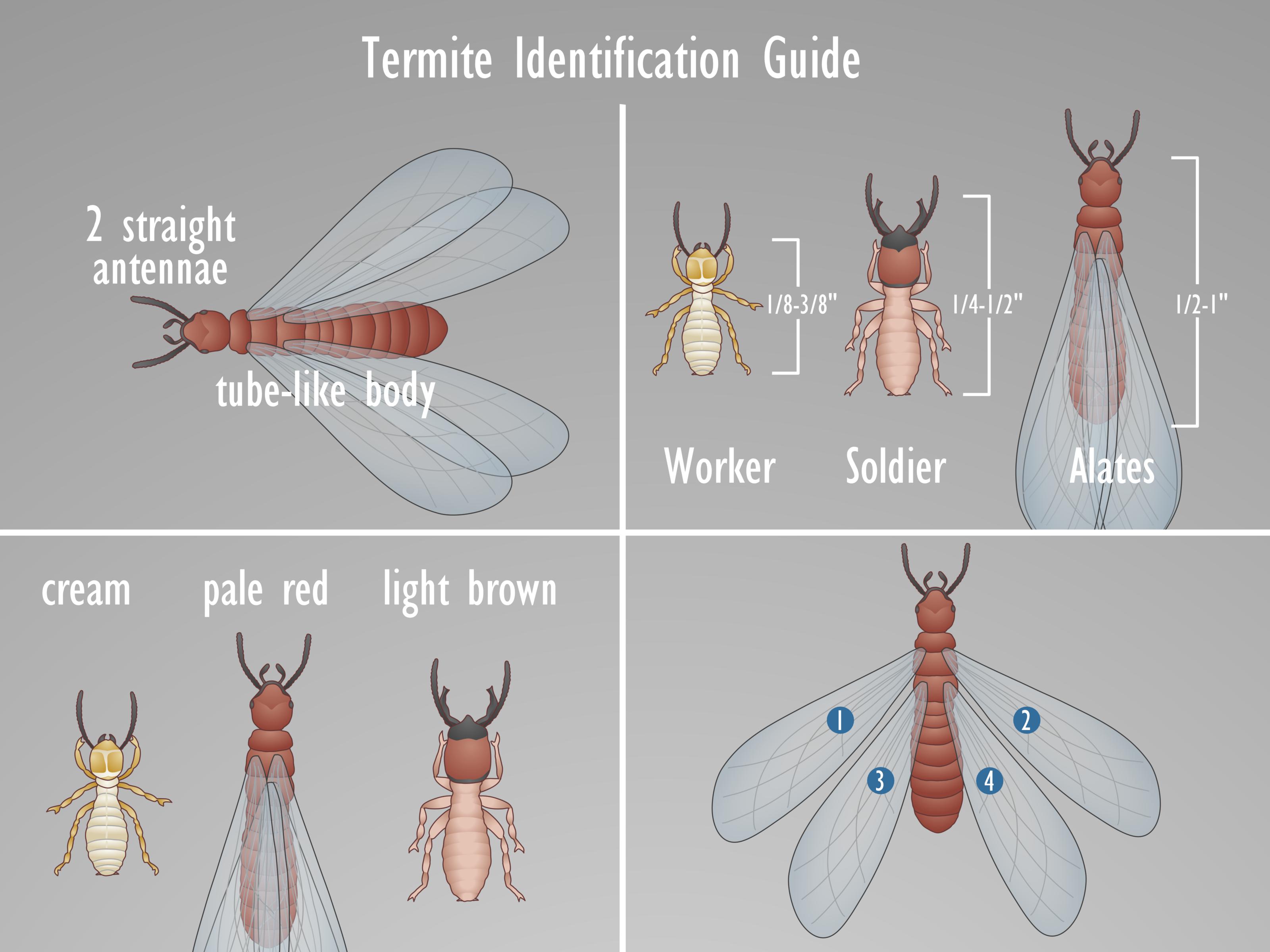
Although size and color vary, termites typically have the following characteristics:
- A soft body rather than a hard, glossy shell
- A broad or straight waist without a narrow middle
- Straight, bead-like antennae
- Six legs
- A body usually measuring about one-quarter to one-half inch, depending on the species and caste
- Four wings of approximately equal length on swarmers
Worker termites are usually creamy white or pale tan. They are sometimes informally called “white ants,” although termites are not ants. Soldiers may also be pale, but they usually have darker, enlarged heads and strong jaws used to defend the colony. Swarmers tend to be darker and may appear brown, black, amber, or yellowish.
How to Tell a Termite From a Flying Ant
Flying ants are the insects most frequently mistaken for termites. Both may suddenly appear in large numbers, both have four wings, and both tend to inspire the same response: staring at the ceiling while reconsidering every financial decision that led to homeownership.
Look closely at three features: the antennae, waist, and wings.
1. Examine the Antennae
A termite has relatively straight antennae that resemble a string of tiny beads. A flying ant has distinctly elbowed or bent antennae. A magnifying glass or a close-up photograph can make this difference much easier to see.
2. Check the Waist
A termite has a broad, fairly uniform body. Its chest and abdomen connect without an obvious pinch. A flying ant has a narrow, constricted waist between the thorax and abdomen.
Imagine the termite as a small grain of rice with legs. The ant looks more like three separate body sections joined at a narrow middle.
3. Compare the Wings
A termite swarmer has two pairs of wings that are approximately equal in length and shape. The wings usually extend well beyond its abdomen and may appear translucent, milky, smoky, or lightly colored.
A flying ant also has two pairs of wings, but its front wings are noticeably larger than its rear wings. Termite wings are fragile and detach easily, which is why piles of loose, matching wings near a windowsill can be an important warning sign.
| Feature | Termite Swarmer | Flying Ant |
|---|---|---|
| Antennae | Straight and bead-like | Bent or elbowed |
| Waist | Broad and straight | Narrow and pinched |
| Wings | Four wings of similar length | Front wings longer than rear wings |
| Body texture | Soft-bodied | Harder and more defined |
| Typical antenna shape | Nearly straight | Clearly angled |
How to Identify Different Types of Termites
The United States has several termite groups, but homeowners most commonly deal with subterranean, drywood, dampwood, and Formosan subterranean termites. The location of the colony and the evidence left behind are often more useful than the color of a single insect.
Subterranean Termites
Subterranean termites live primarily in soil and travel between their colony and food sources. Because their soft bodies lose moisture easily, they build protective mud tubes across foundations, masonry, pipes, piers, and other exposed surfaces.
Workers are generally small and creamy white. Soldiers have darker rectangular heads with prominent jaws. Swarmers are often dark brown or black and have pale or smoky wings of equal length.
The clearest signs of subterranean termites include:
- Pencil-width mud tubes on foundation walls or crawl-space supports
- Soil or mud packed into cracks and damaged wood
- Wood galleries that follow the grain
- Winged termites emerging indoors
- Discarded wings near doors, windows, vents, or light fixtures
Drywood Termites
Drywood termites live within the wood they infest. Unlike subterranean species, they do not require continuous contact with soil. They may infest structural lumber, trim, doors, window frames, furniture, hardwood flooring, and other seasoned wood.
One of the best clues is the presence of small, hard fecal pellets known as frass. Drywood termites push these pellets through tiny openings called kick-out holes. The material may collect in neat piles resembling coarse sand, ground pepper, coffee grounds, or tiny seeds.
Under magnification, drywood termite pellets are relatively uniform and often have ridged or flattened sides. Their color can vary according to the wood being consumed. Fresh pellets that return after an area has been cleaned suggest ongoing activity.
Dampwood Termites
Dampwood termites generally infest moist or decaying wood. They are usually larger than subterranean and drywood termites and are associated with leaks, poor drainage, rotting logs, damaged roof areas, wet crawl spaces, or wood that remains in contact with damp soil.
A dampwood termite problem often reveals a moisture problem as well. Repairing the leaking pipe, damaged roof, or drainage issue is essential because the damp wood is effectively serving as an insect-friendly hotel with complimentary breakfast.
Formosan Subterranean Termites
Formosan termites are an invasive type of subterranean termite established in parts of the southern United States. Their colonies can become exceptionally large. Swarmers are commonly yellowish brown, caramel, or honey-colored and may be attracted to lights during evening swarms.
Formosan soldiers typically have rounded or oval heads and may release a defensive fluid when disturbed. Exact species identification should be left to a qualified specialist because wing veins, body hairs, head shape, and other microscopic characteristics may need to be examined.
Seven Signs of a Possible Termite Infestation
You may never see a living worker termite unless damaged wood or a mud tube is opened. In many cases, the evidence is easier to find than the insect.
1. Mud Tubes
Mud tubes are narrow passageways made from soil, termite saliva, and other materials. Look for them on foundation walls, sill plates, support piers, plumbing penetrations, basement walls, and crawl-space masonry.
Breaking a small section may reveal live workers or soldiers. However, an empty tube does not prove that the colony is gone. Termites may temporarily abandon a route, rebuild it, or use a different hidden passage.
2. Discarded Wings
After mating flights, reproductive termites shed their wings. You may find small piles near windows, sliding doors, vents, sinks, spiderwebs, or indoor lights. Because all four termite wings are similar, a pile of matching wings is more suspicious than a mixture of large and small ant wings.
3. Indoor Termite Swarmers
A swarm outdoors may originate from a colony in a stump, tree, landscape timber, or neighboring property. A swarm emerging inside a building is more concerning because it suggests that a mature colony may be located within or directly beneath the structure.
4. Hollow or Papery-Sounding Wood
Termites often feed beneath the surface, leaving a thin outer layer intact. Damaged trim, flooring, or wall material may sound hollow when tapped. A screwdriver or probe may penetrate unusually soft wood, but avoid aggressively testing structural components or finished surfaces.
5. Blistered, Buckled, or Darkened Wood
Termite activity can produce irregular wood surfaces that resemble water damage. Flooring may blister, paint may bubble, and wood may appear darkened or wavy. These symptoms can also result from moisture, rot, installation problems, or plumbing leaks, so they are clues rather than proof.
6. Fecal Pellets
Small piles of uniform pellets are strongly associated with drywood termites. By comparison, carpenter ants often push coarse sawdust, dead insects, and nest debris from their galleries. Wood-boring beetles may leave fine powder beneath round exit holes.
7. Clicking or Rustling Sounds
Large colonies may occasionally produce faint sounds inside wood. Soldier termites can strike their heads against gallery surfaces as an alarm signal. Workers feeding within thin wood may create subtle rustling noises, although household sounds make this clue unreliable on its own.
Termite Damage Versus Carpenter Ant Damage
Carpenter ants do not eat wood. They excavate it to build nests, often selecting damp, softened, or decaying material. Their galleries typically look smooth and clean, almost as though someone sanded them with a tool designed for very tiny carpenters.
Termites consume cellulose and tend to leave rougher galleries. Subterranean termite galleries may contain soil or mud. Termite-damaged wood can look layered, honeycombed, or packed with earthen material.
Carpenter ants frequently leave piles of sawdust-like shavings mixed with insect fragments. Drywood termites leave harder, more uniform pellets. Subterranean termites generally retain their waste within their sheltered environment rather than producing obvious piles of dry pellets.
Termites Versus Wood-Boring Beetles
Wood-boring beetles can also damage structural lumber and furniture. The most useful clues are exit holes and powdery frass.
Beetles commonly leave round or oval holes in the wood surface. Fine flour-like powder may sift from those holes when the wood is bumped. Termite galleries generally lack the numerous clean, round exit holes associated with beetles, although drywood termite kick-out holes may be visible.
Because old insect damage may remain long after activity has stopped, a professional may need to determine whether the evidence is fresh.
Where to Inspect for Termites
Begin in areas where wood, soil, and moisture are close together. Use a bright flashlight and inspect slowly rather than attempting an enthusiastic demolition project.
- Foundation walls and expansion joints
- Crawl-space piers, beams, joists, and sill plates
- Basement walls and unfinished utility areas
- Areas around plumbing and utility penetrations
- Wooden porches, decks, steps, and fences
- Window and door frames
- Roof edges and attic areas affected by leaks
- Wood flooring near exterior doors
- Garages, sheds, and detached wooden structures
- Firewood, stumps, cardboard, and landscape timbers near the house
Pay special attention to wood that touches soil. Termites can enter through cracks only a fraction of an inch wide, so an infestation may exist even when no major foundation opening is visible.
What to Do When You Find a Suspected Termite
Collect a Sample
Place several insects, wings, or pellets in a sealed container. Avoid crushing the sample. A clear photograph beside a ruler or coin can document its size, but an intact specimen is usually more useful for identification.
Record the Location
Photograph mud tubes, damaged wood, pellet piles, or swarm locations before cleaning or disturbing them. Note the date, time, weather, and whether the insects appeared indoors or outdoors.
Avoid Spraying the Visible Insects
Killing a few swarmers does not eliminate the colony. Household sprays may scatter insects or contaminate an area without reaching the hidden population. They can also make a professional inspection more difficult.
Arrange a Qualified Inspection
Termite treatment is not a one-size-fits-all project. Subterranean colonies, drywood colonies, localized infestations, and structural moisture problems may require different approaches. A licensed pest-management professional can identify the termite type, determine the extent of activity, and explain suitable treatment options.
For a major treatment, consider obtaining more than one inspection and written estimate. Ask what evidence was found, what areas will be treated, which products or systems will be used, how long the agreement lasts, and what follow-up inspections are included.
Common Termite Identification Mistakes
Assuming Every Winged Insect Is a Termite
Ants, flies, moths, beetles, and other insects can gather near windows and lights. Check the antennae, waist, and relative wing sizes before declaring a household emergency.
Relying on Color Alone
Termites are not always white. Workers are often pale, while swarmers can be black, brown, amber, or yellowish. Ants also come in many colors, making body structure more dependable than color.
Assuming an Empty Mud Tube Is Inactive Forever
A damaged or empty tube may be old, temporarily unused, or connected to hidden active pathways. It should still be documented and evaluated.
Mistaking Water Damage for Termites
Bubbling paint, swollen wood, and sticking doors may result from humidity or leaks. Conversely, termite damage may resemble ordinary moisture damage. Investigating both possibilities is wiser than choosing whichever explanation feels less expensive.
Believing a Clean House Cannot Have Termites
Termites are attracted to cellulose, moisture, and accessible construction conditionsnot dirty dishes. A beautifully maintained home can still develop an infestation.
Experience-Based Lessons From Realistic Termite Inspections
The following practical lessons reflect situations commonly encountered by homeowners and pest inspectors. They demonstrate why identifying a termite usually requires examining several clues rather than trusting a single photograph.
The “Flying Ants” on the Windowsill
A homeowner notices dozens of dark insects beside a sunny living-room window. Because the insects are black, the first assumption is that they are ants. Most of the living insects disappear by evening, leaving only loose wings.
A closer inspection changes the picture. The discarded wings are nearly identical in size. An intact specimen has straight antennae, a broad waist, and four long wings. The trim beneath the window sounds slightly hollow, and a narrow section breaks more easily than expected.
The important lesson is that color was not the deciding feature. Wing proportions, antenna shape, body form, and the indoor swarm location provided the stronger evidence. A few dead insects near a closed window might look harmless, but an indoor termite swarm can indicate a mature colony associated with the structure.
The Mysterious “Sand” Beneath a Cabinet
Another homeowner repeatedly sweeps up what appears to be coarse sand beneath a built-in wooden cabinet. The material returns even though the surrounding room remains clean. There is no obvious water leak, no mud tube, and no insects marching around in public.
Under magnification, the particles are small, dry, consistent in size, and shaped like hard pellets. Directly above the pile is a tiny opening in the wood. This pattern is much more consistent with drywood termite frass than ordinary dirt.
The practical lesson is simple: recurring debris matters. Cleaning the pile and checking the location over several days can help reveal whether new material is being pushed from the wood. However, the absence of fresh pellets during a brief observation does not guarantee that a colony is inactive.
The Tube Behind the Storage Boxes
In a basement, cardboard boxes have been stored against a foundation wall for several years. When the boxes are moved, a narrow brown line is discovered running from the floor toward a wooden sill plate.
The line is not a crack or dried caulk. It is a raised mud tube. A small opening reveals pale workers retreating into the passage. Nearby wood looks normal from the outside but contains rough galleries and traces of soil beneath the surface.
This scenario illustrates why clutter can delay detection. Boxes, stored lumber, insulation, and shelving may hide foundation areas where subterranean termites enter. Cardboard also contains cellulose and can remain damp when placed against masonry.
The Hollow Deck Post With No Visible Insects
A deck post looks sound but feels unusually soft near the ground. Tapping produces a hollow response, and a screwdriver penetrates the lower section with little resistance. No live insects are immediately visible.
The temptation is to conclude that the termites have left. Yet hidden insects may retreat deeper into the post, soil, or adjoining structure when disturbed. The damage could also involve decay, carpenter ants, beetles, or a combination of moisture and insect activity.
The lesson is that damaged wood identifies a problem, not necessarily the exact culprit. Structural components should be evaluated for both pest activity and physical safety. Replacing visibly damaged wood without addressing the colony, soil access, or moisture source may merely provide termites with a fresh menu.
The Most Useful Habit: Preserve the Evidence
One of the most valuable inspection habits is also one of the easiest: save what you find. Place insects, wings, pellets, or debris in a small container. Take clear photographs before vacuuming. Mark the location of a suspicious tube or damaged board.
Homeowners often destroy the best identification evidence while attempting to solve the problem quickly. A crushed insect becomes difficult to distinguish from an ant. A vacuumed pellet pile cannot be examined. A mud tube sprayed with cleaner may no longer show whether it was rebuilt.
Termite identification works best as a process. Start with the insect’s antennae, waist, and wings. Study the surrounding evidence. Consider moisture and wood-to-soil contact. Then obtain expert confirmation before committing to treatment. The goal is not to panic faster; it is to identify the pest accurately enough to choose the right response.
Conclusion
To identify a termite, focus on a combination of physical features and environmental evidence. Termite swarmers usually have straight, bead-like antennae, broad waists, and four similarly sized wings. Workers are often pale and soft-bodied, while soldiers have enlarged heads and defensive jaws.
Mud tubes generally point toward subterranean termites, while piles of uniform pellets suggest drywood termites. Hollow wood, discarded wings, rough galleries, blistered surfaces, and indoor swarms provide additional clues. Because ants, beetles, moisture damage, and wood decay can produce similar symptoms, a professional inspection is the safest way to confirm an active infestation and its extent.
Above all, do not let one suspicious bug appoint itself judge, jury, and demolition crew. Preserve the specimen, document the evidence, and make the identification carefully.