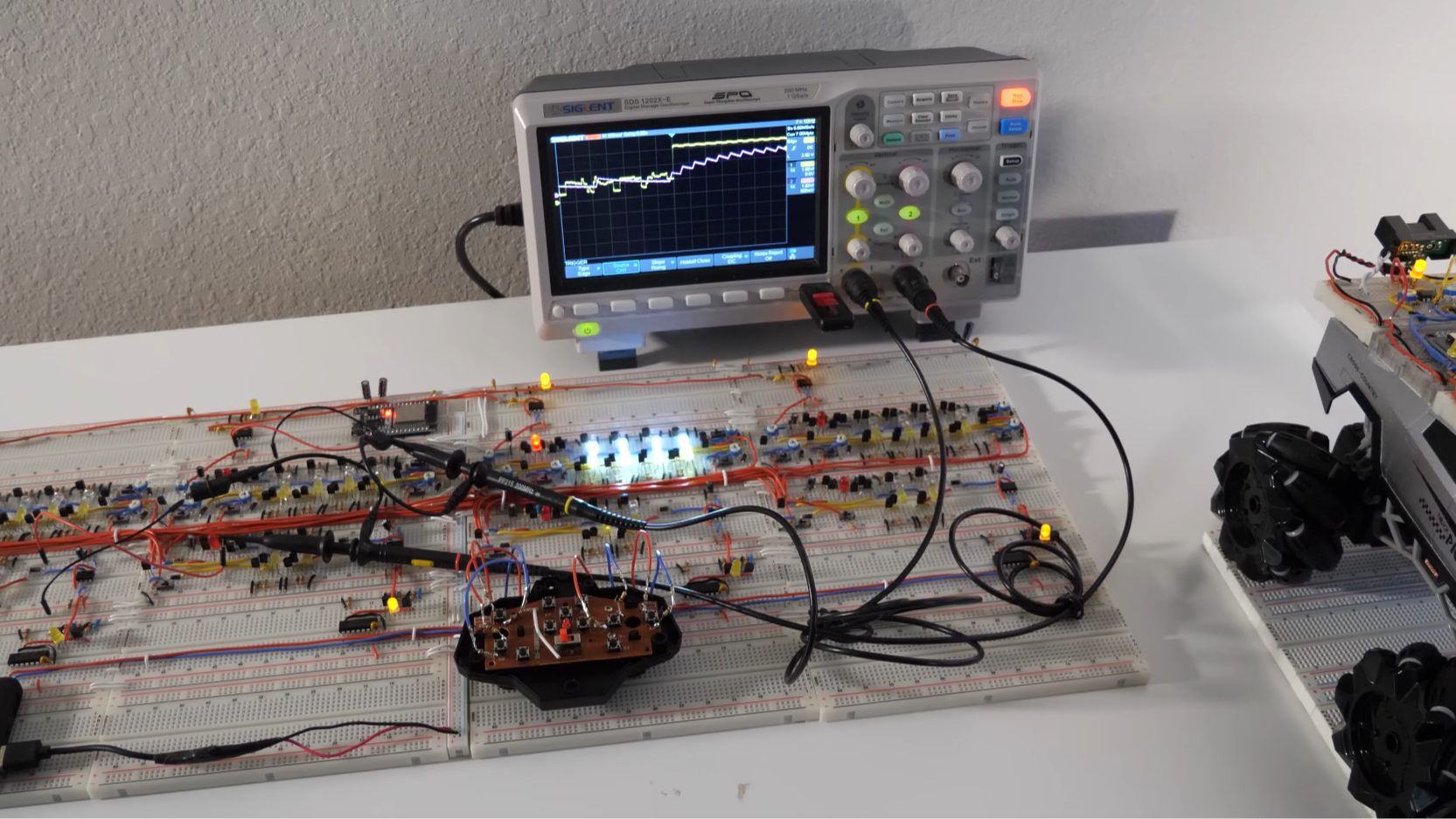
At first glance, the phrase “eight artificial neurons control a fully autonomous toy truck” sounds like a headline escaped from a science fair, a robotics lab, and a tiny parking lot all at once. But the project is real, and it is surprisingly important. A small remote-control truck was modified so that it could sense obstacles, send those signals to an external artificial “brain,” and receive driving commands without a human holding the wheel. The punchline? The brain is not a giant cloud AI model, not a graphics card eating electricity like popcorn, and not a mysterious black box. It is a compact spiking neural network made from only eight artificial neurons.
That is the kind of engineering story that makes people stop scrolling. In an era when artificial intelligence often means billion-parameter models, data centers, expensive chips, and marketing departments using the word “AI” on everything from toothbrushes to toaster ovens, this autonomous toy truck is refreshingly physical. It blinks. It senses. It turns. It avoids obstacles. It behaves. And it does all of that with a tiny neural circuit that feels closer to a biological reflex than a modern chatbot.
The project, known as the GSN SNN 4-8-24-2 Autonomous Vehicle, demonstrates how a spiking neural network can control movement in the real world. The name is not exactly poetry, but it is wonderfully descriptive: four inputs, eight neurons, 24 synapses, and two degrees of freedom in the output. In plain English, the truck has four sensor channels, a small network of artificial neurons, weighted connections between them, and output commands that control direction and motion.
What Makes This Autonomous Toy Truck So Interesting?
The most exciting part of this project is not that a toy truck can avoid obstacles. Hobbyists have been building obstacle-avoiding robots for years using Arduino boards, ultrasonic sensors, infrared modules, and simple “if-this-then-turn-that-way” rules. Those projects are fun, useful, and educational. But this truck is different because its behavior is generated by an artificial neural system rather than a conventional rule-based controller.
The vehicle uses four proximity sensors: one facing forward, one angled toward the front-left, one angled toward the front-right, and one placed at the rear. These sensors detect nearby objects and produce signals that represent the surrounding environment. Those readings are sent wirelessly to the artificial brain, which interprets the situation and decides whether the truck should move forward, reverse, or turn.
Instead of using traditional continuous numerical activations like many artificial neural networks, the system uses spiking neural network behavior. In an SNN, information is represented by discrete pulses, or “spikes.” A neuron does not simply output a smooth number. It fires when its internal state reaches a threshold. That firing pattern can then excite or inhibit other neurons. In other words, timing matters. Frequency matters. The rhythm of activity matters. It is a little like a group chat where nobody writes paragraphs, but the timing of every “ping” changes the conversation.
How Eight Artificial Neurons Can Control Motion
Eight neurons may sound laughably small compared with modern AI systems, but intelligence is not always about size. Sometimes it is about using the right structure for the right job. A cockroach does not need a data center to avoid a shoe. A thermostat does not need a PhD to switch on the heat. A toy truck navigating a simple environment does not need a billion parameters to decide, “Wall ahead, maybe don’t continue straight into it like a determined shopping cart.”
In this autonomous vehicle project, each neuron receives input through synapses. Some synapses are excitatory, meaning they increase the likelihood or rate of firing. Others are inhibitory, meaning they reduce firing activity. This mirrors a fundamental principle of biological nervous systems. Real neurons in animal brains are constantly balancing excitation and inhibition. Too much excitation and the system becomes chaotic. Too much inhibition and nothing useful happens. The magic lives in the balance.
The truck’s “brain” processes the sensor data through this network and produces commands. The outputs are returned to the vehicle through a modified remote-control setup. The result is a toy truck that can operate autonomously, reacting to its surroundings without a human driver. It is not a self-driving car in the commercial sense. It does not recognize pedestrians, read traffic signs, predict cyclist behavior, or argue with city planners. But as a physical demonstration of compact neural control, it is fantastic.
Spiking Neural Networks: The Brain-Inspired Idea Behind the Project
A spiking neural network is often described as the third generation of neural networks. The first generation used simple threshold logic. The second generation, which dominates today’s deep learning boom, uses continuous activations and gradient-based learning. The third generation attempts to model computation more like biological neurons, where information travels as spikes over time.
This matters because the real world is temporal. Sensors do not deliver life as a neat spreadsheet. Robots experience changing light, shifting distance, motor delay, friction, collision risk, and battery limits. Spiking systems are naturally suited to this kind of event-driven information. Instead of constantly calculating everything at full blast, they can respond when something changes. That is one reason neuromorphic computing has attracted interest from companies, universities, and research agencies working on efficient AI hardware.
Neuromorphic computing is the broader field that designs hardware and software inspired by the brain. Intel’s Loihi research chips, IBM’s TrueNorth work, NIST research into neuromorphic hardware, and academic studies of spiking neural networks all point toward the same big question: can machines compute more efficiently by behaving less like traditional computers and more like nervous systems?
The toy truck offers a charming answer on a small scale: yes, at least for certain control tasks, a tiny neural circuit can do meaningful work. It does not replace deep learning. It does not make large AI models obsolete. But it does show that autonomy can be built from simple, interpretable, event-driven components.
Why the Number Eight Matters
The number eight is not magical by itself. The system works because the eight neurons are connected in a purposeful way to the four sensor inputs and the output behavior. Still, “eight neurons” is a powerful reminder that useful robotics does not always require massive computation.
In conventional robotics education, beginners often start with a microcontroller and a loop: read sensor, compare value, choose action. That approach is excellent for learning. But it can become brittle when the environment gets messy. A neural system, even a small one, can create smoother and more adaptive behavior because the output is shaped by interacting signals rather than isolated rules.
Imagine the truck approaching an obstacle slightly to the left. The front-left sensor becomes active, the front sensor may also detect something, and the network’s neurons begin firing in patterns that bias the vehicle away from danger. If the rear sensor detects an obstruction while reversing, the network has additional information to avoid creating a tiny traffic jam with itself. The vehicle is not thinking in a human sense, but it is integrating sensory input into action. That is the core of embodied intelligence.
Hardware: Breadboards, ESP32 Boards, Sensors, and a Modified Remote
One reason this project is so educational is that it does not hide behind polished industrial packaging. The artificial neurons are assembled on breadboards, and the visible electronics make the concept easier to understand. LEDs on the circuitry provide clues about activity inside the system, turning invisible computation into something you can actually watch. For learners, that is gold. For anyone who has stared at a silent black chip wondering if it is working or just judging them, blinking lights are emotional support.
The project uses ESP32 microcontrollers to transmit and receive sensor information. The sensor readings are converted through the ESP32’s analog-to-digital converter, sent wirelessly, and then converted into pulse-width modulation signals. Those signals are filtered and conditioned with analog components such as resistors, capacitors, and op-amps before feeding the artificial neuron circuitry.
This hardware chain is important because it bridges digital communication and analog neural behavior. The sensors produce real-world signals. The ESP32 boards help transport that information. The analog circuit shapes the signal into something the artificial neurons can use. The neural outputs then influence the hacked remote-control interface that drives the truck. It is a hybrid system: part robotics, part electronics, part neuroscience-inspired computing, and part “please don’t let the jumper wire fall out again.”
Why This Is Not Just a Toy
Calling it a toy truck is accurate, but it can also undersell the idea. Many serious technologies begin as small demonstrations. Early aircraft looked fragile. Early computers filled rooms and did less than a wristwatch. Early robots were often clumsy machines that made furniture nervous. The point of a prototype is not to solve every industrial problem immediately. The point is to make an idea visible, testable, and debatable.
This eight-neuron autonomous truck is valuable because it compresses a big idea into a small platform. It shows how sensors, artificial neurons, synapses, wireless communication, and motor commands can become a complete control loop. The truck senses the world, processes signals, and acts. That loop is the heart of robotics.
It also challenges the assumption that “better AI” always means “bigger AI.” For many edge devices, bigger is not better. A warehouse robot, wearable sensor, drone, smart camera, agricultural rover, or medical device may need low latency, low power consumption, and reliable local decision-making. Sending everything to the cloud can introduce delays, privacy concerns, connectivity problems, and battery drain. A small local neural controller may be more practical for narrow tasks.
Artificial Neurons Versus Traditional Code
A traditional obstacle-avoidance robot might use explicit rules. For example: if the front sensor detects an object, stop and turn right. If the right sensor detects an object, turn left. If the rear sensor detects an object, move forward. This is easy to understand and easy to debug, but it can become awkward when multiple sensors activate at once.
An artificial neural circuit handles behavior differently. Inputs influence neurons, neurons influence each other, and outputs emerge from the network’s activity. This can create more fluid behavior, especially when the physical world refuses to follow neat classroom examples. Real floors are uneven. Sensors are noisy. Wheels slip. Objects sit at weird angles. Someone always leaves a chair exactly where the robot planned to feel successful.
That does not mean neural control is automatically better. It can be harder to tune, harder to predict, and harder to explain. The Hackaday discussion around the project included a natural question: how were the parameters set? In this case, they were manually tuned. That is a reminder that small neural systems still require careful design. Neurons are not fairy dust. Synapses are not magic sprinkles. The engineering still matters.
The Educational Value of a Tiny Autonomous Vehicle
For students, hobbyists, and robotics educators, this project is especially useful because it turns abstract AI ideas into physical behavior. A student can read about spiking neural networks for weeks and still feel like the concept is floating somewhere above the clouds. But when a toy truck turns away from an obstacle because a neuron circuit fired differently, the idea becomes real.
The project connects several learning areas at once: analog electronics, microcontroller programming, wireless communication, sensor calibration, motor control, robotics, and neural computation. It also invites experimentation. What happens if you change a synapse from excitatory to inhibitory? What happens if a sensor is moved? What happens if the vehicle drives in a tighter space? What happens when the floor is glossy, the lighting changes, or the battery weakens?
Those questions are not minor. They are the same kinds of questions engineers ask when building larger autonomous systems. Scale changes the stakes, but the logic remains familiar: sense, process, decide, act, measure, improve.
How This Relates to Neuromorphic AI and Edge Robotics
Modern AI has achieved astonishing results, but it often depends on large models, large datasets, and large energy budgets. Neuromorphic computing explores another path. Instead of processing information in dense, clock-driven operations, neuromorphic systems can operate in sparse, event-driven patterns. When nothing important is happening, less computation occurs. When a meaningful signal arrives, the system responds.
That makes spiking neural networks attractive for edge robotics, where devices must operate with limited power and limited hardware. A robot that only needs to avoid obstacles, follow a line, detect vibration, classify a sound, or respond to touch may not need a massive neural model. It may need a small, fast, rugged controller that does one job well.
The eight-neuron truck is a practical demonstration of that philosophy. It does not try to be general-purpose intelligence. It is task-specific, physical, and efficient. It is closer to a reflex arc than a reasoning engine. That is not a weakness. In robotics, reflexes are incredibly valuable. A drone avoiding a branch, a robot arm slowing near a human, or a small rover backing away from a wall all benefit from quick local responses.
Limitations: Let’s Not Put It on the Highway
As exciting as the project is, it is important to keep the claims realistic. This is not a road-ready autonomous vehicle. It does not perform high-level planning, map the environment, identify objects, classify hazards, or learn from large datasets. Its world is small, controlled, and sensor-limited.
The system also depends on manual tuning, external circuitry, and a modified remote-control setup. It is a demonstration platform rather than a consumer product. The four proximity sensors give the network a simple view of the environment, but they do not provide rich perception. If the truck encounters unusual surfaces, transparent materials, complex geometry, or fast-moving obstacles, performance may vary.
Still, those limitations do not reduce the project’s value. In fact, they make it more useful as a learning platform. A small system exposes the trade-offs clearly. You can see where sensing ends, where signal conditioning begins, where neural processing happens, and where motor control takes over. That transparency is rare in modern AI, where models often feel like sealed vaults full of math and mystery.
Why Engineers and Makers Should Pay Attention
The biggest lesson from this project is that autonomy can be built from surprisingly small pieces. Makers often assume that serious robotics requires expensive processors, advanced cameras, or complex software frameworks. Those tools are powerful, but they are not always necessary. A well-designed small system can reveal more than a complicated system that nobody fully understands.
This truck also encourages a healthier way to think about AI. Instead of treating intelligence as something that lives only in giant models, it presents intelligence as behavior emerging from sensors, circuits, timing, feedback, and environment. That is closer to how animals operate. A nervous system is not just a calculator. It is a living control system connected to a body.
For SEO readers searching for artificial neurons, autonomous toy truck, spiking neural network, neuromorphic computing, or AI robotics, this project is a perfect example of where those ideas meet. It is not hype wearing a lab coat. It is a small machine doing a visible job with a tiny brain-inspired controller.
Hands-On Experience: What Building an Eight-Neuron Autonomous Truck Teaches You
Anyone who has built a small robot knows the experience begins with confidence and usually passes through at least one valley called “Why is nothing working?” That is part of the charm. A project like the eight artificial neuron autonomous toy truck teaches lessons that no clean diagram can fully deliver.
The first lesson is that sensors are never as simple as they look on paper. A proximity sensor may behave perfectly on a workbench, then become dramatic when mounted on a moving vehicle. Distance, angle, surface color, reflectivity, lighting, vibration, and wiring all influence the signal. A black object may reflect differently from a white one. A shiny table leg may confuse the sensor. A slightly loose connection can make the truck act like it has developed a personality disorder. Before blaming the neural network, a builder learns to verify the sensor data.
The second lesson is that physical layout matters. Breadboards are excellent for experimentation, but they are also tiny cities of possible mistakes. Long jumper wires can introduce noise. Power rails can become confusing. Ground connections can look correct while secretly ruining your afternoon. When an artificial neuron depends on carefully shaped analog signals, small wiring choices can affect behavior. This is why visible LEDs are more than decoration. They help diagnose what the circuit is doing in real time.
The third lesson is that tuning a neural controller feels different from writing traditional code. In a rule-based robot, you adjust thresholds and commands. In a spiking neural system, you adjust relationships. A stronger excitatory input may make one behavior dominate. Too much inhibition may silence a useful response. A change intended to improve turning may affect reversing. The process feels less like programming a vending machine and more like training a very small electronic animal with no snacks.
The fourth lesson is that autonomy is a loop, not a single decision. The truck senses, processes, acts, then immediately senses again. Every turn changes what the sensors see next. Every motor command affects the next input pattern. That feedback loop is where behavior becomes interesting. Even with only eight neurons, the system can appear more alive than a simple scripted robot because its actions are continuously shaped by the environment.
The fifth lesson is humility. When the truck succeeds, it feels magical. When it drives directly into a box after five minutes of careful tuning, it feels educational in a less flattering way. But that is exactly the point. Robotics teaches that intelligence is not just computation. It is computation under friction, battery sag, noisy signals, imperfect sensors, and real-world timing. The eight-neuron truck is small, but the experience of building and testing something like it gives makers a deep appreciation for why autonomous systems are difficult and why simple, robust designs are worth celebrating.
Conclusion
The eight artificial neurons control fully autonomous toy truck project is a delightful reminder that artificial intelligence does not always need to be enormous to be impressive. By combining four proximity sensors, wireless communication, analog circuitry, 24 synapses, and a compact spiking neural network, the vehicle demonstrates real autonomous behavior in a form that is easy to see and surprisingly easy to appreciate.
Its importance is not in replacing modern self-driving technology or outperforming deep learning. Its importance is in showing another path: small, event-driven, brain-inspired control for physical machines. As neuromorphic computing grows and edge robotics becomes more important, projects like this help bridge the gap between theory and practice. They make AI tangible. They make neurons visible. And they prove that sometimes, eight well-connected artificial neurons can do more than expected especially when the job is keeping a toy truck from enthusiastically headbutting the furniture.
Note: This article synthesizes publicly available engineering, robotics, neuromorphic computing, and maker-project information; source links are omitted for clean web publishing as requested.