The phrase Army’s hypersonic weapon range sounds like something whispered in a Pentagon hallway while someone dramatically closes a folder. In reality, it refers to one of the most important public questions about the U.S. Army’s Long-Range Hypersonic Weapon, now commonly known as Dark Eagle: how far can it reach, why does that range matter, and what does it change for American military planning?
Publicly available information points to a reported range of about 1,725 miles, while some government descriptions use broader language such as more than 2,000 kilometers. The exact performance is not publicly confirmed, which is normal for advanced military systems. Nobody puts the whole recipe for strategic deterrence on a fridge magnet. Still, the publicly discussed range is enough to show why Dark Eagle is a big deal in the Army’s long-range fires portfolio.
Hypersonic weapons are designed to travel at more than five times the speed of sound, but speed is only half the story. The other half is reach. A fast weapon with short legs is impressive, but limited. A fast weapon with long legs can reshape how commanders think about deterrence, theater defense, mobile targets, and crisis response. That is why the Army’s hypersonic weapon range is not just a technical detail. It is the headline act.
What Is the Army’s Long-Range Hypersonic Weapon?
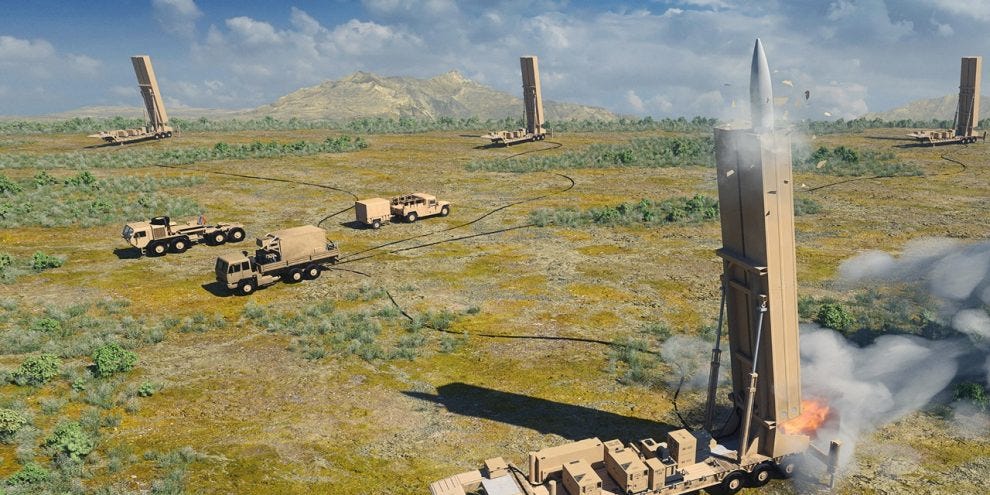
The U.S. Army’s Long-Range Hypersonic Weapon, or LRHW, is a ground-launched, road-mobile weapon system built to deliver a conventional hypersonic glide body over long distances. The Army formally designated the system Dark Eagle in 2025. It is not a nuclear weapon. It is intended to provide a long-range, conventional precision strike option against high-value, time-sensitive, and heavily defended targets.
The system includes much more than a missile. A Dark Eagle battery includes transporter erector launchers, a battery operations center, support vehicles, canisters, fire-control equipment, and the communications architecture needed to plug into Army command-and-control networks. In simpler terms: it is not just a “big rocket on a truck.” It is a mobile strike package with a nervous system.
The Role of the Common Hypersonic Glide Body
Dark Eagle uses a boost-glide concept. A rocket booster accelerates the weapon to hypersonic speed and carries it to the edge of the atmosphere. The booster then separates, and the Common Hypersonic Glide Body, often shortened to C-HGB, maneuvers toward the target at extreme speed. Unlike a traditional ballistic missile that follows a more predictable arc, a hypersonic glide vehicle can maneuver during flight, complicating detection, tracking, and interception.
The Army and Navy share major parts of this hypersonic architecture. The Army’s LRHW and the Navy’s Conventional Prompt Strike program are closely connected, using a common missile approach while adapting launch platforms for different services. This joint development strategy is meant to reduce duplication and speed up fielding. Or, in plain English, the Army and Navy are trying to avoid building two separate expensive science-fiction-looking tools when one shared foundation can do the job.
How Far Can the Army’s Hypersonic Weapon Reach?
The most commonly cited public figure for the Army’s hypersonic weapon range is approximately 1,725 miles. That is roughly the distance from Washington, D.C., to Denver, or from Seattle deep into the central Pacific. Other public government discussions describe the LRHW as having a range of more than 2,000 kilometers. These figures are not necessarily contradictory; one may be more conservative, while the other reflects a broader category of capability.
The important point is that Dark Eagle belongs in the long-range precision fires category. It reaches much farther than traditional Army artillery, farther than many current rocket systems, and beyond the range of weapons designed for tactical battlefield use. This gives the Army a way to influence events across a theater without relying only on aircraft, ships, or fixed bases.
Range Compared With Other Army Fires
For decades, the Army’s strike reach was dominated by artillery, rockets, and missiles designed for battlefield or operational-level use. Systems such as HIMARS gave commanders mobile, precise firepower. The Precision Strike Missile expanded that reach. The Mid-Range Capability, using adapted Navy missile technology, moved the Army into a deeper strike role. Dark Eagle stretches the ladder even further.
Think of the Army’s long-range fires portfolio like a set of golf clubs. You do not use a putter from the tee box, and you do not use a driver on a two-foot tap-in unless you enjoy chaos and broken friendships. Each weapon covers a different distance and mission. Dark Eagle is the long driver: specialized, powerful, and not something you swing casually.
Why Hypersonic Range Matters
Range changes strategy because it changes options. A weapon that can travel well over a thousand miles gives commanders more choices about where to position forces, how to hold adversary assets at risk, and how to respond during fast-moving crises. In contested regions, especially where adversaries deploy anti-access and area-denial systems, long-range weapons can help U.S. forces operate from safer distances while still threatening critical targets.
Anti-access and area-denial, or A2/AD, refers to networks of missiles, radars, aircraft, ships, sensors, and air defenses designed to make it dangerous for U.S. forces to move close to a region. A long-range hypersonic weapon is designed to help crack that problem by reaching defended targets quickly and from farther away.
Speed Plus Range Equals Pressure
Speed alone can be dramatic. Range alone can be useful. Together, they create pressure. A hypersonic weapon that can cover long distances in minutes compresses the timeline for an adversary’s decision-making. It can threaten mobile launchers, command nodes, air-defense systems, logistics hubs, or other high-value targets that may not stay in one place for long.
This does not mean Dark Eagle is a magic wand. Advanced weapons still depend on intelligence, surveillance, targeting data, communications, trained crews, logistics, maintenance, and political approval. A hypersonic weapon without good targeting is like a sports car without a steering wheel: loud, expensive, and deeply unhelpful.
Dark Eagle and the Indo-Pacific Example
The Indo-Pacific is often discussed in relation to Army hypersonic range because geography there is enormous. The region is full of long distances, island chains, maritime chokepoints, and heavily defended areas. A weapon with a reported range around 1,725 miles gives the Army a potential way to support joint operations across broad areas without placing every asset directly on the front porch of an adversary’s missile envelope.
In 2025, the U.S. Army showcased the Dark Eagle system during Exercise Talisman Sabre in Australia. That deployment was important not because it revealed secret performance numbers, but because it demonstrated mobility, command-and-control practice, allied coordination, and the Army’s ability to move the system outside the continental United States. For a weapon whose value depends on theater positioning, that kind of exercise matters.
Range Is Also About Mobility
A road-mobile launcher changes the range equation. The missile has its own reach, but the launcher can also be moved by road, ship, or air transport depending on the operation and available infrastructure. This mobility makes the system harder to predict and gives commanders more flexibility. A fixed missile site is easier to map. A mobile battery is more like a very expensive game of hide-and-seek, except nobody is laughing on the other side.
Mobility also supports deterrence. If an adversary knows that a hypersonic battery could be deployed, repositioned, or integrated into allied exercises, it must plan against more possibilities. Deterrence often works best when the other side has to think twice, then think again, then call a meeting and ask for more coffee.
The Test Range: Where Dark Eagle Proves Itself
The word “range” can also mean the places where the weapon is tested. The Army and Navy have used major U.S. test infrastructure, including the Pacific Missile Range Facility in Hawaii and Cape Canaveral Space Force Station in Florida, to conduct hypersonic flight tests. These test ranges provide controlled environments, tracking systems, telemetry, safety corridors, and instrumentation needed to evaluate performance.
Testing has been a central issue for the LRHW program. Hypersonic systems face brutal engineering challenges: heat, vibration, guidance, materials, booster performance, glide body separation, communications, and manufacturing consistency. At hypersonic speeds, even small design flaws can become very dramatic very quickly. The air does not gently suggest improvements; it files complaints in plasma and pressure.
Recent Testing Progress
After earlier delays and test challenges, the Army and Navy completed successful end-to-end flight testing of the common hypersonic missile in 2024. A December 2024 test was especially notable because it included a live-fire event using the Army’s Battery Operations Center and Transporter Erector Launcher. That means the test was closer to how the Army intends to operate the system, rather than simply proving an isolated missile component.
This matters because a weapon is not truly field-ready just because one part works in a lab. The launcher, crew procedures, command-and-control systems, missile canister, booster, glide body, and targeting process must work together. A full system test is the difference between owning a race car engine and actually finishing a race.
Production, Cost, and the Road to Fielding
Advanced range and speed come with advanced bills. The Congressional Budget Office has noted that hypersonic missiles are likely to cost more than ballistic missile alternatives with similar range and accuracy. The reasons are easy to understand: extreme heat, complex materials, precision guidance, limited production scale, and a supply chain that cannot be built overnight.
In 2024, the Army awarded Lockheed Martin a major contract to support the LRHW system, including launcher-related work, batteries, sustainment, and flight testing support. In 2026, Leidos announced a $2.7 billion Army contract tied to advancing hypersonic weapons from prototyping toward production, including work related to the Thermal Protection Shield and Common Hypersonic Glide Body. These contracts show that the program is moving from experimental promise toward operational reality, though oversight and testing will remain critical.
Why Production Is Hard
Building one advanced prototype is difficult. Building many reliable weapons at scale is harder. Production requires qualified suppliers, stable designs, repeatable manufacturing, quality control, trained maintainers, and enough funding to keep the line warm. Hypersonic glide bodies must survive extreme thermal and aerodynamic stress. That is not exactly the same as stamping out bottle caps.
Scaling production will determine whether Dark Eagle becomes a niche capability or a meaningful part of the Army’s future force. A few missiles may have deterrent value, but commanders need enough inventory, launchers, trained crews, and sustainment capacity to make the system credible in a prolonged crisis.
What the Army’s Hypersonic Weapon Range Does Not Mean
It is tempting to talk about hypersonic weapons as if they make all other systems obsolete. They do not. Aircraft, submarines, surface ships, cyber capabilities, satellites, drones, special operations forces, air defenses, and conventional artillery all still matter. Dark Eagle fills a specific gap: long-range, fast, conventional strike against targets that are valuable, defended, and time-sensitive.
Range also does not remove the need for basing access. Even a long-range missile must be launched from somewhere. Host-nation politics, transport routes, maintenance facilities, communications security, and alliance coordination all shape how useful the weapon can be. The missile may fly at hypersonic speed, but diplomacy still moves at human speed, which is to say: bring snacks.
Targeting Remains the Hard Part
The farther a weapon can fly, the more important targeting becomes. Long-range strike depends on sensors that can find, identify, track, and update targets across large distances. Mobile targets are especially challenging. A launcher, radar, or command vehicle that moves after detection may no longer be where it was when the weapon was fired.
That is why Dark Eagle must be understood as part of a larger kill chain. Satellites, aircraft, drones, electronic intelligence, communications networks, and command authorities all contribute to successful employment. The weapon’s range is impressive, but range without reliable targeting is just geography with attitude.
Strategic Value: Deterrence, Not Just Destruction
The Army’s hypersonic weapon range is strategically valuable because it can deter action before conflict begins. If an adversary believes that key systems can be held at risk quickly and from long distance, it may be less willing to escalate. Deterrence is not only about having destructive power. It is about making the cost of aggression look uncomfortably high.
Dark Eagle also gives the Army a stronger voice in joint operations. Traditionally, long-range strike was dominated by the Air Force and Navy. With LRHW, the Army contributes a land-based option that can complicate adversary planning and support combatant commanders in regions where airfields and ships may be vulnerable.
A Conventional Strategic Signal
Because Dark Eagle is conventional, it occupies an important space between ordinary battlefield fires and nuclear deterrence. It can signal resolve without crossing the nuclear threshold. That does not make it risk-free. Any fast, long-range weapon can create escalation concerns, especially if an adversary has limited time to identify what is incoming. Clear doctrine, command authority, and communication with allies are essential.
In that sense, hypersonic range is not only a technical number. It is a policy question. How should the United States use such a capability? Where should it be deployed? How many should be produced? How should it be integrated with allies? Those questions are as important as speed, altitude, and miles.
Experiences and Practical Lessons Related to Army’s Hypersonic Weapon Range
Looking at the Army’s hypersonic weapon range from a practical perspective, the most useful lesson is that breakthrough technology rarely arrives as a single thunderclap. It arrives through years of testing, delays, redesigns, budget debates, training events, contract awards, and the occasional awkward congressional hearing. Dark Eagle is a reminder that military innovation is less like a superhero landing and more like building a very complicated bridge while people keep asking when it will open.
One experience that stands out is the importance of realistic testing. Early development can prove individual technologies, but full-system testing reveals whether crews, launchers, command posts, canisters, software, communications, and missiles actually work together. The December 2024 test was significant because it involved Army launch equipment and operationally relevant components. That kind of testing matters because soldiers do not fight with PowerPoint slides. They fight with systems that must function under pressure, in weather, on schedules, and with limited room for excuses.
Another lesson is that range creates logistics problems as well as operational advantages. A long-range weapon can influence a wide area, but the battery still needs transportation, security, maintenance, power, communications, spare parts, and trained personnel. Moving a hypersonic battery into a theater is not like carrying a laptop to a coffee shop. It requires planning, permissions, infrastructure, and rehearsals. The 2025 deployment to Australia during Talisman Sabre showed why exercises are so valuable: they expose the practical details that glossy brochures politely ignore.
There is also a human side to the Army’s hypersonic weapon range. Soldiers assigned to these units must learn a new mission culture. Traditional artillery units are used to thinking in miles or tens of miles. Long-range fires units must think across entire regions. That changes how crews understand targeting, timing, communications discipline, and joint coordination. The weapon may be hypersonic, but the people operating it still need training repetitions, clear procedures, and confidence in the system.
A fourth practical experience is that public expectations need careful handling. Hypersonic weapons sound unstoppable, but no weapon is perfect. Weather, intelligence gaps, electronic warfare, supply shortages, maintenance issues, and political constraints can all affect real-world usefulness. Treating Dark Eagle as a miracle weapon would be a mistake. Treating it as a specialized tool with major strategic value is much more realistic.
Finally, the Army’s hypersonic weapon range teaches a broader lesson about deterrence in the modern era: distance is no longer a comfortable shield. Long-range precision fires, hypersonic glide vehicles, space-based sensors, and integrated command networks are shrinking the map. For U.S. planners, that creates opportunities. For adversaries, it creates uncertainty. For everyone else, it is a reminder that the future of defense technology is moving very fastliterally.
Conclusion: Range Is the Real Power Behind Dark Eagle
The Army’s hypersonic weapon range matters because it turns speed into strategy. Dark Eagle is not simply about flying faster than Mach 5. It is about giving the U.S. Army a conventional, mobile, long-range strike option that can reach high-value targets across vast distances, support joint operations, strengthen deterrence, and complicate adversary planning.
Public information suggests a reported range around 1,725 miles, though exact performance remains undisclosed. That range places the system in a category far beyond traditional battlefield fires. Combined with mobility, hypersonic speed, and a maneuvering glide body, Dark Eagle represents a major step in the Army’s push toward long-range precision fires.
At the same time, the weapon’s future depends on more than impressive numbers. Testing, production, cost control, targeting networks, training, basing access, and alliance coordination will determine how effective the system becomes. Dark Eagle may be fast, but building a credible hypersonic force is a marathon wearing rocket boots.
Note: This article is written from publicly available, non-classified information and avoids operational instructions, classified performance claims, or sensitive targeting guidance.