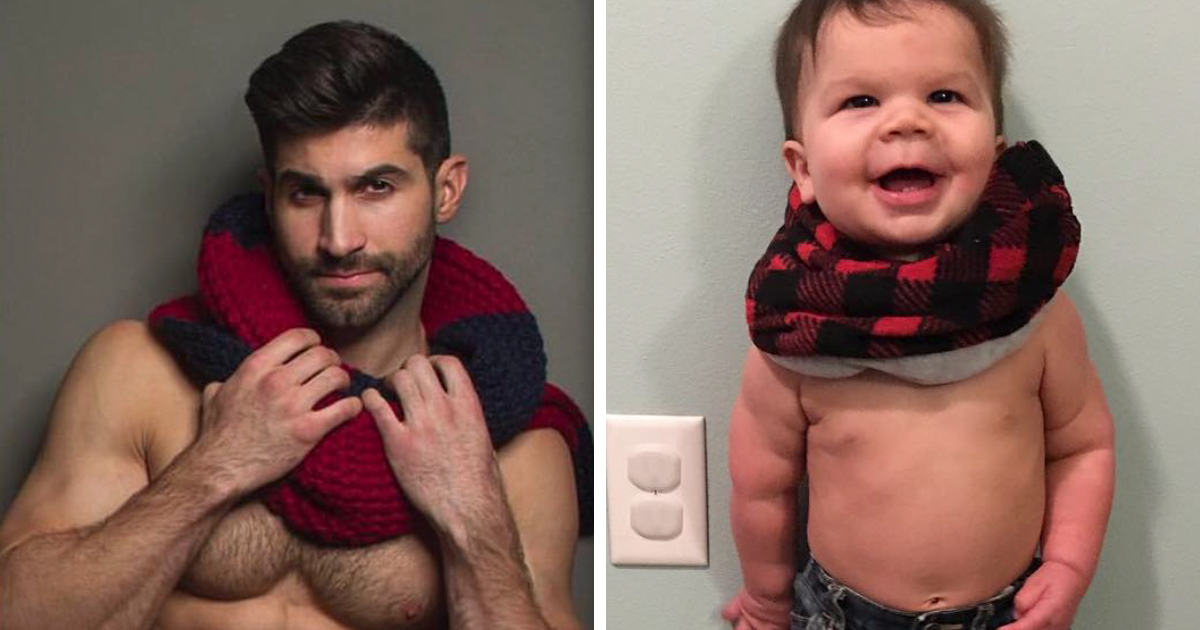
Some family jokes disappear after dinner. Others become an internet treasure, complete with tiny shoes, oversized shirts, dramatic stares, and a toddler who accidentally proves that high fashion has nothing on snack-time confidence. That is exactly what happened when mom Katina Behm began poking fun at her model brother, Aristotle Polites, by having her toddler son, Augie, recreate his polished modeling poses.
The idea sounds simple: take a professional model’s serious photo, dress a toddler in a similar outfit, place both images side by side, and ask the only question that truly matters in modern culture: Who wore it better? The answer, according to much of the internet, is usually “the toddler,” because nobody can compete with chubby cheeks, wobbly balance, and the expression of a child who has absolutely no idea he is participating in peak comedy.
What began as affectionate sibling teasing soon became a viral photo project known as “Baby and the Body,” a funny Instagram-style concept built around contrast. On one side: Aristotle, a model with sculpted angles and professional confidence. On the other: Augie, a small child delivering the same energy with toddler-level commitment and the occasional diaper cameo. Together, they created one of the most hilariously adorable family photo projects online.
The Accidental Beginning Of A Viral Family Joke
Like many internet-famous moments, this one did not begin in a studio, a marketing meeting, or a carefully planned content calendar. It started at home, with a toddler refusing to cooperate with clothing. Katina was trying to get Augie into a plaid button-up shirt, but the shirt stayed awkwardly open. Instead of looking dressed, Augie looked like a miniature romance-novel cover model who had just discovered juice boxes.
Katina noticed the resemblance between her son’s unintentionally dramatic look and the kind of stylish, moody photos her brother posted as part of his modeling career. She searched Aristotle’s photos, found a similar pose, placed the pictures together, and sent the comparison to family members. The joke landed immediately. The family laughed, the “who wore it better?” question became irresistible, and a playful series was born.
The beauty of the project is that it never feels mean. It is not a takedown of modeling, fashion, or Aristotle himself. It is a sibling roast wrapped in a baby blanket. Katina clearly admires her brother, but like any good older sister, she also reserves the sacred right to lovingly mock him. Aristotle, for his part, has taken the joke well, which is crucial. Without his good humor, the project would feel awkward. With it, the whole thing becomes a family comedy act.
Why The Photos Are So Funny
The humor comes from contrast. Aristotle’s pictures often carry the polished seriousness of fashion photography: strong posture, intentional lighting, carefully selected clothes, and expressions that say, “I am thinking deep thoughts near a wall.” Then comes Augie, recreating the same pose with soft toddler limbs, miniature clothes, and the facial expression of someone who may or may not have just been promised crackers.
That mismatch is comedy gold. A dramatic jacket becomes funnier when a toddler is wearing a similar one. A thoughtful hand-near-face pose becomes adorable when Augie copies it with the concentration of a child solving the mysteries of the universe. A shirtless model shot becomes suddenly less intense when the toddler version includes a belly that deserves its own fan club.
The side-by-side format also makes the joke instantly understandable. Readers do not need a long explanation. They see the model pose, then they see the toddler version, and their brain fills in the rest. The humor is visual, quick, family-friendly, and emotionally warm. In an online world often full of arguments, outrage, and comment sections that need adult supervision, this project offers something refreshingly harmless: a baby making high fashion look silly.
Meet The Stars: Aristotle, Augie, And Katina
Aristotle Polites is the model uncle whose photos provided the source material. His pictures are exactly the kind that work well for parody because they have strong shapes, clear styling, and serious model energy. That is not an insult. In fact, it is the reason the recreations work. If the original images were boring, the toddler versions would not have the same punch.
Augie, meanwhile, is the tiny co-star who steals the show without trying. He does not need perfect posture or professional lighting. He has something better: toddler authenticity. When adults pose, they think about angles. Toddlers think about whether socks are optional, whether they can run away, and why adults keep saying “just one more picture.” That innocent unpredictability makes every recreation funnier.
Katina is the creative engine behind the project. She finds the photos, studies the pose, hunts for similar clothing, sets up the toddler-friendly version, and captures the image before Augie decides the shoot is over. Anyone who has photographed a toddler knows this is less like directing a model and more like negotiating with a tiny celebrity who has no manager, no schedule, and very strong opinions about snacks.
The Secret Ingredient: Loving Sibling Teasing
Sibling humor has its own special flavor. It is part affection, part competition, and part “I have known you since before you were cool.” Katina’s project works because it comes from that familiar family dynamic. She is not mocking a stranger; she is teasing her younger brother. There is history there. There is warmth there. There is probably at least one childhood story Aristotle would prefer not to see in print.
The best sibling teasing has boundaries. It pokes fun without trying to wound. It exaggerates without humiliating. It says, “I love you, but also this modeling pose is begging for a toddler remake.” That tone is what keeps the project charming instead of cruel. Aristotle becomes part of the joke rather than the target of it.
In fact, the series makes him more likable. A model who can laugh at himself feels approachable. A family that can turn a professional portfolio into a wholesome running gag feels relatable. And a toddler who can out-pose a grown man without understanding the assignment? That is simply elite-level entertainment.
Why The Internet Fell In Love With “Baby And The Body”
Viral content often succeeds when it is easy to share and easy to feel good about. These photos check both boxes. They are funny at first glance, sweet on a second look, and memorable enough that people want to send them to a friend. The concept is also repeatable. Every new model shot creates a new opportunity for Augie to enter the ring with his toddler interpretation.
The phrase “who wore it better?” gives the audience a role. Viewers are not just looking at photos; they are judging a very unserious fashion battle between a professional model and a small child. That creates instant engagement. People naturally pick sides, leave comments, and argue jokingly that Augie is clearly the superior model because his confidence is more authentic and his accessories are more chaotic.
Another reason the project works is that it blends two popular online categories: cute kids and clever parody. Baby photos are already internet-friendly. Fashion parodies are also internet-friendly. Put them together, and you get a project that feels designed by the algorithm but powered by real family humor. The result is shareable without feeling manufactured.
The Art Of Recreating A Pose With A Toddler
Recreating a professional photo with a toddler is not as easy as it looks. Adults can follow instructions like “tilt your chin” or “look serious.” Toddlers follow instructions like “please don’t eat that” with mixed results. That means the magic of the project depends on flexibility. Katina has to capture the spirit of the original pose, not an exact copy.
Sometimes the clothing is close. Sometimes the angle is close. Sometimes the expression is nowhere near the original, and that makes it even better. A toddler’s half-confused stare can outperform a professional smolder because it is completely unfiltered. He is not trying to look cool. He is simply existing in a tiny outfit while adults laugh nearby.
The best recreations often highlight the smallest details. A similar shirt, a matching hand position, a chair, a pair of boots, a serious gaze, or an accidentally dramatic lean can make the comparison pop. The more polished Aristotle looks, the funnier Augie’s version becomes. The more casual Augie appears, the more the whole thing feels like a tiny rebellion against the seriousness of fashion imagery.
Why Toddler Imitation Is So Endearing
Part of the charm comes from the way young children learn through imitation. Toddlers copy faces, gestures, routines, and behaviors long before they understand the full meaning behind them. That is why a child pretending to talk on the phone, cook dinner, or pose like an uncle can be both funny and developmentally familiar.
In Augie’s case, the imitation is guided by his mom, but the results still feel spontaneous. He brings his own toddler personality to every frame. He is not a miniature adult. He is a child entering an adult visual world and accidentally making it more joyful. That is why the photos do not just parody modeling; they remind us how funny adult seriousness can look when filtered through childhood.
Adults work hard to appear composed. Toddlers are gloriously uncomposed. Adults curate their image. Toddlers may show up with one sock missing and a face full of confidence. That difference is what gives the series its heart.
A Gentle Reminder About Sharing Kids Online
Any viral child-centered project also raises a modern parenting question: how do families share cute moments online while protecting a child’s privacy? The “Baby and the Body” project is playful and positive, but it still fits into a larger conversation about “sharenting,” or parents sharing photos, videos, and stories about their children on social media.
For parents inspired by this kind of project, the takeaway is not “never share.” It is “share thoughtfully.” That means considering privacy settings, avoiding sensitive details like locations or routines, and asking children for permission when they are old enough to understand. It also means keeping the child’s dignity at the center. Cute is great. Embarrassing forever is not.
Katina’s reported approach reflects the spirit of keeping it fun: if Augie is not interested, the photo does not need to happen. That is a healthy creative boundary. A family joke is only charming when everyone involved is safe, respected, and free to opt out. The internet may love a good side-by-side, but no post is worth turning playtime into pressure.
What Parents Can Learn From This Adorable Photo Project
The biggest lesson is that creativity does not have to be expensive or complicated. Katina did not need a studio, a production crew, or a luxury wardrobe. She needed a funny idea, a willing family, a camera, and the patience to work with a toddler. That is encouraging for any parent who wants to make memorable family content without turning the living room into a full media company.
The second lesson is that humor can strengthen family bonds. A shared joke becomes a ritual. A silly photo becomes something grandparents look forward to. A model uncle becomes part of a running gag that connects him with a nephew who may live far away. In that sense, the project is more than internet entertainment. It is a family scrapbook with better punchlines.
The third lesson is that perfection is overrated. The toddler version does not need to match the original perfectly. In fact, the imperfections are the point. A slightly wrong pose, a mismatched outfit, or a facial expression that says “I require applesauce” often makes the final image funnier. Real family life is messy. That is why it is relatable.
Why The Toddler Usually Wins
Let us be honest: Aristotle may have the modeling experience, but Augie has the unfair advantage of toddler cuteness. A professional model can master lighting, posture, and wardrobe. A toddler can simply stand there with a round belly and win the room. It is not a fair competition. It is like bringing a cupcake to a tax audit: suddenly everyone forgets the rules.
Augie’s versions win because they remove the intimidation factor from fashion imagery. Modeling can sometimes feel distant, glossy, and untouchable. A toddler recreation brings it back down to earth. Suddenly, the serious pose is not about perfection. It is about play. It tells viewers that beauty, style, and confidence can be funny too.
That is why the photos have lasting appeal. They are not just cute in a passing way. They gently deflate the seriousness of image culture. They remind viewers that behind every polished photo is a pose that might look hilarious if copied by a child in tiny pants.
Experience Section: What This Story Feels Like For Families, Parents, And Anyone With A Camera Roll Full Of Chaos
For many parents, the “Mom makes fun of her model brother” story feels familiar even if they have never had a model brother to roast. Every family has some version of this: a dad who takes himself too seriously in vacation photos, an uncle with dramatic gym selfies, an aunt who poses like she is launching a perfume campaign in the grocery store parking lot, or a grandparent who accidentally becomes a meme in the family group chat.
The magic is in noticing. A parent sees a funny resemblance, a silly pose, or a tiny moment that could disappear in two seconds. Instead of letting it vanish, they capture it. That is often how the best family memories are made. Not from perfect holiday portraits where everyone is bribed into smiling, but from small accidents: a shirt buttoned wrong, a child wearing adult sunglasses, a toddler copying a yoga pose, or a baby giving a facial expression far too dramatic for someone whose biggest problem is a delayed banana.
Anyone who has tried to photograph children knows the process requires humility. You may begin with an artistic vision. The child begins with a different vision, usually involving leaving the frame. You might want a serious pose. The toddler may want to sit down, run away, inspect a shoe, or suddenly become fascinated by the wall. The final photo is rarely what you planned, but sometimes it is better because it contains real personality.
That is why Augie’s recreations feel so delightful. They capture the unpredictable collaboration between adult imagination and toddler reality. Katina may plan the outfit and setup, but Augie brings the spark. His version is not funny because it is technically flawless. It is funny because it is alive. It has the wiggle, the uncertainty, the confidence, and the “I am only doing this because Mom seems excited” energy that every parent recognizes.
Families can borrow the spirit of this project without copying it exactly. A child can recreate a grandparent’s old school photo, a parent’s awkward yearbook pose, a famous movie poster, or a sibling’s sports-team picture. The goal should not be internet fame. The goal should be shared laughter. When a family creates something silly together, the photo becomes more than content. It becomes a story people retell.
There is also a meaningful lesson for adults: do not be afraid to laugh at yourself. Aristotle’s willingness to be part of the joke makes the project work. If he had taken offense, the whole thing would have collapsed. Instead, his relaxed attitude gives the photos permission to be joyful. That kind of self-awareness is valuable, especially in an online culture where image can become too serious too quickly.
For parents, the best version of a project like this follows a simple rule: keep it fun for the child. If the toddler wants to participate, wonderful. If not, try another day or abandon the idea entirely. The sweetest family humor is never forced. A child’s comfort matters more than the shot. A blurry happy photo is better than a perfect unhappy one.
In the end, the reason this story keeps charming readers is not just because a toddler copied a model. It is because the project turns family love into comedy. It celebrates the ridiculousness of posing, the patience of parenting, the joy of sibling teasing, and the unbeatable power of a toddler who can accidentally outshine a professional model while looking like he might ask for more crackers at any moment.
Conclusion
“Mom Makes Fun Of Her Model Brother By Having Her Toddler Recreate His Poses, And Result Is Hilariously Adorable” is more than a funny headline. It is a perfect example of how a small family joke can become a viral moment when it is creative, warm, and instantly understandable. Katina Behm transformed her brother Aristotle Polites’ polished modeling poses into a playful side-by-side series starring her son Augie, and the internet responded exactly as expected: with laughter, heart emojis, and a general agreement that toddlers are undefeated in the category of accidental fashion comedy.
The project works because it is built on affection. It does not tear anyone down. It lets everyone shine: Aristotle as the stylish model, Katina as the witty mom and creative director, and Augie as the tiny scene-stealer whose charm cannot be taught in modeling school. The result is a reminder that family humor, when done with care, can be one of the most joyful forms of storytelling online.
Note: This article is original, fully rewritten editorial content based on publicly reported details about the “Baby and the Body” photo project and broader context about family humor, toddler imitation, and thoughtful online sharing.