Some family heirlooms arrive in velvet boxes. Others arrive folded, faintly creased, and smelling like a cupboard that has been guarding secrets since approximately the invention of soup. For German-born weaver Annette Aylward, heritage did not announce itself with a brass band. It came quietly, in the form of old homespun linens from her familysheets, towels, tablecloths, and the sort of practical household textiles that once lived very busy lives before “decorative storage basket” became a personality type.
Aylward grew up in rural Hessen, Germany, where weaving was not merely an aesthetic hobby but part of family memory. Her great-grandparents had worked with flax, spinning and weaving it into household necessities. Like many traditional crafts, the practice faded as commercial cloth became widely available after World War II. But once Aylward moved to the United States and received family linens from home, the old thread pulled at her. Eventually, in Northern California, she began weaving by hand and turned that revived inheritance into Annette Aylward Woven Goods, a small studio practice centered on 100 percent linen, careful texture, and everyday usefulness.
This is the charm of woven heritage: it refuses to sit politely behind museum glass. It wants to wipe a counter, cover a table, soften a kitchen bench, and survive the laundry. In Aylward’s story, German textile tradition does not remain frozen in the past. It travels, adapts, learns a new accent, and settles into American domestic life with the quiet confidence of a linen towel that knows it is better than paper towels but is too polite to say so.
From Hessen Farm Life to a Northern California Loom
The phrase “family tradition” can sound sentimental, but in textile history it often means workreal work, shoulder work, hand work, foot-pedal work. In rural European households, flax was grown, processed, spun, and woven long before linen became a lifestyle keyword attached to breezy curtains and $18 toast. Aylward’s family history fits into that broader pattern. Her great-grandparents’ weaving business transformed flax into practical cloth for sheets, tablecloths, towels, and clothing. These were not precious objects in the modern boutique sense. They were tools for living.
When Aylward later encountered the family’s homespun linens, she met more than fabric. She met evidence. Every thread carried proof that someone had measured, warped, thrown the shuttle, checked the edge, and made something durable enough to outlast fashion. That realization inspired her to learn weaving herself. The result was not a costume-drama reenactment of village life but a contemporary craft business that keeps the spirit of the tradition alive in a modern American setting.
Her Northern California studio is part of a larger movement in American craft: the return to slower, more traceable goods. Consumers who once bought textiles by color and price alone are increasingly curious about fiber, origin, production, and longevity. A handwoven linen towel is not just a towel; it is a small rebellion against disposable convenience. It says, “I am here for the long haul,” which is more than can be said for most kitchen sponges and several dating apps.
Why Linen Still Matters
Linen is made from flax, one of the oldest textile fibers used by humans. Its enduring appeal is not accidental. Linen is strong, absorbent, breathable, quick-drying, and naturally lustrous. Textile references commonly describe linen as one of the best-wicking natural fibers, which helps explain why it has long been used for towels, summer clothing, bedding, and household cloth. It wrinkles, yesbut that is not a flaw so much as a personality. Linen wrinkles the way wise people smile: visibly, honestly, and with no apology.
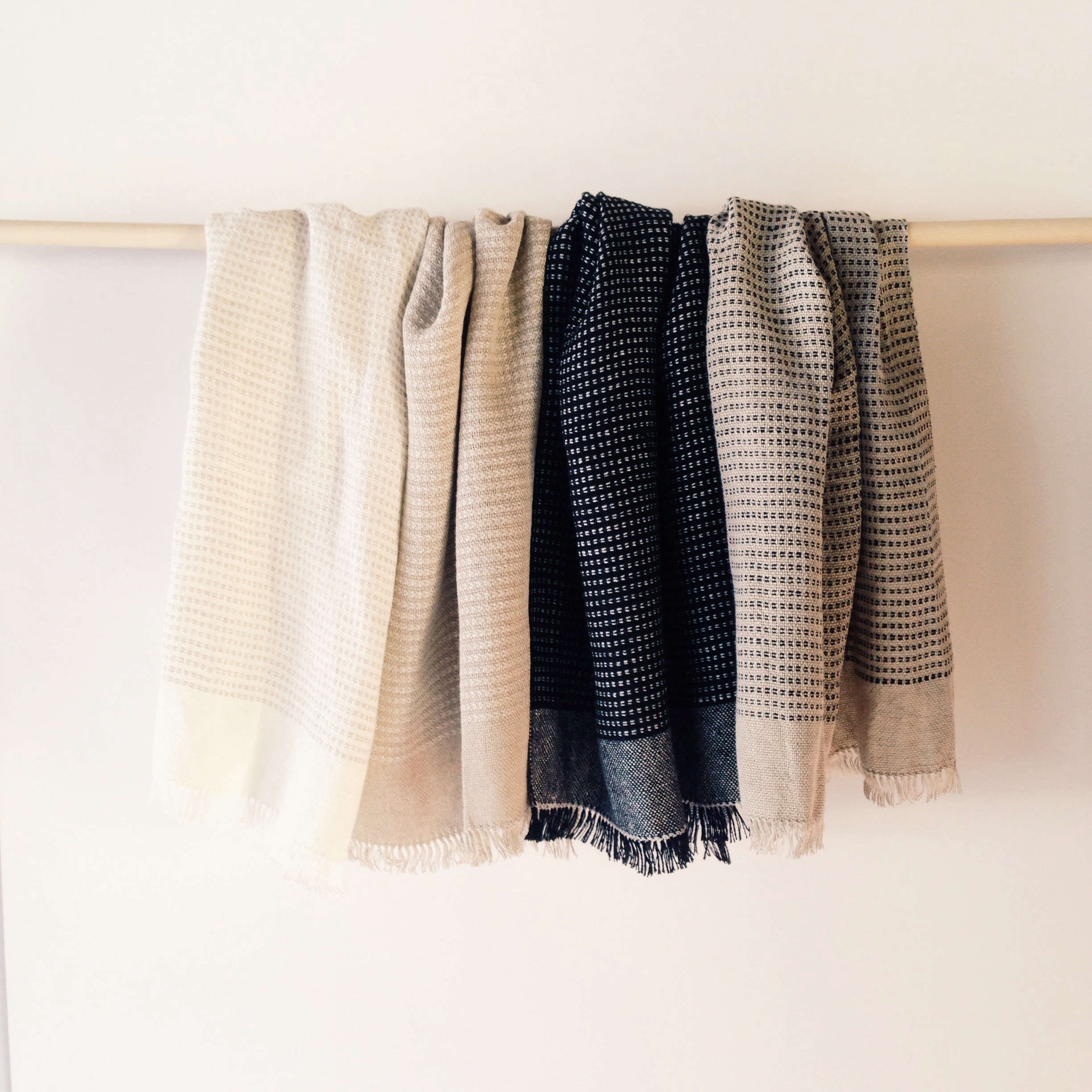
For household use, linen’s strength is a serious advantage. A good linen towel can become softer with washing while retaining structure. That makes it ideal for the kitchen, where textiles must endure water, heat, soap, repeated laundering, and the occasional mystery stain that nobody in the house will confess to creating. Aylward’s work highlights these practical qualities rather than hiding them. Her towels, pillows, and potholders celebrate the tactile character of handwoven cloth: subtle irregularity, weight, drape, and the visible rhythm of the loom.
In the age of mass production, we often confuse sameness with quality. Handwoven linen argues for a different standard. Its beauty lies in precision plus life. The maker’s control is present, but so is the hand. A slight variation in texture is not a manufacturing error; it is a signature. The cloth has not been bullied into anonymity by a factory line. It has been coaxed into usefulness by a person who understands yarn, tension, and patience.
German Weavers and the American Textile Story
Aylward’s journey also belongs to a much older German-American textile story. German immigrants brought many skills to the United States, including farming, education, music, science, and the arts. In cities, German Americans worked in craft trades and needle trades; in rural settlements, textile knowledge often traveled with families who needed cloth for everyday life. Pennsylvania, in particular, became a major region for German-speaking settlers, and textile production formed part of that material culture.
American coverlets offer one of the clearest examples of immigrant weaving traditions taking root in the United States. Museums note that many professional coverlet weavers were immigrants from European weaving centers. German-trained weavers, especially those associated with Pennsylvania and later westward movement into Ohio and Indiana, were known for linen-weaving backgrounds and techniques related to damask structures. Their work contributed to a distinct American coverlet tradition that flourished from the colonial period through the nineteenth century.
These coverlets were more than blankets. They were technical documents, family records, and design statements. Some included names, dates, locations, flowers, birds, buildings, and patriotic motifs. The introduction of Jacquard mechanisms in the United States during the 1820s helped weavers create more elaborate figured designs. Imagine a nineteenth-century weaver discovering new pattern technology and thinking, “Excellent, now I can put an eagle, a tree, and my client’s name on a bedcover.” That is not minimalism. That is textile confidence.
The Bauhaus Thread: When Weaving Became Modern Art
No discussion of German weaving in America is complete without Anni Albers. Born in Berlin, trained at the Bauhaus, and later a faculty member at Black Mountain College in North Carolina, Albers helped change how the art world understood weaving. At the Bauhaus, weaving was often treated as a women’s workshop, but Albers turned that limitation into a powerful design language. After the Bauhaus closed under Nazi pressure in 1933, Anni and Josef Albers came to the United States, where she taught weaving and textile design from 1933 to 1949.
Albers approached the loom as a tool for thinking. Her work explored structure, material, pattern, and function, blurring the line between craft and fine art. She used natural and synthetic fibers and helped establish textiles as a serious modern discipline. Her influence is important because it gives contemporary handweavers a broader vocabulary. A towel can be useful; a wall hanging can be conceptual; a pillow can carry geometry; a woven surface can be both domestic and intellectually sharp. The loom, in other words, is not a quaint machine from grandmother’s attic. It is a design laboratory with pedals.
Aylward’s work is more domestic and intimate than the museum-scale legacy of Albers, yet both stories share a meaningful connection: German textile knowledge finding new life in America. One is rooted in family linen and household use; the other in modernist education and fine art. Together, they show how weaving can move across borders, classes, and purposes without losing its central magicthe transformation of thread into meaning.
Handwoven Goods in a Fast-Click World
To appreciate Aylward’s work, it helps to understand the modern craft economy. Handweaving is slow. It requires planning the warp, dressing the loom, testing tension, weaving row by row, finishing the cloth, washing, pressing, cutting, sewing, and occasionally staring into the middle distance while wondering why one thread has decided to behave like a tiny anarchist. This is not a process built for instant gratification.
That slowness is exactly the point. A handwoven linen towel asks buyers to value labor they can feel. It invites a shift from “How cheap can this be?” to “How long can this last, and who made it?” Organizations such as the Handweavers Guild of America, Textile Center in Minnesota, and Craft in America have helped preserve and promote fiber arts through education, exhibitions, public programs, and storytelling. Their work matters because craft traditions survive when people can learn them, practice them, and see them respected.
American fiber art has also gained greater recognition in museums. Exhibitions focusing on fiber work by women have challenged the old dismissal of cloth as merely domestic or decorative. Cotton, wool, linen, felt, thread, and yarn are now understood as materials capable of carrying personal, political, cultural, and aesthetic meaning. This wider recognition benefits makers like Aylward, whose work lives at the intersection of utility, memory, design, and heritage.
Design Lessons from Annette Aylward’s Woven Goods
1. Let the Material Speak
Aylward’s linen goods do not rely on loud decoration. Their appeal comes from fiber, weave, tone, and texture. This restraint reflects a mature design philosophy: when the material is good and the technique is honest, the object does not need to shout. It can simply sit there looking elegant while the plastic dishcloth across the room reconsiders its life choices.
2. Make Everyday Objects Worth Noticing
The best handmade textiles improve daily rituals. Drying a glass, setting out bread, resting a warm pan, or leaning against a kitchen pillow becomes a small moment of contact with craft. These objects do not demand ceremonial treatment. They earn affection through use.
3. Keep Heritage Flexible
Aylward did not recreate her great-grandparents’ business exactly. She translated it. That distinction matters. Living tradition is not copying the past perfectly; it is carrying forward what still has energy. Her work keeps the family thread intact while allowing it to belong to California kitchens, modern interiors, and contemporary consumers.
4. Build Beauty Around Function
In good textile design, usefulness is not the enemy of beauty. It is the foundation. A towel that absorbs well, dries quickly, washes beautifully, and feels good in the hand has already achieved a kind of elegance. The pattern is a bonus; the performance is the plot.
Why This Story Resonates with Today’s Homeowners
Modern homes are full of things, but not always full of meaning. We own gadgets that beep, baskets that pretend to organize us, and decorative objects whose only job is to be moved when dusting. Handwoven linen offers something different: a useful object with a visible relationship to time, place, and maker.
That is why Aylward’s story feels especially relevant now. It speaks to people who want homes that feel collected rather than assembled overnight by algorithm. It appeals to readers interested in sustainable home goods, slow living, handmade textiles, German heritage, linen towels, and American craft traditions. These are not separate interests; they overlap in the growing desire for objects that are practical, beautiful, and rooted in a story.
There is also an immigrant dimension that gives the story emotional depth. Moving countries often means losing easy access to family places, familiar language, inherited routines, and the small domestic habits that shape identity. Craft can become a bridge. For Aylward, weaving connected rural Hessen, family memory, and her American life. In that sense, each piece of linen is not only a product. It is a map.
Experiences Related to Woven Heritage and Rediscovering Family Craft
Anyone who has tried to revive a family tradition knows the first step is rarely glamorous. It usually begins with a box. The box may be in an attic, a basement, a garage, or a closet where holiday decorations go to form emotional support groups. Inside are old linens, photographs, tools, recipes, handwritten notes, or objects whose purpose is unclear but whose importance is somehow obvious. You lift one piece out and think, “I don’t fully understand this, but I know I should not throw it away.”
With textiles, the experience is especially intimate because cloth keeps the shape of use. A linen towel may have softened at the fold. A tablecloth may carry faint marks from meals long finished. A woven edge may reveal the maker’s discipline more clearly than any signature. When people rediscover family weaving, embroidery, quilting, or sewing, they often rediscover the labor of relatives they knew only through names. Suddenly, an ancestor is not just a date on a family tree. She is the person who hemmed that cloth straight enough to make you feel slightly judged.
The learning curve can be humbling. A beginner at the loom quickly discovers that weaving is both simple and wildly complex. Over, under, over, undereasy, right? Then come sett, tension, threading errors, broken warp threads, drawdowns, selvedges, finishing, shrinkage, and the mysterious ability of yarn to tangle while apparently sitting still. The loom teaches patience because it gives you no alternative. You cannot rush a warp into cooperation. You can only work with it.
That patience becomes part of the emotional reward. The first finished piece may be uneven, too tight at one edge, and slightly shorter than planned. Still, it carries an astonishing feeling: “I made cloth.” Not decorated cloth. Not purchased cloth. Made it. That experience changes how you see every textile in your home. The dish towel, the bedsheet, the curtain, the napkineach becomes evidence of human ingenuity. Even machine-made fabric begins to look less ordinary once you understand the ancient logic behind interlaced threads.
For immigrants and descendants of immigrants, reviving craft can also restore a sense of continuity. You may not live in the same village, speak the old dialect, or cook exactly as your great-grandparents cooked. But when your hands repeat a motion they might recognizespinning, weaving, stitching, mendingyou create a physical conversation across time. It is quiet, but it is not small. Heritage becomes something you do, not merely something you claim.
This is the larger gift of Aylward’s story. It encourages us to look again at the practical arts in our own families. Maybe your inheritance is not weaving. Maybe it is woodworking, gardening, bread baking, lace making, canning, boat repair, or the sacred family skill of stretching leftovers into a meal that somehow tastes intentional. Whatever the tradition, the question is the same: what knowledge is waiting to be picked up, unfolded, and used again?
Conclusion: A Thread That Crossed the Ocean
“Woven Heritage: A German Emigre Rediscovers a Family Tradition in the States” is more than a beautiful design story. It is a reminder that craft can carry identity across geography and generations. Annette Aylward’s handwoven linen goods connect rural Hessen, family flax traditions, American studio craft, and the modern appetite for meaningful home goods. Her work proves that heritage does not need to be loud to be powerful. Sometimes it is folded in a drawer, waiting for someone to notice the thread.
In a culture that often rewards speed, handwoven linen makes a persuasive case for slowness. It asks us to value materials, skill, memory, and use. It brings German weaving tradition into the American home not as nostalgia, but as living design. And perhaps that is the best kind of inheritance: one that does not merely tell us where we came from, but gives us something useful to carry forward.