Every face has a tiny animated movie hiding inside it. Some people look like they are one dramatic wind gust away from singing on a balcony. Others clearly belong in a cozy forest cottage with a talking raccoon who gives questionable life advice. That is the fun behind painting real people as Disney-worthy cartoon characters: you are not just copying a photo. You are translating a personality into a character that feels ready to wink, sparkle, trip over a sidekick, and somehow still look heroic.
This project turns 26 people into polished, storybook-style cartoon portraits inspired by the charm of classic animated character design. The goal is not to make exact copies of existing animated icons, but to capture the same ingredients that make animated portraits so irresistible: expressive eyes, soft shapes, dramatic lighting, warm color palettes, and a little bit of theatrical exaggeration. Think of it as portrait painting after it drank a large cup of fairy-tale coffee.
Behind the cuteness, however, there is real technique. A strong cartoon portrait needs observation, anatomy, color theory, digital painting skills, and a careful sense of what makes each person unique. When the process works, the result feels familiar and fantastical at the same time: still recognizably human, but with the emotional volume turned up.
What Makes a Portrait Feel Disney-Worthy?
A Disney-worthy cartoon portrait usually begins with appeal. In animation, “appeal” does not simply mean “pretty.” It means the character is clear, memorable, and pleasant to look at. The viewer understands the face quickly. The eyes lead the expression. The silhouette is readable. The shapes feel intentional. Even a villain, a grumpy uncle, or a suspiciously judgmental cat can have appeal if the design is strong enough.
For real-person cartoon portraits, this means the artist must balance likeness with exaggeration. Too realistic, and the image becomes a regular digital painting. Too exaggerated, and the person disappears into generic cartoon soup. The sweet spot sits somewhere in the middle: the nose might become softer, the eyes larger, the hair more sculpted, and the smile brighter, but the subject’s recognizable features remain intact.
The Project: 26 People, 26 Little Main Characters
Painting 26 people in this style is like casting an animated universe one face at a time. Each person brings a different challenge. One has striking eyebrows that deserve their own agent. Another has curls that could easily become a cloud, a crown, or a small weather system. Someone else may have a quiet smile that needs subtlety rather than sparkle fireworks.
The best portraits in this genre do not rely on one formula. They respond to the subject. A shy person might become a soft, dreamy character with gentle lighting and rounded shapes. A bold personality may call for sharper eyebrows, stronger contrast, and a more dramatic pose. A playful subject might get bright highlights, lifted cheeks, and eyes full of mischief. The magic is not in making everyone look the same; it is in making everyone look like they walked out of their own animated story.
From Photo Reference to Cartoon Personality
The first step is observation. Before sketching, the artist studies the reference photo and asks: What feature makes this person instantly recognizable? Is it the eyes, the jawline, the smile, the hairstyle, the cheek shape, or the way they tilt their head? A cartoon portrait succeeds when it protects that signature feature.
After that comes simplification. Human faces are full of tiny details: pores, uneven lighting, stray hairs, shadows, under-eye texture, skin tone variations, and expressions that change from second to second. Cartoon design filters all of that into clean visual information. Instead of painting every eyelash, the artist chooses the lashes that matter. Instead of copying every strand of hair, the artist groups the hair into elegant shapes. Instead of rendering every skin texture, the artist builds soft gradients and carefully placed highlights.
The Eyes Do Most of the Acting
In this type of character art, the eyes are the emotional headquarters. Bigger eyes allow more room for highlights, color shifts, and expression. A tiny change in eyelid angle can turn “friendly” into “suspicious,” “hopeful” into “about to cry,” or “confident” into “I definitely know where the snacks are hidden.”
When painting real people, the eyes should be exaggerated without becoming strangers. The artist may enlarge them, brighten the iris, simplify the lashes, and deepen the shadow under the upper lid. But the gaze still has to feel like the person. That is where the portrait becomes more than decoration. It becomes character design.
Shape Language Gives the Portrait Its Mood
Animated characters often use shape language to communicate personality. Rounded shapes feel friendly, soft, and approachable. Triangular shapes can feel energetic, sharp, or mischievous. Square shapes suggest strength, steadiness, or reliability. In portrait painting, these ideas help guide the design without turning the person into a symbol.
For example, a gentle subject might be painted with rounded cheeks, soft hair shapes, and curved shoulders. A confident subject might receive stronger angles in the brows, a lifted chin, and a bolder silhouette. The trick is subtlety. You are not building a traffic sign. You are building a person who looks like they might burst into a musical number if the lighting hits just right.
Color Turns a Face Into a Scene
Color is where the transformation really starts to glow. A normal photo may have flat indoor lighting or harsh shadows. A cartoon portrait can reimagine the face with warm rim light, jewel-toned backgrounds, rosy cheeks, golden highlights, or cool blue shadows. This is why digital painting works so well for the style. With layers, brushes, blending modes, and careful color adjustments, the artist can push the mood far beyond the original photo.
Vibrant color does not mean dumping a rainbow on the canvas and hoping for applause. Good color needs control. Skin tones should feel alive. Hair should have volume. Eyes need contrast. Backgrounds should support the subject rather than wrestle them for attention. A great portrait uses color like a movie score: you may not notice every note, but you feel the emotion.
Why the Results Feel So Charming
People love these transformations because they combine recognition and fantasy. You recognize the real person, but you also see a version of them that feels more cinematic, more expressive, and slightly more likely to own a magical necklace. This taps into the same pleasure people get from avatars, caricatures, costume portraits, and illustrated profile pictures. We enjoy seeing ourselves reimagined.
There is also nostalgia involved. Many adults grew up with animated films where faces were designed to communicate emotion instantly. Large eyes, clear expressions, and soft lighting can make a portrait feel warm and familiar even when the character is completely original. It reminds viewers of childhood storytelling without needing to copy any specific character.
That familiarity is powerful. It makes the artwork easy to share, easy to understand, and easy to love. A polished cartoon portrait says, “Here is who you are, but with better lighting and fewer emails.” Honestly, that is a service society needs.
The Tools Behind the Magic
Although the final images may look effortless, this kind of artwork is not a one-click filter. A strong digital portrait usually involves a drawing tablet, painting software such as Photoshop or similar tools, and many stages of refinement. The artist often begins with a rough sketch, adjusts proportions, blocks in flat colors, builds shadows, adds highlights, paints hair volume, refines facial details, and then polishes the final lighting.
Layers are especially useful. They allow the artist to separate the sketch, base colors, shadows, highlights, background, and special effects. This makes experimentation safer. If a highlight looks too intense, it can be adjusted. If the hair color needs more warmth, it can be changed without repainting the whole portrait. If the background suddenly looks like radioactive pudding, the artist can quietly fix it and pretend nothing happened.
Brush choice also matters. Soft brushes help with skin transitions. Textured brushes can add painterly movement to hair and clothing. Harder brushes define edges around the eyes, mouth, and silhouette. The best digital paintings often mix clean rendering with visible brush energy, so the portrait feels polished but not plastic.
Specific Examples of Cartoon Transformation
Imagine a portrait of someone with thick curly hair. In a realistic painting, the artist might render hundreds of strands. In a cartoon version, the curls become big, rhythmic shapes with bright highlights and deep shadow pockets. The result keeps the subject’s hair identity while making it feel animated and sculptural.
Now picture someone with a small, reserved smile. A careless cartoonist might turn that into a giant grin and lose the person’s personality. A better approach would be to keep the smile modest, lift the cheeks slightly, soften the eyes, and use warm lighting to suggest kindness. Not every character needs to look like they just won a kingdom and a bakery.
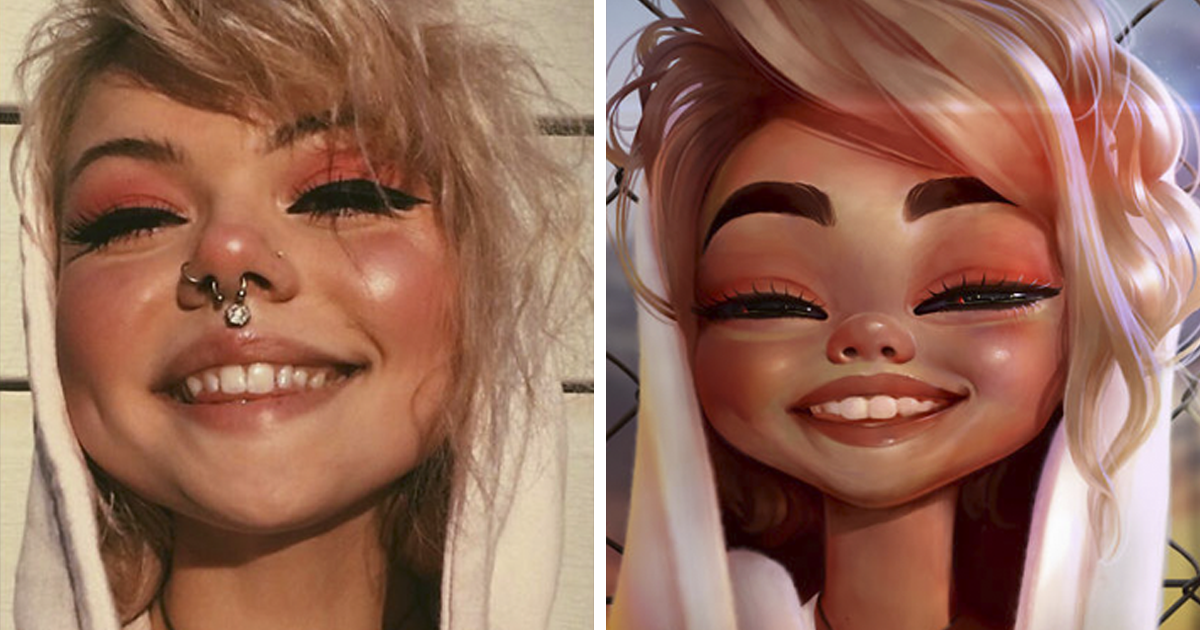
For a person with dramatic makeup, bold eyeliner, or colorful hair, the cartoon version can push the design further. The colors can become more saturated, the eye shape more graphic, and the lighting more theatrical. These details help the portrait feel like concept art for a character who already has a theme song.
What Artists Can Learn From This Style
The biggest lesson is that style is not a shortcut around fundamentals. Disney-worthy cartoon portraits still depend on drawing, anatomy, lighting, and composition. The artist needs to understand the real face before simplifying it. Exaggeration works best when it is based on truth.
Another lesson is restraint. It is tempting to enlarge every eye, shrink every nose, polish every cheek, and add sparkles until the artwork needs its own electrical bill. But charm comes from selective emphasis. Choose one or two features to celebrate. Let the rest support the design.
Artists should also be mindful of originality and intellectual property. “Disney-worthy” can describe a level of polish, warmth, and animated appeal, but original artists should avoid copying protected characters, costumes, logos, or exact studio designs. The safest and most creative route is to build an original portrait inspired by broad animation principles: expressive acting, strong shapes, appealing color, and clear storytelling.
Why People Love Seeing Themselves Animated
A painted cartoon portrait can feel surprisingly personal. It shows someone not as they appear in a rushed phone photo, but as they might appear in a story. That story could be adventurous, romantic, funny, mysterious, or sweet. The portrait gives the subject permission to be seen with a little more wonder.
This is why the format performs so well online. Before-and-after images are instantly understandable. Viewers love comparing the original photo with the finished artwork. They look for what changed, what stayed, and how the artist solved the puzzle of likeness. It is satisfying in the same way as a makeover show, except nobody has to cry in a mirror while dramatic piano music plays.
There is also a generous feeling behind the art. To paint someone this way is to say, “I noticed what makes your face special.” That can be more meaningful than simple flattery. It is observation turned into affection.
Experience Notes: What Painting 26 People Teaches You
Working on 26 cartoon portraits teaches patience very quickly. At first, every face looks like a fun little adventure. By portrait number seven, you realize hair has more opinions than most people. By portrait number twelve, you understand that capturing likeness is not about copying every feature; it is about finding the two or three details that carry the whole identity. By portrait number twenty, you are negotiating with eyelashes like a tired diplomat.
The most valuable experience is learning to see people as designs without reducing them to designs. A real person is not just a set of eyes, a nose, and a mouth. They have posture, mood, attitude, and energy. Some people look calm even when smiling. Others look mischievous even in a neutral photo. Some have faces built for soft light, while others come alive with strong contrast. The artist has to notice these things before touching the canvas.
Another lesson is that references are helpful, but they are not the boss. A photo may have bad lighting, awkward shadows, or a strange angle. The artist’s job is to respect the person while improving the presentation. That might mean adjusting the head tilt, clarifying the jawline, simplifying the hair, or adding a more flattering color scheme. The final portrait should feel like the person on their best animated day, not a photocopy wearing cartoon makeup.
Painting many people also reveals how different “cute” can be. Cute does not always mean round cheeks and huge eyes. Sometimes it is a tiny smirk. Sometimes it is a serious gaze softened by warm color. Sometimes it is a messy bun that gives the whole character life. The more portraits you paint, the less you rely on one recipe.
There is also a technical rhythm that develops. Sketch loosely, check likeness early, block large shapes, choose the color mood, refine the face, polish the eyes, then step back before overworking everything. The stepping back part is important. Digital artists are brave, but they are also fully capable of zooming in at 300 percent and spending forty minutes painting a nostril highlight no human will ever notice.
Most of all, painting 26 people teaches humility. Some portraits come together quickly. Others fight back. A face that seems simple may be difficult because its charm is subtle. A dramatic face may be easier because the design clues are obvious. Every subject teaches something new about exaggeration, restraint, and emotional honesty. The final collection becomes more than a gallery of cute characters. It becomes a record of looking carefully, painting thoughtfully, and trying to make each person feel like the hero of their own little animated world.
Conclusion
Painting 26 people as Disney-worthy cartoon characters is more than a cute art challenge. It is a study in likeness, storytelling, color, and emotional design. The best results happen when the artist keeps the person recognizable while gently pushing the portrait into a more magical, animated world. Larger eyes, softer shapes, glowing light, and expressive poses all help, but the real secret is attention. A memorable cartoon portrait begins with noticing what makes someone different.
That is why these transformations are so satisfying. They remind us that everyone has main-character potential. Some people just need better rim lighting, a dramatic eyebrow, and maybe a tiny woodland sidekick who handles scheduling.
Note: This article is based on publicly available information about digital portrait transformation, animation-inspired character design, and general visual art practices. It is not affiliated with, endorsed by, or sponsored by Disney or Pixar.