Some puzzles are background noise. You pour out the pieces, put on a show, and two hours later you’ve accidentally “watched” three seasons of something you’ll never recommend to anyone. Wish You Were Here by Amber Vittoria (COLLECTION NO. 1) is the opposite: it’s a puzzle that asks you to actually show upeyes, hands, and a tiny bit of patience included.
This 500-piece art puzzle turns a bold, geometric portrait into a satisfying little ritual: assemble it and you get a vibrant, figure-driven artwork; scatter the pieces and it becomes abstract color therapy in a box. In this guide, we’ll break down what makes the piece special, what you can expect from the experience, and how to get the most out of itwhether you’re a seasoned puzzler or someone who still thinks sorting is “optional.”
What “Wish You Were Here” Actually Is (and What You Get)
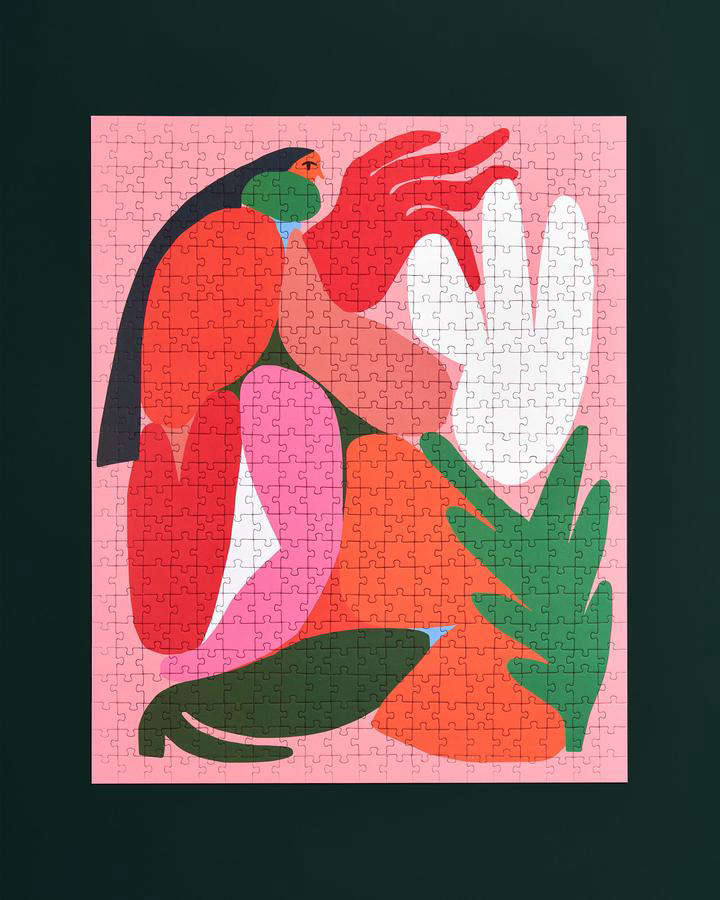
Wish You Were Here is a 500-piece jigsaw puzzle featuring artwork by Amber Vittoria, released as part of Ordinary Habit’s COLLECTION NO. 1. It’s positioned as a design-forward puzzlesomething you’d happily leave on a coffee table even when it’s not being solved.
Key specs at a glance
- Piece count: 500 pieces
- Finished size: 16” x 20”
- Box size: 9 ½” x 7 ¾”
- Finish: soft-touch, glare-free coating
- Extras: drawstring cloth bag + artwork postcard
- Materials: made with recycled materials
Those details matter more than they sound. A glare-free finish makes long sessions easier on the eyes (especially under overhead lights), and the included postcard is a small gift to your future self when you’re trying to confirm whether that shape is “teal” or “slightly different teal.”
Meet Amber Vittoria: The Artist Behind the Color
Amber Vittoria is an artist, poet, and author known for vibrant gradients, expressive simplified forms, and work that explores emotion, beauty, and social expectations. Her style often combines fluid color with crisp lineworkan approach that translates especially well into puzzles because it gives you both “big picture” color fields and clear visual anchors.
A recurring theme across her body of work is expanding the visual language of femininitywomen rendered boldly, sometimes with exaggerated features and an unapologetic sense of presence. That matters here because Wish You Were Here isn’t just “a pretty picture”; it’s a portrait that’s meant to hold space on your table and in your head.
Why This Artwork Makes a Surprisingly Good Puzzle
Let’s talk about the thing puzzlers care about most: Does it feel good to solve? With this design, the answer is yesand for a few specific reasons that go beyond “nice colors.”
1) It’s figurative, but it behaves like abstract art
The finished image reads as a geometric ode to the female figure, but while you’re building it, you’re often working inside cropped fragments of color and shape. That creates a fun tension: you get the satisfaction of assembling something recognizable, while still enjoying the “hunt” that abstract puzzles do so well.
2) The geometry gives you landmarks
Clean edges, distinct angles, and shape transitions act like road signs. Even when two areas share similar hues, the shift from a hard line to a curve (or from one color block to another) helps you avoid the classic puzzling spiral of: “I’ve tried this piece twelve times and now I’m bargaining with it.”
3) The color palette supports multiple solving styles
Some people solve by shape. Others solve by color. A lot of us solve by “whatever seems less annoying right now.” This puzzle supports all three. Big gradients are perfect for grouping, while distinct outlined regions reward methodical sorters. It’s approachable, but it doesn’t feel like a kids’ puzzle pretending to be grown-up.
Ordinary Habit and the Rise of “Design Puzzling”
Ordinary Habit’s whole brand vibe is built around the idea that play can be functionalless “time killer,” more “time keeper.” Their positioning frames puzzles as artful objects that help people reset and reconnect, turning puzzling into a habitual moment of calm and connectedness rather than a once-a-year holiday activity.
That philosophy is part of why COLLECTION NO. 1 feels curated: it’s not random stock imageryit’s artist-driven work selected because it’s visually compelling and interesting to assemble. In other words, you’re not just buying 500 pieces of cardboard. You’re buying a small, repeatable ritual with a finished product you might actually want to keep.
How to Get the Best Experience (Without Turning Into a Puzzle Goblin)
You don’t need a special setup to enjoy Wish You Were Here, but a few small choices can turn it from “fine” to “this is my new favorite weekend thing.”
Set up your space like you mean it
- Lighting: Use bright, even light. Glare-free helps, but shadows still mess with color matching.
- Surface: A table beats a couch. Sofas are cozy until you realize you’re assembling a portrait on a moving marshmallow.
- Sort zone: Leave room for color piles so you’re not stacking pieces like poker chips.
Try a “soft strategy” for 500 pieces
For this one, a hybrid approach works well:
- Edges first (because boundaries are comforting, and also because that’s how puzzles work).
- Big color blocks next (group gradients and solid regions).
- Anchor shapes (distinct angles/lines that repeat across the figure).
- Fill-in work (the slow, satisfying part where it suddenly “clicks”).
Use the postcard like a pro, not a crutch
Keep the reference image nearby, but don’t stare at it so hard you stop seeing the pieces. A good trick is to glance when you’re stuck, then go back to the board and let your hands solve it. Yes, this is also how people pretend they’re “not looking” at their phone while they’re definitely looking at their phone.
What You Can Do With the Finished Puzzle
A 16” x 20” finished size sits in a sweet spot: big enough to feel like real art, small enough to frame without needing a second mortgage. If you love the image, you have options.
Option A: Frame it
Use puzzle preserver (or adhesive sheets) and frame it like a print. This works especially well with Vittoria’s bold palette because it reads as a graphic artwork from across the room. If your home leans modern, eclectic, or color-forward, it can fit right in.
Option B: Break it and replay it
Some puzzles are “one-and-done.” This one invites repeat play because it transforms into something abstract when disassembled. If you enjoyed the build, re-bag it and revisit it when you need an offline reset.
Option C: Make it social
A 500-piece puzzle is approachable enough for two people without turning into a territorial negotiation. It’s a good “low-stakes hang” activity: you can talk, snack, and still feel like you accomplished something beyond scrolling.
The Brain-and-Mood Angle (Without Overpromising Magic)
It’s tempting to say puzzles will “fix your brain” and “cure your stress” and “make your inbox disappear.” They won’t. But they can support habits that are genuinely good for your mental state.
Puzzling is naturally mindful
Mindfulness, at its core, is paying attention to the present momentyour internal state and your surroundingsrather than running on autopilot. A puzzle makes that easier because it gives your mind one clear job: notice, test, adjust, repeat. That’s basically meditation with corners.
It’s an easy way to take a stress break
Many stress-management guides recommend stepping away from your phone and doing something absorbing but low-risklike playing games or working on puzzles. A puzzle is a structured pause: it occupies attention without demanding performance, productivity metrics, or “growth.”
It engages multiple cognitive skills
Activities like puzzles can engage visual perception, memory, attention, and reasoning. And while cognitive health is influenced by many factors, mentally stimulating routines are widely encouraged as part of overall brain-health habitsespecially when paired with movement, sleep, and social connection.
The key is consistency. The “benefit” isn’t that one puzzle transforms you into a genius. It’s that choosing an absorbing, screen-free activity becomes a repeatable way to resetsomething you can do on purpose, not just by accident.
Who This Puzzle Is For
- Art and design lovers who want an object that looks good mid-progress and finished.
- Fans of Amber Vittoria or anyone drawn to modern figurative work with bold color.
- Busy people who want a calm hobby that doesn’t require “gear,” lessons, or a new personality.
- Gift givers who want something thoughtful that isn’t another candle (no shade to candles; they’re doing their best).
Conclusion: A Puzzle That Feels Like a Mini Getaway
Wish You Were Here by Amber Vittoria (COLLECTION NO. 1) hits a rare balance: it’s aesthetically strong, genuinely fun to assemble, and thoughtfully produced. The geometry makes it solvable without being boring. The color makes it uplifting without turning into visual chaos. And the overall experiencebox, finish, extras, and conceptleans more “designed ritual” than “random rainy-day activity.”
If you want a modern art puzzle that doubles as a reset button, this one earns its spot on the table. And if you’re the kind of person who frames finished puzzles, congratulations: you just found a piece that can pass as wall art without anyone asking, “So… what is it?” (Even though that question is half the fun.)
Experiences: Living With “Wish You Were Here” (A 500-Word Reality Check)
Imagine you set this puzzle on your table on a Friday eveningthe moment when your brain is still sprinting, but your body has already filed for a long weekend. You open the box, and the first “experience” is oddly specific: the pieces feel pleasant. That soft-touch finish changes the vibe. It’s not a huge thing, but it makes the puzzle feel like an object you’re meant to handle, not just a task you’re meant to finish.
The early stage is pure optimism. You flip pieces face up like you’re dealing cards in a friendly game, and for five glorious minutes you believe you’ll “knock it out tonight.” Then reality arrives in the form of eight pieces that are all the same shade of blue-green but not exactly the same shade of blue-green. This is where the puzzle starts doing its quiet work: it slows you down. Not in a frustrating waymore like a gentle speed limit sign for your attention.
By the second session, you notice how the artwork changes depending on what you’re doing. When you step back and look at the board, it reads as a bold, graphic portrait. But when you zoom in, you’re solving little abstract problems: a curve that should meet a straight line, a color gradient that should darken by a hair, an angle that feels “right” even before you can explain why. It’s weirdly satisfying because it’s both logical and intuitive. Your brain toggles between “pattern recognition machine” and “art student squinting at a canvas.”
Somewhere in the middle, a tiny miracle happens: you stop thinking about the rest of your life. Not forever, obviously. But for a stretch of time, your attention has one job, and it’s simplefind the piece that belongs. That’s the part people mean when they describe puzzles as calming. It’s not that nothing is stressful; it’s that the puzzle gives your mind a place to land that isn’t an open browser tab.
The final stretch is the best kind of dramatic. You go from “this is taking a while” to “wait, we’re basically done” in a sudden rush of progress. The figure emerges with clarity, and you get that last-piece moment that is half pride, half disbelief, and half “how is it always missing until it’s not?” (Yes, that’s three halves. That’s puzzle math.)
And then you’re left with a choice that feels more emotional than it should: do you frame it, photograph it, or break it back down? If you keep it on the table for a day, it becomes a kind of quiet centerpiecea reminder that you made something with your hands and your patience. If you break it down, it becomes a promise you can keep later: another night, another reset, another small getaway you can start whenever you’re ready.