Calculating theoretical yield sounds like something a chemistry teacher says right before the room gets suspiciously quiet. But once you know the pattern, it is less like wizardry and more like following a recipe. Theoretical yield is the maximum amount of product a chemical reaction can produce if everything goes perfectly: no spills, no side reactions, no stubborn crystals clinging to the filter paper like they pay rent there.
In real labs, the actual amount you collect is often smaller. That is why chemists compare theoretical yield with actual yield and percent yield. The theoretical yield gives you the “perfect world” answer. The actual yield tells you what really happened. Percent yield tells you how close reality came to behaving itself.
This guide explains how to calculate theoretical yield in 12 clear steps, using stoichiometry, mole ratios, molar mass, limiting reactants, and practical examples. Whether you are doing homework, preparing for a chemistry lab, or trying to make sense of why 10 grams of reactants did not magically become 10 grams of product, this walkthrough will help.
What Is Theoretical Yield?
Theoretical yield is the maximum amount of product predicted by a balanced chemical equation. It assumes that the reaction goes to completion and that the limiting reactant is fully converted into the desired product. In simpler words, theoretical yield is the “best possible score” for your reaction.
For example, if stoichiometry predicts that a reaction can produce 18.0 grams of water, then 18.0 grams is the theoretical yield. If the lab only produces 15.2 grams, that lower number is the actual yield.
Why Theoretical Yield Matters
Theoretical yield is useful because it lets chemists plan reactions, compare efficiency, estimate costs, and evaluate lab performance. In school, it helps you practice stoichiometry. In industry, it helps companies estimate how much material they can produce from expensive raw ingredients. Nobody wants to order a truckload of reactants and then discover their math was held together with hope and masking tape.
Theoretical yield also connects directly to percent yield:
Percent yield = (actual yield / theoretical yield) × 100%
So before you can calculate percent yield, you need to know the theoretical yield first.
How to Calculate Theoretical Yield: 12 Steps
Step 1: Write the Chemical Equation
Start with the unbalanced chemical equation. This tells you which reactants turn into which products. For example:
H2 + O2 → H2O
This equation shows hydrogen reacting with oxygen to form water. However, it is not balanced yet, which means it cannot be used for accurate stoichiometry.
Step 2: Balance the Equation
A balanced chemical equation follows the law of conservation of mass: atoms are not created or destroyed during a chemical reaction. They simply rearrange. Balance the equation by making sure each element has the same number of atoms on both sides.
The balanced version is:
2H2 + O2 → 2H2O
This means 2 moles of hydrogen gas react with 1 mole of oxygen gas to produce 2 moles of water. Those coefficients are the heart of the calculation.
Step 3: Identify the Given Amounts
Read the problem carefully and list the amounts of each reactant. You may be given grams, moles, liters of gas, or solution concentration. Most beginner problems give masses in grams.
Example problem:
If 4.00 g of H2 reacts with 32.00 g of O2, what is the theoretical yield of H2O?
Here, the given amounts are 4.00 grams of hydrogen and 32.00 grams of oxygen.
Step 4: Convert Grams to Moles
Chemical equations work in moles, not grams. That means you must convert each reactant from grams to moles using molar mass.
The formula is:
moles = grams / molar mass
For hydrogen gas, H2, the molar mass is about 2.02 g/mol:
4.00 g H2 ÷ 2.02 g/mol = 1.98 mol H2
For oxygen gas, O2, the molar mass is about 32.00 g/mol:
32.00 g O2 ÷ 32.00 g/mol = 1.00 mol O2
Step 5: Use the Mole Ratio from the Balanced Equation
The mole ratio comes from the coefficients in the balanced equation:
2H2 + O2 → 2H2O
The ratio tells us that 2 moles of H2 react with 1 mole of O2 to form 2 moles of H2O. This ratio acts like a conversion factor. It is the chemistry version of “two slices of bread make one sandwich,” except with more goggles.
Step 6: Determine the Limiting Reactant
The limiting reactant is the reactant that runs out first. It controls how much product can form. Once the limiting reactant is gone, the reaction stops, even if another reactant is still standing around awkwardly with nothing to do.
To find the limiting reactant, calculate how much product each reactant could produce.
From hydrogen:
1.98 mol H2 × (2 mol H2O / 2 mol H2) = 1.98 mol H2O
From oxygen:
1.00 mol O2 × (2 mol H2O / 1 mol O2) = 2.00 mol H2O
Hydrogen produces the smaller amount of water, so hydrogen is the limiting reactant.
Step 7: Calculate Moles of Product from the Limiting Reactant
Once you know the limiting reactant, use only that reactant to calculate theoretical yield. In our example, hydrogen is limiting, and it can produce 1.98 moles of water.
This number is the theoretical yield in moles:
1.98 mol H2O
However, most final answers are requested in grams, so there is one more conversion to do.
Step 8: Convert Moles of Product to Grams
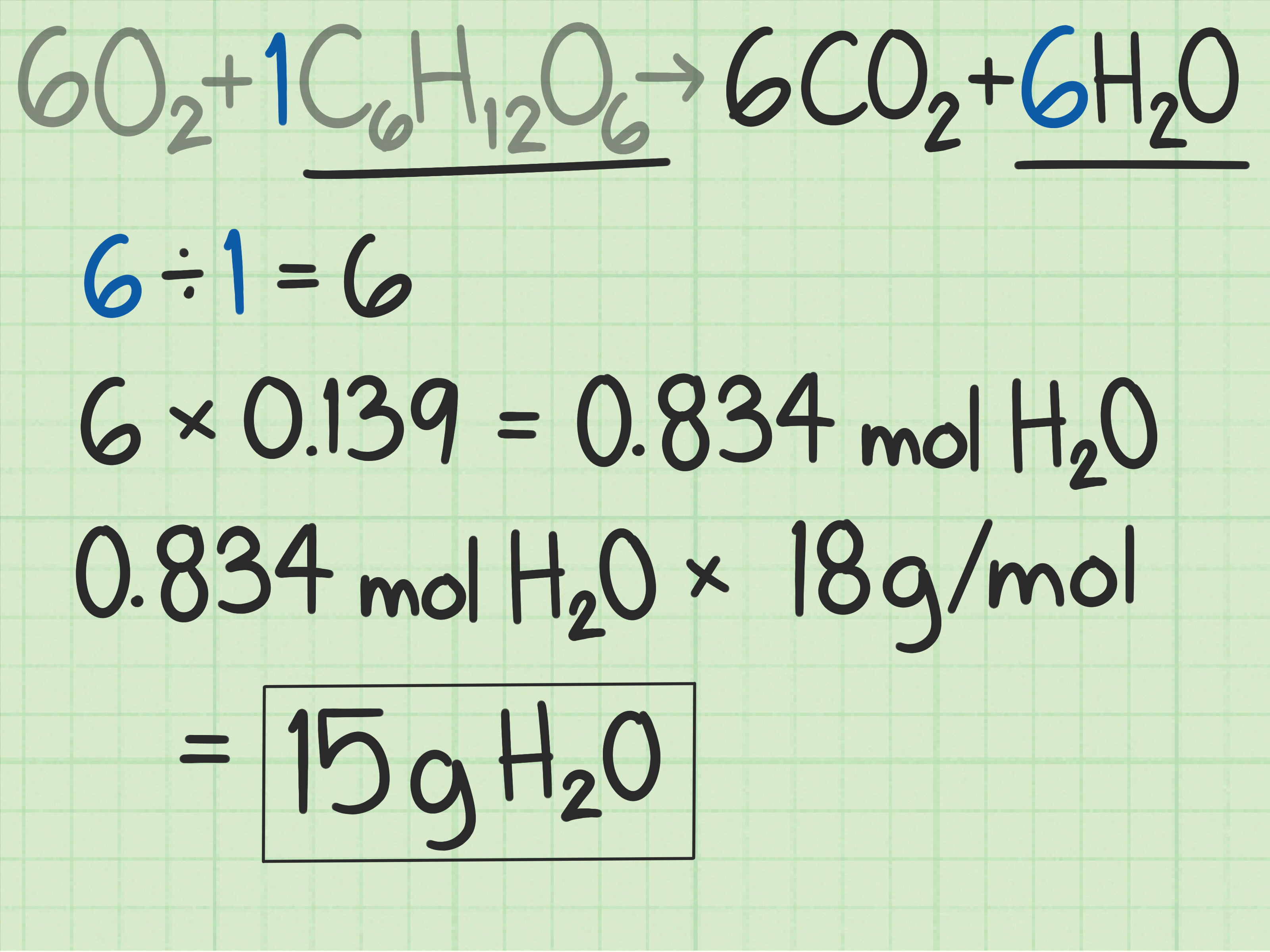
Use the molar mass of the product. Water, H2O, has a molar mass of about 18.02 g/mol.
1.98 mol H2O × 18.02 g/mol = 35.7 g H2O
The theoretical yield is:
35.7 grams of water
Step 9: Check Your Units
Units are not decorative confetti. They tell you whether your calculation makes sense. A clean theoretical yield setup should move from grams of reactant to moles of reactant, then to moles of product, then to grams of product.
A useful pattern is:
grams reactant → moles reactant → moles product → grams product
If your final answer is in “mol H2 per sandwich” or another mystery unit, pause and fix the conversion.
Step 10: Round Using Significant Figures
Use significant figures based on the given measurements. In the example, 4.00 g and 32.00 g are given with three and four significant figures. The final answer should reasonably be written as 35.7 g H2O, using three significant figures.
Do not round too early. Keep extra digits during the calculation, then round at the end. Early rounding can quietly sabotage your answer like a tiny calculator gremlin.
Step 11: Compare with Actual Yield if Needed
If the problem gives an actual yield, you can calculate percent yield. Suppose the lab produced 30.5 g of water.
Percent yield = (30.5 g / 35.7 g) × 100%
Percent yield = 85.4%
This means the reaction produced 85.4% of the maximum predicted amount.
Step 12: Interpret the Result
The theoretical yield is not a guarantee. It is a prediction under ideal conditions. Actual yield may be lower because of incomplete reactions, side reactions, transfer loss, evaporation, impurities, measurement error, or product left behind during filtration or drying.
A lower actual yield does not always mean the math is wrong. Sometimes chemistry simply refuses to behave like a clean textbook diagram.
Quick Formula Summary
To calculate theoretical yield, use this general setup:
1. Balance the equation.
2. Convert reactant mass to moles.
3. Use mole ratios to find moles of product.
4. Identify the limiting reactant.
5. Convert product moles to grams.
The key formula chain is:
grams reactant × (1 mol reactant / molar mass reactant) × (mol product / mol reactant) × (molar mass product / 1 mol product)
Worked Example: Calculating Theoretical Yield
Let’s try another example with a classic reaction:
2Na + Cl2 → 2NaCl
Question: If 10.0 g of sodium reacts with excess chlorine gas, what is the theoretical yield of sodium chloride?
1. Convert sodium to moles
Molar mass of Na = 22.99 g/mol
10.0 g Na ÷ 22.99 g/mol = 0.435 mol Na
2. Use the mole ratio
From the balanced equation, 2 mol Na produces 2 mol NaCl. That is a 1:1 ratio.
0.435 mol Na × (2 mol NaCl / 2 mol Na) = 0.435 mol NaCl
3. Convert moles of NaCl to grams
Molar mass of NaCl = 58.44 g/mol
0.435 mol NaCl × 58.44 g/mol = 25.4 g NaCl
The theoretical yield is 25.4 g of NaCl.
Common Mistakes When Calculating Theoretical Yield
Using an Unbalanced Equation
This is the biggest mistake. If the equation is not balanced, the mole ratios are wrong. Wrong mole ratios lead to wrong answers, and wrong answers lead to dramatic sighing over homework.
Comparing Grams Instead of Moles
You cannot determine the limiting reactant by simply comparing grams. Ten grams of one substance is not chemically equivalent to ten grams of another because molar masses differ. Always convert to moles first.
Ignoring the Limiting Reactant
If more than one reactant amount is given, you usually need to find the limiting reactant. The reactant that produces the smaller amount of product determines the theoretical yield.
Using the Wrong Molar Mass
Check formulas carefully. O is not the same as O2. H is not the same as H2. A tiny subscript can change the whole calculation.
Rounding Too Soon
Keep extra digits until the final answer. Rounding at every step can create small errors that pile up like laundry during finals week.
Theoretical Yield vs. Actual Yield vs. Percent Yield
These three terms are related but not identical.
Theoretical yield is the maximum predicted amount of product based on stoichiometry.
Actual yield is the amount of product actually collected in the lab.
Percent yield compares actual yield to theoretical yield.
For example, if the theoretical yield is 50.0 g and the actual yield is 42.0 g:
Percent yield = (42.0 / 50.0) × 100% = 84.0%
A percent yield below 100% is common. A percent yield above 100% usually means the product contains impurities, solvent, water, or measurement errors. In other words, your reaction probably did not break the laws of physics; your sample may just be a little messy.
How to Know Which Reactant Is Limiting
There are two common ways to identify the limiting reactant. The first method is to calculate how much product each reactant can make. The reactant that makes less product is limiting. This method is straightforward and beginner-friendly.
The second method is to divide the moles of each reactant by its coefficient in the balanced equation. The smaller adjusted value usually identifies the limiting reactant. This shortcut works well, but many students find the product-comparison method easier to understand because it directly connects to theoretical yield.
Practical Tips for Solving Theoretical Yield Problems
Write every conversion factor clearly. Label units. Circle the limiting reactant. Underline the product you are solving for. Chemistry problems are much easier when your paper does not look like a raccoon ran through wet ink.
Also, always ask: “What product am I calculating?” Some reactions produce more than one product, and the theoretical yield depends on the specific product requested.
When in doubt, return to the balanced equation. It is the map. The coefficients tell you the mole relationships, and the mole relationships tell you the yield.
Experience-Based Advice: What Theoretical Yield Teaches You in Real Chemistry
One of the most useful experiences with theoretical yield is realizing that chemistry math and chemistry lab work are close friends, but not identical twins. On paper, a reaction can look beautifully simple. You balance the equation, convert grams to moles, apply the mole ratio, and calculate a clean theoretical yield. The numbers line up neatly, and the final answer looks confident enough to wear a lab coat.
Then you enter the lab.
Suddenly, real-world chemistry adds personality. A solid sticks to the side of a beaker. A few drops remain in the pipette. A precipitate passes through the filter paper because the particles are smaller than expected. A sample is not completely dry before weighing. A reaction needs more time, better mixing, purer reactants, or a more controlled temperature. The theoretical yield still matters, but now it becomes a benchmark instead of a promise.
Students often feel frustrated when their actual yield is lower than the theoretical yield. That frustration is understandable, but it is also part of learning chemistry. A lower yield gives you something to analyze. Did the reaction finish? Was the limiting reactant correctly identified? Was the product lost during transfer? Was the product contaminated? Was the balance calibrated? Was the glassware clean? These questions turn a number into scientific thinking.
A good habit is to write down every step of the experiment as if you are leaving clues for your future self. If you notice that some solid was left on the filter paper, record it. If the solution splashed, record it. If the product was still damp, record it. These observations help explain why actual yield differs from theoretical yield.
Another lesson from experience is that units save livesor at least grades. Many theoretical yield errors come from skipping units. When every number carries a unit, mistakes become easier to catch. If grams fail to cancel into moles, or moles fail to convert into grams of product, the setup is waving a little red flag.
It also helps to estimate before calculating. If you start with only a tiny amount of limiting reactant, your product should not be enormous. If your answer claims that 2 grams of reactant produced 300 grams of product, your calculator may have gone on a fantasy vacation.
Finally, theoretical yield builds patience. At first, stoichiometry feels slow because there are many steps. But with practice, the pattern becomes familiar: balance, convert, compare, calculate, interpret. Once that rhythm clicks, theoretical yield problems become less intimidating. They are not random puzzles. They are recipes written in the language of moles.
Conclusion
Learning how to calculate theoretical yield is one of the most important skills in stoichiometry. The process begins with a balanced chemical equation, moves through mole conversions and mole ratios, and ends with the maximum possible mass of product. The limiting reactant is the star of the show because it determines how far the reaction can go.
Theoretical yield may seem tricky at first, but the method is reliable. Balance the equation, convert grams to moles, use the correct mole ratio, identify the limiting reactant, and convert the product back to grams. Add careful units and sensible rounding, and you have a calculation that can survive both homework and lab reports.
In the real world, actual yield often falls short of theoretical yield. That is not failure; it is chemistry being chemistry. The gap between theoretical and actual yield helps scientists improve methods, reduce waste, and understand what happened during a reaction. And honestly, any formula that can explain both lab results and why your beaker betrayed you deserves respect.