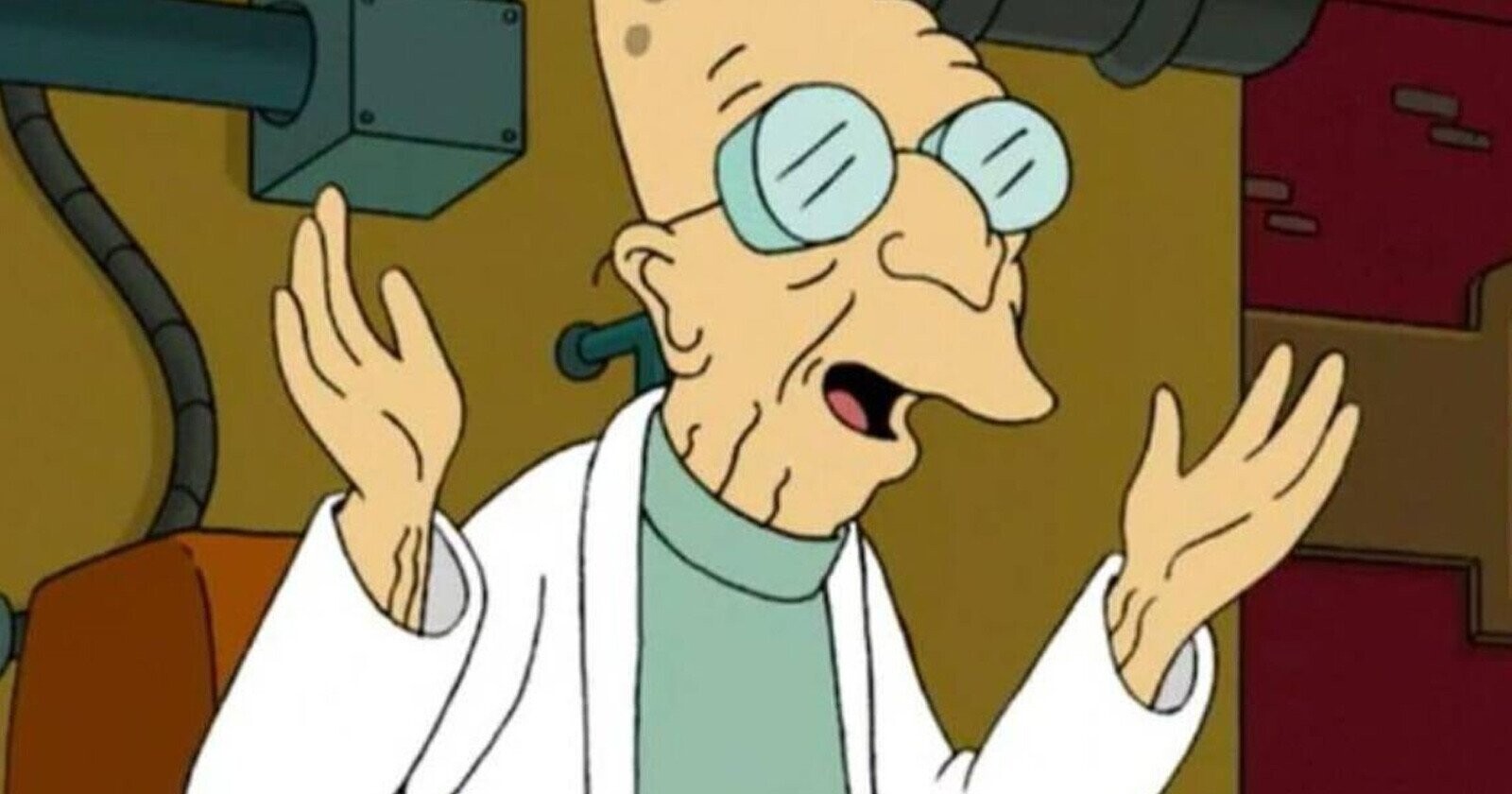
There are many sounds that can make a Futurama fan instantly sit up like Bender hearing the word “free.” The Planet Express ship roaring into disaster is one. Zoidberg making an entrance nobody asked for is another. But nothing triggers delightful panic quite like Professor Hubert J. Farnsworth shuffling into a room and announcing, “Good news, everyone!”
On paper, that phrase should be comforting. In the world of Futurama, it usually means the exact opposite. The crew may be sent to a deadly planet, asked to test a deranged invention, informed of corporate nonsense, or handed a problem that sounds like it escaped from a graduate-level physics exam wearing clown shoes. That contradiction is what makes the gag so durable: the sentence promises relief, then immediately delivers doom with a bow on it.
Created by Matt Groening and developed with David X. Cohen, Futurama has always been more than a sci-fi cartoon with robots and space deliveries. It is a joke machine built out of math, pop culture, workplace misery, and emotional sucker punches. Professor Farnsworth, voiced by Billy West, is one of the show’s best delivery systems for chaos. His “Good news, everyone” catchphrase is not just a line; it is a warning label printed in invisible ink.
Why “Good News Everyone” Became a Perfect Futurama Running Gag
The best recurring jokes do not simply repeat. They evolve. Farnsworth’s catchphrase works because viewers learn the pattern quickly: cheerful announcement first, terrible explanation second. By the time he says the words, the audience is already bracing for the trapdoor.
That is classic Futurama comedy. The show often starts with something familiar, like a workplace meeting, a delivery assignment, or a boss giving instructions. Then it tilts the ordinary situation sideways until it becomes absurd. Planet Express is technically a delivery company, but its business model appears to be “send underpaid employees into impossible danger and hope accounting approves the fuel bill.”
Farnsworth is central to that absurdity. He is brilliant, ancient, distracted, and alarmingly casual about risk. When he says “good news,” he often means “good news for science,” “good news for my bank account,” or “good news because I am not personally doing the dangerous part.” For the Planet Express crew, the news is frequently less good and more “update your emergency contact.”
The Funniest “Good News Everyone” Gags in Futurama
1. The Trisol Delivery in “My Three Suns”
One of the earliest and most important uses of the gag appears in “My Three Suns.” Farnsworth announces good news, only to send the crew to Trisol, a mysterious planet located in a dramatic-sounding forbidden region. That is already funny because the setup treats a cosmic hazard like an office errand.
The real magic is how quickly the crew understands the pattern. Bender senses that “good news” will not stay good for long, and the audience learns the same lesson. The joke is not only the dangerous destination; it is the gap between Farnsworth’s cheery tone and the obvious misery about to follow. It feels like a boss saying, “Great news, team! We’re all working this weekend inside a volcano.”
2. The Virus Planet Delivery in “A Big Piece of Garbage”
Few shows can make an interplanetary shipping route sound like a workplace benefit gone wrong. In “A Big Piece of Garbage,” Farnsworth’s good news leads to a delivery to a terrifyingly named virus planet. The phrase “good news” does Olympic-level gymnastics here. For any sensible employee, that assignment would be a resignation letter with rockets attached.
The gag is funny because it turns corporate optimism into sci-fi negligence. Farnsworth speaks as if he has secured a lovely opportunity. The crew hears something closer to “please deliver this package directly into the mouth of consequences.” It is a sharp parody of bosses who dress bad assignments in cheerful language.
3. The Mob Planet Subpoenas in “Hell Is Other Robots”
In “Hell Is Other Robots,” the crew is told they will deliver legal documents to a planet associated with organized crime. That is such a beautifully Futurama idea: bureaucracy, space travel, and danger all stacked in one joke.
The humor comes from the mismatch. A subpoena is boring. A mob planet is not. Put them together and you get a mission that sounds like it was designed by a lawyer with a death wish and a travel rewards card. Farnsworth’s joy makes it even funnier because he seems almost proud of how bad the job is.
4. The Anti-Pressure Pill in “The Deep South”
“The Deep South” gives fans one of the most memorable Farnsworth medical gags. The Professor presents an experimental anti-pressure pill for Fry, and the punchline reveals that the method of taking it is not exactly what Fry hoped. The famous “suppository” turn is short, silly, and perfectly timed.
What makes this one work is not just the gross-out surprise. It is Farnsworth’s scientific confidence. He behaves as though he has solved a practical problem with a brilliant invention, while everyone else is stuck processing the deeply unpleasant user experience. The joke captures the Professor’s entire personality: genius first, human comfort never.
5. Tweenis 12 Was Destroyed, But They Paid in Advance
One of the sharpest “good news” gags arrives in “The Day the Earth Stood Stupid.” The crew was supposed to make a delivery to Tweenis 12, but the planet has been destroyed. Leela naturally questions how this can possibly count as good news. Farnsworth’s answer: the company already got paid.
This is one of the purest examples of Futurama’s dark business comedy. A whole planet is gone, and Farnsworth views the matter through the tiny keyhole of Planet Express accounting. The gag is brutal without needing to be graphic. It is funny because the Professor’s priorities are so magnificently wrong.
6. “There’s a Report on TV With Some Very Bad News”
In “Mother’s Day,” Farnsworth’s version of good news is that television is reporting bad news. This is the kind of joke that feels even more accurate every year. The Professor is excited not because the world is improving, but because a fresh disaster has become available for viewing.
The gag also plays with the word “news” itself. Farnsworth is not promising good events; he is promising the existence of news. The content of that news is apparently optional. It is a beautifully dumb language trick, and Futurama loves beautifully dumb language tricks almost as much as it loves complicated math jokes.
7. “I’ve Taught the Toaster to Feel Love”
One of the funniest Farnsworth invention gags involves his announcement that he has taught a toaster to feel love. That sentence is pure Futurama: technically impressive, emotionally alarming, and completely unnecessary.
The joke works because it begins as a miracle of artificial intelligence and immediately becomes a question nobody wants answered. Why would a toaster need love? What does a toaster do with love? Does it become clingy? Does it burn bread out of jealousy? The line is funny because it opens an entire sitcom inside one appliance.
8. The Super Collider: “Good News, Anyone” to “Bad News, Nobody”
In “Less Than Hero,” Farnsworth plays with the structure of his own catchphrase. He announces good news involving a delivered super collider, and later follows it with a grim variation after the device explodes. The shift from “everyone” to “anyone” and then to “nobody” shows how flexible the gag became over time.
This is a great example of Futurama rewarding longtime viewers. Once the audience knows the formula, the writers can bend it, shorten it, reverse it, or make it collapse like an overfunded science project. The laugh comes from recognition and surprise working together, which is basically the comedy version of two robots trying to share one trench coat.
9. “I’m Still Technically Alive” in “The Farnsworth Parabox”
“The Farnsworth Parabox” is one of the show’s best high-concept episodes, and the good-news structure fits it perfectly. Farnsworth has survived one of his own dangerous experiments and announces that he is still technically alive. That word “technically” does a lot of comedic heavy lifting.
In everyday life, “I’m alive” is usually enough. In Futurama, the Professor needs a qualifier. The gag works because it suggests a universe where survival has footnotes, alternate dimensions have paperwork, and scientific achievement is measured by how narrowly everyone avoided being vaporized.
10. The Meta Joke in “Bender’s Big Score”
The Futurama movie “Bender’s Big Score” delivers one of the most satisfying “Good news, everyone” moments because it points directly at the show’s own cancellation and revival. Farnsworth announces that the foolish people who canceled them have been removed from power, turning the catchphrase into a victory lap.
This gag lands because it speaks to real fan history. Futurama survived cancellations, network reshuffling, direct-to-DVD movies, Comedy Central episodes, and later a Hulu revival. The line feels like the show winking at the audience and saying, “Yes, we noticed what happened too.” It is fan service, but the good kindthe kind with timing, bite, and just enough pettiness to season the joke.
11. Hermes Borrowing the Line in “Overclockwise”
The catchphrase is so closely tied to Farnsworth that it becomes funny when someone else uses it. In “Overclockwise,” Hermes echoes the Professor’s line because Farnsworth is unavailable due to legal trouble. The joke depends on absence. The phrase is not just a sentence anymore; it is part of the Planet Express operating system.
When another character says it, the audience immediately hears Farnsworth anyway. That is how you know a catchphrase has fully entered a show’s DNA. It becomes portable, but never really transferable.
12. “Movietone News” and Other Late-Series Variations
Later episodes and anthology-style segments continue to remix the phrase. “Movietone news,” “top secret news,” and other variants show that the writers understood the value of controlled mutation. The joke stays recognizable while adapting to different formats, genres, and episode structures.
This matters because catchphrases can become lazy if they never change. Futurama avoids that problem by making the audience ask, “What version of the trap are we getting this time?” The line remains familiar, but the punchline has room to breathe.
What These Gags Reveal About Professor Farnsworth
The “Good news, everyone” gag is funny because it reveals character. Farnsworth is not evil in a simple way. He is worse: he is enthusiastic, distracted, and scientifically curious at exactly the wrong moments. He is the kind of man who can invent impossible technology before breakfast and forget basic workplace ethics by lunch.
His catchphrase also makes him a perfect sitcom boss. Like many fictional bosses, he creates problems for the employees. Unlike most fictional bosses, his problems involve alien planets, broken physics, questionable medicine, robot societies, and inventions that should have been reviewed by at least one adult.
That is why the joke has lasted. It is not only a funny sentence. It is a summary of the Planet Express workplace. Every time Farnsworth enters with good news, the show reminds us that the future may have spaceships, clones, and talking robots, but work is still work. Someone in charge will always describe trouble as an opportunity.
Why Fans Still Love the Catchphrase
Fans love “Good news, everyone” because it is instantly usable. It works as a meme, a reaction, a greeting, a sarcastic announcement, and a way to make ordinary updates sound hilariously suspicious. Did the printer start working? Good news, everyone. Did the printer start working because it is now smoking? Even better. That is the Farnsworth spirit.
The phrase also has musicality. Billy West’s performance gives it a creaky, delighted, slightly unhinged rhythm. Farnsworth sounds thrilled, but never fully connected to the consequences of what he is saying. That vocal performance turns the line from a written joke into a comedy alarm bell.
Most importantly, the gag belongs to the emotional texture of Futurama. The show can be cynical, but it is rarely empty. It mocks bureaucracy, science, capitalism, pop culture, and humanity’s endless talent for making things worse. Yet it also loves its characters. When Farnsworth says “good news,” fans know danger is coming, but they also know the crew will probably survive, complain, and be back at work next week.
Viewer Experience: Watching the “Good News Everyone” Gags Like a Fan
Rewatching the “Good news, everyone” gags is a strangely comforting experience, even when the actual news is terrible. The first time you hear Farnsworth say it, you may take the sentence at face value. The second or third time, your brain starts installing a warning system. By the fifth time, the phrase becomes a comedy ritual. You hear the opening words and immediately think, “Ah, yes, the employees are doomed again.”
That is part of the pleasure of Futurama. The show trains viewers to recognize patterns, then rewards them for paying attention. A casual viewer can laugh because the mission sounds ridiculous. A longtime fan gets an extra laugh because the phrase itself has become suspicious. It is like hearing dramatic music in a horror movie, except instead of a monster, you get an elderly scientist with a clipboard and no concern for labor safety.
One of the best things about these gags is how easy they are to bring into real life. Any mildly bad update becomes funnier if introduced in Farnsworth’s voice. “Good news, everyone, the meeting has been moved earlier.” “Good news, everyone, the Wi-Fi works in every room except the room we are currently in.” “Good news, everyone, dinner is ready, but I misread the recipe and invented soup with corners.” The line turns inconvenience into shared comedy.
It also creates a specific fan connection. When someone says “Good news, everyone” in a group and another person instantly answers with concern, you know you have found your people. It is a small password for fans who understand that in the Futurama universe, optimism should be handled with tongs.
The gags age well because they are not dependent on only one kind of humor. Some are wordplay. Some are workplace satire. Some are science-fiction absurdity. Some are meta jokes about television itself. That variety keeps the catchphrase from becoming stale. Instead of feeling like a button the writers press automatically, it feels like a comedy doorway. Farnsworth opens it, and the show decides what kind of nonsense will walk through.
For many fans, the funniest versions are the ones where the Professor’s priorities are completely upside down. A destroyed planet is good because the bill was paid. A dangerous invention is good because it technically functions. A horrible report is good because it is, at minimum, news. That twisted logic is the heartbeat of the gag. Farnsworth is not lying exactly; he is just using a definition of “good” that only makes sense if you are 160 years old, scientifically reckless, and possibly wearing the same slippers since the 2900s.
That is why the phrase remains one of Futurama’s most beloved comic signatures. It is short, memorable, flexible, and packed with character. It can introduce a mission, a disaster, an invention, a parody, or a punchline. Good news, everyone: the joke still works.
Conclusion
The funniest “Good news, everyone” gags in Futurama succeed because they turn optimism into a trap. Professor Farnsworth’s cheerful announcements are rarely comforting, but they are almost always hilarious. From dangerous deliveries and bizarre inventions to corporate satire and meta commentary, the catchphrase captures everything fans love about the show: clever writing, absurd escalation, and characters who treat cosmic disaster like a normal Tuesday meeting.
In the end, Farnsworth’s most famous line is more than a catchphrase. It is a promise that something ridiculous is about to happen, and somehow, against all workplace regulations, we are happy to hear it every time.