A mosquito-borne disease with a tongue-twisting name and a reputation for brutal joint pain returned to the international spotlight in 2025. Southern China recorded its largest documented chikungunya outbreak, with infections concentrated in Guangdong Province and especially the city of Foshan. As the total moved beyond 10,000 cases, Taiwan confirmed its first imported infection linked to the mainland outbreak, giving health authorities another reminder that mosquitoes do not need passportsand infected travelers can move a virus into places where capable mosquitoes are already waiting.
The World Health Organization had already urged countries to act quickly as chikungunya activity expanded across the Indian Ocean region, Asia, the Americas, and parts of Europe. The concern was not that chikungunya would behave like COVID-19. It does not normally spread directly from person to person. The danger is a different chain reaction: an infected traveler is bitten by a local Aedes mosquito, that mosquito becomes infectious, and a new local transmission cycle begins.
China’s Chikungunya Outbreak Grew With Unusual Speed
Foshan Became the Center of the Crisis
The outbreak emerged in Foshan, a major manufacturing city in the Pearl River Delta, during the summer of 2025. Early official reports counted hundreds of infections, but the curve rose sharply. By late July, Guangdong had reported thousands of confirmed cases. Within weeks, the total exceeded 10,000 across southern China, with most infections initially linked to Foshan and nearby communities.
A later WHO update put the scale in clearer perspective. By September 27, 2025, Guangdong Province had recorded 16,452 locally transmitted, laboratory-confirmed cases. Foshan accounted for 10,032, while Jiangmen reported more than 5,000. Smaller clusters or related infections appeared in Guangzhou, Shenzhen, Zhuhai, Zhanjiang, and other cities. WHO described it as the largest documented chikungunya outbreak in China to date.
The encouraging news was that reported mainland cases were overwhelmingly mild, with no severe cases or deaths recorded in that WHO update. The less comforting news was how efficiently the virus had entered a densely populated, highly connected region with abundant Aedes albopictus mosquitoes and little preexisting population immunity.
Taiwan Reported an Imported Case Linked to Guangdong
On August 7, 2025, Taiwan health authorities announced an imported chikungunya case involving a woman in her 40s who had traveled in Guangdong. Reports described it as Taiwan’s first confirmed case that year linked to the mainland China outbreak.
That distinction matters. An imported case means the person acquired the infection elsewhere and was diagnosed after arriving. It does not automatically mean mosquitoes were spreading chikungunya locally in Taiwan.
Imported cases are still closely watched because a traveler can carry enough virus in the blood during the first week of illness to infect a mosquito that bites them. Public health teams therefore focus on rapid diagnosis, mosquito control around the patient’s location, and preventing the infected person from receiving additional mosquito bites.
Why the WHO Issued a Global Chikungunya Warning
The WHO warning was broader than China. During 2025, large outbreaks were reported in the Indian Ocean region, including Réunion, Mauritius, and Mayotte. Cases also climbed in parts of Africa, South Asia, Southeast Asia, the Americas, and Europe. France and Italy reported locally acquired infections, demonstrating that chikungunya is no longer a problem that can be filed neatly under “tropical diseases happening somewhere else.”
WHO experts compared the pattern with the major international chikungunya wave that began in the Indian Ocean in 2004 and 2005. That epidemic spread widely as infected travelers, suitable mosquito species, favorable weather, and vulnerable populations lined up like four very unfortunate dominoes.
Aedes Mosquitoes Are Excellent Urban Opportunists
Chikungunya is mainly transmitted by Aedes aegypti and Aedes albopictus. These mosquitoes are well adapted to human environments. They can breed in surprisingly small collections of water: flowerpot saucers, buckets, roof gutters, discarded cups, construction materials, clogged drains, and the mysterious backyard container everyone forgot existed.
These mosquitoes frequently bite during daylight hours, making ordinary activities such as walking to work, visiting a market, sitting in a garden, or waiting for a bus potential exposure opportunities.
Weather, Travel, and Low Immunity Created a Perfect Storm
Heavy rainfall and high temperatures in southern China created more breeding sites and increased mosquito activity. Meanwhile, the Pearl River Delta’s enormous population, intense domestic movement, and international business connections increased the chance that infected people would travel before realizing they were sick.
Population immunity also mattered. Chikungunya had not been established as a regularly circulating virus in mainland China, so most residents had no immunity from previous infection. When a virus meets a large susceptible population and a dense mosquito network, it does not need a motivational speaker.
What Chikungunya Does to the Body
Chikungunya is caused by an alphavirus. Its name is associated with a word from the Makonde language referring to a bent or stooped posture, an image that captures the disease’s most notorious feature: severe joint pain.
Common Chikungunya Symptoms
Symptoms usually begin several days after an infected mosquito bite. The most common signs include sudden fever and intense pain in multiple joints. Headache, muscle aches, swollen joints, fatigue, nausea, and rash may also occur.
Many people recover from the acute illness within about a week, but recovery is not always a clean exit. Joint pain can linger for weeks or months, and some patients develop recurrent or persistent rheumatologic symptoms that interfere with work, sleep, exercise, and daily movement.
Chikungunya is rarely fatal, but “rarely fatal” should not be confused with “pleasant.” A virus can be medically non-catastrophic and still make climbing stairs feel like a negotiation with gravity.
Who Faces a Higher Risk of Severe Illness?
Newborns infected around the time of birth, adults 65 and older, and people with conditions such as hypertension, diabetes, or cardiovascular disease face a higher risk of serious complications.
Pregnant travelersespecially late in pregnancyshould discuss outbreak-related travel with a healthcare professional because infection near delivery can endanger the baby.
Why Diagnosis Can Be Tricky
Chikungunya can resemble dengue, Zika, and other illnesses that cause fever, rash, and body pain. Travel history is therefore essential. During roughly the first week of illness, laboratories may detect viral RNA using a nucleic acid test such as RT-PCR. Antibody testing becomes more useful later, although confirmatory testing may be needed because some antibodies can cross-react with related viruses.
Doctors must be especially cautious when dengue is possible. Until dengue has been ruled out, acetaminophen is generally preferred for fever and pain because aspirin and some anti-inflammatory drugs may increase bleeding risk in a patient who actually has dengue.
How China Responded to the Mosquito-Borne Outbreak
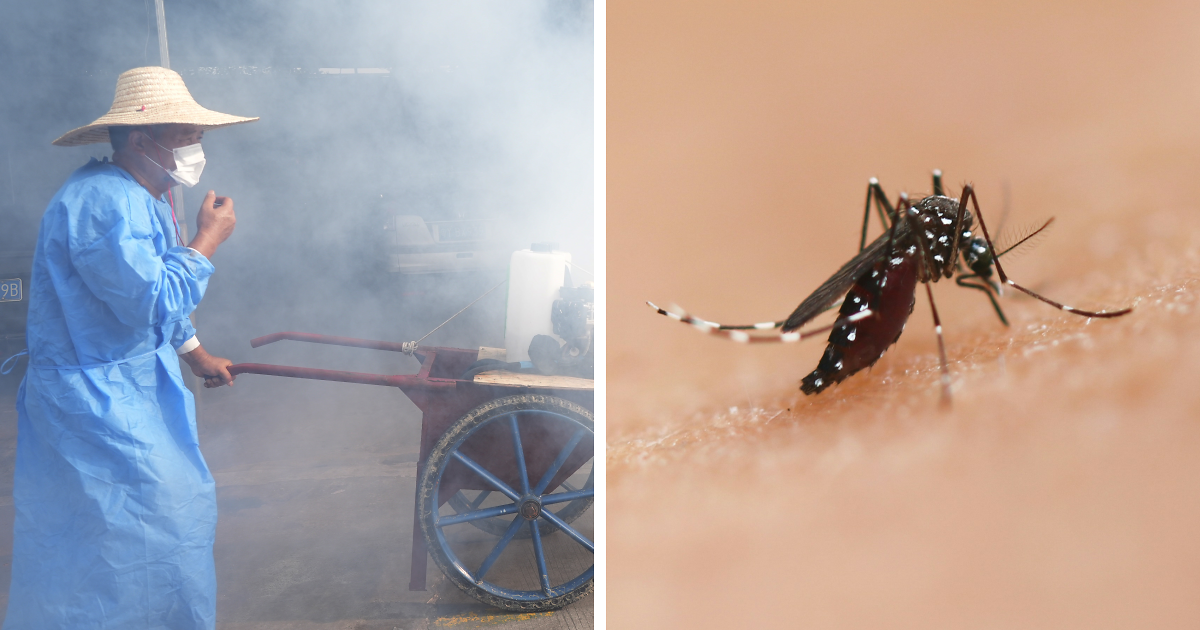
Chinese authorities launched a highly visible mosquito-control campaign. Crews sprayed insecticide in streets, residential areas, construction sites, and public spaces. Drones were used to identify standing water and possible breeding zones. Residents were told to empty containers, clean drains, use screens and nets, and cooperate with inspections.
Authorities also experimented with biological control, including fish that consume mosquito larvae and larger mosquito species whose larvae prey on other mosquito larvae. Some cities threatened fines for properties where standing water was repeatedly found.
Several measures drew criticism because they resembled COVID-era containment tactics even though chikungunya is not spread through ordinary human contact. Hospitalizing patients in screened environments may help prevent mosquitoes from biting them, but quarantining a patient does not interrupt transmission in the same way it would for an airborne virus. The critical target is the mosquito-human-mosquito cycle.
Did the Aggressive Measures Work?
Reported weekly case numbers eventually declined in the original epicenter, suggesting that mosquito control, public participation, seasonal changes, and growing awareness helped slow transmission.
However, the appearance of cases in additional cities showed how difficult it is to contain an arbovirus once infected people and mosquitoes are circulating across a large urban region.
Does the China Outbreak Threaten the United States?
For most Americans, the immediate risk from the Guangdong outbreak was low. The United States did not face sustained nationwide chikungunya transmission, and an imported case is not the same as a domestic outbreak. However, both major mosquito vectors exist in parts of the country, which means travel-associated infections require attention.
A returning traveler who is carrying chikungunya virus can theoretically infect a local mosquito. That mosquito could then transmit the virus to another person. The probability depends on mosquito density, temperature, timing, housing conditions, surveillance, and how quickly the patient avoids further bites.
This is why the CDC tells people with suspected or confirmed chikungunya to protect themselves from mosquito bites during the first week of illness. Repellent is not merely personal comfort at that point; it becomes a small public health intervention.
Travelers Should Focus on Practical Prevention
- Use an EPA-registered insect repellent and follow its label directions.
- Wear long-sleeved shirts and long pants when conditions allow.
- Treat clothing and travel gear with 0.5% permethrin or purchase pretreated items.
- Choose lodging with air conditioning, intact window screens, or mosquito nets.
- Empty standing water around homes, rentals, balconies, and work sites.
- Seek medical care for fever and joint pain after travel, clearly describing the itinerary.
- Avoid additional mosquito bites when sick so local mosquitoes cannot acquire the virus.
What About Chikungunya Vaccines?
U.S. vaccine guidance changed during and after the 2025 outbreak. The CDC currently identifies VIMKUNYA, a virus-like-particle vaccine licensed for people age 12 and older, as the chikungunya vaccine available in the United States.
Vaccination is recommended for eligible travelers going to a country or territory with an active outbreak. It may also be considered for certain long-term travelers moving to or spending extended periods in places with elevated chikungunya risk.
Vaccine decisions should be individualized. Destination, duration, age, medical history, pregnancy, immune status, and likelihood of mosquito exposure all matter. A vaccine is an additional layer of protection, not a magical force field that permits travelers to marinate in mosquito bites.
What the Outbreak Reveals About Future Global Risk
The China outbreak illustrates how quickly a mosquito-borne virus can establish itself in a modern city when climate, mobility, susceptible people, and competent vectors overlap. Chikungunya does not need continuous direct human transmission. It only needs infected people and the right mosquitoes to keep meeting each other.
Climate change is not the sole cause of every outbreak, but warmer conditions, altered rainfall patterns, longer mosquito seasons, and expanding vector ranges can increase opportunities for transmission. Urban growth, inadequate drainage, construction activity, and international travel add more fuel.
The best defense is layered: early laboratory testing, transparent case reporting, mosquito surveillance, rapid control around cases, community cleanup, traveler education, clinically appropriate vaccination, and clear communication that avoids both panic and complacency.
Practical Experiences and Lessons From a Chikungunya Alert
The most useful way to understand an outbreak is to imagine the decisions people must make before, during, and after exposure. The following situations are realistic composite examples based on standard public health guidance rather than accounts of specific named patients.
The Traveler Who Assumes It Is “Just a Fever”
A business traveler returns from Guangdong with fatigue, fever, and aching wrists. At first, the illness feels like the flu after an exhausting flight. The mistake would be waiting several days without mentioning the travel history. A better response is to contact a healthcare provider, explain exactly where and when the trip occurred, and avoid mosquito bites while waiting for medical advice.
That last step is easy to underestimate. Staying indoors behind screens, using repellent, and wearing covering clothing can reduce the chance that a local mosquito bites the traveler and becomes infected. The experience teaches a simple rule: after travel, geography is part of the medical history.
The Household That Searches for a Swamp and Misses a Bottle Cap
Many residents think mosquito breeding requires a pond, ditch, or cinematic jungle. In reality, Aedes mosquitoes can use small water-filled containers close to homes. A household may clean the yard but overlook a plant saucer, folded tarp, child’s toy, pet bowl, clogged gutter, or bottle cap after rain.
A productive weekly routine is to walk around the property, tip out water, scrub container walls where eggs may stick, cover stored water, and check shaded corners. The lesson is that mosquito control is less glamorous than drones and fogging trucks, but often more durable. Public health sometimes looks like a neighbor holding a bucket upside down.
The Patient Whose Fever Ends but Joint Pain Does Not
Another common experience begins after the acute fever disappears. A patient expects to return immediately to normal but still wakes with painful hands, ankles, or knees. Work becomes slower. Exercise feels impossible. Friends may assume the illness is over because the thermometer looks normal.
Persistent symptoms deserve medical follow-up. Depending on the diagnosis and the exclusion of conditions such as dengue, clinicians may consider pain management, anti-inflammatory treatment, physical therapy, and evaluation for continuing rheumatologic problems.
Recovery may require pacing rather than heroics. Trying to “push through” severe joint pain can turn a bad week into an even worse month.
The Clinician Who Asks One Extra Question
In a region where chikungunya is uncommon, a patient with fever and joint pain might initially be evaluated for influenza, COVID-19, dengue, or another infection. One question“Where have you traveled recently?”can change the testing plan and trigger a public health report.
A single diagnosed imported case can lead to mosquito control around the patient’s residence, alerts to local clinicians, and faster identification of additional infections. Early action is far cheaper than discovering local transmission after dozens of people are already sick.
The Community That Needs Information, Not Theater
Outbreak communication works best when authorities explain what the virus does, how it spreads, and which actions have evidence behind them. Dramatic spraying can reassure the public, but residents also need practical instructions: remove water, use repellent correctly, recognize symptoms, seek testing, and protect sick people from mosquitoes.
The China outbreak showed that aggressive action can mobilize neighborhoods quickly, yet overly coercive policies may create fear or resistance. Trust is not decorative. People cooperate more effectively when rules match the biology of the disease and officials acknowledge uncertainty instead of filling every gap with a siren.
Conclusion
The 2025 chikungunya outbreak in southern China was a warning, not a rehearsal for another COVID-style pandemic. The virus spreads mainly through infected mosquitoes, but that does not make it harmless. More than 10,000 infections, the later WHO-confirmed total of over 16,000 locally transmitted cases in Guangdong, and an imported case detected in Taiwan demonstrated how quickly chikungunya can move through connected regions.
The response should be serious without becoming sensational. Travelers need bite prevention and timely medical advice. Communities need routine mosquito control. Clinicians need to ask about travel and distinguish chikungunya from dengue and other infections. Governments need fast surveillance, proportionate interventions, and public communication grounded in how the virus actually spreads.
Note: This article is for general educational purposes and is not a substitute for diagnosis, treatment, or personalized travel-health advice from a qualified medical professional. Outbreak notices and vaccine recommendations can change, so readers should check current public health guidance before traveling.