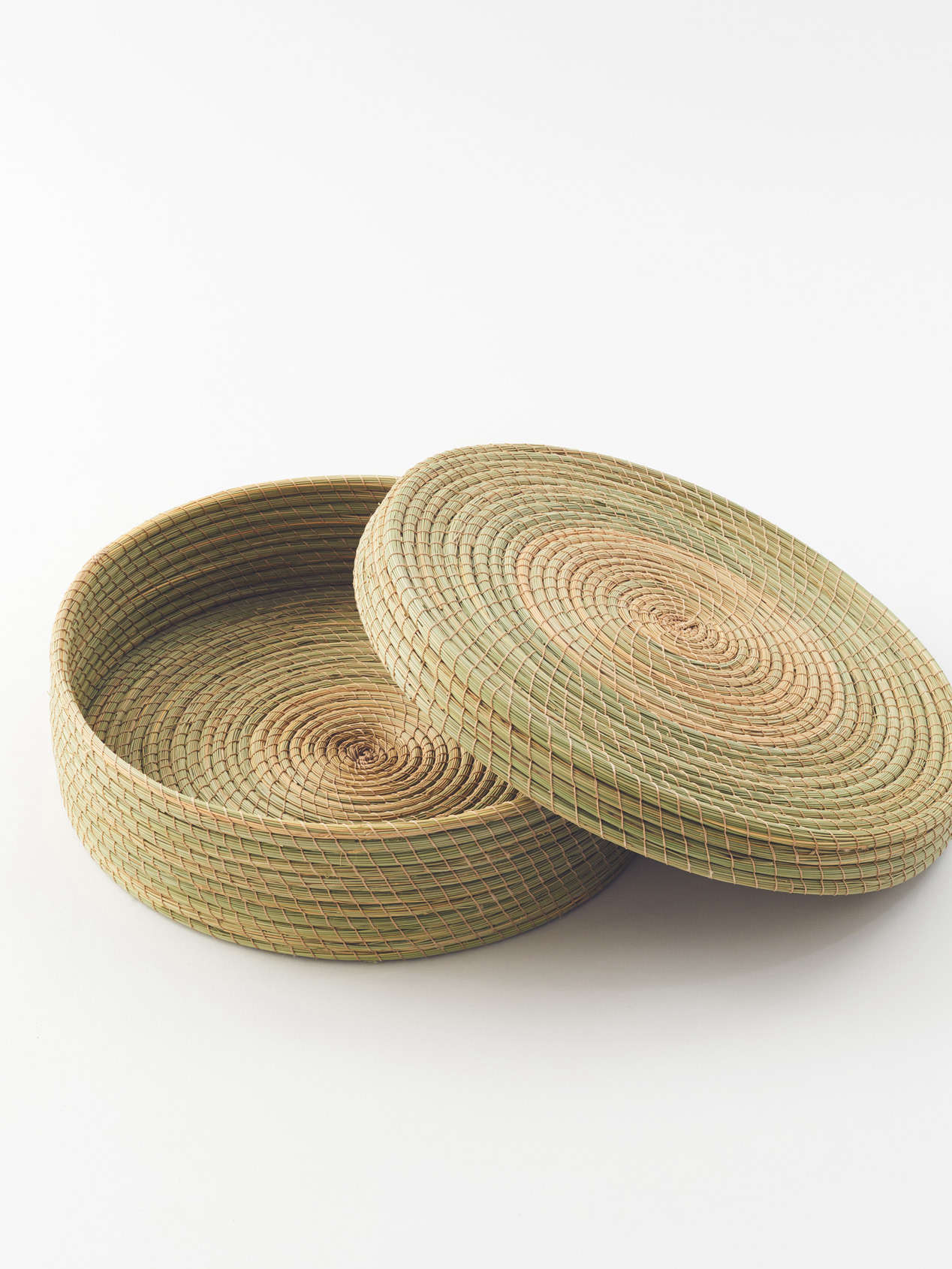
The Artisans Solidaire Kasserine Halfa Box is proof that storage does not have to look like it escaped from an office-supply catalog. Handwoven from natural halfa grass in Tunisia, this lidded box combines practical organization, traditional craftsmanship, and a relaxed organic texture that works beautifully in modern American homes.
At first glance, it is a simple round box. Look more closely, however, and you begin to see the individual fibers, subtle variations in the weave, and evidence of the human hands behind it. It is functional enough to hide charging cables, coasters, keys, jewelry, or the remote control that mysteriously disappears whenever a movie starts. At the same time, it is attractive enough to sit openly on a coffee table, console, dresser, or bookshelf.
This guide explores the origin, materials, craftsmanship, decorating potential, practical uses, maintenance needs, advantages, and realistic ownership experience of the Artisans Solidaire Kasserine Halfa Box.
What Is the Artisans Solidaire Kasserine Halfa Box?
The Artisans Solidaire Kasserine Halfa Box is a handmade storage container woven from locally sourced halfa grass, also called esparto. It is produced by Artisans Solidaires Kasserine, a collective based in the Kasserine region of western Tunisia near the Algerian border.
The collective is composed primarily of women who create baskets, rugs, pottery, and other decorative household products using natural materials and techniques learned from previous generations. According to accounts from the artisans, members often work together in their homes, combining traditional patterns and regional forms with cleaner shapes suited to contemporary interiors.
An earlier product listing described the round box as approximately 15 inches in diameter and 4 inches high when the lid and base were assembled. That makes it wider than a typical keepsake box but lower and less bulky than a traditional storage basket. Current dimensions, pricing, colors, and availability may differ between retailers and production batches.
Product and artisan details verified through Remodelista and Soukra.
Understanding Halfa Grass
A Resilient North African Plant
Halfa is the regional name commonly used for esparto grass, a tough perennial grass associated with the dry landscapes of North Africa and parts of the western Mediterranean. One botanical name frequently connected with the material is Stipa tenacissima.
The plant produces long, narrow leaves with fibers that can be dried, sorted, twisted, braided, coiled, or woven. Its strength has made it useful for practical objects such as mats, ropes, baskets, trays, and containers. Modern designers have expanded the material’s role into rugs, pendant lights, decorative wall pieces, planters, and sculptural home accessories.
Halfa is especially well suited to dry environments. It can grow where many thirstier plants would struggle, although that does not automatically make every halfa product perfectly sustainable. Responsible harvesting, fair compensation, processing methods, packaging, and international transportation all influence a product’s total environmental impact.
A Material With a Long History
Grass basketry is hardly a new design trend invented by someone with a mood board and a large coffee. The Metropolitan Museum of Art has documented an ancient Egyptian basket made from halfa grass and rushes dating to roughly the Middle Kingdom. That object does not establish a direct production line to today’s Tunisian artisans, but it does demonstrate how long people in North Africa have relied on plant fibers for useful containers.
In Kasserine, halfa weaving continues as a living regional craft rather than merely a museum subject. Artisans transform a local plant into objects that still solve everyday household problems, only now those objects may travel from rural Tunisia to apartments, studios, and family homes around the world.
Halfa history and modern craft context verified through The Metropolitan Museum of Art, UNIDO, Artisraw, and Wilderhouse.
How the Halfa Box Is Made
Every artisan may make small adjustments to preparation and weaving, but the general process begins with harvesting and preparing the grass. Leaves must be dried and sorted so that usable fibers can be separated according to strength, flexibility, thickness, and color.
Some fibers may be left in their natural pale-gold or straw-colored state. Others can be colored with natural dyes to create decorative contrasts. The prepared fibers are then twisted, braided, coiled, or woven by hand into the box’s rounded base and fitted lid.
Creating a low, broad container requires more precision than the finished object initially suggests. The base must remain relatively flat, the walls must rise evenly, and the lid must be large enough to close without looking as though it borrowed its hat from a smaller box.
Because the construction is manual, minor irregularities are normal. Slight differences in shape, weave tension, color, and lid alignment should not immediately be treated as defects. They are often signs that the product was made individually rather than stamped out by an automated machine.
Design and Visual Appeal
Organic Texture Without Visual Clutter
The most noticeable feature of the Artisans Solidaire Kasserine Halfa Box is its texture. The woven fibers introduce depth and warmth without relying on glossy finishes, oversized logos, or dramatic ornamentation.
Natural fiber decor is particularly effective in rooms dominated by smooth surfaces. Place the box beside a lacquered table, metal lamp, glass vase, or stone countertop, and the contrast makes the room feel more layered. Interior designers often use woven materials for exactly this reason: texture can make a neutral space feel intentional instead of unfinished.
A Shape That Fits Multiple Styles
The low, round silhouette is visually quiet and easy to incorporate into different decorating styles. It can complement:
- Warm minimalist interiors with cream, beige, and wood tones
- Modern Mediterranean rooms with plaster walls and pottery
- Bohemian spaces filled with textiles and collected objects
- Coastal interiors using pale woods and natural fibers
- Rustic homes with handmade furniture and vintage accents
- Eclectic rooms that combine objects from several cultures
The box does not need to be surrounded by matching baskets. In fact, too many identical woven pieces can make a room resemble the storage aisle of a home-goods store. One or two well-placed natural accessories usually create a more thoughtful result.
Interior styling principles synthesized from Architectural Digest, Remodelista, and The Spruce.
Practical Ways to Use the Halfa Box
Living Room Storage
On a coffee table, the halfa box can hold television remotes, game controllers, charging cords, reading glasses, coasters, or small electronics. Closing the lid transforms a collection of visual nonsense into one attractive object. That is the domestic equivalent of sweeping crumbs under a rug, except far more respectable.
It can also store playing cards, small craft supplies, photographs, matchbooks, or seasonal decorations. Because the box is relatively shallow, items remain accessible rather than sinking into a bottomless basket dimension.
Entryway Organization
Placed on an entry console, the box can serve as a landing zone for keys, sunglasses, transit cards, receipts, and small accessories. The lid helps keep the entrance looking tidy, although anyone using it as a key box must agree to put the keys inside. The box cannot negotiate household discipline on its own.
Bedroom and Closet Uses
On a dresser, the halfa box is suitable for scarves, belts, fabric accessories, keepsakes, or costume jewelry stored in protective pouches. It can also organize sleep masks, spare charging cables, or personal items that should remain nearby without being permanently displayed.
In a closet, it may hold gloves, handkerchiefs, reusable shopping bags, or lightweight accessories. Avoid overloading it with heavy objects that could distort the bottom or place excessive pressure on the weave.
Home Office Storage
A halfa storage box can soften an office filled with screens, cables, and hard-edged equipment. Use it for sticky notes, spare adapters, flash drives, headphones, notebooks, or stationery. Small objects should be placed in a fabric pouch or inner container so they do not slip between fibers.
Decorative Display
The box can function as decor even when nearly empty. Stack it with one or two books, pair it with a ceramic vase, or place it beneath a small sculptural object. It may also be displayed with other handmade pieces, provided the arrangement leaves enough breathing room for each object to be appreciated.
What Should Not Go Inside?
Halfa is a plant-based material, not an airtight food-storage system. Unless the seller specifically states otherwise, avoid using the box for unpackaged food, wet items, cosmetics that may leak, candles that are still warm, or anything likely to stain the fibers.
Do not use it as a planter without a fully waterproof inner pot and saucer. Even then, removing the plant for watering is safer. Persistent moisture can encourage odors, staining, warping, mildew, or deterioration.
Sharp metal objects may snag the weave, while very small jewelry pieces can disappear into gaps. Valuable jewelry is better stored in a lined compartment box. The halfa box is excellent at hiding clutter, but it should not be promoted to bank vault.
How to Care for a Handwoven Halfa Box
Keep It Dry
Natural woven fibers generally perform best in dry indoor conditions. Keep the box away from damp bathroom corners, leaking windows, wet countertops, and direct contact with plant pots.
If it becomes lightly damp, empty it and allow it to air-dry naturally in a ventilated location. Avoid concentrating intense heat on one area with a hair dryer, radiator, or heater because uneven drying may alter the shape.
Remove Dust Gently
Use a clean, dry microfiber cloth, a soft brush, or a vacuum with low suction and a brush attachment. Support the lid and base with your hand while cleaning so the fibers are not pulled or bent.
For a small surface mark, blot carefully with a barely damp cloth after testing an inconspicuous area. Do not soak, scrub aggressively, bleach, or place the box in a washing machine. The spin cycle has no respect for traditional craftsmanship.
Protect the Shape
Store the box on a flat surface. Do not place heavy furniture, large stacks of books, or overfilled containers on top of it. If the lid develops a slight temporary distortion, gently reshape it by hand and leave it resting flat in a dry room.
Limit Prolonged Direct Sunlight
Sunlight can gradually change the color of plant fibers and natural dyes. Some owners enjoy the mellow patina that develops over time, but rotating the box occasionally can encourage more even aging.
Why Artisan-Made Storage Matters
A handmade product can create value beyond its immediate function. When retailers work transparently with artisan collectives, international sales may provide access to customers who would otherwise never encounter the craft.
That access can help support income, strengthen small enterprises, and create reasons for younger generations to continue learning specialized skills. Organizations working in the artisan sector frequently emphasize the importance of market access, collaboration, product development, and business training in maintaining viable livelihoods.
However, buyers should avoid assuming that every product described as “artisan” or “ethical” automatically guarantees fair compensation. Look for sellers that identify the makers, explain where the product comes from, describe the materials, and maintain long-term relationships with producer groups.
Artisans Solidaires Kasserine stands out because the makers and regional tradition are central to the product story rather than reduced to an anonymous “imported basket” label.
Artisan-economy analysis informed by the Fair Trade Federation and documented cooperative profiles.
Advantages and Possible Drawbacks
Advantages
- Handwoven from natural halfa fibers
- Provides concealed storage without looking utilitarian
- Adds organic texture to modern interiors
- Connects contemporary design with Tunisian craft traditions
- Works in living rooms, bedrooms, entryways, and offices
- Each piece has subtle handmade variations
- Offers a reusable alternative to plastic decorative boxes
Possible Drawbacks
- Not waterproof, airtight, or suitable for all foods
- May vary slightly from product photographs
- Fibers can snag on sharp objects
- Requires gentler care than plastic storage
- International shipping may affect price and availability
- The natural scent or texture may not appeal to everyone
- Limited production can make replacements difficult to match
How to Choose an Authentic Halfa Box
Before purchasing, confirm the listed dimensions instead of estimating from photographs. A 15-inch-wide box can occupy more table space than expected, especially on a narrow console or bedside table.
Read the material description carefully. “Woven,” “wicker,” and “natural style” do not identify a specific fiber. An authentic product listing should clearly state whether the box uses halfa, seagrass, palm, raffia, rattan, or a synthetic substitute.
Check whether the retailer names the artisan collective and production region. Look for close-up photographs that show the weave, lid, edges, and underside. Review shipping charges, return conditions, and any policies addressing natural variation.
Buyers should also determine whether the lid sits loosely or fits snugly. A handmade lid may rest naturally over the base without forming a rigid seal. That is appropriate for decorative storage but less useful when the contents must remain dustproof.
Is the Artisans Solidaire Kasserine Halfa Box Worth Buying?
The box is best suited to someone who values craftsmanship, natural texture, and objects with a traceable regional identity. It offers more character than a mass-produced storage bin while remaining useful enough for everyday life.
It may not be the right choice for shoppers who need waterproof storage, perfectly uniform dimensions, heavy-duty stacking, or the lowest possible price. Handmade imports often cost more because production is slower, quantities are smaller, and international distribution adds expenses.
For the right buyer, however, the value is not limited to cubic inches of storage. The piece combines organization, decoration, material history, and human skill in one modest object. Few plastic boxes can make that claim without becoming extremely nervous.
Extended Experience: Living With a Kasserine Halfa Box
The following scenario is a practical illustration of what owning and using the Artisans Solidaire Kasserine Halfa Box may feel like. It is not presented as a personal hands-on product test.
Imagine placing the box on a living room coffee table that normally collects remote controls, charging cords, pens, receipts, and one mysterious screw that nobody is willing to throw away. The box immediately gives those loose objects a home. Once the lid is closed, the table appears calmer without becoming sterile.
The first thing a visitor is likely to notice is not the storage function but the texture. Light catches the woven surface differently throughout the day, emphasizing the small changes in fiber thickness and tension. From across the room, the box reads as a simple natural shape. Up close, the handwork becomes more apparent.
Opening it creates a different experience from lifting the lid of a molded plastic container. The material feels dry, firm, and slightly irregular. The lid may not behave like a precision-engineered seal, but that is part of the object’s character. It was created by weaving flexible leaves, not launched from a factory machine with tolerance measurements calculated to the thousandth of an inch.
After a week, the box may begin to reveal which use suits the household best. In one home it becomes the official remote-control headquarters. In another, it stores knitting tools, photographs, or a rotating collection of small toys. On a bedroom dresser, it may hide scarves and personal accessories while making the room feel less cluttered.
The broad, shallow shape is particularly convenient because items remain visible when the lid is removed. There is less digging than with a deep basket. On the other hand, the box is not designed to swallow an entire room’s disorder. It encourages selective organization rather than heroic clutter concealment.
Maintenance is usually uneventful when the box is kept dry. A quick pass with a soft brush removes ordinary dust. The biggest adjustment is remembering that natural fiber cannot be treated like washable plastic. A spilled drink should be addressed promptly, and a dripping houseplant should be kept several diplomatic feet away.
As months pass, the halfa fibers may mellow slightly in color. Small changes can make the box feel more integrated with wood furniture, linen fabrics, ceramics, and other natural materials. Owners who expect machine-level sameness may focus on irregularities, while those who appreciate handmade goods will likely see them as identifying marks.
The box also works well as a gift because it does not require an exact clothing size, fragrance preference, or knowledge of someone’s kitchen appliances. It can hold another small present, turning the packaging into part of the gift. Fill it with tea towels, stationery, wrapped treats, or a handwritten note, and the recipient receives something useful after the original contents are gone.
Perhaps the most satisfying part of the experience is the contrast between the object’s modest appearance and its layered background. A simple storage box carries the story of a regional plant, an inherited weaving practice, a community of makers, and the journey from Kasserine to a contemporary home. It organizes ordinary belongings while quietly reminding us that useful objects can still contain culture, patience, and personality.
Conclusion
The Artisans Solidaire Kasserine Halfa Box offers a thoughtful balance of utility and cultural craftsmanship. Made by hand from natural halfa grass, it turns everyday storage into a warm decorative feature while helping preserve the visibility of a distinctive Tunisian weaving tradition.
Its appeal lies in its simplicity. The box is not flashy, technologically advanced, or capable of sending phone notifications when someone forgets where the keys are. It simply holds household objects, introduces natural texture, and demonstrates what skilled hands can create from a resilient regional plant.
Choose it for dry indoor storage, treat the fibers gently, and allow the handmade variations to remain visible. In return, the halfa box can provide years of practical organization and a much richer story than the average container.
Note: Product dimensions, colors, prices, shipping terms, and availability can change. Confirm current details with the retailer before ordering.