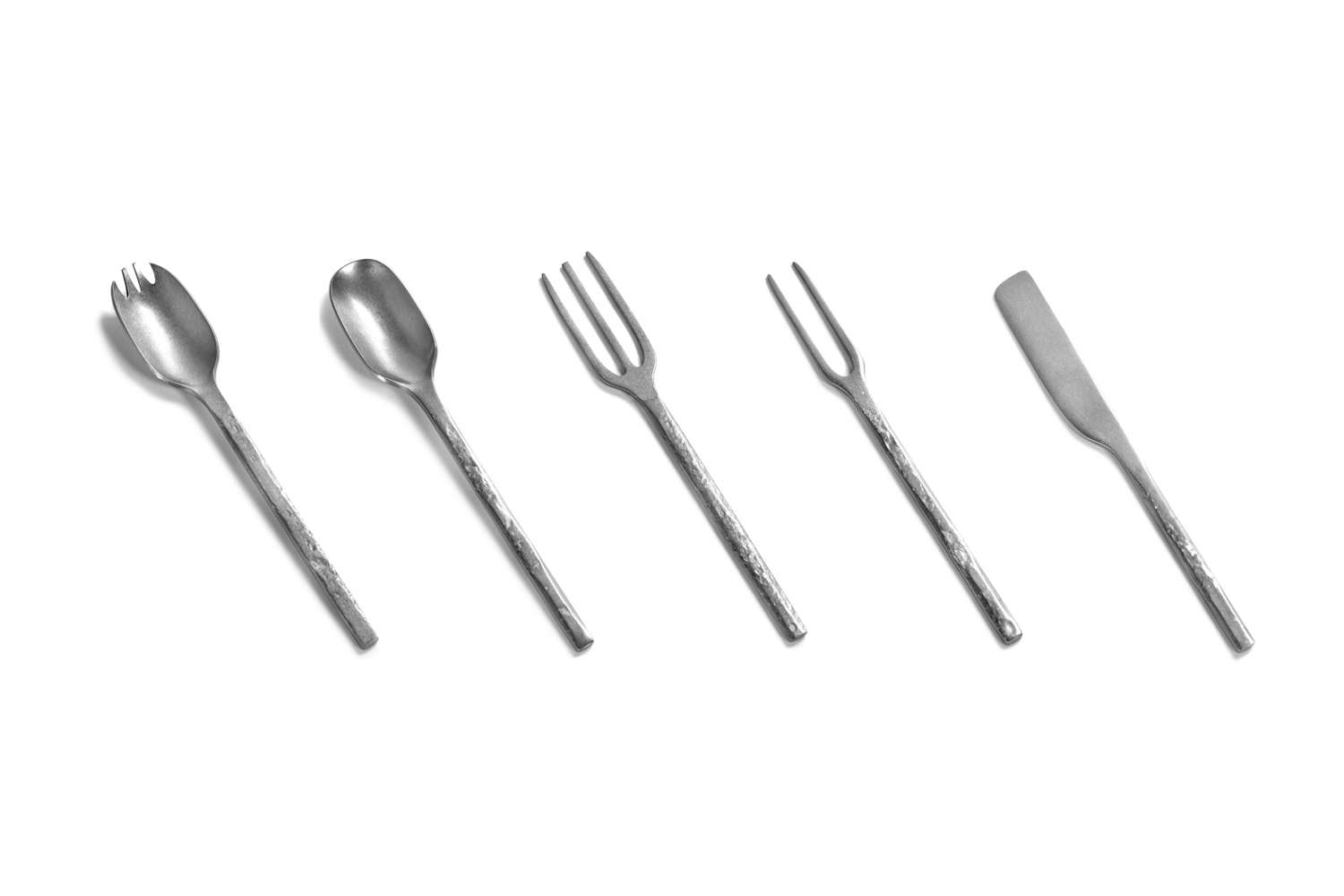
A hammered metal knife is the rare kitchen tool that can make an onion nervous before the chopping even begins. Its textured blade catches the light, hints at traditional craftsmanship, and looks far more interesting than the smooth stainless-steel knives occupying most kitchen drawers.
Appearance, however, is only part of the story. Known in Japanese cutlery as a tsuchime finish, the hammered pattern may help reduce friction and make certain ingredients release from the blade more easily. The usefulness of that texture depends on its depth, placement, blade geometry, steel, and the food being cut. In other words, those handsome dimples can help, but they are not tiny culinary force fields.
This guide explains what a hammered metal knife is, how it differs from Damascus and hollow-edge knives, which blade styles are available, what to examine before buying one, and how to keep it performing beautifully for years.
What Is a Hammered Metal Knife?
A hammered metal knife has a deliberately textured blade surface created by striking, pressing, stamping, or otherwise forming shallow indentations in the metal. In Japanese knife terminology, this finish is called tsuchime, a word that simply means “hammered.”
The marks are generally applied above the primary cutting bevel. They may be irregular and rustic, carefully arranged in rows, or incorporated into an elaborate decorative pattern. On handmade knives, individual variations can be part of the appeal. Factory-produced models may use dies or mechanical hammers to create a more consistent texture.
The texture does not form the cutting edge itself. Sharpness comes from the edge angle, grind, steel, heat treatment, and quality of sharpening. A beautiful hammered blade can be an excellent cutter, but hammer marks alone do not guarantee performance.
Hammered Finish vs. Damascus Pattern
Hammered and Damascus are often mentioned together because many premium knives feature both. They are not the same thing.
A hammered finish is a three-dimensional surface texture. Damascus describes visible layered or patterned steel, commonly created by combining multiple layers around a harder cutting core. A knife may be hammered without being Damascus, Damascus without being hammered, or both at once.
Damascus-style layering is primarily associated with construction, protection of the core, and visual patterning. Hammering creates physical depressions on the blade face. Manufacturers frequently combine the two because the layered waves and textured dimples produce a dramatic, handcrafted appearance.
Hammered Finish vs. Hollow Edge
A hollow-edge knife usually has a row of smooth oval depressions near the cutting edge. These indentations are sometimes called kullenschliff or Granton-style hollows. They are larger, more uniform, and placed closer to the edge than most hammered marks.
Both designs attempt to create small air spaces between the blade and food. Hollow-edge knives are especially common among santoku, carving, and slicing knives. Hammered knives distribute a more irregular texture across a larger area of the blade.
Neither design can completely prevent sticky foods from clinging. Potatoes, cheese, cucumbers, and squash are remarkably committed to hitching a ride. Still, properly formed indentations may reduce surface contact, drag, and sticking during repetitive slicing.
Does a Hammered Blade Improve Cutting Performance?
The main functional argument for a hammered blade is food release. When a smooth, wide blade passes through a moist ingredient, the food may adhere to the metal because of surface tension, pressure, and friction. Hammered depressions reduce some of the continuous contact between the blade and the ingredient.
The effect is often most noticeable when cutting firm, moist produce such as potatoes, apples, zucchini, carrots, and onions. It can also help when slicing boneless proteins. Pieces may fall away more readily instead of stacking against the side of the knife.
Results vary. Shallow decorative hammering near the spine may produce little practical difference. Deeper marks extending toward the lower blade face are more likely to affect food release. Blade thickness and grind remain crucial: a thin, well-ground knife usually moves through ingredients more efficiently than a thick knife wearing a spectacular hammered costume.
Metallurgical testing and knife-performance research consistently emphasize that edge geometry and heat treatment can matter more than the name of the steel. The same logic applies to surface decoration. Hammering is a potentially useful feature, not a replacement for sound engineering.
How Hammered Metal Knives Are Made
Production methods vary considerably. A traditional bladesmith may heat and forge the blade, shape it with a hammer, refine the profile, heat-treat the steel, grind the bevels, polish selected areas, sharpen the edge, and attach the handle. Modern workshops often combine handwork with power hammers, presses, grinding machines, and precision-controlled furnaces.
Heat treatment commonly includes heating the steel to a target temperature, quenching it, and tempering it. These steps influence hardness, toughness, edge retention, and the risk of chipping. The hammered pattern is immediately visible, but the invisible heat-treatment process may have a greater effect on how the knife performs after months of use.
Some knives use a hard carbon-steel core surrounded by more corrosion-resistant stainless cladding. The hammering may be applied to the cladding rather than directly to the exposed cutting core. This construction can provide excellent sharpness while reducing the amount of reactive steel that requires special care.
Popular Types of Hammered Kitchen Knives
Hammered Chef’s Knife or Gyuto
An eight-inch chef’s knife or Japanese gyuto is the most versatile choice for many kitchens. It can slice meat, chop vegetables, mince herbs, and handle routine meal preparation. A gyuto normally has a slimmer profile and lighter feel than a heavy German-style chef’s knife, although designs vary by maker.
Hammered Santoku Knife
A santoku usually measures between six and seven inches and has a tall blade with a relatively flat cutting profile. Its name is commonly associated with three broad uses: meat, fish, and vegetables. The generous blade height provides knuckle clearance and makes it easy to scoop chopped ingredients from the board.
Hammered Nakiri Knife
A nakiri has a rectangular profile and straight cutting edge designed primarily for vegetables. It excels at push cuts, clean downward chopping, shredding cabbage, and producing uniform slices. Despite its cleaver-like appearance, a thin nakiri should not be driven through bones, frozen food, or hard fruit pits.
Hammered Petty or Utility Knife
A petty knife fills the space between a paring knife and a chef’s knife. It is useful for shallots, citrus, strawberries, trimming meat, and detailed board work. Its shorter blade offers agility without feeling as tiny as a traditional paring knife.
Hammered Carving Knife
A long, narrow carving knife is designed to produce smooth slices from roasts, poultry, ham, and large vegetables. Hammered or hollowed surfaces can be helpful here because broad slices have plenty of opportunity to cling to the blade.
How to Choose a Hammered Metal Knife
Start With the Intended Job
Choose the blade style before becoming hypnotized by the finish. For one all-purpose knife, consider an eight-inch chef’s knife, 210-millimeter gyuto, or seven-inch santoku. Frequent vegetable preparation may justify a nakiri. Precision work is better suited to a petty knife.
Evaluate the Steel and Heat Treatment
Stainless steel resists corrosion and is generally convenient for busy home cooks. High-carbon steel can take an exceptionally keen edge and may be easy to sharpen, but it can discolor or rust when left wet. Stainless-clad carbon knives offer a compromise, although the exposed edge still requires prompt cleaning and drying.
Do not select a knife solely because the product page announces a fashionable steel acronym. Steel involves trade-offs among toughness, corrosion resistance, hardness, ease of sharpening, and edge retention. A well-treated, sensibly ground midrange steel can outperform an exotic steel with poor geometry.
Inspect Blade Geometry
Look at the knife from the spine toward the edge. A good kitchen knife generally becomes progressively thinner behind the cutting edge. Excessively thick shoulders can wedge in carrots, squash, and dense potatoes even when the actual edge is sharp.
The hammered marks should not create obvious warping or irregularities in the cutting line. Check that the edge appears straight, the grind is reasonably even, and the blade does not bend noticeably to one side.
Consider Balance and Handle Comfort
A knife can have perfect specifications and still feel wrong in your hand. Handle diameter, shape, texture, length, and weight distribution affect control. Some cooks like forward-balanced Japanese knives, while others prefer the substantial handle and bolster of a Western design.
When possible, hold the knife with a pinch grip, placing the thumb and index finger near the base of the blade while the remaining fingers wrap around the handle. The knife should feel controllable rather than handle-heavy, slippery, or eager to dive nose-first toward the cutting board.
Examine the Hammered Pattern
Functional hammering should be smooth enough to clean easily. Avoid knives with sharp burrs, unfinished pits, or rough transitions that could trap debris. Irregularity is normal on handmade blades, but poor finishing is not the same as charming individuality.
Also ask whether the pattern is forged, pressed, machine-stamped, or laser-engraved. None of these methods automatically makes a bad knife, but shallow printed or etched marks should not be marketed as performance-enhancing hammer work.
Advantages and Disadvantages
Advantages
- The textured blade may improve food release when slicing moist or starchy ingredients.
- Hammer marks hide minor cosmetic scratches better than a mirror-polished surface.
- The finish gives each knife a distinctive, handcrafted appearance.
- Hammered patterns are available on many useful blade styles and steel constructions.
- A textured blade can become an attractive centerpiece in an open kitchen.
Disadvantages
- The hammering may be mostly decorative on inexpensive or poorly designed knives.
- A premium appearance can increase the price without improving the edge.
- Deep or roughly finished indentations may require extra attention while cleaning.
- Food will still stick under some conditions.
- Hard, thin Japanese-style knives may chip if twisted, dropped, or used on bones.
How to Use a Hammered Knife Safely
Use a stable wooden, plastic, paper-composite, or rubber cutting board. Avoid cutting on glass, granite, ceramic plates, metal counters, and other hard surfaces that can quickly damage the edge. When transferring chopped ingredients, turn the knife over and use its spine rather than scraping the sharp edge across the board.
Keep the guiding hand in a claw position with the fingertips curled away from the blade. Cut with smooth, deliberate movements and allow a sharp knife to do the work. Do not pry open containers, twist the blade inside dense food, strike bones, or attempt to catch a falling knife. The floor may suffer, but it has fewer fingers.
After preparing raw meat, poultry, or seafood, wash the knife, cutting board, and nearby surfaces with hot, soapy water before using them for ready-to-eat food. Separate boards may also help reduce cross-contamination during complicated meal preparation.
Cleaning, Storage, and Sharpening
Hand-Wash and Dry Immediately
Wash a hammered knife with warm water, mild dish soap, and a soft sponge. Clean the blade from the spine toward the edge rather than running a hand carelessly along its length. Dry it immediately with a soft towel.
A dishwasher exposes knives to heat, harsh detergent, moisture, vibration, and contact with other utensils. Even when a manufacturer labels a synthetic-handled knife dishwasher-safe, hand-washing usually provides better protection for the edge, finish, and handle. Wooden handles should never be soaked.
Protect Reactive Carbon Steel
Carbon steel may develop a gray, blue, or rainbow-colored patina. A stable patina is not the same as active orange rust. Wipe acidic food from the blade promptly, keep it dry, and apply a very thin layer of food-safe mineral oil before extended storage when recommended by the maker.
Store the Edge Separately
Use a knife block, fitted drawer insert, magnetic rack, blade guard, or knife roll. Do not leave a sharp knife loose in a drawer where the edge can strike other utensils and surprise anyone searching for a measuring spoon.
Understand Honing and Sharpening
Honing realigns an edge that has moved slightly out of position. Sharpening removes metal to create a new cutting apex. Traditional honing rods are suitable for many softer Western knives, but very hard or thin Japanese blades may be better maintained with ceramic rods, fine stones, or methods specifically approved by the manufacturer.
Match the sharpening angle to the knife. Avoid aggressively forcing a thin blade through a coarse pull-through sharpener unless the tool is designed for that edge geometry. A whetstone or experienced professional sharpener offers greater control when a valuable hammered knife needs a complete edge restoration.
A Week of Cooking With a Hammered Metal Knife
Day One: The Potato Test
The first meaningful test was not a tomato, sheet of paper, or dramatic arm-hair demonstration. It was a potato. Potatoes reveal whether a knife glides, wedges, or behaves like a polished metal magnet. The hammered chef’s knife moved through the potato cleanly, and several slices fell away without assistance. Others still clung to the lower blade face, proving that physics had not resigned from the kitchen.
Compared with a thick, smooth-bladed chef’s knife, the hammered model required less effort. The thin grind probably contributed more than the texture, but the dimples appeared to help once the slices reached the upper blade face.
Day Two: Onions and Carrots
Onion preparation showed the value of a tall blade and comfortable pinch grip. The knife produced clean vertical cuts without crushing the layers. During cross-cutting, chopped onion accumulated against the blade, although it released with a small wrist movement.
Carrots exposed another useful trait: feedback. A good thin knife enters a carrot with a controlled whisper rather than a loud crack. The hammered knife passed through medium carrots smoothly, but twisting the edge to finish an incomplete cut felt unwise. Thin, hard blades reward straight movement and punish improvisational crowbar techniques.
Day Three: Herbs and Garlic
Mincing parsley was comfortable, although the flatter Japanese-style profile preferred a gentle push cut over exaggerated rocking. Garlic behaved like garlic and stuck whenever it found an untextured area near the cutting edge. The hammering made cleanup slightly easier, but it did not prevent every fragment from attaching itself to the knife like an enthusiastic passenger.
Day Four: Chicken Preparation
The knife trimmed boneless chicken thighs neatly and removed small pockets of fat with excellent control. It was not used to split joints or strike bones. A chef’s knife may handle many jobs, but versatility is not permission to use it as a cleaver. Kitchen confidence improves when the cook recognizes both what a tool can do and what it should politely decline.
Afterward, the blade and board were washed immediately before any vegetables were prepared. The textured surface did not make cleaning difficult because the hammer marks were smoothly finished without sharp pits.
Day Five: Squash and Sweet Potatoes
Sweet potatoes offered the most resistance of the week. The knife entered cleanly, but the dense flesh gripped the blade. The hammered texture reduced some suction once the cut became deeper, yet technique mattered more. Keeping the blade vertical and applying steady pressure was safer than rocking or twisting.
A large winter squash was handled with a heavier Western chef’s knife instead. That decision was less glamorous but more sensible. A refined hammered knife should not be forced into every task simply because it looks heroic on the magnetic rack.
Day Six: Maintenance
After several meals, the edge still sliced tomato skin without crushing the flesh. It did not need sharpening. The knife was washed, dried, and returned to a guarded storage slot after every use. This routine took less than a minute and prevented the stains, edge damage, and mysterious sink encounters that shorten the lives of good kitchen knives.
Day Seven: Final Impressions
The strongest impression after one week was not that hammering transformed cutting performance. It was that a well-balanced, thin, sharp knife made cooking feel more deliberate. The texture helped food release in some situations, looked attractive, and disguised fingerprints better than a polished blade.
The knife was enjoyable because its features worked together: useful length, comfortable handle, sensible weight, refined grind, sharp edge, and properly finished hammer marks. Remove those fundamentals and the texture would become decoration. Preserve them, and the hammered surface becomes a practical bonus attached to an already capable tool.
Is a Hammered Metal Knife Worth Buying?
A hammered metal knife is worth considering when you appreciate its appearance and the underlying knife is well designed. The finish may reduce sticking and drag, but the buying decision should begin with blade style, edge geometry, steel treatment, balance, handle comfort, and maintenance requirements.
For most home cooks, a stainless hammered gyuto, chef’s knife, or santoku measuring seven to eight inches provides the broadest usefulness. Experienced enthusiasts may enjoy carbon-steel or stainless-clad options that demand more attentive care in exchange for easier sharpening and a highly refined edge.
Choose the knife that feels secure in your hand, suits your cutting technique, and comes from a maker or retailer willing to explain the steel, construction, hardness, grind, warranty, and sharpening recommendations. A trustworthy seller discusses more than the pretty dents.
Note: A hammered finish should be treated as one component of knife design. It cannot compensate for poor heat treatment, uncomfortable balance, thick geometry, weak quality control, or an improperly sharpened edge.