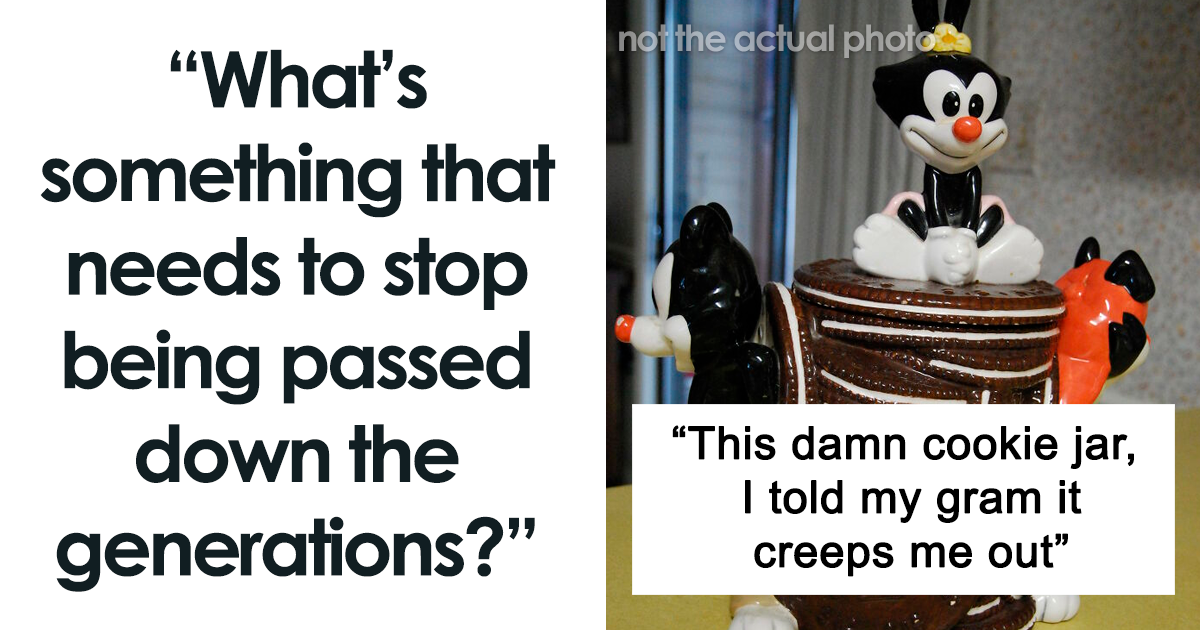
Every generation hands something to the next one. Sometimes it is a family recipe, a good work ethic, a photo album, or the sacred knowledge that a cookie tin almost never contains cookies. Other times, what gets passed down is less charming: guilt, silence, shame, outdated expectations, and furniture nobody wants but everyone is too polite to reject.
An online group once discussed the things people wish older generations would keep to themselves instead of passing down. The answers were funny, sharp, painfully honest, and occasionally aimed directly at that one creepy decorative object sitting in Grandma’s hallway. But beneath the jokes was a serious theme: inheritance is not only money, property, or last names. We also inherit habits, fears, beliefs, emotional reflexes, and family rules that may have expired three decades ago.
That does not mean every older idea is bad or every new idea is genius. Every generation has its blind spots. The goal is not to turn family dinner into a courtroom drama with mashed potatoes. The goal is to ask: what deserves to continue, and what should politely retire with its original owners?
Why Some Generational Habits Need an Expiration Date
Generational patterns can feel normal simply because they are familiar. A family that never talks about feelings may call it “being strong.” A workplace that rewards burnout may call it “commitment.” A household that treats children like tiny employees may call it “discipline.” But research on mental health, parenting, workplace well-being, and financial pressure increasingly suggests that many old assumptions do more harm than good.
Here are 28 things people often say should stay within their own generation instead of being handed down like a cursed casserole dish.
28 Things People Should Stop Passing Down
1. The “I Suffered, So You Should Too” Mentality
This might be the grand champion of bad generational hand-me-downs. Surviving hardship can build empathy, but it can also become a strange excuse to preserve misery. A better legacy is: “I went through this, so I want you to have better tools than I did.” Pain should not be treated like a family heirloom.
2. Forced Respect Without Accountability
Respect matters. Blind obedience is another thing entirely. Age can bring wisdom, but it does not automatically make someone kind, honest, or correct. Younger people should learn manners, but they should also learn that respect works best when it travels both ways.
3. Physical Punishment as “Discipline”
Many people grew up hearing, “I was hit and I turned out fine.” Yet modern child development research has strongly moved toward nonviolent discipline, clear boundaries, emotional coaching, and consistency. Fear may stop behavior in the moment, but it does not teach trust, self-control, or problem-solving.
4. Emotional Silence Disguised as Strength
“Don’t cry.” “Toughen up.” “Keep it inside.” These phrases have been doing emotional damage in bulk for years. Strength is not the absence of feeling. Strength is knowing what to do with feelings before they come out as sarcasm, stomach pain, or a group text sent in all caps.
5. Toxic Gender Scripts
Boys do not need to be raised like tiny action figures with unpaid emotional labor. Girls do not need to be treated like decorative princesses waiting for approval. Passing down rigid gender expectations limits everyone. Children deserve room to become people, not stereotypes with backpacks.
6. The Idea That Family Must Be Endured at Any Cost
Family can be beautiful. Family can also be complicated, unhealthy, or unsafe. “Because they’re family” should not be used as a lifetime coupon for bad behavior. Healthy family loyalty includes boundaries, accountability, and the freedom to step back from relationships that consistently cause harm.
7. Making Children Responsible for Adult Emotions
When children are forced to comfort adults, manage household tension, or keep the peace, they may grow up too fast. Kids should learn empathy, yes, but they should not become unpaid emotional support staff for grown-ups who refuse to self-regulate.
8. Forced Hugs, Kisses, and “Don’t Be Rude” Affection
Many families mean well when they push children to hug relatives. But children also need to learn that their comfort matters. A wave, high-five, or verbal greeting can show politeness without teaching a child that someone else’s feelings automatically outrank their bodily boundaries.
9. Shame-Based Parenting
Shame can sound like discipline, but it usually lands like humiliation. Children learn better from guidance than from being mocked, compared, or called lazy. A correction can be firm without becoming a character assassination.
10. The “Good Job, House, Marriage, Kids” Life Checklist
For many families, success followed a familiar route: school, stable job, marriage, home, children, retirement. For younger generations facing different housing markets, education costs, job patterns, and family choices, that checklist may not fit. A meaningful life can have more than one floor plan.
11. Treating College as the Only Respectable Path
Education is valuable, but not every person needs the same route. Trade schools, apprenticeships, community college, entrepreneurship, military service, caregiving, creative work, and technical careers can all be valid. The old “degree or disgrace” mindset needs a vacation.
12. Financial Secrecy
Many households never talk honestly about money until something goes wrong. Younger people need practical conversations about debt, credit, saving, budgeting, taxes, insurance, and scams. Silence does not protect kids from financial stress; it just makes adulthood feel like opening a mystery box full of bills.
13. Debt as a Normal Family Tradition
Some debt is strategic or unavoidable, such as education, housing, or medical costs. But passing down casual debt habits, unpaid bills, and “we’ll figure it out later” budgeting can trap the next generation. Financial literacy is a better inheritance than a drawer full of unopened statements.
14. Children as Retirement Plans
Helping parents can be loving and honorable. But raising children with the expectation that they must become financial safety nets can create guilt and resentment. Families need realistic planning, honest conversations, and respect for the next generation’s ability to build their own lives.
15. Mental Health Stigma
One of the most damaging things to pass down is the belief that anxiety, depression, trauma, or therapy should be hidden. Mental health care is health care. Telling people to “just pray,” “just work harder,” or “just get over it” is not a treatment plan; it is a motivational poster with bad Wi-Fi.
16. Unprocessed Trauma
Trauma can echo through families when nobody names it, understands it, or heals from it. The next generation should not have to decode old pain through silence, anger, addiction, or emotional distance. Healing is not betrayal. It is maintenance on the family bridge.
17. Racism, Prejudice, and “That’s Just How We Talk” Excuses
Every generation has heard some version of “we didn’t mean anything by it.” But harmful language and stereotypes still shape how people are treated. Younger generations do not need inherited prejudice wrapped in nostalgia. Some “old sayings” belong in the verbal landfill.
18. Political Loyalty as a Family Obligation
People should be allowed to think, read, question, and vote according to their own values. Passing down civic engagement is great. Passing down automatic political identity like a last name is not. Democracy works better when people are citizens, not family-brand bumper stickers.
19. Religion as Pressure Instead of Personal Meaning
Faith can be a source of comfort, ethics, community, and tradition. But forced belief often creates resentment rather than devotion. Passing down values is different from demanding a copy-paste spiritual identity. The healthier gift is space to ask honest questions.
20. Ageism in Both Directions
Older people are not automatically out of touch, and younger people are not automatically fragile. Age-based insults make everyone dumber. A healthier generational conversation starts with curiosity: what shaped your view, and what can I learn from it?
21. Workplace Martyrdom
Older workplace culture often rewarded staying late, skipping rest, and treating burnout like a badge of honor. Younger workers are challenging that model, not because they are lazy, but because mental health, caregiving, and life outside work matter. Productivity should not require becoming a haunted office chair.
22. The Belief That Career Suffering Proves Character
Hard work is valuable. Needless suffering is not. A bad boss, low pay, unsafe conditions, or constant stress should not be romanticized as “paying dues.” Some dues are just fees charged by dysfunctional systems.
23. The Fear of Talking About Boundaries
Boundaries are often misread as disrespect. In reality, they help relationships survive. Saying “I can visit for two hours” or “I don’t want to discuss my body, job, or dating life at dinner” is not cruelty. It is emotional traffic control.
24. Comparing Children to Everyone Else’s Children
Comparison is a fast way to turn family love into a scoreboard. One child may be academic, another artistic, another practical, another still figuring things out. Constant comparison does not inspire; it usually produces resentment and private panic.
25. Hoarding Objects Nobody Wants
Every family has something like this: fancy glasses never used, furniture too heavy to move, boxes labeled “important” that contain charger cords from 2004. Sentimental items matter when they carry real meaning. But guilt-storage is not tradition; it is clutter with a family tree.
26. Outdated Ideas About Love and Dating
The idea that one gender must always pursue, pay, decide, or lead has aged about as gracefully as carpeted bathrooms. Healthy relationships need communication, respect, consent, shared effort, and emotional maturity. The old script was often more about performance than partnership.
27. Digital Recklessness
Every generation has its technology problem. Older adults may be more vulnerable to certain scams, while younger people may overshare online or live under constant notification pressure. The better inheritance is digital wisdom: privacy, skepticism, balance, and knowing that not every argument requires a comment.
28. The Belief That “My Generation Was Better”
This one deserves to be sealed in a jar and launched into space. Every generation had brilliance and nonsense. Boomers, Gen X, Millennials, and Gen Z all inherited problems and created a few new ones for fun. The point is not to crown a winner. The point is to stop using nostalgia as evidence.
What Should Be Passed Down Instead?
Not everything old should disappear. Many families pass down resilience, humor, craftsmanship, recipes, music, sacrifice, faith, storytelling, community care, and practical wisdom. Those are treasures. The question is whether a tradition helps people grow or keeps them small.
A healthier inheritance might include emotional honesty, financial education, respect for boundaries, curiosity about difference, and the humility to admit when an old rule no longer works. It might sound less dramatic than “because I said so,” but it is much more useful at Thanksgiving.
Experience-Based Reflections: What This Looks Like in Real Life
In real life, generational change rarely happens through one grand speech. It usually happens in small moments. Someone decides not to yell during homework. Someone says, “You don’t have to hug anyone if you don’t want to.” Someone goes to therapy and stops pretending the family’s emotional weather is normal. Someone looks at the old career checklist and says, “Actually, I want a different life.”
These moments can feel awkward because families are experts at maintaining familiar patterns. If everyone is used to sarcasm, kindness may feel suspicious. If everyone is used to silence, honest conversation may sound dramatic. If everyone is used to guilt, a boundary may feel like rebellion. Change often gets criticized first because it interrupts the family script.
One common experience is the money conversation. Many younger adults grew up knowing their families were stressed about bills but never understanding why. Then they became adults and discovered interest rates, credit scores, student loans, rent increases, insurance deductibles, and the thrilling horror movie known as “unexpected car repair.” When families talk openly about moneynot to scare kids, but to prepare themthey replace mystery with skill. That alone can change a person’s future.
Another experience involves emotional expression. A parent who was raised to hide feelings may struggle when their child names anxiety, sadness, or overwhelm. At first, the parent may hear it as weakness. But over time, many families learn that naming a feeling does not make it bigger; it makes it manageable. A child who can say “I’m stressed” is not less strong than one who pretends everything is fine. They are simply using a better tool.
Boundaries are another major battlefield. A person may love their family and still not want surprise visits, invasive questions, or holiday guilt trips. Older relatives sometimes interpret boundaries as rejection because they were not taught a vocabulary for personal limits. But boundaries are not walls with spikes. They are doors with handles. They tell people how to enter respectfully.
The same applies to career expectations. Many parents and grandparents were taught to value security above all else, often for good reasons. They survived economic uncertainty, discrimination, war, migration, layoffs, or family instability. So when younger people choose flexible work, creative paths, remote jobs, or nontraditional education, older relatives may worry. The challenge is to separate love from control. Advice is helpful when it comes with listening. It becomes pressure when it arrives wearing steel-toed boots.
Perhaps the most powerful experience is realizing that breaking a pattern does not mean rejecting your family. It means refusing to pass pain forward simply because it is familiar. You can honor where you came from without copying every method. You can love your parents and still parent differently. You can respect your grandparents and still decline their worldview. You can keep the recipe and retire the resentment.
Every generation gets to edit the inheritance. The best legacy is not perfection. It is progress with receipts.
Conclusion
The online group’s answers may have started as a list of pet peeves, but they point toward a deeper cultural shift. People are questioning old rules around family, work, discipline, money, identity, and emotional health. That questioning is not disrespectful by default. Often, it is how families become healthier.
Some things should be passed down proudly: compassion, courage, humor, useful skills, good stories, and maybe that one soup recipe nobody wrote down correctly. But shame, prejudice, silence, forced obedience, and unnecessary suffering can stop here. The next generation does not need every suitcase we carried. Some luggage can be left at the station.
Note: This article is an original, publication-ready synthesis. It does not copy forum comments directly and is written for clean web publishing without source-link clutter inside the HTML body.