Business travel can sound glamorous until you are eating a convenience-store sandwich beside a hotel ironing board while trying to remember which time zone your body has resigned from. After the meetings end and the emails stop multiplying for five whole minutes, a quiet hotel room can begin to feel like a beige aquarium.
One business traveler staying in Azerbaijan found a more imaginative solution than watching another dubbed action movie. Using pillows, blankets, towels, and a few quick drawings, he began leaving playful creations for the hotel housekeeper. Instead of silently dismantling his miniature linen museum, the housekeeper responded with handwritten notes and drawings of her own.
What started as a bored hotel guest’s private joke became a cheerful, days-long conversation between two people who apparently shared no formal introduction. The exchange was simple, funny, and unexpectedly touchingproof that sometimes the most memorable part of a hotel stay is not the breakfast buffet but a smiling face made from two pillows and an aggressively rolled blanket.
How a Boring Hotel Room Became a Creative Playground
The traveler’s idea was wonderfully low-tech. There were no elaborate props, expensive gifts, or professional art supplies. He used items already in the room to construct strange characters and oversized faces across the bed.
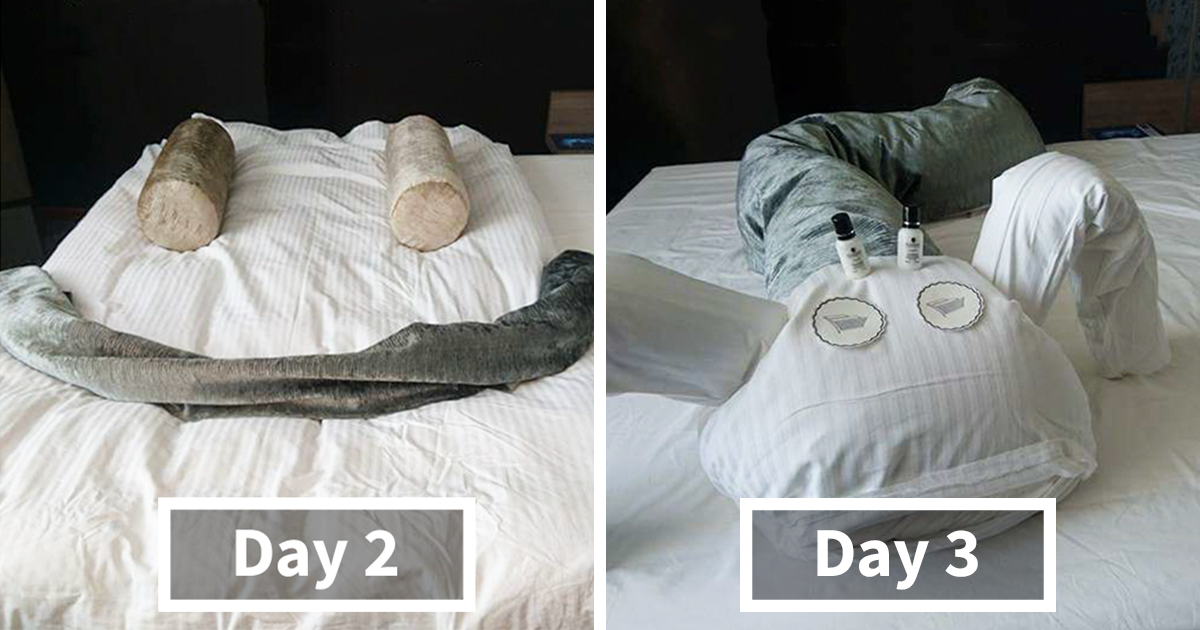
Early in the exchange, he arranged bedding into a giant smile. Rolled cushions became eyes, while a long blanket formed an enormous curved mouth. The housekeeper remade the bed but preserved the joke, adding a handwritten smiley face for him to discover later.
That response was effectively permission to continue.
The following creations became increasingly ambitious. One resembled a wide-eyed creature with pillow limbs. Another looked like a seated figure assembled from folded sheets and cylindrical cushions. A later character had a gray body, white appendages, and the general energy of an alien rabbit who had just been informed that checkout was at 11 a.m.
The traveler labeled the photographs as daily “room service challenges,” although the person responding was clearly a member of the housekeeping team rather than someone delivering club sandwiches. The terminology may have been slightly confused, but the enthusiasm was fully checked in.
By the later days, the bed had hosted a turtle-like figure decorated with hand-drawn pictures, a large round character wearing what looked like a towel hat, and even a robe-clad “businessman” positioned at the desk. That final office worker had a cushion for a head, sleeves made from folded fabric, and the weary posture of someone attending a conference call that absolutely could have been an email.
The Housekeeper’s Notes Turned a Joke Into a Conversation
The creations were amusing, but the housekeeper’s responses gave the story its heart. She did not merely tolerate the unusual arrangements. She joined the game.
Some replies were short: a smiling drawing, an enthusiastic “OK,” or a simple reaction to the latest bedding sculpture. Other notes became more personal. After encountering a creation accompanied by drawings of two smiling figures, she wrote that he had cheered her up and thanked him.
Later, after finding the robe-wearing character seated at the hotel desk, she left another drawing and described the display as “very, very beautiful.” Her English did not need to be elaborate. The warmth of the message was perfectly clear.
The exchange worked because neither participant tried to dominate it. The guest created something playful. The housekeeper acknowledged it. He interpreted that acknowledgment as an invitation to produce another surprise. She responded again. A silent service interaction gradually became a shared story.
For the farewell, the traveler shaped a long blanket into a large heart on the bed. Inside it, he placed a small collection of treats as a final thank-you. The goodbye did not need a dramatic speech. After days of smiling creatures and handwritten messages, a heart made from hotel bedding said enough.
Why This Funny Hotel Housekeeping Story Resonated Online
It transformed ordinary objects into a continuing story
A pillow is not especially exciting. Neither is a towel, unless you have just stepped out of the shower and discovered someone forgot to replace yours. Yet the traveler turned familiar hotel objects into a serialized comedy.
Each day created a tiny cliffhanger. What would he build next? Would the housekeeper respond? Would the gray blanket eventually achieve consciousness and request its own rewards membership?
That progression made the images more engaging than a single funny hotel-room photograph. Viewers were not simply looking at linen sculptures. They were watching a relationship develop through them.
It made an often-invisible worker visible
Hotel housekeepers usually work when guests are elsewhere. Travelers leave for breakfast or meetings and return to find the bed made, the trash removed, the bathroom cleaned, and the room reset. The work is obvious, but the person doing it can remain almost completely unseen.
The notes changed that dynamic. They reminded the guestand everyone following the storythat housekeeping is performed by an individual with a personality, a sense of humor, and a day that can be improved by an unexpected act of kindness.
The guest did not treat the room attendant like a background character. He gave her something cheerful to discover, and she answered as herself rather than as an anonymous hotel function.
The humor was gentle rather than cruel
Many online “challenges” depend on embarrassing an employee, provoking an angry response, or creating a problem for someone who did not agree to participate. This hotel guest challenge was different.
The joke was not aimed at the housekeeper. She was invited into it, and her positive responses showed that she enjoyed the interaction. The creations were also made from soft, ordinary room items rather than food, liquids, glitter, tape, or anything requiring an emergency meeting with the laundry department.
That distinction matters. A prank creates work at another person’s expense. A playful exchange creates enjoyment for both people.
The Real Work Behind a Perfectly Made Hotel Bed
The viral photographs are lighthearted, but hotel housekeeping itself is demanding work. Room attendants make beds, replace linens, clean bathrooms, vacuum floors, remove trash, restock supplies, inspect rooms, and report maintenance problemsoften while moving through a tightly scheduled list of departures and occupied rooms.
The job also involves repetitive reaching, bending, pushing, pulling, and lifting. Mattresses do not politely rise when sheets need to be tucked beneath them. Cleaning carts must be maneuvered through corridors, linens must be transported, and bathrooms require work in awkward spaces.
Government occupational-safety resources identify repetitive motion, forceful exertion, lifting, and awkward posture as important ergonomic risks in housekeeping work. In other words, the crisp bed that looks effortless when a guest walks in may represent considerable physical effort.
Housekeepers must also balance speed with accuracy. A room needs to be clean, organized, properly supplied, and ready when the next traveler arrives. Missing towels, leftover trash, or an overlooked surface can affect a guest’s entire impression of the property.
That context makes the housekeeper’s participation in the creative challenge even more meaningful. She was not sitting around waiting for a pillow monster to appear. She had real work to complete, yet she still took a moment to draw a smile and leave a note.
Hotel Guest Etiquette: Keep the Fun From Becoming Extra Labor
The story may inspire travelers to create their own hotel-room surprises, but there is an important rule: the activity should not make a housekeeper’s job harder.
Use only clean, undamaged items
Do not draw on linens, attach decorations with adhesive, pour substances onto bedding, or use hotel property in ways that could stain or damage it. A towel elephant is charming. A towel elephant covered in permanent marker is an invoice.
Keep floors and working areas clear
Housekeepers need safe access to beds, bathrooms, trash cans, and furniture. Avoid creating obstacles, tying items together, or placing heavy objects where they could fall.
Read the response before continuing
The Azerbaijan exchange continued because the housekeeper repeatedly answered with smiles and positive notes. Without that encouragement, the considerate choice would have been to stop. Employees should never feel pressured to entertain guests or participate in content intended for social media.
Leave the room reasonably organized
Guests are not expected to clean the room themselves, but small actions help. Place trash in a bin, keep personal belongings away from surfaces that need cleaning, gather used towels in one visible location, and avoid leaving food scattered around the room.
Show appreciation in practical ways
A sincere thank-you note can brighten someone’s shift, but it should not automatically replace a gratuity where tipping is customary. In the United States, frequently cited guidance suggests leaving approximately $1 to $5 per day for housekeeping, with more appropriate for larger groups, unusually messy rooms, or exceptional service.
Because different room attendants may work on different days, leaving a clearly labeled daily tip is generally more reliable than waiting until checkout. Customs vary outside the United States, so travelers should check local expectations.
What Hotels Can Learn From This Guest-Housekeeper Interaction
Hotels invest heavily in mattresses, lighting, apps, loyalty programs, lobby fragrances, and shower controls that require an engineering degree to operate. Yet guests frequently remember human moments more clearly than physical features.
A personalized note, a remembered preference, or a warm employee response can turn a routine stay into a story worth sharing. Hospitality research has consistently emphasized the importance of employee communication and engagement in shaping how customers evaluate service.
That does not mean hotels should instruct room attendants to build sculptures or write elaborate messages in every room. Forced whimsy quickly becomes another quota, and nobody needs a performance review measuring quarterly towel-animal output.
The better lesson is to give employees enough support and discretion to respond naturally when an opportunity for positive interaction appears. Genuine hospitality cannot be mass-produced, but workplaces can create conditions in which it is allowed to happen.
Managers should also recognize that customer appreciation is pleasant but cannot substitute for safe workloads, proper equipment, fair compensation, training, and respect. A thank-you note may improve a shift. It cannot lift a mattress or reduce an unrealistic room assignment.
Related Experiences: Small Hotel Moments That Become Great Travel Stories
The viral housekeeping challenge belongs to a broader category of travel experiences in which ordinary interactions become unexpectedly memorable. These stories rarely begin with luxury. They begin with attention.
The traveling stuffed animal
One familiar example involves a childor an adult who correctly understands that stuffed animals remain important foreveraccidentally leaving a toy behind. Instead of simply mailing it home, hotel employees sometimes photograph the toy “enjoying” the property before returning it.
The forgotten bear may appear behind the front desk, on a luggage cart, beside the pool, or inspecting a tray of desserts. The owner receives both the toy and evidence that it had a better vacation than most humans.
These gestures work for the same reason as the pillow challenge. Employees take an impersonal task and add a small story. The practical problem is solved, but the emotional value comes from the playful effort.
The handwritten housekeeping conversation
Some guests begin leaving a short note each morning: “Thank you for making the room so comfortable,” “No fresh towels needed today,” or “The extra coffee was greatly appreciated.” A room attendant may answer with a smile, a greeting, or a note wishing the guest a pleasant day.
Over a multi-night stay, these messages can become a conversation between people who never meet. One person writes before leaving for work; the other responds while servicing the room. Their schedules pass like trains in opposite directions, but a small piece of hotel stationery creates a meeting place.
The creative tip presentation
A clearly labeled tip does not need theatrical staging, but some travelers add a harmless touch: a thank-you card, a simple drawing from a child, or a piece of wrapped candy beside the envelope.
The important word is “clearly.” Loose money on a desk may look forgotten rather than intentionally left. A note marked “For Housekeepingthank you” removes uncertainty and ensures the gesture communicates what the guest intended.
The towel-animal reply
At resorts and cruise properties, attendants sometimes fold towels into swans, dogs, monkeys, or creatures that appear to have escaped scientific classification. Guests occasionally answer by rearranging the animal, giving it a paper hat, or drawing it a tiny passport.
When employees respond positively, the room can develop its own continuing cast of characters. Again, the best versions remain simple and respectful. The guest does not destroy the attendant’s work or create a complicated cleanup. The humor comes from continuing the idea.
The most valuable experience is mutual recognition
All these examples share a basic pattern. A traveler recognizes that a service worker is a person rather than an invisible mechanism. The employee recognizes the guest as more than a room number. Each offers a small signal of goodwill, and the other chooses to answer.
That is why the bored hotel guest’s challenges remain appealing years after the photographs first circulated. The bedding sculptures were funny, but they were not masterpieces. The drawings were charming, but they were not polished works of art. Their value came from the fact that two strangers kept showing up for the joke.
Travel can make people feel anonymous. Guests move through airports, elevators, hallways, and conference rooms surrounded by individuals they may never see again. A smiling note breaks that anonymity. For a moment, the hotel room becomes less like temporary accommodation and more like a place where two people managed to make each other’s day better.
Conclusion
The story of the bored hotel guest and the responsive housekeeper is not really about clever ways to fold bedding. It is about participation, appreciation, and knowing when a harmless joke has become a shared experience.
The traveler found a creative cure for business-trip boredom. The housekeeper answered with humor and warmth. Together, they turned a routine hotel stay into a cheerful narrative involving smiley faces, mysterious creatures, an overworked pillow businessman, and one final heart-shaped goodbye.
Guests hoping to recreate that spirit should remember the most important challenge: make someone’s day brighter without making their job more difficult. Be considerate, respect boundaries, leave the room in reasonable condition, and express appreciation in a way that is both personal and practical.
After all, a good hotel provides a clean bed. A memorable stay sometimes begins when someone turns that bed into a smiling monsterand another person leaves a note saying it made them happy.