Note: This article is written as original web content inspired by a real viral social media trend and synthesized with general research on sleep habits, bedroom organization, household routines, relationship humor, and modern couple dynamics.
Every couple has a private little museum of domestic habits. Some people display theirs in the kitchen sink. Others reveal it through the suspicious chair in the corner that somehow became a fabric-based mountain range. But one viral internet trend has proven that the most accurate relationship personality test may be much simpler: look at each person’s side of the bed.
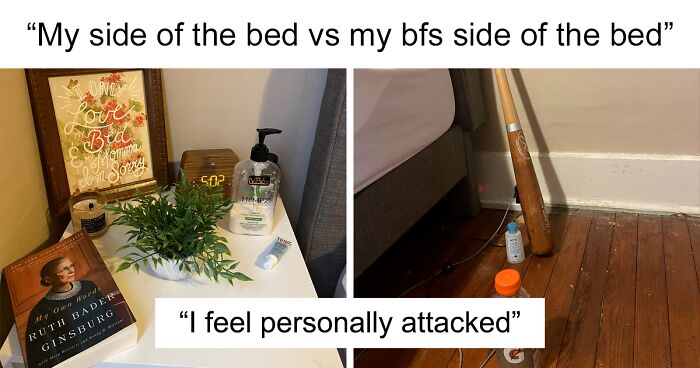
The idea took off when women began posting side-by-side photos comparing their carefully arranged bedside areas with their boyfriends’ dramatically minimalist setups. On one side: water bottle, lip balm, hand cream, hair tie, book, phone charger, candle, backup water bottle, sleep mask, tiny jewelry dish, and possibly a receipt from three emotional eras ago. On the other side: one phone charger, a glass that may or may not be from last Thursday, and the quiet confidence of a man who believes a pillow is a full nightstand strategy.
People found the similarities between men hilarious because the pattern felt oddly universal. The women’s side often looked like a cozy self-care station, a tiny command center for bedtime survival. The boyfriend’s side looked like he had moved in 12 minutes ago and was waiting for the rest of his furniture to arrive by carrier pigeon.
Why the “Side of the Bed” Trend Went Viral
The trend worked because it was instantly understandable. No long caption was needed. No complicated backstory. Just two photos: her side and his side. The joke delivered itself before the viewer even had time to adjust their screen brightness.
That is the magic of good internet humor. It turns a tiny household detail into a shared cultural experience. Many women saw the photos and thought, “Wait, this is my life.” Many men saw them and thought, “Why am I being attacked by a nightstand?” And many couples probably turned their heads at the exact same time to inspect their own bedroom crime scene.
What made the trend especially funny was not that every boyfriend’s side was messy. In fact, some were extremely clean. That was part of the joke. The male side often appeared almost suspiciously bare: phone, wallet, maybe keys, maybe a lonely bottle of water. Meanwhile, the female side looked prepared for sleep, skincare, sudden thirst, emotional reflection, a mild medical emergency, and a power outage.
Her Side: A Bedside Survival Kit With Decorative Lighting
For many women, the side of the bed is not just a place to sleep. It is a small but mighty headquarters. It contains items that answer several important questions: What if my lips get dry? What if I wake up thirsty? What if I suddenly remember I am a person with pores? What if I need to write down a dream before it disappears? What if I want to read three pages of a book and then immediately fall asleep with it on my chest?
This explains the familiar collection: lip balm, lotion, book, phone charger, water, vitamins, scrunchie, sleep spray, eye mask, tissues, and a candle that is mostly decorative but emotionally essential. Some bedside tables also include crystals, framed photos, tiny plants, prescription glasses, backup glasses, and a lamp that creates the exact level of lighting required to feel like the main character in a soft-focus movie.
There is also a practical reason for this setup. Many people use their nightstand as part of a wind-down routine. Sleep experts often recommend creating a calm, consistent bedtime environment, and for some women, that means having comforting items within reach. The nightstand becomes a ritual station: remove jewelry, apply moisturizer, drink water, set alarm, read a little, pretend not to scroll, scroll anyway, feel guilty, plug in phone, repeat tomorrow.
His Side: Minimalism, Mystery, and One Suspicious Sock
Then there is the boyfriend’s side.
The funniest examples usually fall into two categories. The first is extreme minimalism. One cable. One phone. No lamp. No book. No coaster. No evidence that a human being with needs has ever existed there. This kind of side says, “I close my eyes and become unavailable to the world.” It is peaceful, terrifying, and impressive in the way a hotel room is impressive before you unpack.
The second category is chaos minimalism. This is when the boyfriend owns very few bedside items, but every item is placed with the confidence of a raccoon who has been interrupted mid-project. A sock is halfway under the bed. A water glass sits directly on wood despite the existence of coasters in the home. A video game controller appears for no clear reason. Coins, receipts, and a single screw gather as if forming a tiny committee.
People laugh because the similarities feel too specific to be random. How do so many men end up with the same sparse setup? How do so many girlfriends end up with a bedside table that could support a family of four during a snowstorm? The answer is partly personality, partly habit, and partly the strange way couples divide comfort and responsibility without ever holding an official meeting.
What Your Side of the Bed Says About You
Of course, a nightstand is not a scientific personality test. Nobody should end a relationship because one person keeps nasal strips next to a Nintendo Switch. Still, the side of the bed can reveal a lot about how someone moves through daily life.
The Prepared Partner
This person keeps everything nearby “just in case.” Their side includes water, skincare, medicine, charger, reading material, tissues, and possibly a small snack that they insist is not a snack but “for emergencies.” They are often the person who remembers travel-size toothpaste, extra socks, and where the insurance card is hiding.
The Minimalist Sleeper
This person needs almost nothing. They may not understand the purpose of decorative pillows and probably think “bedtime routine” means lying down. Their side of the bed looks calm, but their partner may suspect this calm exists only because someone else owns the household scissors, spare batteries, and hand lotion.
The Accidental Collector
This sleeper does not plan to create clutter. It simply happens. One glass becomes two. A hoodie appears. A book stack grows. A charger tangles itself into a modern art installation. This person is not messy in spirit; they are just living in fast-forward while objects quietly gather around them.
The Trend Is Funny Because It Is About More Than Furniture
The reason this joke spread so widely is that it touches something bigger than nightstands. It reflects the way couples build a shared life out of two very different operating systems.
One partner may see the bedroom as a sanctuary that should feel soft, organized, and personal. The other may see it as the place where unconsciousness happens. One person may want lamps, baskets, matching trays, and a calming color palette. The other may want a phone charger that reaches the bed and a mattress that does not actively injure them.
Neither approach is automatically wrong. The comedy comes from the contrast. It is the same reason couples argue about throw pillows. One partner sees texture, warmth, and design. The other sees an obstacle course that must be removed nightly and replaced every morning for reasons still under investigation.
Gender, Clutter, and the Invisible Labor Behind a “Cute” Bedside Table
The funny side of the trend is obvious, but there is also a deeper layer. Many women’s bedside tables look more “complete” because women are often socialized to think ahead, prepare, decorate, organize, and maintain comfort in shared spaces. In many households, women still report doing more of the daily chores and mental planning, even when both partners work.
That does not mean every woman is organized or every man is clueless. Plenty of men have spotless nightstands, labeled bins, and skincare routines that could humble a beauty editor. Plenty of women have a bedside area that looks like a tote bag exploded during a thunderstorm. But the trend became popular because it exaggerates a pattern many people recognize: one partner curates the nest, while the other simply roosts in it.
The bedside table can become a tiny symbol of invisible labor. Who bought the lamp? Who chose the sheets? Who knows where the extra pillowcases are? Who notices when the room feels cluttered? Who decides that the old water glass should probably stop participating in the relationship?
When the joke stays light, it is harmless fun. When the imbalance becomes constant, it can become frustrating. A woman laughing at her boyfriend’s empty side of the bed may also be laughing at a bigger truth: sometimes “low maintenance” is only possible because someone else is maintaining the environment.
Why Bedroom Organization Matters for Sleep
Beyond the humor, the bedroom environment really can affect how well people sleep. Sleep experts commonly recommend keeping the room cool, dark, quiet, and relaxing. A cluttered bedroom may not bother everyone, but for many people, visual mess can make it harder to mentally shut down at night.
That is why the nightstand matters. It is the last thing you see before sleep and one of the first things you see in the morning. If it is covered in old cups, tangled wires, snack wrappers, and work papers, your brain may interpret the space as unfinished business. If it is too sparse to function, you may spend half the night reaching for things that are across the room.
The best bedside setup is not necessarily the prettiest one. It is the one that supports rest. That might mean a lamp, book, water, charger, tissues, and a small tray. It might mean nothing but an alarm clock and a glass of water. It might mean separate storage styles for each partner, because romance is lovely, but so is not fighting over drawer space at 11:43 p.m.
Couple Compatibility: Same Bed, Different Worlds
Sharing a bed is one of the most intimate parts of a relationship, but it is also one of the most logistically weird. Two people with different body temperatures, alarm schedules, pillow preferences, blanket ethics, and nightstand philosophies are expected to merge into one peaceful sleeping arrangement. Frankly, it is amazing anyone survives February.
Some couples have strict assigned sides of the bed. Others switch occasionally. A few rare souls randomly choose sides every night, which the internet has treated with the same suspicion usually reserved for haunted dolls. The outrage is funny because people become deeply attached to their side. It is not just geography; it is identity. Your charger is there. Your water is there. Your tiny pile of “I’ll deal with it tomorrow” is there.
In healthy relationships, these differences become part of the couple’s folklore. “He sleeps next to one phone cable and calls it a night.” “She has seven lip balms and still asks where one is.” These little observations can be affectionate. They become part of the private comedy that makes a home feel lived-in.
When the Joke Stops Being Funny
Like all relationship humor, the side-of-the-bed joke works best when both people are in on it. It becomes less cute when one partner feels shamed, dismissed, or stuck doing all the work.
If one person’s clutter keeps the other person from relaxing, that deserves a real conversation. If one partner mocks the other’s bedtime routine, that also deserves attention. The goal is not to make both nightstands identical. The goal is to create a space where both people can rest without resentment.
A good compromise might be simple: each person gets one drawer, one small tray, and one weekly reset. The minimalist partner does not have to become a candle collector. The prepared partner does not have to give up the lip balm army. But both people should be able to reach the bed without stepping over yesterday’s jeans like they are crossing a river.
How to Create a Bedside Setup That Works for Both Partners
1. Respect Different Comfort Styles
Some people feel calm when everything is visible. Others feel calm when surfaces are clear. Instead of arguing over which style is “right,” focus on what helps both people sleep better.
2. Give Every Item a Home
A small tray can hold jewelry, lip balm, glasses, and keys. A drawer can hide medicine, chargers, and sleep accessories. A basket under the nightstand can collect books or electronics without turning the floor into a storage unit.
3. Keep Work Out of the Bedroom
Laptops, paperwork, and stress-heavy items can make the bedroom feel like an office with pillows. If possible, move work materials somewhere else before bed.
4. Solve the Charger War
Many couples’ bedside problems begin with cords. Use longer chargers, cable clips, or a charging station so nobody has to perform a nightly gymnastics routine to plug in a phone.
5. Schedule a Tiny Reset
Once a week, clear cups, toss receipts, return books, and rescue the socks. It takes five minutes and prevents the nightstand from evolving into a legally recognized habitat.
Why People Love Relationship Trends Like This
Relationship trends go viral because they make private habits public in a way that feels safe and funny. Nobody is exposing a major secret. They are sharing something small: a bedside table, a blanket arrangement, a snack drawer, a thermostat battle. Yet these details carry a surprising amount of emotional truth.
The side-of-the-bed trend also avoids the harshness of many relationship conversations online. It is not about cheating, red flags, or dramatic breakups. It is about laughing at the tiny differences that come with loving another person. It says, “Look at this ridiculous human I chose. Look at his one sad charger. I adore him, but also, what is this?”
That affectionate teasing is part of why people found the similarities between men so hilarious. The joke is not that men are bad. The joke is that many men appear to approach bedtime with the packing list of a person going to the mailbox, while many women approach it like they are preparing for a comfortable overnight expedition.
Experiences Related to the Side-of-the-Bed Trend
One of the funniest things about this trend is how quickly it makes people audit their own bedroom. A woman might read one post, glance at her side of the bed, and realize she has accidentally built a luxury airport lounge within arm’s reach. There is water, sparkling water, lip balm, lotion, a half-read novel, a gratitude journal, two pens that do not work, a phone charger, and a small dish full of earrings she removed while half asleep. Then she looks at her boyfriend’s side and sees one cord and a T-shirt on the floor. Suddenly, the internet feels less like entertainment and more like surveillance.
Many couples can probably relate to the bedtime routine mismatch. One partner has a full sequence: wash face, apply serum, moisturize, braid hair, fill water bottle, set alarm, adjust pillow, check door lock, check alarm again, spray pillow mist, and announce, “I’m going to sleep,” before scrolling for 18 minutes. The other partner removes socks in a way that launches them into an unknown corner, lies down, and falls asleep in approximately seven seconds. No meditation. No skincare. No emotional transition. Just immediate power-down mode, like a laptop with excellent battery health.
Another common experience is the mysterious migration of objects. Even when the boyfriend’s side begins empty, things slowly appear. A receipt. A watch. A protein bar wrapper. A random Allen wrench from furniture assembled three years ago. He may insist he is not messy because there are “only a few things,” but those few things somehow never leave. Meanwhile, her side may be crowded, but each item has a purpose, a backstory, and a legal right to remain there.
Some women also recognize the emotional comfort of having “just in case” items nearby. The nightstand is not clutter; it is reassurance. Lip balm means dry lips will not win. Water means thirst will not require a cold hallway journey. Tissues mean allergies will not ruin the night. A book means there is at least a symbolic commitment to becoming a calmer person. Even the candle, which may never be lit, contributes to the atmosphere. It says, “This bedroom has a vibe, and the vibe has been curated.”
Men, however, often defend the simple setup with admirable logic. Why keep lotion nearby if you are not currently using lotion? Why have three beverages when one beverage is enough? Why own a lamp if the ceiling light exists? Their approach is not necessarily careless; it is beautifully, almost aggressively, direct. The difference is that many women design for possible future needs, while many men design for the current 30 seconds. Both systems work until someone wakes up at 2 a.m. needing a tissue, water, and moral support.
The best couples usually learn to laugh and adapt. Maybe he gets a small tray so the coins and mystery screws stop spreading. Maybe she gets a drawer so the nightstand surface can breathe. Maybe they agree that old cups leave the bedroom every morning. Maybe they do absolutely nothing, because the contrast has become part of the relationship’s charm. After all, love is not always roses and grand speeches. Sometimes love is noticing your boyfriend owns no bedside lamp, buying him one, and watching him use it once before going back to the ceiling light like a man committed to tradition.
Conclusion
The “women’s side of the bed vs. boyfriend’s side” trend is hilarious because it turns a tiny domestic detail into a mirror for modern relationships. It captures the contrast between preparation and minimalism, decoration and function, cozy chaos and suspicious emptiness. More importantly, it reminds us that shared spaces are built from small negotiations, private jokes, and habits we barely notice until the internet points at them and says, “Actually, this is everyone.”
Whether your bedside table looks like a spa, a library, a pharmacy, or an abandoned charging station, the real goal is simple: create a bedroom that helps both people rest. Laugh at the differences, fix the ones that cause stress, and remember that sometimes the most romantic thing a partner can do is take the old water glass to the kitchen without being asked.