Note: This article analyzes the published Bob Vila test of the Whynter ARC-14S along with current product specifications and independent portable-AC testing. It is not a new hands-on test, and results can vary based on room size, insulation, sunlight, humidity, and installation quality.
Portable air conditioners have a reputation for making big promises while quietly turning your living room into a mildly cooler machine room. That is why the Whynter ARC-14S stands out. It is not a tiny fan wearing an air-conditioner costume. It is a large, dual-hose portable AC designed for people who need serious cooling but cannot install a traditional window unit.
In the Bob Vila test, the Whynter ARC-14S delivered noticeably fast cooling in a large, humid space. The reviewer found that it lowered a 600-square-foot room from 80 degrees Fahrenheit to 72 degrees within about 30 minutes, then reached a 61-degree setting after roughly an hour. The test also reported that the unit helped make a much larger connected living and dining area feel comfortable over time. That is an unusually strong result for a portable air conditioner, a category that often struggles in large open spaces.
So, is the Whynter portable air conditioner really a cooling powerhouse? The honest answer is yes, with a few asterisks the size of beach umbrellas. It has powerful cooling performance for a portable unit, but it is still a portable unit: heavy, somewhat noisy, dependent on a well-sealed window kit, and less energy-efficient than many window or ductless systems. Still, for renters, homeowners with awkward windows, and anyone with one stubbornly hot room, the ARC-14S can be a serious summer lifesaver.
Whynter ARC-14S at a Glance
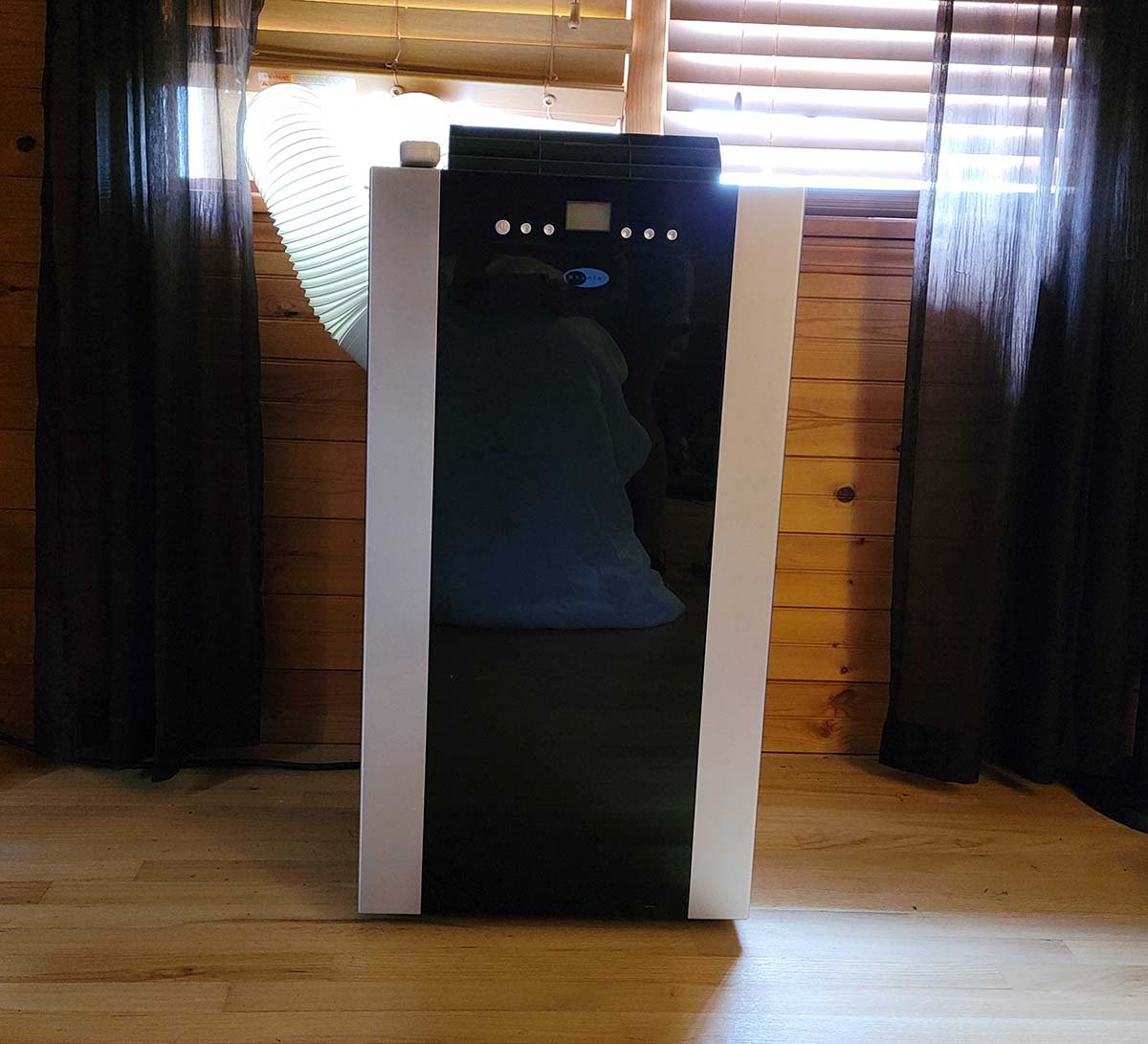
The Whynter ARC-14S is a three-in-one portable appliance that works as an air conditioner, fan, and dehumidifier. Its headline rating is 14,000 BTU under the older ASHRAE standard, while its more useful DOE SACC rating is 9,500 BTU. The manufacturer rates it for rooms up to 500 square feet and lists a dual-hose design, three fan speeds, a programmable timer, remote control, activated carbon filter, washable pre-filter, and dehumidification capacity of up to 71 pints per day.
- Model: Whynter ARC-14S
- Cooling capacity: 14,000 BTU ASHRAE / 9,500 BTU SACC
- Recommended coverage: Up to 500 square feet
- Hose system: Dual hose
- Modes: Cool, fan, dehumidify
- Noise rating: Under 51 dBA on low and under 56 dBA on high, according to the manufacturer
- Power consumption: Up to 1,300 watts
- Window kit range: Approximately 20 to 56 inches, depending on the included panel configuration
The first thing to understand is that the 9,500 SACC rating matters more than the flashy 14,000-BTU number printed in many product listings. SACC, or Seasonally Adjusted Cooling Capacity, is intended to provide a more realistic estimate of portable AC performance under variable conditions. The U.S. Department of Energy developed the metric because traditional capacity claims did not always reflect how portable units performed in everyday use.
Why the Dual-Hose Design Makes a Real Difference
The biggest reason the Whynter ARC-14S performs better than many portable competitors is its dual-hose setup. One hose brings outdoor air into the unit to cool its internal components, while the other pushes hot air back outside. That may sound like a minor plumbing detail, but it is actually the secret sauce.
Most cheaper portable air conditioners use a single hose. Those units pull conditioned air from inside the room to cool their mechanical parts, then send some of that air outside through the exhaust hose. This creates negative pressure, which can pull warm outdoor air or hot air from nearby rooms back into the space. In other words, a single-hose portable AC can spend part of the day fighting itself like a dog chasing its own tail.
Dual-hose portable ACs avoid much of that problem. Consumer Reports notes that single-hose systems can draw warm, unconditioned air into a room because of the pressure imbalance they create. Dual-hose units are generally better at maintaining more stable cooling in larger or hotter spaces.
The Whynter ARC-14S is not the newest portable AC on the market, and it does not use the advanced inverter technology found in some modern competitors. However, its dual-hose system gives it a meaningful advantage over many similarly priced single-hose models. For rooms that become hot, humid, sunny, crowded, or cursed by a computer setup that runs hotter than a pizza oven, that advantage can be significant.
What Bob Vila’s Test Revealed
The Bob Vila review is impressive because it did not test the Whynter ARC-14S in a tiny bedroom with blackout curtains, one sleeping cat, and ideal laboratory conditions. The unit was used in a 600-square-foot room that reached 80 degrees Fahrenheit, with the air conditioner set to its coldest temperature and highest fan speed.
According to the test, the Whynter began delivering cold air immediately, made the room noticeably cooler within about 10 minutes, dropped the room to 72 degrees after approximately 30 minutes, and reached the selected 61-degree set point after about an hour. The reviewer also reported that the unit eventually cooled a connected living and dining space of about 1,000 square feet to a comfortable temperature after several hours.
That does not mean every buyer should expect to cool a 1,000-square-foot open floor plan to 61 degrees in the middle of a Texas heat wave. Real-world cooling depends heavily on ceiling height, sun exposure, insulation, open doorways, kitchen appliances, humidity, and the quality of the window seal. Still, the test suggests that the ARC-14S has more muscle than its 500-square-foot recommendation might imply.
Independent testing from Good Housekeeping also ranked Whynter’s dual-hose portable air conditioner as a strong overall performer. Its testers praised the unit’s cooling power, dehumidification ability, straightforward controls, and relatively quiet operation, though they noted it cooled slightly more slowly than some other dual-hose models.
Setup: Easier Than a Window Unit, But Not Quite Plug-and-Play
Portable air conditioners are often marketed as easy to install, and that is mostly true. “Easy” here means easier than lifting a heavy window AC above your waist while wondering whether your insurance policy covers accidental indoor waterfalls.
In the Bob Vila test, setup took about 10 minutes. The hoses attached to the back of the unit, the window panel was fitted into place, and the machine was ready to cool. The ARC-14S includes the necessary window kit, adjustable exhaust hoses, mounting hardware, and instructions.
Still, the quality of installation matters enormously. A portable air conditioner can lose much of its cooling efficiency when hot outdoor air slips through gaps around the window panel. Use the included foam insulation, seal visible openings, keep both hoses as short and straight as possible, and avoid stretching the hoses across half the room like a pair of reluctant garden snakes.
Before buying, measure your window carefully. Most standard sliding and double-hung windows are relatively simple to work with, while casement windows, unusually narrow windows, and very tall openings may require an extra seal kit or a custom panel. The unit is portable in the sense that it rolls on casters, but once the hoses are connected, it is not likely to become your favorite item to relocate every afternoon.
Cooling Performance, Humidity Control, and Everyday Comfort
Cooling is only half the battle during summer. In humid climates, a room can feel sticky and uncomfortable even when the thermostat says the temperature is acceptable. The Whynter ARC-14S includes a dehumidifier mode that can help remove moisture from the air, making the room feel cooler and less swamp-like.
The manufacturer says the unit can remove up to 71 pints of moisture per day and uses an auto-drain system that evaporates much of the collected condensation through the exhaust hose in normal cooling conditions. In extremely humid spaces, however, some users may still need to drain collected water manually or use a continuous-drain setup.
The machine’s airflow is strong enough for large bedrooms, home offices, studio apartments, basements, workshops, and living rooms that central AC cannot handle. The top vent pushes cool air outward rather than directly at the floor, which helps circulate cooling across the room. Pairing the unit with a ceiling fan or floor fan can improve that circulation even more.
Noise is noticeable but not shocking. The Whynter ARC-14S is quieter than some older portable air conditioners, yet it is not whisper-quiet. On high fan speed, you will know it is operating. That makes it better suited for living rooms, workspaces, kitchens, and daytime cooling than for very light sleepers who want near silence at night.
Energy Use: Powerful, But Not a Budget-Friendly Featherweight
The Whynter ARC-14S can draw up to 1,300 watts, so it is not the kind of appliance you should run casually all day just because your cat enjoys sitting in front of the vent. It delivers meaningful cooling power, but the electricity cost can add up during long heat waves.
That is the tradeoff. A conventional window air conditioner is often more efficient because much of its heat-producing machinery remains outside the room. Consumer Reports has repeatedly found that portable units tend to be heavier, louder, and less energy-efficient than window ACs, especially when buyers choose single-hose models.
Still, the Whynter’s dual-hose setup helps it avoid some of the inefficiency found in single-hose portable units. For a renter who cannot install a window AC, a homeowner dealing with a poorly cooled upstairs room, or someone needing temporary cooling during a renovation, the extra electricity use may be worth the comfort.
Whynter ARC-14S Pros and Cons
Pros
- Strong cooling performance for a portable air conditioner
- Dual-hose design improves efficiency and reduces negative pressure
- Effective dehumidifier for humid rooms
- Easy-to-use controls, timer, remote, and washable filter
- Works well for larger rooms and connected living spaces
- Sleek black-and-platinum design looks less like a plastic appliance invasion
Cons
- Heavy and bulky at around 80 pounds
- Not as efficient as a window AC or ductless mini-split
- Noticeable sound on high settings
- No built-in Wi-Fi, app control, or heating mode
- Requires careful window sealing for the best performance
- May be overkill for a small bedroom under 250 square feet
Who Should Buy the Whynter Portable Air Conditioner?
The Whynter ARC-14S is best for buyers who genuinely need a portable cooling solution with more power than a basic bedroom unit. It is especially suitable for renters, apartment dwellers, homeowners with rooms that central AC cannot reach, and people with sliding windows or situations where a standard window AC is impractical.
It is also a smart choice for humid regions, large home offices, kitchen-adjacent living areas, workshops, and spaces that get brutal afternoon sun. The dual-hose design makes it particularly valuable for rooms that remain hot even after a single-hose portable AC has been running for hours and accomplishing little besides raising the electric bill.
Skip it if you need something lightweight, silent, smart-home compatible, or extremely energy-efficient. In that case, a newer inverter portable AC, a high-efficiency window model, or a ductless mini-split may be a better fit. ENERGY STAR guidance also emphasizes that proper sizing and a tight installation seal are essential; bigger is not always better, and leakage around an AC installation can undermine comfort and efficiency.
Real-World Experience: What Living With the Whynter ARC-14S Feels Like
Living with the Whynter ARC-14S is less like owning a small appliance and more like adopting a helpful, loud roommate. It takes up meaningful floor space, has opinions about where it wants to sit, and refuses to do its best work unless the window setup is handled properly. Once it is installed correctly, though, it can make a miserable summer room dramatically more livable.
Imagine a typical hot afternoon in a home office. The room has a large window, a laptop, a second monitor, a router, and enough electronic equipment to make the space feel like a low-budget data center. Central AC may technically reach the room, but it never quite catches up. The Whynter can be rolled into position, connected to the window kit, and set to cool before the room turns into a productivity sauna.
At first, the machine is most noticeable because of the airflow and compressor sound. On high, it does not disappear into the background. But the payoff arrives quickly: the warm air begins to feel less dense, the humidity drops, and the room stops radiating heat from every surface. Within a short period, the discomfort shifts from “Why am I sweating while answering email?” to “Maybe I can finish this spreadsheet without moving to the refrigerator.”
The dual-hose system matters most when the outdoor temperature is high. Single-hose portable units often create the frustrating sensation that they are working hard without fully winning. You can feel cool air near the vent, yet the rest of the room remains stubbornly warm. With the ARC-14S, the cooling tends to spread more effectively because the system is not pulling as much already-conditioned indoor air outside.
Humidity control is another part of the experience that people often underestimate. A room at 76 degrees can feel comfortable when the air is dry, but the same room can feel miserable when humidity is high. On muggy days, using the Whynter’s dehumidifier setting can make the space feel better even before the temperature falls dramatically. It is one of those improvements that sounds boring until you realize your furniture, sheets, and shirt no longer feel vaguely damp.
There are practical quirks. The unit is heavy enough that moving it across thick carpet or over a door threshold can feel like transporting a small refrigerator on roller skates. The hoses need to stay connected, the window panel needs occasional checking, and the air filter should be cleaned regularly. It is portable, but it is not “carry it upstairs every evening” portable.
For overnight use, the experience depends on your tolerance for background noise. Some sleepers will find the steady hum comforting, like white noise with a cooling upgrade. Others may prefer placing it in a nearby room and using a fan to circulate the cool air. The timer function is useful here because it allows the AC to run during the hottest part of the evening without working at full blast until sunrise.
Over a full summer, the Whynter ARC-14S makes the most sense as a targeted cooling solution. It is excellent for one hot room, one open living area, or one space where permanent AC options are not realistic. It is not a replacement for central air, and it will not make an uninsulated garage feel like a luxury hotel lobby. But in the right room, with a tight window seal and realistic expectations, it can feel remarkably close to a cooling powerhouse.
Final Verdict: Is the Whynter ARC-14S Worth It?
The Whynter ARC-14S earns its reputation because it solves one of the biggest problems with portable air conditioners: weak cooling performance in larger rooms. Its dual-hose design, strong airflow, dehumidification capability, and published Bob Vila test results make it one of the better options for buyers who need serious portable cooling.
It is not perfect. It is heavy, somewhat noisy, and not the most energy-efficient choice available. But compared with many single-hose portable ACs, it offers stronger real-world cooling and better room comfort. For renters, hot bedrooms, home offices, humid living rooms, and stubborn spaces where window units are not an option, the Whynter portable air conditioner is more than hot air.