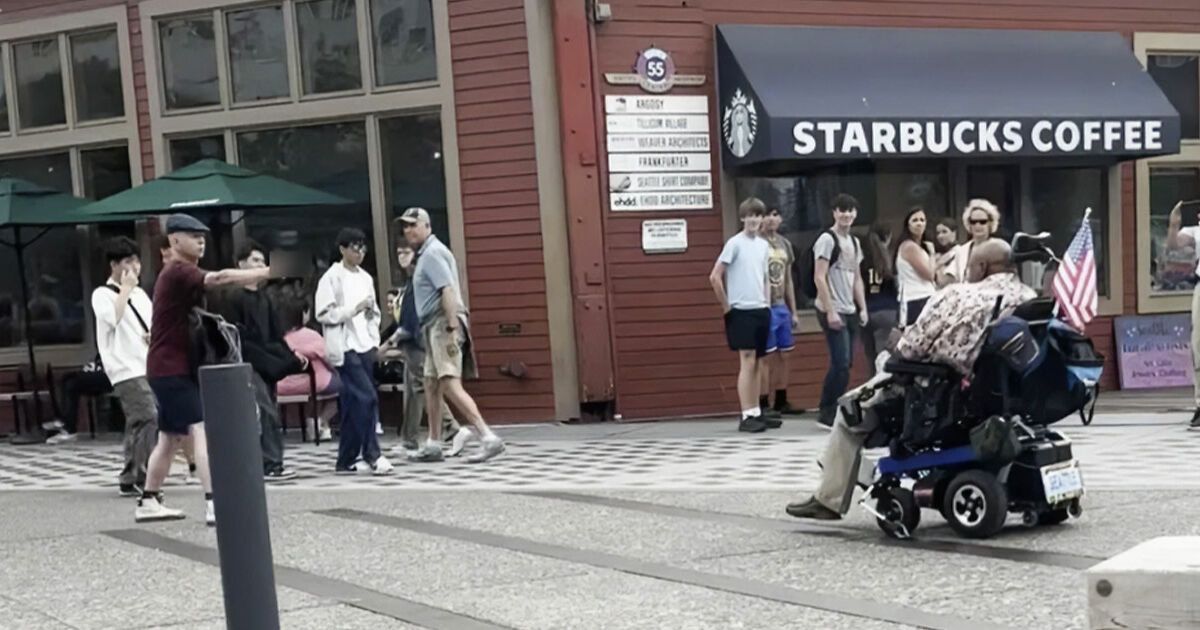
Editorial note: This article is based on reporting and public court outcomes involving the July 31, 2025 Seattle waterfront shooting of Navy veteran Harold Powell. The racial language in the headline reflects how the incident circulated publicly, but the reported conviction was for second-degree assault and third-degree theftnot a bias-crime finding. Accuracy matters, especially when a story already contains enough tragedy without adding internet guesswork on top.
It began with an accusation that should have ended with a person walking away.
Instead, on a busy Seattle waterfront, a disabled Navy veteran performing music from his wheelchair was confronted over whether he had really served in the military. The dispute escalated from demands for identification to the taking of a Navy patch, then to a gunshot wound to the chest. The victim survived. The shooter was later convicted and sentenced to prison.
That sequence is difficult to process because it exposes several uncomfortable realities at once: the danger of self-appointed “truth policing,” the vulnerability faced by people with disabilities in public spaces, the emotional weight of military identity, and the terrible speed with which an argument can turn into irreversible violence.
There is no comedy in a shooting. But there is something darkly absurd about the premise that a stranger can appoint himself chairperson of the Department of Demanding Papers From Random People. America has enough paperwork already. Nobody needs a sidewalk tribunal with a backpack and a temper.
What Happened on Seattle’s Waterfront?
On July 31, 2025, Harold Powell, a 68-year-old Navy veteran who uses a wheelchair, was performing music near Pier 55 on Seattle’s waterfront. Powell had reportedly been a familiar figure in the area for decades, playing music and accepting donations from visitors and locals.
According to charging documents and later trial reporting, Gregory William Timm approached Powell and accused him of falsely claiming military service, an accusation commonly described as “stolen valor.” Timm demanded that Powell provide identification proving his veteran status. During the confrontation, Timm took a Navy patch from Powell’s belongings while Powell was attempting to retrieve identification.
The confrontation grew more dangerous. Powell reportedly drew a knife after feeling threatened, and video evidence showed he also had a replica or BB-style gun in a holster. Timm then removed a real firearm from his backpack and fired one shot into Powell’s chest. Powell survived the shooting after being transported for emergency medical care.
Seattle police arrested Timm after the shooting. A jury later found him guilty of second-degree assault with a firearm and third-degree theft. On April 24, 2026, he was sentenced to 42 months in prison, followed by community custody. The sentencing judge described the incident as a senseless act of violence and noted the risk to other people in the crowded waterfront area.
Why the “Stolen Valor” Accusation Matters
“Stolen valor” is a phrase used when someone falsely claims military service, medals, awards, or combat experience. It can trigger intense reactions because military service is deeply personal. For many veterans, uniforms, patches, medals, and service records represent years of sacrifice, discipline, loss, friendship, and identity.
But suspicion is not proof. And even if someone were lying about military service, that would never give a bystander the right to harass, threaten, steal property, or use violence. Being annoyed is not a legal permit. Being offended is not a badge. And being loud in public is not the same thing as being correct.
Federal law does address certain fraudulent claims involving military awards. Under 18 U.S.C. § 704, falsely claiming to have received military decorations or medals for money, property, or another tangible benefit can be criminally punishable. The law is targeted at fraud connected to a benefitnot at turning strangers into armed investigators.
Veterans also have several legitimate ways to verify their service when they need to access benefits, discounts, records, or official programs. A Department of Veterans Affairs Veteran ID Card can serve as proof of service in many situations, while a DD Form 214 is the standard separation document used to verify military service for benefits, employment, retirement, and veterans’ organizations.
Still, no veteran should have to carry sensitive paperwork around simply to satisfy a stranger’s curiosity. A DD-214 can contain personal information. Treating it like a receipt someone must produce on demand is not respect for veterans. It is entitlement wearing combat boots two sizes too big.
What the Case Says About Self-Defense Claims
One of the central legal arguments in the case involved self-defense. Timm’s defense argued that Powell’s knife and replica gun created a threat. Prosecutors, however, argued that Timm had initiated and escalated the confrontation by approaching Powell, demanding proof of service, and taking the Navy patch.
Washington law allows force only in limited circumstances. State law defines “necessary” force as force used when no reasonably effective alternative appears available and when the amount of force is reasonable for the lawful purpose involved. Deadly force includes intentional force likely to cause death or serious injury, including gunfire.
That legal framework matters because self-defense is not a magic phrase that erases everything that happened before a trigger was pulled. Courts evaluate the full sequence: who initiated the confrontation, whether someone had an opportunity to disengage, whether threats were immediate, and whether the response was proportionate.
In this case, the jury convicted Timm after hearing evidence about the confrontation, the weapon, the stolen patch, and video footage. The verdict did not declare that every conflict involving a weapon is simple. It did establish criminal responsibility for the shooting and theft charges before the court.
Disability, Public Safety, and the Unequal Burden of Risk
Powell’s disability is not a side note. It is central to understanding the event. A person using a wheelchair may have fewer ways to leave a confrontation quickly, create distance, or physically escape escalating danger. When another person chooses aggression, mobility differences can turn a tense moment into a life-threatening one.
National data shows that people with disabilities face a disproportionate risk of violent victimization. The U.S. Bureau of Justice Statistics reported that, from 2009 through 2019, people with disabilities experienced violent victimization at a rate nearly four times higher than people without disabilities. The Office for Victims of Crime similarly notes that people with disabilities are more likely to become victims of violent crime.
Those statistics do not explain every incident, and they do not mean disability makes a person helpless. They do mean that communities, businesses, law enforcement agencies, and bystanders should think harder about accessibility and safety. A public space is not truly welcoming if some people must constantly calculate how quickly they can get away from danger.
For veterans with disabilities, the risk can be layered. They may manage chronic pain, mobility limitations, financial stress, trauma, medical appointments, and the ordinary labor of moving through a world that is often built without them in mind. A public confrontation can therefore carry consequences long after the sirens leave.
Race, Identity, and Responsible Reporting
Stories involving race, disability, veterans, guns, and public violence can become internet accelerant. Headlines move faster than court documents. Social media clips move faster than nuance. And once people select a preferred narrative, facts often get treated like unwanted terms and conditions.
The responsible approach is to state what is known and avoid inventing what is not established. Powell was a disabled Navy veteran who survived being shot. Timm was convicted of second-degree assault with a firearm and third-degree theft. The reported court outcome did not include a finding that the shooting was racially motivated or a bias-crime conviction.
That does not make race irrelevant to public discussion. Black veterans and Black people with disabilities may reasonably view such incidents through the realities of bias, unequal treatment, and historical distrust. But responsible reporting should distinguish between personal interpretation, social context, criminal charges, and judicial findings.
Truth does not become less powerful when it is precise. It becomes harder to dismiss.
The Human Cost After the Headlines Fade
Gun violence does not end when a victim leaves the hospital. Recovery can include physical pain, follow-up care, lost income, disrupted routines, anxiety in public places, and the exhausting process of retelling the event to police, lawyers, doctors, family members, reporters, and strangers online.
Powell later returned to the Seattle waterfront, the place where he had performed for years. His decision to return mattered symbolically. It was not merely about a location. It was about refusing to surrender a familiar part of his life to the worst moment of someone else’s judgment.
At sentencing, Powell expressed forgiveness and said he hoped Timm could become a productive member of the community. Forgiveness in that setting should not be confused with minimizing the crime. It can be a survivor’s refusal to let violence occupy permanent space in his mind.
That is one of the most striking elements of the story. The legal system imposed punishment. The survivor chose how to carry the aftermath. Those are different things, and both matter.
Experiences Related to the Case: What People Can Learn From a Public Confrontation Gone Wrong
The first experience many veterans recognize in stories like this is the feeling of being asked to defend an identity that should not require a courtroom cross-examination in the grocery-store parking lot, on a city sidewalk, or beside a coffee shop. Veterans may wear hats, jackets, patches, license plates, pins, or shirts that reference their branch of service. Some people wear them because they are proud. Others wear them because they want to remember friends. Others simply like the jacket. None of those reasons turns a stranger into an authorized inspector.
For some veterans, questions about service are welcome when they are respectful: “What branch were you in?” or “Thank you for serving.” A conversation can be kind and human. But there is a massive difference between curiosity and accusation. The first opens a door. The second kicks it in and asks why the hinges are upset.
The second experience is the reality of disability in public. People who use wheelchairs, canes, prosthetics, service animals, or other mobility aids often have to think ahead about routes, ramps, curb cuts, elevators, crowd density, transportation, and access to restrooms. Safety planning may be part of that daily mental checklist. A confrontation can be especially frightening when moving away quickly is not an easy option.
That is why bystanders matter. A calm witness can call 911, create distance, alert security, move other people away from danger, or document what is happening from a safe location. Bystanders should not rush into an armed confrontation or attempt to play action hero. The real world is not an action movie, and nobody gets a dramatic soundtrack while making terrible decisions. The safest role is often to get help, protect vulnerable people nearby, and provide accurate information afterward.
The third experience is the emotional shock felt by communities after public violence. A waterfront, park, transit stop, store, or neighborhood corner can feel permanently different after a shooting. Employees may become anxious. Regular visitors may avoid the area. Families may remember the incident every time they return. Public violence leaves psychological debris even where no physical damage remains.
The fourth experience is recovery. A survivor may appear composed in public while privately dealing with pain, fear, disrupted sleep, financial pressure, or anger. Recovery is rarely a neat upward line. It is more like assembling furniture with one missing screw and instructions written in another language: progress happens, but it can be frustrating, uneven, and exhausting.
Veterans who have experienced violence or trauma can seek support through VA health services, Vet Centers, community-based counseling, victim assistance programs, and trusted family members. The VA also provides crisis support through the Veterans Crisis Line by calling 988 and selecting option 1.
The fifth experience is learning when to disengage. If someone believes another person is falsely claiming military service, the responsible response is to walk away, avoid public confrontation, and report suspected fraud through appropriate channels when there is actual evidence of fraud for financial gain. Trying to enforce personal outrage on the street is dangerous, legally risky, and morally reckless.
Respecting veterans means respecting their dignity. Respecting disabled people means recognizing their right to occupy public space without being treated as easy targets. Respecting the law means letting trained authorities and courts handle allegations instead of turning suspicion into spectacle.
Conclusion: Accountability Without Sensationalism
The Seattle waterfront shooting involving Harold Powell is not simply a story about an argument over military service. It is a story about escalation, vulnerability, bad judgment, public safety, and survival.
A man accused a disabled veteran of lying. The accusation became a confrontation. The confrontation became violence. A jury later convicted the shooter, and a court imposed a prison sentence. But the broader lesson reaches beyond one case: nobody should have to prove their humanity, their disability, or their service record to a stranger with a grievance.
Veterans deserve respect. People with disabilities deserve safety. Public spaces deserve better than rage disguised as righteousness.