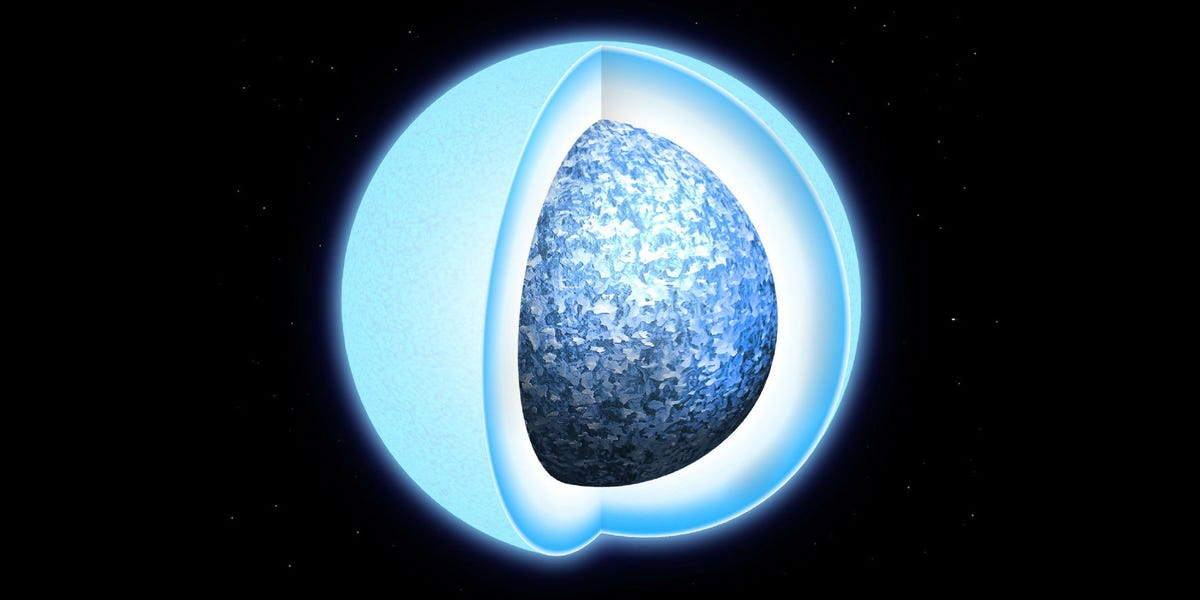
The Sun looks confident up there, doesn’t it? Every morning it rises like the universe’s most punctual employee, throws light across the planet, powers photosynthesis, warms oceans, fuels weather, and still somehow has time to make sunglasses fashionable. But even stars have expiration dates. The Sun is not eternal. It is a middle-aged star, glowing steadily today, but slowly moving through a long cosmic life story that ends in one of the strangest ways imaginable: as a dense, Earth-sized white dwarf that may eventually crystallize into something like a massive cosmic crystal ball.
Before anyone panics and starts shopping for SPF 9 billion, relax. The Sun’s dramatic retirement party is billions of years away. Scientists estimate that our star has roughly another five billion years before it begins the final major transformation of its life. It will not explode as a supernova, become a black hole, or vanish like a bad Wi-Fi signal. The Sun is not massive enough for those blockbuster endings. Instead, it will swell into a red giant, shed its outer layers into space, and leave behind a compact core called a white dwarf.
That white dwarf will be hot, faint, incredibly dense, and slowly cooling. Deep inside, carbon and oxygen ions may arrange themselves into a solid crystal structure under extreme pressure. The phrase “massive crystal ball” is not just space poetry with a glitter pen. It is a playful but surprisingly accurate way to describe the final frozen heart of a Sun-like star.
The Sun Is Middle-Aged, Not Immortal
The Sun formed about 4.6 billion years ago from a collapsing cloud of gas and dust known as the solar nebula. Most of that material gathered in the center, creating the star that now contains about 99.8 percent of the mass in our solar system. The leftover crumbs became planets, moons, asteroids, comets, and everything else orbiting around like guests at the Sun’s very long dinner party.
Today, the Sun is a main-sequence star. That means it is in the stable part of its life, fusing hydrogen into helium in its core. This fusion process releases energy, which travels outward and eventually reaches Earth as sunlight. Every beach day, every tomato plant, every solar panel, and every dramatic movie scene at sunset owes its existence to this nuclear furnace.
But hydrogen fuel in the core will not last forever. As helium builds up and usable hydrogen decreases in the central region, the Sun’s internal balance will slowly change. Gravity will squeeze the core, the outer layers will respond, and the Sun will begin leaving the calm main-sequence phase. In cosmic terms, this is the Sun entering old age. In human terms, it is less “quiet retirement” and more “suddenly bought a red sports car and expanded past Mercury.”
Step One: The Sun Becomes a Red Giant
When the Sun starts to run out of hydrogen in its core, it will expand enormously. It will become a red giant, a cooler but much larger star with outer layers stretching far beyond their current size. Mercury and Venus are expected to be engulfed. Earth’s fate is less certain in some models, but even if the planet avoids being swallowed directly, it will not remain the blue, comfortable world we know today. Oceans would be gone long before the final red-giant phase reached its peak.
The phrase “red giant” can sound almost cozy, like a big cosmic tomato. Do not be fooled. A red giant Sun would transform the inner solar system. The habitable zone would move outward. The familiar order of planetary comfort would be rewritten. Earth, currently sitting in the sweet spot for liquid water, would become an overheated memory.
During this phase, the Sun’s core will become hotter and denser. It will eventually begin fusing helium into heavier elements, mainly carbon and oxygen. These elements matter because they help form the future white dwarf’s interior. In other words, the Sun will spend part of its final active life making the ingredients for its own crystal-like remnant. That is both scientifically elegant and slightly dramatic, like baking your own retirement cake while the solar system rearranges itself around you.
Step Two: The Sun Sheds Its Outer Layers
After the red-giant stage, the Sun will not have enough mass to continue fusing heavier and heavier elements like massive stars do. A very massive star can build elements up to iron, collapse, and explode as a supernova. The Sun is more modest. It will instead lose its outer layers into space.
This ejected material may form a glowing cloud called a planetary nebula. The name is misleading: planetary nebulae have nothing to do with planets forming. Early astronomers saw round, fuzzy objects through small telescopes and thought they looked planet-like. The name stuck, because astronomy, like your old school folders, contains a few labels nobody got around to updating.
A planetary nebula can be beautiful. Images of objects such as the Helix Nebula and NGC 7027 show glowing shells of gas surrounding the hot exposed cores of dying Sun-like stars. These nebulae are short-lived compared with a star’s full lifetime, but they are visually spectacular. They are the cosmic equivalent of a star signing off with a glowing farewell note.
Step Three: The Sun Becomes a White Dwarf
Once the Sun’s outer layers drift away, the remaining core will become a white dwarf. This is the dense, hot remnant of a star that has exhausted its nuclear fuel. A typical white dwarf can have a mass comparable to the Sun packed into a volume roughly the size of Earth. Imagine compressing something star-sized into planet-sized space. Now imagine trying to park it. Exactly: impossible, and also bad for the driveway.
A white dwarf no longer produces energy through ordinary nuclear fusion. Instead, it shines because it is still extremely hot from its earlier life. Over billions of years, it slowly radiates that leftover heat into space. It is like a stove burner after the flame has been turned off, except the stove burner is made of dense stellar matter and takes longer than civilization has existed to cool down.
The matter inside a white dwarf is supported by electron degeneracy pressure, a quantum mechanical effect that prevents the star from collapsing further under gravity. This is not normal gas pressure like air in a balloon. It is a deeper physical rule about how electrons behave when squeezed into extreme conditions. The result is one of the universe’s strangest objects: a star corpse that is small, heavy, hot, and slowly fading.
Why the Sun Will Not Become a Black Hole
One of the most common questions about the Sun’s death is whether it will become a black hole. The answer is no. The Sun simply does not have enough mass. Black holes form from the collapse of much more massive stars, usually after supernova explosions. The Sun’s gravity is impressive, but it is not in that league.
The Sun also will not explode as a supernova. That kind of ending requires a massive stellar core that can collapse violently. Our star’s future is quieter, although “quiet” is relative when you are talking about a star swelling into a red giant and changing the architecture of the inner solar system.
Instead of a cinematic explosion, the Sun gets a slow fade: red giant, planetary nebula, white dwarf, and then an extremely long cooling period. It is not the Hollywood ending, but it is scientifically fascinating. Sometimes the universe skips the explosion and goes straight for the weird physics.
The Massive Crystal Ball: How White Dwarfs Crystallize
Here is where the story becomes truly strange. As a white dwarf cools, the carbon and oxygen inside it do not simply sit around like cold soup. Under extreme pressure, the ions in the core can begin arranging themselves into a solid crystalline structure. This process is called crystallization.
It is not exactly the same as water freezing into ice, but the comparison helps. In both cases, particles that once moved more freely settle into an ordered structure as conditions change. In a white dwarf, the “freezing” happens at temperatures that would still seem unimaginably hot on Earth. The pressure is so intense that matter behaves in ways that make everyday experience look very underqualified.
Scientists long predicted that white dwarfs should crystallize as they cool. Observations from the Gaia spacecraft later gave strong evidence for this process by showing patterns in white dwarf populations that matched cooling delays caused by crystallization. As the core crystallizes, latent heat is released, slowing the cooling of the star. Element separation inside the crystallizing core can also release gravitational energy, creating additional delays.
So yes, the Sun’s final remnant may become a kind of giant crystal sphere. But before anyone imagines a sparkling diamond the size of Earth floating in space, let’s add a science-friendly warning label. A crystallized white dwarf is not a jewelry-store diamond. It is a dense carbon-oxygen stellar remnant under extreme pressure, with a structure far beyond anything you could put on a ring. If someone did try, the proposal would be memorable, but the gravitational consequences would be inconvenient.
Will the Sun Become a Diamond?
The “diamond star” idea is catchy, and it is not completely wrong in spirit, but it needs careful wording. White dwarfs can contain carbon, and carbon can form diamond-like crystal structures under certain conditions. However, white dwarf interiors are also rich in oxygen, and the matter exists in an exotic state shaped by extreme density and pressure. Calling the future Sun a “massive crystal ball” is better than calling it a giant diamond, because it keeps the wonder without overselling the gemstone comparison.
The future Sun’s white dwarf core will likely be made mostly of carbon and oxygen. As it cools, parts of that interior may crystallize from the inside outward. The result is a solidifying stellar ember. It will not twinkle like a cut diamond in a display case. It will glow faintly for a very long time, slowly losing heat across billions and eventually trillions of years.
What Happens to the Planets?
The planets will not experience the Sun’s death equally. Mercury and Venus are in the danger zone and are expected to be engulfed during the red-giant phase. Earth’s long-term survival as a physical object is debated, but its habitability will end much earlier. Rising solar brightness over time will make Earth increasingly hostile long before the Sun reaches maximum red-giant size.
Mars and the outer planets may avoid direct engulfment, but their orbits and environments will change. As the Sun loses mass, its gravitational grip will weaken, and surviving planets may drift into wider orbits. Icy moons in the outer solar system could experience temporary warming during the red-giant era. Places that are frozen today might briefly become less frozen, as if the solar system moved the thermostat and forgot to ask anyone.
Once the Sun becomes a white dwarf, the solar system will be dimmer and colder. The white dwarf will still shine, but with far less total energy than the Sun produces today. Any surviving worlds would orbit a stellar remnant, not a life-giving main-sequence star. It would be a quieter, darker neighborhood, like the solar system after closing time.
Why White Dwarfs Matter to Astronomers
White dwarfs are not just interesting because they are weird. They are also useful. Since white dwarfs cool in somewhat predictable ways, astronomers can use them as cosmic clocks. By studying their temperature, brightness, and cooling patterns, scientists can estimate the ages of star clusters and parts of the galaxy.
Crystallization makes that work more complicated and more interesting. If crystallization releases heat and slows cooling, then some white dwarfs may be older than they look. Understanding this process helps astronomers refine age estimates for stellar populations. In other words, the future crystal heart of stars can help scientists read the timeline of the Milky Way.
White dwarfs also tell us about the future of planetary systems. Some white dwarfs show signs of “pollution” from rocky debris, meaning asteroids or planetary fragments have fallen onto them. This suggests that planets and smaller bodies can survive parts of stellar death, then later be disrupted by gravity. Even after a star’s main life ends, its planetary system may continue to be active, messy, and scientifically delicious.
A Simple Timeline of the Sun’s Future
Today: Main-Sequence Stability
The Sun is currently fusing hydrogen into helium in its core. It is stable, bright, and roughly halfway through its main-sequence lifetime.
About 5 Billion Years From Now: Red Giant Phase Begins
The Sun will expand dramatically as its core changes and outer layers swell. The inner solar system will be transformed.
Later: Outer Layers Drift Away
The Sun will shed material into space, possibly creating a glowing planetary nebula around the exposed core.
About 10 Billion Years From Now: White Dwarf Era
The remaining core will become a white dwarf: small, dense, hot, and slowly cooling.
Far Future: Crystallization and Cooling
As the white dwarf cools, its carbon-oxygen interior may crystallize, turning the Sun’s remnant into a massive crystal-like sphere.
Experience and Reflection: Imagining the Sun’s Crystal-Ball Future
Thinking about the Sun’s death is a strange experience because it mixes science with emotion. On one hand, the timeline is so enormous that it makes daily worries look tiny. Your unread emails, your laundry pile, and that one houseplant judging you from the windowsill all exist on a human scale. The Sun’s future belongs to deep time. Five billion years is not just “later.” It is later with extra zeros and a telescope.
When people first hear that the Sun will become a red giant, the reaction is often dramatic: “So Earth is doomed?” Technically, yes, but not in a way that affects tomorrow’s lunch plans. The value of learning this story is not panic. It is perspective. The Sun’s life cycle reminds us that Earth is part of a changing cosmic environment. Our planet is not sitting under a permanent lamp. It is orbiting a star with a biography.
There is also something beautiful about the idea that the Sun’s final form may be crystalline. The same star that now gives us daylight could one day become a compact sphere with a solidifying heart. It will no longer warm beaches or grow forests, but it will still be a physical record of everything it once was. Its carbon and oxygen core will be like the final signature of fusion, gravity, pressure, and time.
Imagine standing far in the future, safely around another star, looking back with advanced instruments at the Sun’s remnant. It would not look like the golden disk we see today. It would be faint, small, and dense, surrounded perhaps by the scattered remains of a changed solar system. The planets, if any survived, would be altered. The familiar warmth would be gone. Yet the object at the center would still be our Sun in a final form: not dead in the simple sense, but transformed.
This is one reason astronomy is so powerful. It teaches us that endings are often changes of state. Gas becomes plasma. Stars become giants. Cores become white dwarfs. Hot interiors become crystals. The Sun’s death is not a disappearance; it is a transition from shining furnace to glowing ember to cosmic crystal. That does not make it less dramatic. It makes it more interesting.
For writers, students, stargazers, and anyone who has ever stared at a sunset a little too long, the Sun’s future offers a rare combination of facts and wonder. It is real science, but it feels mythic. The star that lights our mornings will one day shed its atmosphere, reveal its core, and cool into a dense crystalline remnant. If the universe had a museum, the Sun’s final white dwarf would deserve a velvet rope and a sign reading: “Please do not touch. Extremely dense. Also older than your entire species.”
Conclusion: The Sun’s Final Trick Is Pure Cosmic Weirdness
The Sun will not go out like a candle, explode like a supernova, or collapse into a black hole. Its future is quieter, slower, and in many ways more fascinating. After billions of years of stable hydrogen fusion, it will expand into a red giant, shed its outer layers, and leave behind a white dwarf. Over immense stretches of time, that white dwarf will cool, and its carbon-oxygen interior may crystallize into a solid structure.
So, what will the Sun become when it dies? A stellar ember. A white dwarf. A dense remnant about the size of Earth. And eventually, in a scientific sense, a massive crystal ball. It is not magic, but it is close enough to make the universe seem delightfully strange.