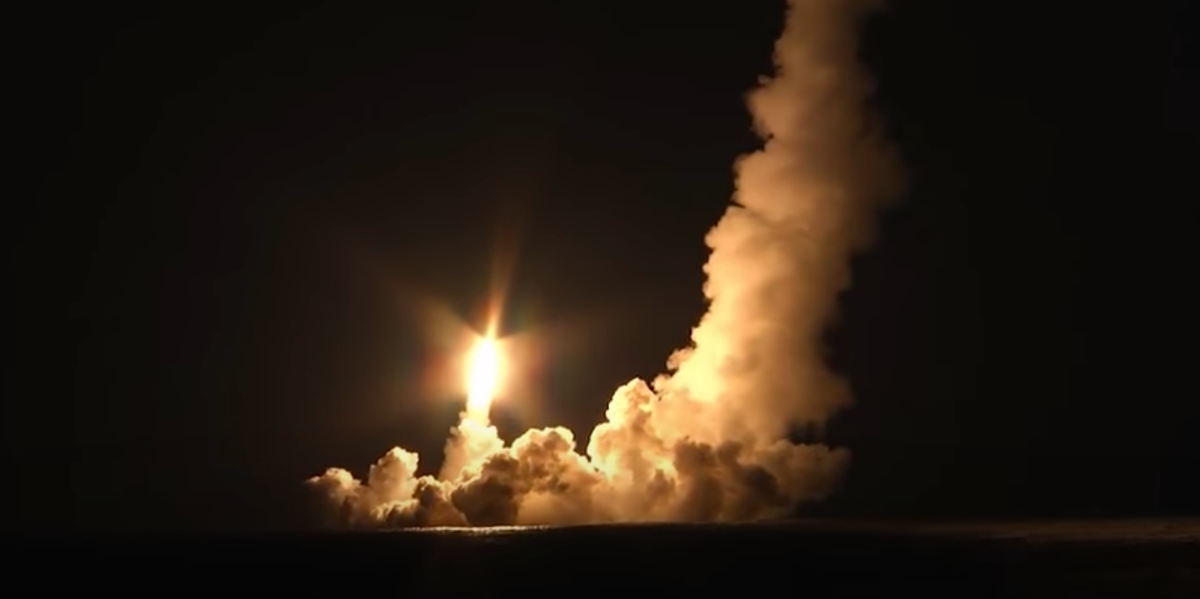
Few military videos make the internet pause quite like footage of a Russian submarine firing a Bulava missile. One second, the sea looks quiet enough for a postcard. The next, a missile bursts out of the water and climbs into the sky with the subtlety of a dragon leaving a bathtub. It is dramatic, loud, highly choreographed, and meant to send a message far beyond the camera frame.
The phrase “watch Russian submarine fire Bulava missiles” usually points to official footage of Russia’s sea-based nuclear forces, especially the Borei-class submarines built to carry the RSM-56 Bulava submarine-launched ballistic missile. The most widely reported modern example came in November 2023, when Russia said its new nuclear-powered submarine Imperator Alexander III launched a Bulava from a submerged position in the White Sea and hit a target on the Kamchatka Peninsula, thousands of miles away.
This article breaks down what viewers are actually seeing, why the Bulava matters, how the Borei-class submarine fits into Russia’s nuclear strategy, and why these launch videos are never just “cool military footage.” They are part engineering demonstration, part deterrence signal, and part geopolitical theater. Popcorn is optional. Context is not.
What Is the Bulava Missile?
The Bulava, also known as the RSM-56 Bulava, is a Russian submarine-launched ballistic missile designed for strategic nuclear deterrence. In plain English, it is a missile launched from beneath the sea, intended to travel intercontinental distances, and designed to carry nuclear warheads. It is one of the central weapons associated with Russia’s newer Borei and Borei-A class ballistic missile submarines.
Unlike a cruise missile, which flies lower and can maneuver through the atmosphere for much of its route, a ballistic missile is launched upward on a high arc before its reentry vehicle descends toward a target area. The Bulava is built for submarines, meaning it must survive storage at sea, launch through water, break the surface, ignite properly, and then follow its programmed flight path. That is a lot to ask from a machine that begins its work inside a moving metal tube under the ocean.
Public estimates describe the Bulava as having a range of roughly 8,300 kilometers, or about 5,160 miles. Analysts also describe it as capable of carrying multiple independently targetable reentry vehicles, often called MIRVs. Exact warhead loading is difficult to verify because nuclear arsenals are not exactly run like restaurant menus. Open-source estimates vary, and responsible reporting should treat those numbers as estimates rather than showroom specifications.
What Happens in a Bulava Launch Video?
When you watch a Russian submarine fire a Bulava missile, the most striking part is the suddenness. The ocean surface may look calm. Then a column of water erupts, the missile punches through, and its rocket motor ignites as it begins its climb. In many official clips, the video cuts quickly between angles: sea surface, launch plume, sky trail, command-room footage, and sometimes a distant view of the missile streaking away.
That edited presentation is important. These videos are not casual vacation clips filmed by someone named Igor who happened to be nearby with a phone. They are official military communications. The angles, timing, and release date all matter. The point is to show that the submarine can launch, the missile can fly, and the strategic force is functioning.
The White Sea and Kamchatka Connection
Several Russian submarine missile tests have involved launches from northern waters such as the White Sea toward the Kura test range on the Kamchatka Peninsula in Russia’s Far East. That route allows Russia to test long-range ballistic missile performance across its own territory and controlled test areas. It also produces a clean narrative for state media: launched in the Arctic north, landed in the distant east, mission accomplished.
For viewers, this geography matters because it shows the scale involved. The launch is not a short-range splashy stunt. It is a demonstration of a system meant to operate across continents. That is why a few seconds of video can carry strategic meaning for military planners in Washington, Brussels, Beijing, and beyond.
The Submarine Behind the Launch: Borei and Borei-A Class
The Bulava is closely tied to Russia’s Borei-class submarines, known in NATO terminology as Dolgorukiy-class ballistic missile submarines. These submarines are part of Russia’s effort to replace older Soviet-era strategic submarines with quieter, more modern vessels. The improved Borei-A variant includes design changes intended to improve stealth, survivability, and operational performance.
Each Borei-class submarine is generally described in open sources as carrying 16 Bulava missiles. That makes each boat a major strategic asset. A single ballistic missile submarine at sea can be difficult to track, and that uncertainty is the point. Sea-based nuclear forces are designed to survive a first strike and preserve the ability to respond. In the grim vocabulary of nuclear strategy, this is called second-strike capability.
It is not a cheerful topic. But it is central to why countries build ballistic missile submarines. The logic is simple and terrifying: if an adversary knows that some nuclear forces are hidden at sea and likely to survive, launching a first strike becomes less attractive. In other words, the submarine’s value is not only in what it can fire, but in the doubt it creates.
Why Russia Releases Bulava Missile Footage
Russia does not release videos of Bulava launches just because someone in the Ministry of Defense discovered cinematic slow motion. These clips serve several strategic purposes.
1. Domestic Messaging
Inside Russia, launch footage supports the image of a strong, modern military. It tells the public that expensive defense programs are working and that the state remains technologically capable. A missile launch is easy to understand visually: big machine goes up, national pride goes with it.
2. International Signaling
Outside Russia, the message is sharper. Bulava launch videos remind NATO and other powers that Russia’s nuclear triad remains active. The triad refers to land-based missiles, strategic bombers, and submarine-launched missiles. Sea-based systems are especially important because they are mobile and hard to locate.
3. Procurement and Modernization
Launch footage also supports the story of modernization. The Bulava program had a troubled development history, including failed tests in earlier years. Successful launches help demonstrate that Russia has moved beyond those problems and can field the missile as part of its modern naval nuclear force.
The November 2023 Imperator Alexander III Test
The November 2023 test involving the Imperator Alexander III attracted global attention because the submarine was one of Russia’s newer Borei-A boats. Russia said the missile was fired from an underwater position in the White Sea and successfully reached the Kamchatka target area. The test came during a period of high tension between Russia and the West over the war in Ukraine, nuclear rhetoric, and arms-control uncertainty.
That timing mattered. Military tests are often scheduled long in advance, but public announcements are still political acts. When a state showcases a nuclear-capable system during a tense geopolitical moment, the audience is not limited to engineers. Diplomats, analysts, military officers, and newsrooms all hear the message.
In May 2024, Russian state media reported that Bulava had officially entered service. That announcement positioned the missile as a key part of Russia’s modernized nuclear arsenal. For readers watching the launch video later, that detail matters: the footage is not just about a one-off test. It represents a broader shift toward Borei-class submarines and the Bulava missile as the backbone of Russia’s sea-based deterrent.
What Makes Submarine-Launched Ballistic Missiles Different?
Submarine-launched ballistic missiles, or SLBMs, are different from land-based missiles because their launch platform can move and hide. A land-based silo is powerful but fixed. A road-mobile missile can move, but it still operates on land. A ballistic missile submarine can patrol vast ocean areas, making it harder to detect and track.
This creates a cat-and-mouse game beneath the surface. Anti-submarine warfare aircraft, satellites, underwater sensors, attack submarines, and acoustic intelligence all play roles in trying to locate strategic submarines. Meanwhile, submarine designers work to reduce noise, improve propulsion, and help crews remain hidden. It is less like a Hollywood chase scene and more like the world’s most expensive game of hide-and-seek, except nobody is laughing very hard.
The Bulava’s role is to give Russia’s Borei-class submarines a long-range strategic weapon. The submarine provides survivability. The missile provides reach. Together, they form a deterrent system meant to convince adversaries that Russia could retaliate even after a catastrophic attack.
How to Interpret the Video Without Falling for Hype
When watching a Russian submarine fire Bulava missiles, it helps to separate visual drama from strategic reality. A launch video proves that a missile was launched and that the event was considered successful by the releasing authority. It does not prove every claimed performance detail. It does not reveal reliability across the entire force. It does not show the full command-and-control chain. And it definitely does not explain the classified parts analysts would most like to know.
That does not make the video meaningless. It makes it a piece of evidence, not the whole case. A serious viewer should ask: Which submarine launched it? Where was it launched? Was it a test, a drill, or an operational demonstration? What else was happening politically at the time? Was the target area identified? Did independent reporting confirm the basic event?
That approach keeps the viewer from sliding into either panic or dismissal. The Bulava is not a magic doomsday wand. It is also not just a firework with a defense budget. It is a strategic weapon system, and the best response is informed analysis.
Bulava, Borei, and Russia’s Nuclear Triad
Russia’s nuclear triad includes land-based intercontinental ballistic missiles, long-range bombers, and submarine-launched ballistic missiles. The Bulava belongs to the sea-based leg. This leg is especially valuable because submarines can patrol away from fixed bases and complicate an opponent’s targeting plans.
Russia has invested heavily in replacing older Delta-class ballistic missile submarines with Borei and Borei-A class boats. Analysts generally view this as one of the more successful parts of Russia’s strategic modernization program. While Russia’s conventional military performance has faced intense scrutiny during the war in Ukraine, its nuclear modernization remains a major concern for Western defense planners.
For NATO, Bulava launches are watched not as isolated spectacles but as indicators of readiness, modernization, training tempo, and strategic messaging. A single video may look like a dramatic clip. In defense analysis, it becomes one data point in a much larger pattern.
Arms Control and the Bigger Picture
The Bulava story also sits inside the broader decline of U.S.-Russian arms control. The old architecture that helped limit and verify strategic nuclear forces has weakened significantly. The New START treaty, once the last major agreement limiting U.S. and Russian deployed strategic nuclear arms, has been under severe strain, and its expiration has raised serious questions about transparency and predictability.
In that environment, missile launch videos become even more symbolic. When formal verification and communication channels weaken, public displays can become louder. That does not mean war is imminent. It does mean the world has fewer guardrails than it once did, and fewer guardrails are rarely a delightful road-trip feature.
Why People Search for Bulava Launch Videos
People search for “watch Russian submarine fire Bulava missiles” for different reasons. Some are military enthusiasts fascinated by technology. Some are students trying to understand current events. Some are investors or policy watchers tracking geopolitical risk. Others simply saw a dramatic clip online and wanted to know whether it was real.
The curiosity is understandable. Submarine missile launches are visually rare, technically impressive, and politically loaded. They combine secrecy and spectacle in a way few military events do. Most of a ballistic missile submarine’s life is invisible. Then, for a few seconds, the whole purpose of the platform erupts into view.
That contrast is why the footage feels so powerful. The ocean hides the submarine. The missile reveals the mission.
Common Misunderstandings About the Bulava Missile
Misunderstanding 1: Every Launch Means a Crisis
Not every missile launch means the world is seconds from disaster. Militaries conduct tests and exercises to validate systems and train personnel. However, tests involving nuclear-capable systems always deserve attention because they can influence perceptions during tense periods.
Misunderstanding 2: The Video Shows Everything
Launch footage shows only what the releasing government wants viewers to see. It usually does not show failures, delays, classified procedures, targeting details, or technical limitations. A polished clip is not the same thing as a full performance report.
Misunderstanding 3: Bigger Plume Means Better Missile
Video drama is not a reliable measure of strategic value. The important questions are reliability, survivability, range, payload, command-and-control security, and how the missile fits into doctrine. The plume may look impressive, but deterrence is built on systems, not smoke trails.
Experience Section: Watching Russian Submarine Fire Bulava Missiles
Watching footage of a Russian submarine firing a Bulava missile is a strange experience because it feels both distant and uncomfortably close. On one level, it looks like a technical demonstration: water erupts, a missile rises, and the clip cuts away before the viewer has time to process the scale. On another level, the mind catches up and whispers, “That is not a rocket launch for weather satellites.” The mood changes quickly.
The first impression is usually visual. The sea surface is calm, almost boring. Then the launch interrupts everything. The missile exits the water with a violent burst, trailing spray and vapor, and the ocean briefly looks as if it has been punched from below. There is no elegant countdown, no cheering crowd, no mission patch floating in a space-agency livestream. It is colder than that. The launch feels hidden, sudden, and purposeful.
The second impression is scale. A viewer might know, intellectually, that the Bulava is an intercontinental missile. But seeing it climb from the sea makes the idea more concrete. The submarine is somewhere under the water. The missile is heading toward a target range thousands of miles away. The crew is unseen. The command structure is unseen. The technology is mostly unseen. What appears on screen is only the visible tip of a massive strategic system.
The third impression is discomfort. Military technology often attracts fascination because it represents engineering under extreme conditions. Submarine launches require precision, pressure management, timing, materials science, navigation, and command discipline. From a technical standpoint, it is impressive. From a human standpoint, it is sobering. The same machine that demonstrates engineering excellence also exists because nations plan for the possibility of nuclear war. That is not exactly the kind of fun fact one puts on a coffee mug.
A careful viewer should also notice the editing. Official military videos are designed to communicate confidence. They rarely show uncertainty. The camera angle, the timing, the music if present, and the final statement of success all create a narrative. The message is: the system works, the crew is ready, the state is strong. That does not mean the video is fake. It means the video is strategic communication, not neutral documentary footage.
For writers, educators, and analysts, the best way to discuss a Bulava launch is to keep two ideas together. First, the launch is real enough to matter. Second, the video is curated enough to require caution. Treat it like a window, not a full map. It shows a moment, not the entire arsenal. It reveals capability, not every limitation. It signals power, but it also signals insecurity: states show weapons because they want others to think about them.
In the end, watching a Russian submarine fire a Bulava missile is less like watching an action scene and more like reading a very loud diplomatic telegram. The message is written in water, flame, and altitude. It says that Russia’s sea-based nuclear deterrent is modernizing, that Borei-class submarines are central to that plan, and that the Bulava missile is meant to be taken seriously. Viewers do not need to panic. But they should pay attention.
Conclusion
The Bulava missile is more than a dramatic object in a launch video. It is a major component of Russia’s modern sea-based nuclear deterrent, designed for Borei-class submarines and intended to preserve a second-strike capability. When Russia releases footage of a submarine firing a Bulava missile, it is showing technology, training, and political intent all at once.
For the average viewer, the key is context. The missile’s rise from the sea is spectacular, but the real story is beneath the surface: submarine modernization, nuclear signaling, arms-control uncertainty, and the enduring logic of deterrence. The video may last only seconds. The strategy behind it has been decades in the making.
Note: This article is written for public-interest analysis and SEO publication. It summarizes publicly available reporting and expert analysis without providing operational instructions, classified details, or technical guidance for weapons use.