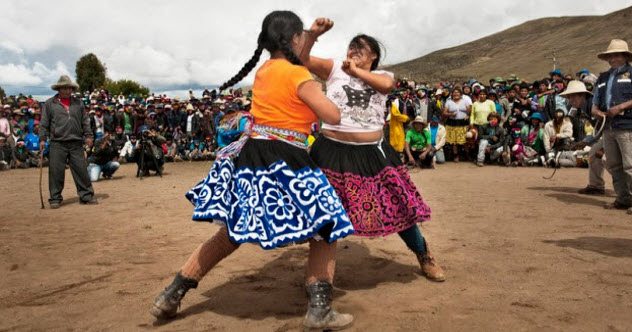
Most festivals promise music, dancing, good food, and perhaps an uncle making questionable decisions near a karaoke machine. The celebrations on this list take a more forceful approach. Their traditions involve fistfights, flying fruit, flaming projectiles, wooden spears, giant logs, ritual piercing, andin one caseactual nails.
Calling these events “bizarre festivals of violence” is convenient outsider shorthand, but it does not tell the whole story. To the communities that maintain them, the apparent violence may represent conflict resolution, religious devotion, agricultural fertility, neighborhood identity, historical resistance, or spiritual renewal. The spectacle attracts attention; the cultural meaning explains why the tradition survives.
With that important distinctionand a sensible amount of protective headgearin mind, here are 10 of the world’s most unusual violent festivals and ritual celebrations.
1. Takanakuy: Christmas Day Fight Club in Peru
In parts of Peru’s Chumbivilcas Province, Christmas can include music, dancing, food, colorful costumes, and the opportunity to punch someone with whom you have been arguing since February.
Takanakuy is an annual tradition in which residents participate in organized one-on-one fights. Some bouts address family quarrels, property disagreements, romantic disputes, or personal insults. Others are fought for sport or prestige. Participants publicly challenge one another, enter a designated fighting area, and exchange blows under the supervision of local authorities or referees.
The objective is not an endless feud. Ideally, the fight closes the dispute so both people can begin the coming year without carrying old resentment. Afterward, opponents may shake hands or embrace. The celebration is also accompanied by huaylia music, dancing, drinking, and elaborate regional clothing, making it far more than a sequence of fistfights.
Takanakuy may look like a rural boxing tournament with unusually personal matchmaking, but its social purpose is significant. It provides a highly visible form of community justice in places where formal legal procedures may be distant, expensive, or slow. Researchers and reporters have described the fights as a method of releasing tension and restoring community relationships rather than simply encouraging revenge.
2. Chiaraje: A Ritual Battle for the Earth
Every January 20, people from neighboring communities in Peru’s Canas Province gather in the high Andes for Chiaraje, a ritual confrontation connected to the fertility of the land.
Participants traditionally face rival groups using slings, stones, whips, and intimidating displays of horsemanship. The confrontation may unfold in separate phases, with music, food, drinking, and communal gathering taking place between bursts of combat. Women in traditional dress sing and encourage the participants while musicians add a festive soundtrack to a scene that otherwise resembles a medieval skirmish.
According to commonly reported local beliefs, blood spilled during the encounter is an offering to Pachamama, or Mother Earth, and may help secure rain, fertile soil, and a successful agricultural year. That interpretation should not be treated as a universal explanation shared identically by every participant. Like many traditions passed through generations, Chiaraje carries overlapping meanings involving spirituality, local identity, courage, territory, and historical memory.
Stones launched from a traditional sling can cause serious injuries, so this is not theatrical combat with foam weapons. Yet the opposing communities are not conventional enemies. The encounter operates inside a recognized ritual framework and is followed by a return to ordinary social life.
3. Calcio Storico: Florence’s Beautifully Dressed Brawl
Florence gave the world Renaissance painting, elegant architecture, influential political philosophy, and a sport that appears to have been designed by combining soccer, rugby, wrestling, and an argument outside a late-night restaurant.
Calcio Storico Fiorentino is played by teams representing four historic districts of Florence. Traditionally, each side fields 27 players on a sand-covered field. The objective involves moving a ball into the opposing scoring area, but players may also grapple, tackle, strike, block, and wrestle opponents to create space.
The players wear colorful clothing inspired by Renaissance-era dress, producing the unusual sight of muscular competitors engaging in full-contact chaos while looking prepared for a portrait by a 16th-century court painter. Matches are associated with Florence’s celebrations surrounding San Giovanni, the city’s patron saint.
Calcio Storico is not simply an old sport preserved for tourists. District identity matters deeply, and selection as a player can be a major source of local pride. The combination of physical punishment, neighborhood loyalty, ceremony, and historical pageantry gives the event an atmosphere closer to civic ritual than a normal weekend game. Smithsonian has described it as a soccer-rugby-brawl hybrid featuring 27 players per team and relatively few restrictions compared with modern field sports.
4. Battle of the Oranges: Italy’s Citrus Civil War
The Carnival of Ivrea in northern Italy includes a three-day battle in which organized teams throw enormous quantities of oranges at one another. It is messy, bruising, dramatic, and presumably the reason local washing machines require emotional support.
The event is commonly explained through a legend about a popular uprising against a tyrannical ruler. Participants on foot symbolize rebellious townspeople, while opponents riding horse-drawn carts represent the ruler’s forces. The historical details surrounding the origin have become blurred, but the festival’s symbolism centers on resistance, liberation, and community identity.
The oranges are not gently tossed. They are thrown with enthusiasm at close range, and experienced participants wear padded clothing and protective helmets. Spectators who do not wish to become part of the battle traditionally wear red caps, although staying behind protective netting remains a wiser strategy than trusting citrus etiquette.
Recent editions have used hundreds of tons of oranges, with the Associated Press reporting nearly 1,000 tons thrown during the 2024 celebration. Organizers say the fruit is unsuitable for ordinary retail sale, and the pulpy remains are collected for composting after the fighting ends.
5. Bolas de Fuego: El Salvador’s Fireball Fight
Residents of Nejapa, El Salvador, celebrate Bolas de Fuego by dividing into teams and throwing flaming balls of cloth at one another. Somewhere, a cautious event planner is still staring at that sentence and whispering, “No.”
The festival is held on August 31 and is linked to stories about a volcanic eruption in 1658 that forced residents to relocate. Another layer of local legend presents the eruption as a supernatural battle between Saint Jerome and the Devil. The modern celebration transforms that story into a very real exchange of fire.
Participants wrap cloth into balls, soak them in a flammable substance, ignite them, and hurl them through the streets. Many wear gloves, face paint, masks, wet clothing, or other protective equipment. Police, firefighters, and medical workers are typically present because goodwill alone is not an effective treatment for burning kerosene.
Although the fireball fight is visually alarming, it is also a central expression of local identity. Families prepare for it, crowds gather along the route, and participation can become a source of pride. The event combines religious imagery, volcanic history, neighborhood rivalry, and enough flames to make a dragon request a safer seat.
6. Rouketopolemos: The Easter Rocket War of Greece
On the Greek island of Chios, two church congregations in the town of Vrontados celebrate Orthodox Easter by firing thousands of homemade rockets toward each other’s bell towers.
Known as Rouketopolemos, or “rocket war,” the event involves the parishes of Saint Mark and Panagia Ereithiani. Their churches sit on opposing hillsides, creating an almost suspiciously convenient layout for pyrotechnic rivalry. Teams aim at designated architectural targets while the churches and nearby properties are protected with metal mesh and temporary barriers.
Local stories often trace the custom to the Ottoman period. One version claims the congregations once used cannons before authorities prohibited them, inspiring residents to replace artillery with homemade rockets. The exact history remains uncertain, but the modern result is spectacular: streams of glowing projectiles cross the dark valley while Easter services continue inside the protected churches.
Property damage, safety concerns, and complaints from residents have led to cancellations, restrictions, and negotiations over how the event should operate. The tradition has nevertheless returned under tighter controls, demonstrating the familiar festival compromise: keep the heritage, reduce the likelihood of accidentally redecorating a neighbor’s roof with fire.
7. Onbashira: Riding Giant Logs Down a Mountain
The Onbashira Festival in Japan’s Nagano Prefecture is associated with the renewal of the Suwa Grand Shrine. Its most famous stage involves enormous fir logs, steep slopes, ropes, crowds, and volunteers who decide the safest place to stand is directly on the moving timber.
Held every six years according to the traditional zodiac cycle, the festival begins with the selection and felling of large trees. Sixteen logs are transported from the mountains and eventually raised as sacred pillars at the corners of the shrine’s buildings.
During the dramatic downhill stage known as Kiotoshi, participants ride or cling to the logs as they slide down a steep slope. Later, during the pillar-raising ceremonies, men may remain on the logs while teams pull them upright using ropes.
Onbashira has deep Shinto significance and represents renewal, continuity, cooperation, and regional identity. The risk is not symbolic, however. Participants have been seriously injured or killed during past festivals, particularly during descents and pillar raising. That history explains why Onbashira is frequently labeled one of Japan’s most dangerous traditional celebrations, even though describing it only as a thrill ride would ignore its sacred purpose.
8. Pasola: Horseback Spear Fighting in Indonesia
On the Indonesian island of Sumba, Pasola brings groups of skilled riders onto open fields for a ritual competition involving galloping horses and flying wooden spears.
The event is rooted in the Indigenous Marapu belief system and is connected to the agricultural calendar. Its timing traditionally follows the appearance of nyale, colorful sea worms whose arrival is interpreted by religious leaders as an important seasonal sign.
During Pasola, riders charge toward opposing groups and throw wooden spears while attempting to avoid incoming projectiles. Modern spears are generally blunted rather than fitted with metal points, but the speed of the horses and the force of the throws mean injuries remain possible.
Blood spilled during the ritual has traditionally been associated with soil fertility and a prosperous harvest. Pasola also demonstrates riding ability, courage, status, and loyalty to the community. It is not merely an equestrian performance arranged for visitors; the associated prayers, offerings, ancestral beliefs, and seasonal rituals are central to its meaning.
National Geographic describes Pasola as a mounted spear-throwing competition held during February or March, while regional accounts emphasize that religious leaders and natural signs play an important role in determining its timing.
9. Phuket Vegetarian Festival: Purification Through Pain
Despite its gentle-sounding name, Thailand’s Phuket Vegetarian Festival is famous for processions involving firecrackers, firewalking, blade ladders, and extreme body piercing.
The nine-day celebration is associated with the Nine Emperor Gods and Phuket’s Chinese community. Devotees commonly observe a vegetarian diet, wear white, avoid alcohol and sexual activity, and follow rules intended to purify the body and mind.
The most dramatic participants are spirit mediums often called ma song. During processions, some pierce their cheeks with metal rods, blades, tools, or other objects. The acts are understood within the festival as signs of spiritual possession, sacrifice, protection, and devotionnot as stunts performed merely to shock an audience.
Other ceremonies may involve walking over hot coals, climbing ladders fitted with blades, or moving through clouds of exploding firecrackers. Medical teams and shrine assistants support the processions, but spectators should remember that the participants are engaged in religious observance. A camera does not turn a sacred ritual into a theme-park attraction.
Smithsonian photography coverage documents the festival’s shrine processions, spirit mediums, purity practices, and intense exposure to firecrackers, while Thailand’s tourism authority identifies the annual Chinese Vegetarian Festival as an important part of Phuket’s cultural life.
10. San Pedro Cutud Crucifixions: Good Friday in the Philippines
In several communities in Pampanga Province, Philippines, Good Friday observances include volunteers being nailed to wooden crosses during reenactments of the crucifixion of Jesus.
The best-known event takes place in San Pedro Cutud. Participants may carry crosses through the heat, wear crowns of thorns, or undergo brief crucifixion using sterilized nails driven through the hands and feet. Other penitents walk barefoot and strike their backs with bamboo or wooden implements.
Devotees undertake these acts for different reasons: fulfilling religious vows, seeking forgiveness, giving thanks for perceived miracles, praying for relatives, or asking for help during personal hardship. The ceremony reflects a distinctive combination of Catholic imagery, folk belief, public penitence, and local tradition.
The Catholic Church does not officially endorse crucifixion or self-flagellation and has encouraged believers to demonstrate devotion through prayer, charity, and service rather than bodily injury. Nevertheless, the reenactments have continued for decades and attract large crowds of residents, journalists, and visitors.
The Associated Press reported that 10 devotees were nailed to crosses during the 2024 observance, while other penitents engaged in self-flagellation. The event is therefore not a historical reenactment in the ordinary theatrical sense. The pain, wounds, vows, and medical risks are real.
The Experience: Witnessing Violent Festivals Responsibly
Expect Sensory Overload
Watching one of these festivals is rarely a quiet museum-style encounter. A visitor may hear rockets screaming through the air, oranges striking helmets, drums echoing across a mountain, horses charging over dry ground, firecrackers exploding beside a procession, or thousands of spectators reacting at once. Smoke, sweat, dust, fruit pulp, incense, fuel, wet clothing, animal odors, and street food can occupy the same few yards.
The first emotional response is often disbelief. Photographs flatten an event into a dramatic image, but being present adds sound, movement, heat, crowd pressure, and uncertainty. Even a well-organized ritual can feel chaotic when viewed without cultural context.
Look Beyond the Most Shocking Moment
The obvious temptation is to focus only on the punch, piercing, flame, spear, or falling log. Doing so can reduce an entire community to a viral clip. The more meaningful experience begins before the violent action: families preparing clothes, musicians rehearsing, elders conducting prayers, participants sharing food, shrine assistants organizing processions, and neighbors discussing a tradition inherited from earlier generations.
A traveler who learns the religious or historical background will see more than danger. Takanakuy becomes a method of public reconciliation. Pasola becomes part of an agricultural and spiritual calendar. Onbashira becomes an act of shrine renewal. Phuket’s piercings become expressions of purity, vows, and possession rather than displays created for spectators.
Choose Safety Over the Perfect Photograph
A telephoto lens is cheaper than reconstructive dentistry. Visitors should remain inside official viewing areas, follow police and organizer instructions, protect their eyes and ears when appropriate, and avoid standing in escape routes. At events involving animals, projectiles, fire, or large moving objects, “the crowd is standing there” is not proof that the location is safe.
Travel insurance, sturdy footwear, water, sun protection, and a charged phone are sensible. Alcohol should not become part of a personal courage experiment. Most importantly, spectators should never imitate a ritual, enter a combat area, touch religious objects, or encourage participants to perform something more dangerous for a photograph.
Practice Cultural Humility
Terms such as “crazy,” “primitive,” and “savage” may generate clicks, but they also reveal more about the visitor than the tradition. Respectful observation does not require pretending that injuries are harmless. It requires recognizing that a practice can be dangerous while also carrying serious meaning for the people who maintain it.
Ask permission before taking close portraits. Follow local expectations regarding clothing. Do not use flash near participants in trance, around animals, or during solemn religious moments. Avoid blocking relatives, medical workers, shrine staff, or members of the community merely because your social feed is experiencing an emergency shortage of dramatic content.
What Visitors Usually Remember
The lasting memory may not be the violent act itself. It may be the handshake after a fight, the silence before riders charge, the teamwork required to move a sacred log, the sudden glow of thousands of rockets, or the way a community returns to ordinary life after several hours of controlled disorder.
These experiences challenge the assumption that festivals exist only for entertainment. Some celebrations allow communities to stage conflict, pain, sacrifice, resistance, or danger inside an established cultural structure. They reveal how human societies transform frightening forces into stories, ceremonies, and shared identityalthough most of us will remain perfectly happy transforming our disagreements into strongly worded emails.
Conclusion
The world’s bizarre festivals of violence are not interchangeable spectacles. Each developed from a particular combination of environment, religion, history, social organization, and local memory. Flying oranges symbolize rebellion in Ivrea, public fights promise a fresh social start in Peru, spears connect Sumbanese riders with the agricultural year, and dangerous logs renew sacred spaces in Japan.
The physical risks should never be minimized, romanticized, or copied. At the same time, dismissing these traditions as meaningless brutality prevents outsiders from understanding why communities continue to invest them with pride and spiritual importance. The best approach is neither horrified mockery nor reckless admiration. It is informed curiositywith a respectful attitude, a safe viewing position, and absolutely no attempt to catch a flaming ball as a souvenir.