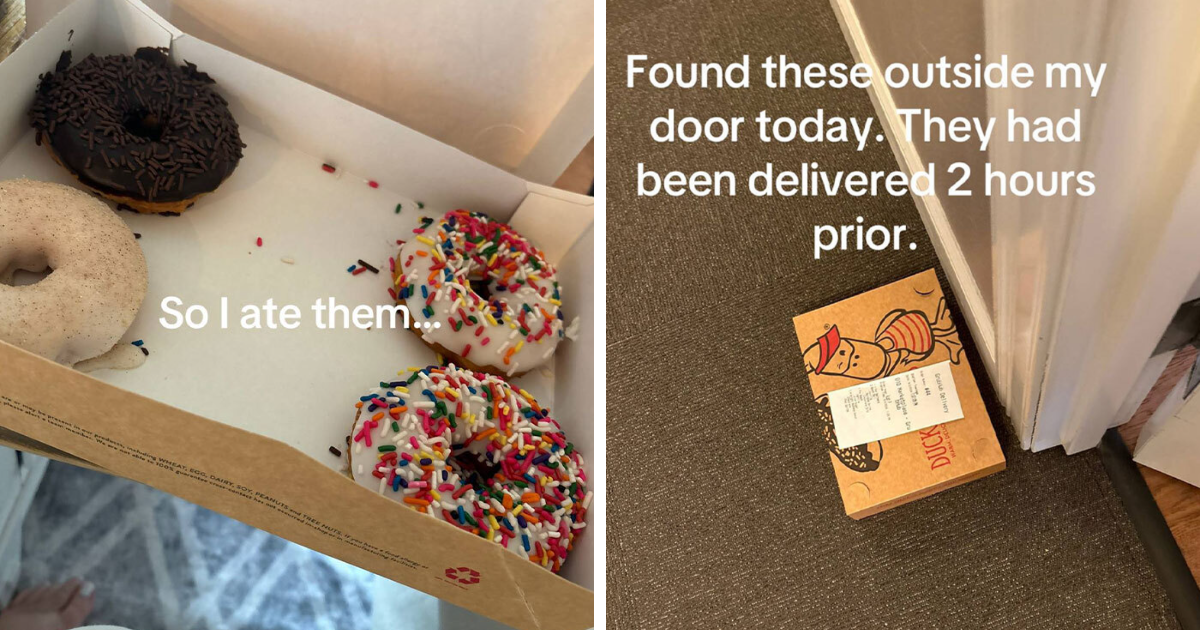
Every apartment building has its own tiny universe of mysteries: the elevator that smells like fries at 11 p.m., the neighbor who owns exactly one loud chair, and the food delivery that appears at the wrong door like a test from the moral universe. For TikToker Becca Barnoski, that test arrived in the form of a DoorDash order from Duck Donuts. It sat outside her door. It waited. It tempted. And after two hours of nobody claiming it, the donuts began looking less like “someone else’s delivery” and more like “destiny with sprinkles.”
What followed was not a neighborhood feud, a passive-aggressive note war, or a dramatic TikTok courtroom. Instead, the mistaken DoorDash order turned into a funny, wholesome internet moment about honesty, embarrassment, neighborly grace, and the oddly powerful social glue of baked goods. Barnoski ate the donuts, realized they belonged to a neighbor, apologized, and then made things right with a sweet gesture that viewers could not stop cheering for.
The story spread because it hit several very online pressure points at once: food delivery confusion, TikTok storytelling, apartment-life awkwardness, and the classic human question of what to do when delicious food appears on your doorstep without warning. Most people like to believe they would do the perfect thing. Most people have also never been left alone with surprise donuts for two hours.
A DoorDash Delivery, A Box Of Donuts, And A Moral Crisis
According to reports about the viral TikTok, Barnoski found a DoorDash delivery from Duck Donuts outside her door. The order had been sitting there for a while, and nobody came to collect it. The receipt reportedly did not make the destination clear enough for her to identify the correct apartment, and she did not recognize the name attached to the order. Adding to the confusion, Barnoski had recently had a baby and said people had been sending gifts and food, which made the mystery delivery feel at least somewhat plausible as a surprise for her household.
That context matters. This was not a cartoon villain rubbing her hands together over stolen pastries. It was a new mom, an unexplained food delivery, and a box of donuts quietly gaining emotional power outside her door. She even checked in with a friend, asking the question that launched a thousand comment-section debates: morally, could the donuts be hers?
The friend, operating under what can only be described as snack law rather than actual law, joked that after two hours the order was “legally” hers. That was enough encouragement for Barnoski to eat the donuts. Internet history may someday divide itself into eras: before the Duck Donuts decision and after.
The Neighbor’s Note Changed Everything
The plot twist arrived later when Barnoski found a note on her door from the neighbor who had been searching for the missing Duck Donuts. In that instant, the delivery mystery became a social dilemma. She could ignore it, pretend she had never seen the note, or blame the chaos of modern app-based delivery. Instead, she reached out, admitted what happened, and apologized.
That honesty is a big reason the story resonated. Mistakes happen constantly in the delivery-app world. Wrong doors, missing items, confusing apartment numbers, and drivers racing against time are all part of the modern convenience machine. But how people respond after a mistake is where character shows up. Barnoski’s response was simple: she owned it.
The neighbor’s reply made the story even better. Rather than reacting with anger, the neighbor was understanding. The donuts had apparently been a surprise from a cousin, which explained why the neighbor had not been expecting them immediately. The neighbor even congratulated Barnoski on her new baby and told her not to worry. In an age when many viral clips are powered by outrage, this one took a hard left turn into emotional decency.
The Sweet Gesture That Won Over TikTok
Even after the neighbor accepted her apology, Barnoski still felt bad. So she decided to make a bigger gesture. She left a handwritten note for the neighbors, apologizing for eating the donuts and congratulating them on their marriage. Attached to the note was a gift card for Texas de Brazil, a steakhouse chain that is not exactly a one-donut apology. It was more like replacing a paper airplane with a private jet.
That is where the internet’s mood shifted from “Did she really eat the donuts?” to “Actually, this is adorable.” Viewers praised her for being honest and for going beyond a basic reimbursement. A box of donuts became dinner. A wrong delivery became a neighborly introduction. And a potentially awkward apartment-building encounter became a viral story with a surprisingly warm ending.
Some commenters still criticized the decision, arguing that she should have tried harder to identify the owner before eating the order or replaced the exact donuts instead of offering a steakhouse gift card. But the neighbor’s gracious response softened much of that criticism. The people directly involved were fine. In fact, reports noted that Barnoski and her neighbors remained on good terms, with talk of a future double date between the couples. That is a better result than most apartment hallway interactions, which usually peak at a half-wave near the trash room.
Why The Story Went Viral
The TikTok worked because it was built around a tiny but relatable moral dilemma. Everyone understands the temptation of unattended food. Everyone understands the panic of realizing you made the wrong call. And almost everyone has had some experience with delivery confusion, whether it was a missing soda, a bag left at the wrong house, or a driver photo showing your dinner sitting in front of a door you have never seen in your life.
It also helped that the story had a clean emotional arc. There was temptation, mistake, discovery, honesty, forgiveness, and repair. That is basically a mini sitcom episode, except the set design is an apartment hallway and the supporting cast is a box of donuts.
TikTok is especially good at spreading stories like this because the platform rewards compact, visual, emotionally clear narratives. A few screenshots, a few captions, a funny confession, and a satisfying ending can travel faster than a full news article. Pew Research has reported that TikTok remains especially popular among teens and young adults in the United States, which helps explain why everyday stories can become mass cultural moments almost overnight.
DoorDash Mix-Ups Are Part Of A Bigger Delivery-App Reality
This story is funny, but it also sits inside a much bigger shift in how Americans eat. Food delivery is no longer an occasional luxury reserved for pizza night or rainy Sundays. For many households, it is part of weekly life. DoorDash, Uber Eats, Grubhub, and other services have changed how people interact with restaurants, grocery stores, convenience items, and even gifts.
As delivery demand grows, so do the odds of small mistakes. A driver may leave an order at the wrong unit. A customer may forget to update an old address. A building may have confusing numbering. A restaurant may label a bag unclearly. A driver handling multiple orders may mix up names or drop-off points. None of these scenarios require malice. They require only speed, pressure, and a system where a lot of people are trying to move hot food through complicated neighborhoods as quickly as possible.
DoorDash’s own help guidance tells customers to report missing orders through the app or website by selecting the order, tapping help, and choosing the relevant delivery issue. The platform also distinguishes between a missing order, an incorrect item, and a wrong order delivered. That distinction matters because a wrong-door delivery is not the same as a restaurant forgetting fries. For customers, the practical lesson is clear: use the app support tools quickly, provide accurate details, and avoid turning a simple mistake into a neighborhood investigation worthy of detective music.
Was Eating The Donuts Wrong?
Now for the question that launched the drama: was it wrong to eat the donuts? The cleanest answer is yes, probably. If food arrives at your door and you did not order it, the safest and most considerate first step is to wait briefly, check the receipt, look for an apartment number or name, contact the delivery platform if possible, and ask nearby neighbors if the situation is obvious. Food is personal, paid for, and often time-sensitive.
But real life is rarely clean. Barnoski said she waited two hours. She did not know whose order it was. The receipt reportedly did not identify the apartment clearly. She had been receiving gifts after having a baby. Those details do not magically transform someone else’s donuts into community property, but they do make the mistake understandable.
The reason viewers forgave her is not because she made the perfect choice. It is because she made a human choice, then corrected it with honesty and generosity. The story is not “Woman eats neighbor’s food and gets away with it.” The story is “Woman panics after donut-related moral failure and overcompensates in the sweetest possible way.” That is a very different headline.
The Neighbor’s Reaction Was The Real Plot Twist
In many viral stories, the internet waits for conflict. People expect the angry message, the public shaming, the demand for repayment, the dramatic update. Here, the neighbor responded with kindness. That reaction changed the tone of the entire situation.
The neighbor had every right to be annoyed. Surprise donuts are still donuts, and nobody wants to go on a dessert treasure hunt only to discover the treasure has been eaten. But instead of escalating, the neighbor accepted the apology and even celebrated Barnoski’s good news as a new mom. That little bit of grace is what made the story feel refreshing.
There is a lesson there for digital culture. Not every mistake needs to become a scandal. Not every awkward situation requires public punishment. Sometimes the best ending is a calm text, a sincere apology, and a gift card large enough to make everyone forget the original pastry count.
Why People Loved The Texas de Brazil Gift Card
The Texas de Brazil gift card became a character in the story because it was hilariously disproportionate. A typical donut order is a small treat. A steakhouse gift card is a full apology performance. It said, “I am sorry,” but also, “Please understand that my guilt has developed a budget.”
That made the gesture feel sincere. Barnoski did not merely say sorry and move on. She turned the mistake into a celebratory dinner for the couple, tying the apology to their marriage and making the note feel personal. The gesture worked because it was thoughtful, not just transactional.
Replacing the exact order would have been reasonable. Offering a dinner was memorable. That is why people reacted strongly. It transformed the apology from damage control into a story about neighborliness. In an apartment building, that matters. The difference between strangers and friendly neighbors is often one small interaction, one borrowed tool, one held elevator, or apparently one missing box of donuts.
What To Do If A DoorDash Order Appears At Your Door
If a food delivery arrives and you did not order it, the best move is to pause before becoming emotionally attached to the fries. First, check the receipt or bag label for a name, address, apartment number, or phone number. If the correct unit is obvious, consider placing the order safely near that door and leaving a quick note, as long as it is practical and safe to do so.
If the order is sealed and you cannot identify the owner, avoid opening it. You can contact the delivery service or restaurant if the information is visible. In an apartment building, a brief message in a resident group chat may solve the mystery quickly. If nobody claims it after a reasonable period, the situation becomes more complicated because food safety and quality decline with time. Still, it is wise to document what happened and avoid assuming too quickly that “finders keepers” applies to glazed pastries.
If you discover that you accidentally ate or used something intended for a neighbor, honesty is usually the cleanest exit. A short apology, an offer to reimburse, and a small extra gesture can turn a mistake into goodwill. The key is not perfection. The key is repair.
What Brands And Creators Can Learn From The Viral Moment
For content creators, the story is a useful case study in why ordinary life often outperforms manufactured drama. Barnoski did not need a complicated stunt. She had a relatable mistake, authentic embarrassment, screenshots, and a satisfying resolution. That combination is powerful because viewers can immediately imagine themselves in the same situation.
For brands, especially delivery apps and restaurants, the story shows how emotionally important the “last few feet” of delivery can be. The food may be prepared perfectly and transported quickly, but if it lands at the wrong door, the customer experience collapses. Clear labeling, accurate address details, driver confirmation, and customer communication all matter.
For audiences, the viral reaction is a reminder that the internet still has room for gentle stories. People do not only share outrage. They share awkwardness, forgiveness, humor, and proof that strangers can still be nice to each other. Sometimes a box of donuts can do what a thousand motivational posters cannot.
Experience Section: Real-Life Lessons From The DoorDash Donut Mix-Up
Anyone who has lived in an apartment building, dorm, shared house, or tightly packed neighborhood knows that delivery mistakes are almost a rite of passage. A bag appears outside your door, and suddenly you are starring in a low-stakes ethics exam. The smell of warm food makes the situation worse. Nobody is tempted by a misdelivered envelope from the electric company. But a box of donuts? That is not a package. That is a trap with frosting.
One useful experience from situations like this is that waiting helps, but communication helps more. If food sits outside for a long time, it is easy to assume it has been abandoned. But a quick check can prevent trouble. Many apartment communities have text groups, lobby boards, front desk staff, or leasing offices that can help locate the owner. Even a simple hallway note saying, “A food delivery was left at my door by mistake; please knock if it is yours,” can buy time and show good faith.
Another lesson is that people are usually more forgiving when you tell the truth quickly. The uncomfortable part of Barnoski’s story was not the donuts. It was the moment she realized someone had been looking for them. That is the exact moment when many people freeze. They worry the apology will make things worse. In reality, silence usually creates more awkwardness. A sincere message can defuse the whole situation: “I am so sorry. I thought this might have been sent to me by mistake. I should have checked more carefully. Please let me replace it.” That kind of honesty does not erase the error, but it gives the other person a reason to respond generously.
The third lesson is that an apology lands better when it matches the inconvenience. If you accidentally eat a small order, replacing it is the baseline. Adding a little extra can turn frustration into a funny memory. That does not mean everyone needs to hand out steakhouse gift cards like apology confetti. The gesture can be simple: a replacement order, a coffee card, a handwritten note, or even a small dessert. The point is to show that you understand the mistake affected a real person, not just an app receipt.
There is also a bigger social lesson: neighbors do not become neighbors only through planned introductions. Sometimes community starts through accidents. A borrowed charger, a package held during rain, a warning about a flat tire, or a missing donut order can become the first real conversation between people who have lived twenty feet apart for months. Modern life makes it easy to treat nearby people as background scenery. Stories like this remind us that a small act of repair can open the door to actual connection.
Finally, the viral reaction shows that people are hungry for stories where nobody becomes the villain. Barnoski made a questionable snack decision. The neighbor had a right to be disappointed. But both sides chose humor and kindness. That is why the story worked. It gave people the satisfaction of a mistake being corrected without cruelty. In a comment-section world that often reaches for the pitchfork before reading the caption, a donut apology with a dinner gift card feels almost radical.
Conclusion
The viral story of the TikToker who mistakenly ate her neighbor’s DoorDash order is funny on the surface, but its staying power comes from something warmer. Becca Barnoski’s donut dilemma captured the awkward reality of modern delivery culture, where convenience sometimes lands at the wrong door. But instead of letting the mistake become a feud, she apologized, offered to make it right, and turned a box of missing Duck Donuts into a surprisingly wholesome neighbor story.
The reason people loved it is simple: everyone messes up, but not everyone repairs the mess with honesty and heart. Barnoski’s gesture worked because it was personal, generous, and just a little bit dramatic in the best way. The neighbor’s kind response made the story even better, proving that a calm reaction can be more memorable than a furious one.
So, should you eat a mystery DoorDash order if it appears at your door? Probably not. Should you panic forever if you make a mistake? Also no. Check the receipt, try to find the owner, use the app when needed, and if you accidentally become the villain in someone else’s lunch story, apologize like you mean it. Bonus points if your apology comes with dinner.
Note: This article is an original rewrite and synthesis based on publicly reported details of the viral TikTok story, official delivery-support guidance, and broader U.S. food-delivery and social-media context. No source links are inserted for publication cleanliness.