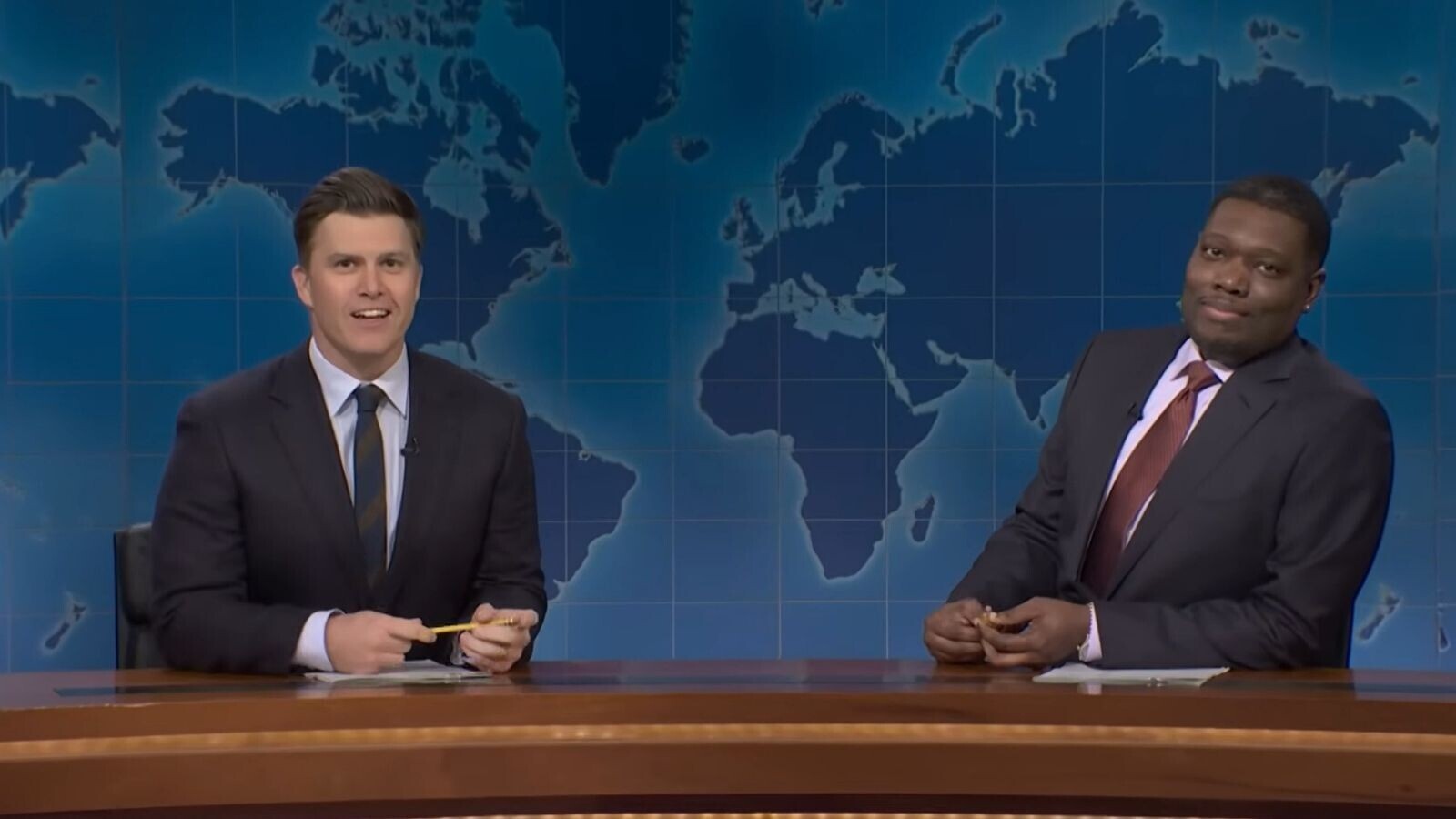
Political comedy has a strange superpower: it can make a room laugh and wince at the exact same time. That was the energy hanging over Saturday Night Live when Weekend Update took on the latest Trump-and-Epstein headlines. The segment did not tiptoe around the story. It grabbed the week’s ugliest, most uncomfortable news, squeezed it into a few lean punchlines, and let the audience do that special late-night-comedy reaction where people laugh first and then immediately look at one another like, “Well, that was dark.”
And yes, it was dark. But it was also disciplined. That is what made the joke so brutal. Weekend Update works best when Colin Jost and Michael Che sound less like performers begging for applause and more like two guys reading the news after everyone else in the room has already given up pretending the news is normal. In this case, the material was already radioactive. Newly released Epstein-related emails had reignited scrutiny around Donald Trump’s past relationship with Jeffrey Epstein, while Trump and the White House denied wrongdoing and dismissed the disclosures as political theater. SNL did what it has always done with combustible headlines: it turned them into a pressure cooker, then popped the lid.
The Joke That Hit Like a Brick
Depending on which entertainment outlet you read, the nastiest line of the night came in one of two forms. Some coverage zeroed in on Jost’s now-famous comparison of Trump to “the Forrest Gump of meeting famous pedophiles,” a line so compact and so nasty that it landed like a folding chair to the spine. It is the kind of joke that sounds simple until you realize how much it is doing at once. It mocks celebrity proximity, turns Trump’s endless orbit around notorious figures into the punchline, and packages a deeply ugly topic into one image that is impossible to forget. Comedy writers love economy; this joke had the efficiency of a paper cut and the sting of lemon juice.
But another camp argued that Che’s later gag was even more savage. In that reading, the evening’s true knockout punch was not the cleaner one-liner but the more grotesque joke built around a lurid “Bubba” email reference and the mental image it created. That joke was messier, nastier, and more deliberately unsettling. It did not just zing Trump; it made the audience sit inside an absurdly gross image long enough to regret being alive. In other words, classic Michael Che behavior.
So which joke was actually the most brutal? The honest answer is that the segment worked because it escalated. Jost brought the scalpel. Che brought the flamethrower. One line was colder, one line was dirtier, and together they created that rare Weekend Update rhythm where each punchline feels like it is trying to outdo the last one in cruelty, confidence, and sheer bad taste. On a regular week, that would be risky. On a week like this, it felt almost inevitable.
Why This One Landed So Hard
1. The setup was already doing half the work
The reason the segment hit so hard is that the story itself arrived preloaded with tension. The underlying news was not random gossip or a disposable social-media scandal. It involved newly released Epstein-related material, fresh political infighting, renewed public suspicion, and an atmosphere of national exhaustion that practically begged to be satirized. By the time Jost and Che got to the desk, viewers did not need a lot of exposition. They needed someone to say, in one brutal sentence, what the week already felt like.
That is the secret sauce of Weekend Update. It is not investigative journalism, and it is not a panel discussion. It is compression. The anchors take bloated, ugly, contradiction-filled news and boil it down until all that remains is the emotional truth people are already carrying around. In this case, the emotional truth was simple: the story was disturbing, politically explosive, and weirdly familiar all at once. A joke that sharp could cut right through the clutter.
2. It weaponized Trump’s own public-image machine
Trump has always understood spectacle. He has spent decades turning publicity into insulation, scandal into branding, and notoriety into content. The best joke of the segment flipped that machinery on him. Instead of treating his long history of celebrity encounters as glamorous or powerful, the bit framed it as grotesque inevitability. That is what made the “Forrest Gump” comparison sting. It mocked not just association, but the sheer recurring absurdity of Trump appearing near every strange, infamous, or morally bankrupt chapter of public life.
Political satire gets much stronger when it does not argue with a politician’s self-mythology but hijacks it. Trump’s mythology says he is at the center of every big moment because he is important. Weekend Update answered: maybe you are at the center because chaos keeps finding you, and because you keep wandering into history like a guy who mistakes notoriety for destiny. Ouch.
3. The news-desk format makes the joke feel colder
A sketch can be broad. A monologue can be chatty. But the Weekend Update desk has a fake-newsroom stiffness that gives every line a little extra ice. Jost and Che do not usually perform these jokes like stand-ups in a club. They read them with the polished rhythm of anchors who are technically delivering headlines, which makes the cruelty feel more official. It is not just a comedian saying something mean. It is the structure of a newscast smuggling the insult into your living room with a tie on.
That tonal contrast matters. The material is outrageous, but the delivery stays controlled. The joke is not screaming at you. It is being read with a professional cadence, like it belongs on a teleprompter. That calm delivery creates a special kind of brutality. The line does not feel hysterical; it feels settled, as if the conclusion has already been reached and everyone is too tired to pretend otherwise.
The Episode Knew Exactly What It Was Doing
This was not an isolated throwaway line floating inside an otherwise normal episode. The broader show leaned into the Epstein story across multiple segments, including a cold open that mocked Trump’s response and other sketches that turned the files into recurring comic fuel. By the time Weekend Update arrived, the episode had already established its thesis: the story was not just politically explosive; it was culturally unavoidable. The desk segment became the place where the show stopped noodling around and went for the throat.
That matters because SNL sometimes gets accused of pulling its punches with powerful political figures, especially when a sketch leans too heavily on impressions, catchphrases, or applause-line moralizing. This time, the show did not sound cautious. It sounded locked in. The jokes were still built for laughs, but they were not polished into harmlessness. They had teeth. And in late-night comedy, teeth are the difference between a joke people politely smile at and a joke people repeat the next morning with their eyebrows halfway up their forehead.
What the Joke Was Really Saying
Underneath the shock value, the joke was not especially mysterious. It was saying that proximity matters. That patterns matter. That sometimes the most devastating way to satirize a public figure is not to invent anything new, but to summarize the existing record in a way that makes the pattern impossible to unsee. Satire often works by forcing recognition. It takes details people have already half-processed and arranges them into one unforgettable sentence.
That is why viewers reacted so strongly. The line felt less like a wild exaggeration and more like an ugly, efficient summary of a larger public discomfort. It gave language to a feeling that had been hovering over the coverage all week: not surprise, exactly, but an exhausted sense of, “Of course we are here again.” The joke was brutal because it did not sound speculative. It sounded like a conclusion delivered with a smirk.
And then Che’s contribution pushed the segment further. Where Jost’s sharpest line turned the scandal into a devastating metaphor, Che’s harsher material made the whole thing feel grimier and less abstract. He has always been the co-anchor more willing to let the audience marinate in discomfort. When that instinct is paired with a story this messy, the result can feel less like satire from a safe distance and more like satire that drags the whole room into the mud on purpose.
Why Audiences Still Show Up for This Kind of Comedy
There is a reason political comedy keeps returning to stories like this even when viewers swear they are tired of hearing about them. Satire offers something ordinary news cannot always provide: emotional clarity. News tells you what happened. Political comedy tells you what the week felt like. And on scandal-heavy weeks, what people often feel is not merely outrage. It is disbelief, disgust, fatigue, and a desperate need for someone to puncture the theater surrounding the whole spectacle.
Weekend Update thrives in that space. Jost and Che know that audiences do not come to the desk for a civics lecture. They come for the release valve. They come to hear a line so sharp that it slices through spin, denials, cable-news noise, and social-media sludge. That is what this segment delivered. Not balance. Not neutrality. Not decorous bipartisan throat-clearing. A joke. A mean one. A really memorable one.
And that, in a way, is why it mattered. The joke did not resolve anything. It did not prove anything. It did not replace reporting, and it should not. What it did do was capture the week’s mood with a level of precision that only comedy sometimes manages. It turned political rot into comic shorthand. It made people laugh at something ugly without pretending the ugliness was not there. That is not comfort comedy. That is gallows humor with good lighting.
The Viewing Experience: Why a Joke Like This Feels Bigger Than One Punchline
Watching a Weekend Update segment like this is a weirdly modern experience, because it is almost never just one experience. First, there is the live laugh in the room, which usually arrives mixed with groans, gasps, and that half-second of “Did he really just say that?” Then there is the social-media afterlife, where one line gets clipped, subtitled, reposted, argued over, stripped of context, turned into a headline, and launched into orbit before the show has even finished airing. By Sunday morning, the audience is no longer just the people who watched SNL. It is also the people who watched twelve seconds of it while standing in line for coffee and muttering, “Okay, that’s nasty.”
That layering changes how political comedy lands. In the old days, a brutal late-night joke lived and died in the room. Now it gets replayed as a cultural event. People rank it. Defend it. Condemn it. Meme it. Suddenly the joke is not just funny or unfunny; it is evidence of whether SNL is still relevant, whether satire is too soft or too cruel, whether the media is normalizing scandal or exposing it. One punchline picks up ten side arguments before lunch.
There is also the emotional whiplash. A viewer comes in carrying the week’s real headlines, which may involve disturbing allegations, partisan trench warfare, and the endless feeling that American politics has somehow become both more absurd and more numb at the same time. Then the show takes that dread and turns it into a punchline. For some people, that feels cathartic. For others, it feels indecent. For most people, it feels like both. That tension is part of the experience. You laugh, but the laugh is not clean. It has splinters in it.
That is why the most effective Weekend Update jokes tend to linger. They are not merely clever. They change the emotional shape of the story. After a line like this, it becomes harder to encounter the news in exactly the same way, because the joke has attached itself to the coverage like a burr on a sweater. The political scandal may continue to evolve, and the legal or factual questions may remain unresolved, but the satirical framing suddenly feels permanent. A good joke does not just comment on the news; it sneaks into the way the news is remembered.
There is, of course, a danger in that. Comedy can oversimplify. It can flatten complex facts into a punchline that is easier to repeat than to examine. But the best political comedy also acts like a highlighter. It does not replace the document; it tells you where people are looking. The audience experience, then, is not just about getting a laugh before bed. It is about feeling, in real time, that a show has identified the pressure point of the week and pressed on it hard enough to make everybody flinch.
That was the real experience of this joke. It was not just that it was mean, or daring, or viral-ready. It was that it felt like the sharpest possible summary of a week full of denial, discomfort, and disbelief. The audience laughed because the line was expertly built. They winced because they knew exactly what it was pointing at. And in the strange chemistry of modern political satire, that combination is usually how a joke stops being just a joke and becomes the line everyone remembers.
Conclusion
So, what was the most brutal Weekend Update joke about Trump and Epstein? The answer depends on your appetite for cruelty. If you prefer surgical comedy, the “Forrest Gump” line is hard to beat. If you prefer the kind of joke that leaves a smoke trail and a bad taste in the room, Che’s nastier “Bubba” material probably takes the crown. Either way, the real story is that Weekend Update found a way to turn one of the week’s ugliest political storylines into satire that felt sharp, current, and impossible to ignore.
That is what strong political comedy does. It does not clean up the mess. It just points at it with better timing.