Everybody makes mistakes. Most of them cost nothing more than a bruised ego, a replacement coffee, or an awkward apology to the person whose lunch you accidentally stole from the office refrigerator. Then there are mistakes that require an insurance investigator, an engineering team, several cranes, and a meeting that begins with, “Before anyone gets angry…”
The online community commonly known as “That Looked Expensive” collects photographs of spectacular accidents involving luxury cars, aircraft, industrial machinery, boats, buildings, and equipment that clearly did not come from the clearance aisle. The group was created in 2018 and grew by giving people a place to share mishaps that are fascinating, painful, and sometimes darkly funnyas long as nobody was seriously hurt.
What makes these expensive accidents so compelling is the contrast between complexity and simplicity. A machine may contain thousands of precision components, yet one missing bolt, forgotten rag, incorrect measurement, or badly timed decision can turn it into modern art. NASA’s NOAA N-Prime satellite, for example, was severely damaged after sliding from an improperly configured turnover cart. Investigators traced the incident to missing bolts and failures to follow verification procedures.
The following rundown paraphrases 45 memorable categories of costly mishaps shared by the community. Exact repair bills are not publicly available for every photograph, but the images have one thing in common: none of them look compatible with a small deductible.
45 Painfully Expensive Accidents and Mistakes
Aerospace and Aviation Disasters
-
A multimillion-dollar weather satellite fell onto the floor.
The NOAA N-Prime spacecraft tipped from its support equipment because essential securing bolts were missing. It was eventually repaired, but “just pick it up” was not an available solution. -
An aircraft hangar filled with fire-suppression foam.
An accidental system discharge buried equipment beneath an enormous white blanket. The foam looked festive; the cleaning bill almost certainly did not. -
A technician accidentally fired an aircraft cannon.
A ground-maintenance incident involving a Vulcan cannon reportedly destroyed an F-16 parked nearby. That is one exceptionally aggressive way to request a new aircraft. -
An emergency slide deployed inside an airplane.
Aircraft slides inflate quickly and with tremendous force. When one opens inside the cabin, it can damage seats, panels, doors, and the career trajectory of whoever triggered it. -
An airport tug struck a wide-body aircraft.
Airplanes may dominate the sky, but on the ground they remain surprisingly vulnerable to small vehicles. NTSB investigations have documented tug collisions caused by improper towing, poor visibility, and inadequate lookout procedures. -
New Boeing fuselages ended up beside a railroad track.
A train derailment in Montana scattered unfinished 737 fuselages along a riverbank. They had technically traveled, just not in the customer-approved direction. -
A maintenance rag was left inside an engine.
Once the engine started, the forgotten cloth became shredded material circulating through expensive machinery. Tool and material accountability suddenly seemed less bureaucratic. -
A sensor problem destroyed a B-2 stealth bomber.
Distorted air-data information entered the flight-control system before a 2008 takeoff in Guam, contributing to the loss of the aircraft. Both crew members survived. -
A unit-conversion error lost a spacecraft near Mars.
NASA’s Mars Climate Orbiter failed after one system supplied English units while another expected metric measurements. It remains the ultimate reminder to check whether a number means pound-seconds or newton-seconds.
Cars, Trucks, and Transportation Trouble
-
A low supercar slid underneath a school bus.
Tailgating is dangerous in any vehicle. It becomes especially embarrassing when the hood is approximately the same height as the bus bumper. -
Cars were crushed by a retractable garage.
One vehicle was reportedly parked above a moving underground garage while another was below. The system operated correctly; the parking decisions did not. -
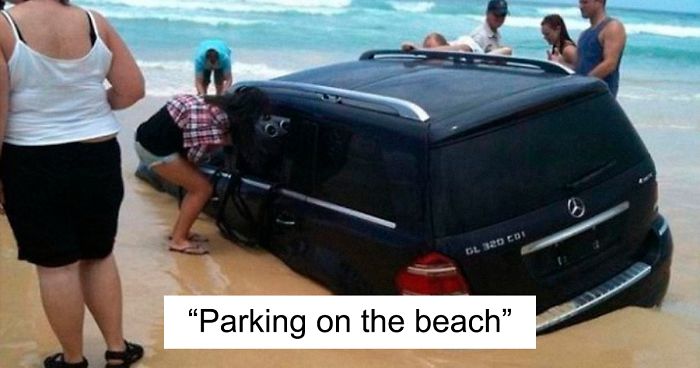
A luxury vehicle was parked on a tidal beach.
Sand can look firm until tires sink and the ocean begins checking its watch. Tow trucks also become less enthusiastic when waves are entering the conversation. -
A dump truck drove away with its bed raised.
The elevated bed struck overhead infrastructure, turning one forgotten control into a collision involving a truck, a bridge, and a great deal of paperwork. -
The rear of a heavily loaded truck separated.
A photograph showing a truck with its back section detached proves that “the back fell off” is occasionally a technical description rather than a comedy line. -
A cement truck suffered a messy mechanical failure.
Concrete is useful when poured into forms. It is considerably less useful when spilled across machinery, pavement, or anything that was supposed to remain movable. -
A rare Aston Martin was badly damaged.
When a collector car valued around £1.5 million crashes, the loss includes more than metal. Rarity, provenance, and original components can make restoration painfully complicated. -
A high-value Porsche crashed during a test drive.
A dealership demonstration involving a car reportedly worth roughly $300,000 ended with extensive damage. The phrase “I’m still thinking about it” probably did not rescue the sale. -
A trailer carrying new Shelby GT500s overturned.
One damaged performance car is unfortunate. A transporter full of them lying on its side is an insurance company’s group project. -
An SUV crashed into a McLaren dealership.
Instead of hitting one expensive car, the driver entered an environment where nearly every object had carbon fiber and an intimidating price tag. -
A Porsche Panamera and Tesla Model S collided.
Two premium cars met in a contest nobody requested. The winner was almost certainly the body shop. -
A valuable collector car became an accident victim.
Rare vehicles can be difficult to repair because replacement panels, trim, glass, and mechanical parts may no longer exist in normal supply chains. -
An armored personnel carrier flipped near a truck.
Heavy military vehicles are designed for difficult terrain, but gravity continues to operate without regard for defense budgets.
Boats, Yachts, and Very Bad Days on the Water
-
A truck and Jeep sank while trying to rescue a boat.
The original problem involved a boat reportedly worth about $300,000. The rescue attempt added two land vehicles to the list of submerged assets. -
Two cruise ships collided in port.
Cruise ships move slowly, but their enormous mass means even low-speed contact can damage railings, decks, cabins, and the vacation mood. -
A large yacht capsized in Greece.
A roughly 70-meter yacht ended up on its side, demonstrating that even floating luxury hotels must respect weight distribution, weather, and water ingress. -
A boat landed on rocks instead of water.
Hulls are designed to handle waves, not geological formations. Fiberglass meeting stone creates a sound best described as financially educational. -
Two expensive vessels were damaged together.
Maritime accidents can multiply quickly because one drifting or poorly controlled vessel may strike several neighboring boats before stopping. -
A poorly planned launch became a recovery operation.
Boat ramps combine slippery surfaces, steep angles, water, vehicles, and optimism. Removing any one of those ingredients would prevent many viral photographs. -
A luxury vessel ended up in an impossible position.
Photographs of boats perched on docks, roads, or other vessels produce the same question every time: how did it get there, and how many cranes will it take?
Construction and Heavy-Equipment Failures
-
A crane mishap split a house.
During a lifting operation in Florida, a residential structure was severely damaged. Cranes are excellent at moving houses until the load decides to explore two directions at once. -
A crane was pushed beyond its lifting capacity.
One operator reportedly warned that the machine could not safely handle a 70,000-pound load. The attempt continued, followed by the expensive demonstration portion of the discussion. -
A heavy machine tipped onto its side.
Large equipment may move slowly, but its center of gravity can shift rapidly. Recovery often requires additional machinery that must avoid joining the accident. -
Wind-turbine equipment required “renewable” replacement.
Damaged blades, towers, or nacelles are expensive not only because of the components, but also because specialized cranes and technicians must reach them. -
An expensive industrial load tipped during transport.
Securing cargo is less glamorous than operating machinery, yet one weak tie-down can transform a routine delivery into a highway closure. -
A sinkhole swallowed valuable property.
Sinkholes can undermine pavement, vehicles, utilities, and buildings with little warning. What looks like a surface problem may involve a much larger underground void. -
A landslide buried or destroyed part of a highway.
Landslides involve rock, soil, or debris moving downslope and can sever transportation routes, damage vehicles, and require extensive stabilization work.
Factories, Tools, Technology, and Costly Everyday Decisions
-
Thousands of dollars were microwaved for “disinfection.”
Banknotes and microwave ovens have incompatible career goals. The attempt reportedly destroyed about 5,000 Canadian dollars and created extremely literal hot money. -
A rare bottle of wine shattered.
The destroyed 1945 Château Mouton Rothschild was reportedly valued around $16,000. It achieved an impressive finish, though unfortunately it was the floor finish. -
A warehouse fire consumed tens of thousands of whiskey barrels.
The Jim Beam warehouse fire involved approximately 45,000 barrels. Beyond the inventory loss, responders had to consider contaminated runoff and nearby waterways. -
A storage area full of bottles collapsed.
Shelving failures can trigger a chain reaction in which one falling rack knocks into the next. The result resembles dominoes, except every domino contains sellable inventory. -
A dog redecorated a Porsche.
A Belgian Malinois left alone with the luxury car reportedly damaged its bodywork. The dog’s artistic period appeared to focus heavily on abstract expressionism and bite marks. -
A stray bullet punctured a newly installed solar panel.
The panel had barely begun producing clean energy before receiving an unwanted ventilation hole. -
A bandsaw blade hit a hidden nail.
High-speed blades can fracture when they encounter unexpected metal. Damaged equipment is costly, but the potential injury risk makes the incident far more serious. -
Internet infrastructure became a tangled disaster.
Damaged or badly organized fiber lines can disconnect homes and businesses while technicians identify, splice, test, and restore individual connections. -
An insurer’s nightmare involved several damaged assets at once.
The most painful accidents combine vehicles, structures, equipment, environmental cleanup, business interruption, and liability into one impressively thick claim file.
Why Can One Small Mistake Become So Expensive?
High-cost failures are rarely caused by a single person having a cartoonishly bad idea. More often, several weak defenses line up: incomplete communication, skipped inspections, unclear responsibilities, time pressure, poor training, badly designed controls, or assumptions that nobody challenges.
The NOAA satellite accident involved missing hardware, undocumented configuration changes, and failed verification. The Mars Climate Orbiter was lost because a unit mismatch passed through multiple project processes. NTSB reports repeatedly show how limited visibility, towing problems, and missed signals can damage aircraft during ordinary ground operations. These are different industries, but the pattern is remarkably similar: the final action gets attention while the system that allowed it is easier to overlook.
Engineering organizations study failures because wreckage can reveal weaknesses that successful operations keep hidden. ASME’s reviews of major engineering disasters emphasize design flaws, inadequate knowledge, underestimated forces, management decisions, and poor safety cultures. OSHA likewise requires employers to address recognized workplace hazards rather than treating safety as something to discuss only after machinery falls over.
The practical lesson is not that humans must become perfect. That plan has been delayed indefinitely. The better approach is to build systems that expect mistakes: checklists, independent verification, load limits, physical interlocks, warning sensors, clear handoffs, preventive maintenance, and permission to stop work when something feels wrong.
What These Expensive Mistakes Teach Us
The photographs are entertaining because the destruction is immediate and visual. A yacht on its side needs no explanation. A satellite on the floor practically writes its own performance review. However, the deeper value of these costly accident stories is that they make risk visible.
Before operating unfamiliar equipment, confirm the procedure rather than relying on memory. Before towing, lifting, launching, or transporting something valuable, calculate the load and verify the route. Before approving a risky shortcut, ask what happens if the most optimistic assumption is wrong. Most importantly, make it easy for workers to raise concerns without being treated as obstacles.
Research examining workplace accidents has found that reducing severe incidents requires attention to everyday safety behavior, not merely reactions to major disasters. A workplace that ignores minor hazards is effectively rehearsing for a larger failure.
Experiences From the Moment a Small Error Becomes a Major Bill
People who have worked around machinery, construction sites, repair shops, warehouses, boats, or commercial vehicles often describe a strangely quiet moment immediately after something goes wrong. The machine stops. The load settles. Everyone looks at the damage, and nobody wants to be the first person to estimate the cost.
The initial reaction is usually disbelief. Workers may replay the previous minute in their heads, searching for the exact moment when the outcome became unavoidable. Was the strap already loose? Did someone misunderstand the signal? Was the equipment making that noise earlier? Could the operation have been stopped ten seconds sooner? These questions arrive rapidly because the human brain dislikes an unexplained failure almost as much as management dislikes an unexplained invoice.
Another common experience is the temptation to fix the problem immediately. That instinct can be dangerous. A truck stuck in sand may be pulled deeper by a poorly positioned recovery vehicle. A leaning load can shift while workers attach a second crane. Water entering a boat may encourage someone to drive another vehicle farther down the ramp. The community’s most memorable posts frequently show a first accident followed by an improvised rescue that creates a second, more expensive accident.
Experienced crews learn to pause. They secure the area, account for people, isolate energy sources, photograph the scene, contact qualified recovery specialists, and resist the urge to make the situation look less embarrassing. Protecting evidence matters because the damaged object may reveal whether the underlying cause involved equipment failure, procedural confusion, inadequate maintenance, or an unsafe instruction.
There is also an emotional cost. The person closest to the mistake may feel shame even when several organizational problems contributed. Coworkers may make jokes to release tension, but careless blame can discourage people from reporting future hazards. A useful review separates accountability from humiliation. It asks what decision was made, what information was available, which safeguards failed, and how recurrence can be prevented.
Many expensive experiences eventually become valuable training stories. A dropped component leads to a mandatory hardware check. A damaged vehicle produces a spotter rule. A towing collision results in improved lighting and communication. A ruined batch of inventory leads to stronger racks and load labels. The company would prefer to learn these lessons without first sacrificing a yacht, turbine, aircraft panel, or historic bottle of wine, but failures have a brutally effective teaching style.
The most important experience is realizing that “be more careful” is not a complete prevention plan. People become distracted, tired, rushed, overconfident, or confused. Reliable operations use barriers that remain effective on an ordinary bad day: checklists that are actually readable, controls that cannot be activated accidentally, equipment that clearly displays its limits, and supervisors who take warnings seriously.
That is why costly accident photographs are more than internet spectacle. They are compact case studies in how small decisions interact with valuable objects and unforgiving physics. Laugh at the absurdity, sympathize with the person calling the insurer, and then check whether all 24 bolts are installed.
Conclusion
The worst expensive accidents are rarely funny to the people paying for them, but they can still teach the rest of us something useful. Whether the casualty is a satellite, supercar, yacht, aircraft, home, or warehouse full of whiskey, prevention usually depends on the same fundamentals: communicate clearly, verify critical steps, respect physical limits, and stop when conditions do not match the plan.
Note: Some values mentioned in community captions are estimates or reported object values rather than confirmed final insurance losses. The article paraphrases publicly shared incidents and uses documented safety investigations to explain their broader lessons.