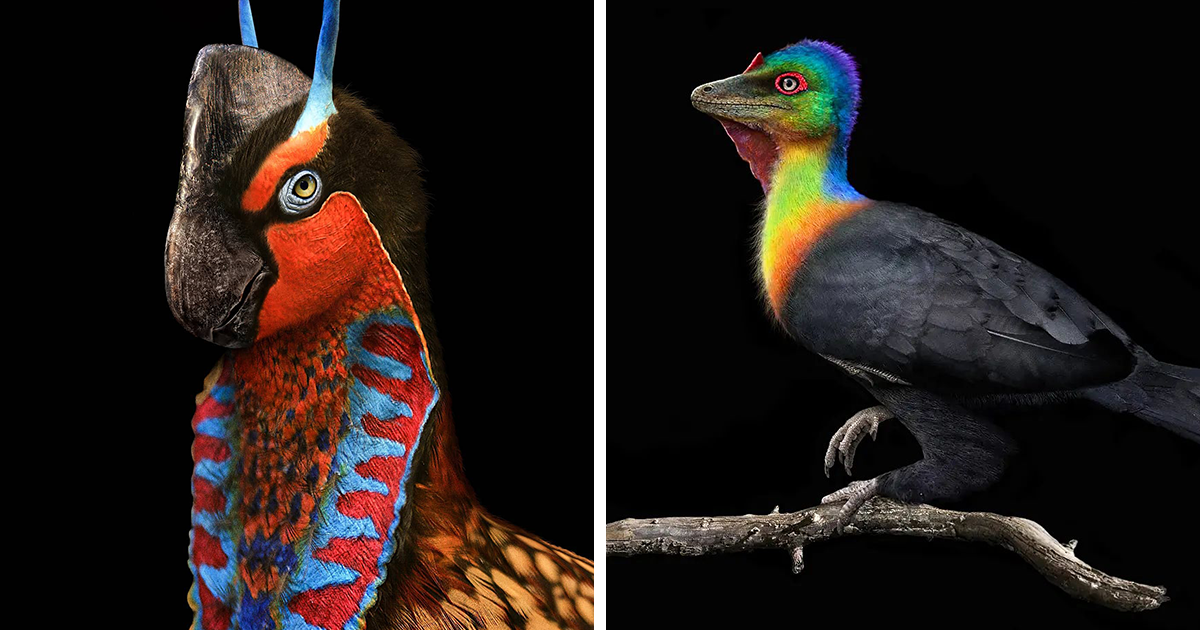
Long before humans started arguing about pineapple on pizza, the planet was already running the wildest animal design contest imaginable. There were feathered predators with sickle claws, horned carnivores with tiny arms, gliding reptiles with dramatic head crests, and mammals that looked like nature had opened a fantasy sketchbook and said, “Sure, let’s try this.”
That is exactly why paleoart is so irresistible. It gives us a way to look at long-extinct animals not as dusty skeletons behind museum glass, but as living creatures that once breathed, hunted, nested, strutted, rested, and probably had very strong opinions about being chased. In the viral series “This Artist Shows What Long-Extinct Animals Might’ve Looked Like In His 21 Illustrations,” the illustrator known online as Paleorex brings prehistoric animals back into the imagination through vivid digital reconstructions.
These are not simple monster drawings. The best paleoart lives in the tricky space between science and imagination. Fossils provide the bones, paleontology provides the rules, and the artist provides the spark that turns ancient evidence into a creature that feels alive. The result is a gallery of extinct animals that looks less like a textbook and more like wildlife photography from a time machine with excellent Wi-Fi.
What Makes These Long-Extinct Animal Illustrations So Fascinating?
The appeal of Paleorex’s work is simple: the animals feel present. They are not just posed like action figures in a prehistoric toy aisle. They have posture, weight, texture, color, and personality. A Velociraptor does not need to roar at the moon to be interesting. Sometimes it is more powerful to show it as a feathered, alert predator standing low to the ground, ready to move like a dangerous bird with very bad intentions.
For many readers, these illustrations also correct outdated pop-culture images. Dinosaurs were not all gray, scaly lizards stomping around like angry garden statues. Many theropods were closely related to birds, and fossil evidence has changed how scientists and artists imagine their bodies. Feathers, display structures, crests, body fat, soft tissue, and behavior all matter. In modern paleoart, a dinosaur can be colorful, elegant, awkward, fluffy, terrifying, and oddly cute all at once. In other words, prehistoric life had range.
Paleoart: Where Fossils Meet Imagination
Paleoart is the artistic reconstruction of prehistoric life based on scientific evidence. That sounds tidy, but the actual process is full of careful decisions. An artist may begin with a skeleton, then study muscle attachments, related modern animals, fossil skin impressions, feather evidence, footprints, bite marks, nesting sites, and environmental clues. When evidence is missing, the artist must make educated choices rather than wild guesses.
Think of it like reconstructing a celebrity’s entire outfit from one shoe, a blurry photo, and a receipt from a hat store. The artist has clues, but the final image requires judgment. Good paleoart is not “anything goes.” It is speculation with a seatbelt.
This is why the 21 illustrations work so well as a doorway into paleontology. They make viewers curious. Why does that dinosaur have feathers? Why is that pterosaur’s head shaped like a flying bottle opener? Why does that horned mammal look like it lost a dare with a unicorn? Every image invites a question, and every question leads back to science.
Standout Creatures From the 21 Illustrations
Oviraptor: The Misunderstood Egg Neighbor
Oviraptor has one of the most unfair names in dinosaur history. Its name means “egg thief,” but later discoveries showed that oviraptorids were likely brooding eggs rather than simply raiding nests. That changes the whole mood. Instead of imagining a sneaky breakfast criminal, modern reconstructions often show an animal with birdlike behaviors, possibly using feathered limbs to shelter eggs.
In paleoart, Oviraptor becomes a reminder that science is allowed to update itself. A fossil once interpreted as theft can become evidence of parenting. Somewhere, Oviraptor’s public relations team is finally breathing a sigh of relief.
Caihong: The Rainbow Dinosaur
Caihong is one of those dinosaurs that sounds like it was designed by someone who had just discovered glitter. Its name means “rainbow” in Mandarin, and fossil evidence suggests it had iridescent feathers. This small Jurassic dinosaur may have shimmered in ways similar to hummingbirds, especially around the head and neck.
That detail changes everything. Instead of a dull little predator, Caihong becomes a dazzling animal with display features that may have helped with communication or courtship. It proves that ancient ecosystems were not just brutal; they were beautiful. Prehistory was not filmed in black and white. It had sparkle.
Synthetoceras: The Prehistoric Headgear Champion
Synthetoceras was not a dinosaur, but it absolutely belongs in the “nature was feeling theatrical” category. This extinct North American mammal had unusual head ornamentation, including a Y-shaped horn-like structure on its snout. It was related to protoceratids, a group of extinct hoofed mammals, and its ornamentation was likely used for display, competition, or species recognition.
The fun of illustrating Synthetoceras is that it shows prehistoric weirdness was not limited to dinosaurs. Mammals were also out there experimenting with dramatic accessories. If this animal walked into a modern deer convention, everyone would stop talking.
Dsungaripterus: The Shellfish Specialist With Style
Dsungaripterus was a pterosaur from the Early Cretaceous, known for its striking skull crest and unusual jaws. Its upward-curving beak and strong crushing surfaces suggest it may have fed on shellfish. This is exactly the kind of animal that proves pterosaurs were more than “flying dinosaurs,” which they were not, by the way. They were their own spectacular branch of reptile evolution.
In art, Dsungaripterus looks like a creature built for both function and flair. It is aerodynamic, odd, and oddly believable. Nature gave it a seafood tool kit and a runway-ready profile.
Velociraptor: Smaller, Feathered, and Still Terrifying
Thanks to movies, many people imagine Velociraptor as a human-sized scaly villain with kitchen-knife claws and suspiciously good door skills. The real animal was smaller, feathered, and still plenty intimidating. Evidence of quill knobs on Velociraptor fossils supports the idea that it had feathers, making it closer in appearance to a fierce ground bird than a naked movie monster.
This does not make Velociraptor less scary. A feathered predator with sharp teeth and a sickle claw is not “cute.” It is basically a turkey designed by a committee of nightmares. Paleorex’s style helps bring that updated vision into focus: not a monster, but an animal.
Carnotaurus: The Meat-Eating Bull
Carnotaurus is instantly recognizable because of its short skull, eyebrow horns, and hilariously tiny arms. Found in Argentina and dating to the Late Cretaceous, it was a fast, strange-looking predator with a name meaning “meat-eating bull.” That name deserves applause. It is direct, dramatic, and exactly what you would not want to hear whispered in the bushes.
For paleoartists, Carnotaurus is a dream subject. Its horns give it character, its body proportions are unusual, and its skin impressions help inform reconstructions. It can be shown as a sleek hunter rather than a generic roaring beast. Also, its arms are so small they make Tyrannosaurus rex look like it had been doing push-ups.
Utahraptor: The Big Raptor That Deserves the Spotlight
Utahraptor was one of the largest known dromaeosaurids, the group that includes Velociraptor and Dromaeosaurus. It lived during the Early Cretaceous in what is now North America and was much heavier than its famous movie cousins. If people want a large raptor-like dinosaur, Utahraptor is the animal they are probably imagining, even if they keep calling it Velociraptor at parties.
Reconstructing Utahraptor often involves informed comparison with other feathered dromaeosaurs. Even when direct feather fossils are not available for every species, relationships between animals can guide artists. This is where paleoart becomes detective work: part anatomy, part evolutionary logic, part visual storytelling.
Why Modern Paleoart Looks So Different From Old Dinosaur Art
Older dinosaur art often reflected the science of its time. Many dinosaurs were shown as sluggish, tail-dragging reptiles. Later research changed that picture. Trackways, bone structure, biomechanics, feather fossils, and comparisons with birds and crocodilians have pushed reconstructions toward more active, dynamic, and biologically complex animals.
Today’s paleoartists are also less afraid to show ordinary behavior. Not every prehistoric animal needs to be biting something. A dinosaur could scratch, preen, nap, display, guard a nest, splash through mud, or simply look confused in the rain. That makes the animals feel more real. Modern wildlife photography is full of awkward moments, so prehistoric life probably had them too. Somewhere in the Cretaceous, a young dinosaur definitely tripped over a branch and pretended it meant to do that.
The Secret Ingredient: Making Extinct Animals Feel Alive
The strongest part of Paleorex’s long-extinct animal illustrations is not just accuracy. It is atmosphere. The creatures have a sense of motion and mood. Textures suggest skin, feathers, scales, keratin, muscle, and weight. Lighting helps them feel like they belong in real environments rather than floating in a science fair poster.
This matters because the public often meets extinct animals through images before it meets them through research papers. A good reconstruction can make someone care. It can turn “an extinct theropod from the Late Cretaceous” into “wait, that thing was real?” That moment of wonder is powerful. It is often the first step toward learning more about evolution, extinction, ecosystems, and Earth’s deep history.
What These Illustrations Teach Us About Extinction
There is a quiet sadness behind every beautiful reconstruction. These animals are gone. Some vanished millions of years before humans appeared. Others disappeared more recently in geological terms. Paleoart cannot bring them back, but it can remind us that extinction is not abstract. It is the permanent loss of real bodies, behaviors, colors, sounds, and ecological roles.
At the same time, these illustrations are not depressing. They are celebratory. They show that life has been endlessly inventive. Earth has produced animals stranger than dragons and more surprising than fiction. Studying them helps us understand how ecosystems change, how species adapt, and how fragile survival can be.
Why Readers Love Galleries of Prehistoric Animals
There is a reason people click on galleries like this. Humans are curious creatures. We want to know what came before us. We want to picture the world without cities, roads, phones, or comment sections. We want to imagine forests filled with feathered dinosaurs, skies crossed by pterosaurs, and plains wandered by horned mammals that look like they were assembled during a very creative lunch break.
The 21 illustrations offer quick visual wonder, but they also reward deeper attention. Each image can lead to a mini research rabbit hole. One minute you are admiring a colorful dinosaur; the next minute you are reading about melanosomes, Cretaceous ecosystems, and the evolutionary origin of feathers. That is the magic of good science communication: it sneaks learning into your brain while your eyes are busy having fun.
Experience Section: Looking at Extinct Animals Through an Artist’s Eyes
Spending time with paleoart changes the way you look at both fossils and living animals. At first, a prehistoric reconstruction feels like a window into a lost world. But after a while, it also becomes a mirror for the present. You start noticing how much information is carried in the body of a living animal. A bird’s posture, a lizard’s scales, a horse’s muscles, a crocodile’s eyes, and a deer’s antlers all become clues. Suddenly, the modern world looks like a reference library for the ancient one.
Imagine standing in a museum hall, looking at a mounted skeleton. The bones are impressive, of course, but they are also quiet. They do not tell you the color of the animal’s skin. They do not show whether it puffed up feathers in a courtship display, tucked its head while sleeping, or limped after a fight. Paleoart fills that silence carefully. It does not claim to know everything. Instead, it asks: based on what we know, what might this animal have looked like on an ordinary day?
That phrase, “ordinary day,” may be the key. The most memorable paleoart is not always the loudest. A roaring predator can be exciting, but a resting predator can be even more convincing. A nesting Oviraptor, a shimmering Caihong, or a watchful Velociraptor feels powerful because it suggests a full life beyond the dramatic moment. These animals were not waiting around to become fossils. They were busy being alive.
For artists, extinct animals are both thrilling and intimidating subjects. There is freedom, but not unlimited freedom. You can choose lighting, pose, color, and mood, but the skeleton still has a vote. Anatomy keeps the imagination honest. That tension is what makes paleoart so satisfying. It is creativity with consequences. A horn must attach somewhere. A muscle must make sense. A feathered arm must obey the body plan. The final image becomes a negotiation between evidence and possibility.
For viewers, the experience is more emotional than expected. Looking at long-extinct animals can make deep time feel personal. Millions of years stop being just numbers. They become landscapes, weather, movement, hunger, fear, display, parenting, survival, and extinction. The creatures in these illustrations may be gone, but the curiosity they inspire is very much alive.
Conclusion
“This Artist Shows What Long-Extinct Animals Might’ve Looked Like In His 21 Illustrations” is more than a catchy gallery title. It points to one of the most exciting corners of science-based art: the attempt to restore lost life with respect, imagination, and evidence. Paleorex’s vivid prehistoric animal illustrations remind us that extinct creatures were not monsters waiting for movie roles. They were animals with bodies shaped by evolution and lives shaped by their environments.
From the iridescent feathers of Caihong to the horned oddity of Carnotaurus, from the misunderstood Oviraptor to the feathered reality of Velociraptor, these reconstructions invite us to update our mental picture of the past. They also remind us that science is never frozen. New fossils, better methods, and fresh artistic interpretations continue to change what we think ancient life looked like.
And honestly, that is the best part. The prehistoric world is not a finished book. It is a mystery still being illustrated, one fossil, one study, and one jaw-dropping piece of paleoart at a time.