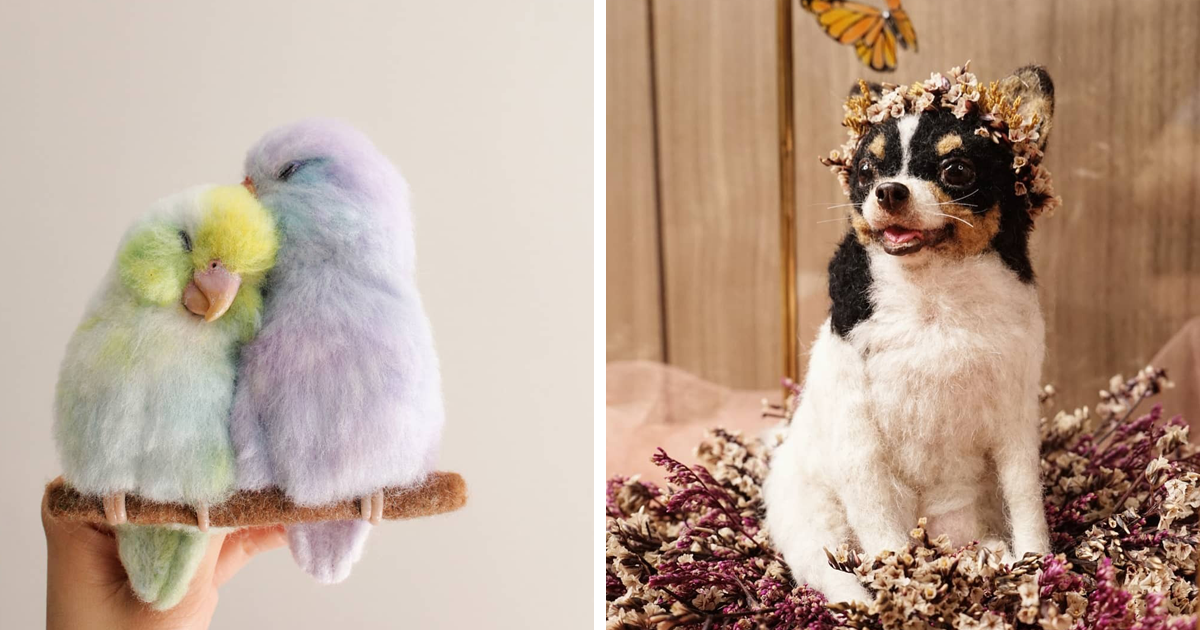
At first glance, Melissa’s tiny animal sculptures look like someone discovered a shrink ray, aimed it at the cutest pets on Earth, and placed the results gently in the palm of a hand. But look again. Those silky ears, bright eyes, soft cheeks, feathered wings, button noses, and fluffy tails are not fur, feathers, or taxidermy. They are wool. Yes, woolthe same humble material that keeps sweaters warm and sheep slightly smug.
Melissa, known online as mootomotto, is an Indonesian artist whose hyper-realistic wool animal sculptures have captured the attention of craft lovers, pet owners, and anyone with a functioning “aww” reflex. Using the needle felting technique, she transforms loose wool fibers into miniature animals that feel alive in expression, posture, and personality. Her best 70 works include dogs, cats, bunnies, parrots, birds, lambs, and other tiny creatures that seem ready to blink, chirp, wag, hop, or demand snacks.
This article explores why her wool-felted animals are so mesmerizing, how needle felting works, what makes these sculptures feel hyper-realistic, and why handmade fiber art has found such a loyal audience online.
Who Is Melissa, the Artist Behind Mootomotto?
Melissa is an Indonesian needle-felting artist who has loved art since childhood. Her journey into wool sculpture began during her college years, when she came across wool art on Instagram and became curious about the technique behind it. That curiosity turned into experiments, and those experiments turned into a recognizable artistic style. After importing high-quality wool from Japan and completing her first projects, she opened an Instagram account. According to published interviews, she received her first customer on the second day. That is faster than most of us can choose a profile picture.
Her work stands out because it is not only cute; it is precise. Many artists make adorable felt animals, but Melissa’s pieces lean into realistic anatomy and emotional detail. A dog is not merely “dog-shaped.” It has the alert eyes, muzzle structure, fur direction, and tiny posture cues that make viewers think, “I know this exact dog. He has stolen toast.”
What Is Needle Felting?
Needle felting is a dry felting method that uses special barbed needles to bind wool fibers together. Instead of sewing pieces of fabric, the artist repeatedly pokes loose wool with a sharp needle. The barbs catch and tangle the fibers, gradually compacting them into a solid form. With enough patience, wool becomes a nose, a paw, an ear, a wing, or a fluffy little cheek.
The process sounds simple until you try it. Then you learn three things very quickly: wool has a mind of its own, felting needles are sharp enough to humble you, and realism requires patience. A realistic miniature animal may take days because the artist must build the core shape, refine the proportions, layer colors, add surface texture, and create the final expression.
Melissa has said that each item can take around 7 to 10 days to complete. That timeline makes sense when you study the details. A tiny parrot needs layered feather colors. A rabbit needs rounded cheeks and soft ears. A corgi needs the correct “I am short but emotionally in charge” energy. This is not fast craft; it is slow sculpture.
Why Her Wool Animal Sculptures Look So Real
1. The Eyes Carry the Personality
The first thing most viewers notice is the face. Melissa’s animals often have glossy, expressive eyes that give the sculpture emotional weight. The difference between a cute object and a believable animal is often the gaze. A slight tilt of the head or careful eye placement can make a felted puppy look curious, sleepy, loyal, mischievous, or deeply concerned that dinner is late.
2. The Fur Direction Feels Natural
Hyper-realistic wool animal sculptures depend heavily on fiber direction. Real animals do not have fur that sits randomly like a bad Monday hairstyle. Their coats follow patterns around the muzzle, ears, neck, chest, and paws. Melissa layers wool in ways that mimic these natural directions, making her miniatures feel more lifelike.
3. The Scale Adds Charm
Many of her pieces are small enough to hold in one hand. This miniature scale makes every detail feel more impressive. A full-size sculpture can rely on size for drama, but a tiny wool animal has to win people over with precision. When a sculpture no bigger than a teacup looks like it has a soul, viewers pay attention.
4. The Subjects Are Emotionally Familiar
Dogs, cats, rabbits, parrots, and birds are not random choices. These animals already live in our emotional memory. We know how a dog looks when it wants a walk. We know how a cat looks when it judges our life choices. We know the soft roundness of a bunny and the bright alertness of a small bird. Melissa uses that familiarity to make wool feel personal.
Her Best 70 Works: What Makes the Collection Special?
The phrase “best 70 works” suggests a gallery full of variety, and Melissa’s portfolio delivers exactly that. Her sculptures are not copies of one template with different colors. They show a range of species, moods, poses, and textures. Some pieces highlight companionship, such as tiny dogs with loyal expressions. Others focus on sweetness, like rabbits with soft cheeks and alert ears. Her bird sculptures show delicate color transitions and charming gestures, including pairs that seem to groom or comfort each other.
Among the most memorable themes in her work are pet portraits, romantic bird pairs, fluffy puppies, calm cats, bunnies, lamb-like miniatures, and colorful parrots. These pieces succeed because they combine realism with tenderness. They do not feel stiff or overly polished. They feel like small animals caught in a quiet moment.
One reason viewers respond so strongly is that the sculptures resemble keepsakes. A felted dog can feel like a tribute to a beloved pet. A small bird brooch can feel like wearable joy. A bunny can look like the kind of creature that belongs in a storybook but somehow wandered onto a desk. This emotional connection is exactly why needle-felted animal art has become popular among collectors and craft fans.
Why Wool Is the Perfect Material for Animal Sculptures
Wool has a natural advantage when it comes to animals: it already looks soft, warm, and organic. Unlike plastic or resin, wool does not need to pretend to be tactile. It invites touch. Even when a sculpture is tiny, the material gives it a sense of warmth that suits living creatures.
Different wool types can create different effects. Fine fibers can suggest smooth fur, while coarser or longer fibers can create fluff, curls, or volume. Artists can blend colors like painters mixing pigments. A realistic brown dog might require tan, cream, chocolate, gray, and black fibers layered gradually. A parrot may need bright greens, yellows, blues, and subtle shading. A cat’s face may require tiny transitions around the eyes and nose.
This painterly quality is one reason many fiber artists describe needle felting as sculpting and painting at the same time. The artist builds a three-dimensional form, then paints it with wool.
The Internet’s Love Affair With Tiny Animals
Melissa’s work fits perfectly into the internet’s favorite category: small things that appear to have big feelings. Social media audiences love miniature art because it offers instant visual impact. A tiny wool dog in a human hand communicates scale immediately. A parrot brooch with realistic feathers surprises the eye. A bunny with a gentle expression creates the kind of pause people crave during endless scrolling.
But her popularity is not only about cuteness. It is also about craftsmanship. In an age of mass-produced décor and instant digital images, handmade work feels refreshingly human. Every tiny wool animal carries evidence of time. Someone shaped it, poked it, layered it, adjusted it, and probably whispered, “Please become a rabbit” at least once.
How Needle-Felted Animals Are Made
Step 1: Building the Core
The artist usually begins with a basic core shape made from wool. This creates the internal structure of the animal. For a dog, that might mean forming the body, head, legs, and muzzle. For a bird, it may begin with an oval body and a carefully shaped head.
Step 2: Refining the Anatomy
Once the core is firm, the artist refines the proportions. This is where realism begins. A rabbit’s face must be round but not shapeless. A dog’s muzzle must fit the breed. A cat’s ears must sit at the right angle. These small decisions determine whether the final sculpture looks believable.
Step 3: Adding Color and Texture
Dyed wool is added in layers. The artist uses the needle to attach wisps of fiber, creating markings, shadows, highlights, and fur patterns. This step can be incredibly slow because realistic color is rarely flat. Even a white animal may need cream, gray, beige, or pale brown tones to look natural.
Step 4: Finishing the Expression
The final stage includes details like eyes, noses, tiny paws, wing markings, ear shapes, and fur direction. This is where the sculpture gains personality. A millimeter can change everything. Move the eyes slightly, and a puppy goes from cheerful to suspicious. Adjust the mouth, and a bunny becomes either angelic or plotting.
Why These Sculptures Feel Like Pet Portraits
Many people see Melissa’s wool animals and immediately think of their own pets. That is part of the magic. Hyper-realistic needle-felted animals can become emotional portraits, especially for pet owners who want a soft, handmade reminder of a companion. Unlike a flat photograph, a wool sculpture has presence. It occupies space. It can sit on a shelf, rest under a glass dome, or become a tiny memorial full of warmth.
This emotional value has helped needle-felted pet portraits become popular with collectors. A handcrafted miniature can capture not just markings but attitude: the tilt of a terrier’s head, the fluff of a Persian cat, the round alertness of a rabbit, or the bright curiosity of a parrot. Melissa’s best works show that realism is not only about exact measurement. It is about recognition.
Specific Examples From the Collection
Several types of works stand out in Melissa’s broader gallery. Her bird pieces are especially striking because feathers are difficult to translate into wool. The best bird sculptures use layered color and tiny posture details to suggest movement and affection. Her paired birds, including pieces that show preening behavior, feel sweet without becoming cartoonish.
Her dog sculptures also show strong character. Puppies and small breeds work beautifully in needle felt because wool naturally creates softness around the face and body. A tiny dog with folded ears, rounded paws, and bright eyes can look almost ready to bark. Her rabbit pieces lean into gentle charm, with soft faces and upright ears that make them feel storybook-ready. The cat sculptures, meanwhile, carry the calm confidence every cat seems to receive at birth.
Why Handmade Wool Art Matters
In a world filled with fast images and disposable products, handmade wool sculpture offers something slower and more intimate. It reminds us that art does not always need marble, bronze, or giant gallery walls. Sometimes it needs wool, a needle, good lighting, and a heroic amount of patience.
Fiber art has often been underestimated because it is associated with domestic craft. Yet artists working in wool continue to prove that textile techniques can be expressive, technically demanding, and deeply moving. Melissa’s work belongs to that larger movement. Her sculptures are charming, but they are also serious demonstrations of observation, material control, and visual storytelling.
Experiences and Reflections: Living With Hyper-Realistic Wool Animal Sculptures
There is a special experience that happens when you encounter hyper-realistic wool animal sculptures in person or even through a screen. At first, your brain says, “Cute toy.” Then your eyes catch the details: the careful fur line around the muzzle, the tiny shine in the eyes, the soft transition of color near the ears. Suddenly the piece stops being just cute and becomes astonishing. It is the difference between seeing a stuffed animal and seeing a small creature with a personality.
For collectors, these sculptures can become conversation starters. Imagine a guest noticing a tiny felted corgi on your shelf. The first reaction is delight. The second is disbelief. The third is usually a closer inspection followed by, “Wait, this is made of wool?” That surprise is part of the joy. Needle-felted animals invite people to slow down and look carefully, which is rare in daily life.
Pet owners may feel an even deeper connection. A custom wool animal can hold the memory of a real companion in a gentle way. It does not replace a pet, of course, but it can preserve a look, a pose, or a feeling. A felted portrait of a dog who always sat with one ear up can become a small tribute. A cat sculpture with the right eye shape can bring back years of couch naps, window watching, and dramatic food-bowl complaints. A tiny bird can remind someone of cheerful morning sounds and bright feathers in sunlight.
There is also something therapeutic about watching or practicing needle felting. The repeated motion is slow, focused, and tactile. It asks for attention without rushing. Beginners quickly discover that wool rewards patience and punishes arrogance. Try to rush a face, and your animal may look like it has heard shocking family news. Work slowly, and the form begins to soften into something recognizable. That process teaches observation. You start noticing how ears attach, how paws curve, how birds hold their bodies, and how much expression can live in a tiny tilt of the head.
Melissa’s work also inspires people to appreciate animals differently. Her best 70 works are not just a parade of cuteness; they are studies of creaturely character. Dogs appear loyal, birds appear affectionate, rabbits appear gentle, and cats appear comfortably superior. The sculptures remind us that animals communicate constantly through posture, eyes, and tiny gestures. Capturing those gestures in wool requires more than technical skill. It requires affection.
For aspiring artists, her portfolio is a lesson in consistency. The realistic effect does not come from one trick. It comes from many small decisions: choosing the right wool, building a solid base, layering colors, trimming and shaping fibers, studying references, and knowing when to stop. That last part may be the hardest. Overworking wool can flatten life out of a piece. Great needle-felted animals keep a sense of softness and breath.
In the end, hyper-realistic wool animal sculptures appeal to both the heart and the eye. They are adorable, yes, but they are also proof that humble materials can become extraordinary in skilled hands. Melissa’s animals show how wool can hold memory, humor, companionship, and personality. They may be small, but they leave a surprisingly large impression.
Conclusion
Melissa, also known as mootomotto, has turned needle felting into a miniature animal kingdom filled with softness, realism, and charm. Her hyper-realistic wool animal sculptures prove that great art can begin with a handful of fiber and a curious mind. From dogs and cats to rabbits and parrots, her best 70 works show a rare balance of technical skill and emotional warmth.
What makes these pieces unforgettable is not only how real they look, but how alive they feel. Each sculpture seems to carry a tiny personality: a loyal puppy, a calm bunny, a proud cat, or a pair of affectionate birds. In a fast-moving digital world, Melissa’s handmade wool animals remind us to pause, look closely, and appreciate the beauty of patient craft. Also, they remind us that wool is clearly more talented than we have been giving it credit for.