Editorial note: This article is written as an original, web-ready feature based on real Simpsons episodes, documented cultural references, and long-running fan discussion. No source links are embedded in the article body for clean publishing.
There are two ways to watch The Simpsons. The first is as a kid, laughing because Homer falls down, Bart says something rude, and Mr. Burns looks like a haunted umbrella in a suit. The second is as an adult, when the same episode suddenly reveals a hidden trapdoor full of political satire, literature references, old Hollywood gossip, math jokes, science nods, and historical burns sharper than Sideshow Bob’s rake collection.
That is the secret sauce of Springfield. The Simpsons has always worked on multiple levels: silly enough for a cartoon marathon, smart enough for a college seminar, and weird enough to make you wonder whether the writers’ room was powered by coffee, encyclopedias, and mild revenge against society. Many jokes that seemed like nonsense years ago were actually carefully engineered references. They sailed over our heads not because they were weak, but because they were wearing tiny academic jetpacks.
Below are 13 classic Simpsons jokes that many viewers missed the first time around, along with why they were funnier, nerdier, and sometimes darker than they looked.
Why So Many Simpsons Jokes Were Easy to Miss
The Simpsons became famous because it could parody American family life while smuggling in references to Shakespeare, Cold War politics, science fiction, philosophy, physics, and forgotten television disasters. A child could enjoy Bart’s chaos. An adult could spot the cultural footnotes hiding behind it. That combination made the show one of the best examples of layered TV comedy: the punchline works even if you miss the reference, but it becomes funnier once you catch it.
The best hidden Simpsons jokes do not stop the story to explain themselves. They flash by on signs, background props, odd one-liners, or casual throwaway comments. Blink, and you miss them. Rewatch, and suddenly Springfield looks less like a town and more like a comedy library with a nuclear plant.
13 Jokes From The Simpsons That Went Right Over Our Heads
1. “Brevity Is… Wit”
In “Mr. Lisa Goes to Washington,” a sign sponsored by a parody of Reader’s Digest says, “Brevity is… wit.” On the surface, it is a quick gag about short writing. Underneath, it is a tiny Shakespeare joke with a scalpel.
The full phrase from Hamlet is “brevity is the soul of wit.” By shortening it, the sign literally removes “the soul.” That makes the joke a jab at condensed publishing, where long essays are trimmed until all the flavor has been replaced by efficient beige paste. It is one of those jokes that rewards anyone who remembers high school English class, even if most of us were busy drawing sunglasses on Hamlet in the margins.
2. The Ayn Rand School for Tots
In “A Streetcar Named Marge,” Maggie is dropped off at the Ayn Rand School for Tots, a daycare that treats pacifiers like contraband and compassion like a software bug. The joke is not just “strict daycare funny.” It is a full parody of Ayn Rand’s Objectivist philosophy.
The signs and slogans in the daycare turn babyhood into a ruthless individualist boot camp. “A is A” nods to a philosophical principle often associated with Rand’s worldview, while the daycare’s anti-helping attitude turns toddler care into a miniature free-market thunder dome. The joke is brilliant because Maggie, a baby whose entire operating system is “please assist me,” gets trapped in a place where helping is practically a moral crime. It is philosophy with diapers.
3. Fake Lisa in the Variety Show Parody
“The Simpsons Spin-Off Showcase” gives viewers a fake variety show called The Simpson Family Smile-Time Variety Hour. In it, Lisa is suddenly replaced by a cheerful blonde performer who is very much not Lisa. As a kid, this might have looked like random absurdity. As an adult, it is a sharp parody of old TV variety specials and awkward cast replacements.
The gag recalls shows like The Brady Bunch Hour, where a familiar character could be recast and everyone was expected to smile through the weirdness like nothing had happened. The joke lands because The Simpsons is making fun of television’s habit of treating audiences like they will accept anything if the theme song is peppy enough. “Here is a new Lisa,” the show seems to say. “Please clap before the illusion collapses.”
4. Homer and the Higgs Boson
In “The Wizard of Evergreen Terrace,” Homer tries to become an inventor and writes complicated equations on a chalkboard. For many viewers, the gag was simply that Homer looked ridiculous pretending to be a genius. But one equation became famous because it appeared to approximate ideas connected to the Higgs boson years before the particle was experimentally confirmed.
The joke works on several levels. First, it is funny because Homer, a man who routinely loses arguments to vending machines, is surrounded by serious-looking math. Second, the writers included real scientific texture instead of meaningless squiggles. Third, it reveals how many mathematically gifted people worked behind the scenes on the show. Springfield’s dumbest dad accidentally standing near advanced physics is exactly the kind of beautiful nonsense that made the series legendary.
5. Martin Prince’s Science Fiction Snobbery
In “Lisa’s Substitute,” Martin Prince runs for class president and promises a science-fiction library featuring “Asimov, Bester, Clarke.” When Ray Bradbury is mentioned, Martin stiffly replies that he is aware of his work.
To many viewers, the joke was just Martin being Martin: formal, fussy, and one cardigan away from becoming a retired librarian at age ten. But the deeper gag is about genre snobbery. Isaac Asimov, Alfred Bester, and Arthur C. Clarke are often associated with classic science fiction, while Bradbury is sometimes placed in a more literary, poetic, or fantasy-adjacent category. Martin’s chilly response turns a school election into a tiny nerd civil war. It is the kind of joke that says, “Yes, even fourth graders can gatekeep.”
6. Grandpa Simpson’s “Rods to the Hogshead”
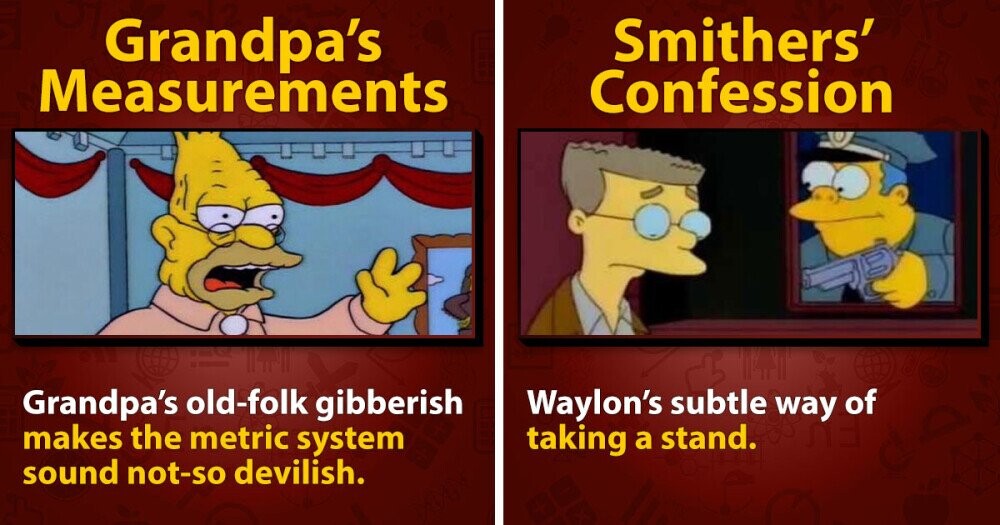
In “A Star Is Burns,” Abe Simpson yells that his car gets “forty rods to the hogshead,” and that is the way he likes it. The line sounds like pure old-man gibberish, which, to be fair, is Grandpa’s primary export. But rods and hogsheads are real old-fashioned units of measurement.
A rod is a unit of length, and a hogshead is a unit of liquid volume. So Grandpa is technically describing fuel economy, just in a way that makes miles per gallon look like futuristic witchcraft. The joke is that his complaint about the metric system is expressed through a measurement system so ancient and inconvenient that even a colonial barrel maker might say, “Abe, please update your spreadsheet.”
7. Smithers and the St. Patrick’s Day Parade
In “Who Shot Mr. Burns? Part Two,” Smithers goes to confession and mentions that he once tried to march in the St. Patrick’s Day parade. It is a quick line, easy to miss if you are focused on the mystery plot. But the joke points toward real-world controversies over whether openly gay groups were allowed to march in certain St. Patrick’s Day parades.
For years, Smithers’ sexuality was handled through coded jokes, longing glances, and carefully placed subtext. This line fits that pattern. It is not simply a random confession; it is another clue tucked into his character’s long-running story. The humor is subtle, political, and bittersweet, which is a lot for one sentence in a cartoon where a baby once shot a billionaire.
8. “Ich Bin Ein Springfielder”
In “Burns Verkaufen der Kraftwerk,” Springfield’s mayor welcomes German investors by saying, “Ich bin ein Springfielder.” Homer immediately thinks of jelly doughnuts. The joke riffs on the famous line “Ich bin ein Berliner,” delivered by President John F. Kennedy in Berlin.
The extra layer is that English-speaking pop culture long circulated the myth that Kennedy accidentally called himself a jelly doughnut because “Berliner” can refer to a pastry in some regions. The myth is historically shaky, but it became famous enough to parody. The Simpsons turns that misconception into a Homer joke: of course the food interpretation is the only part he hears. Foreign policy? No thanks. Pastry? Now we have his full attention.
9. Maggie’s E = mc² Blocks
In “Bart the Genius,” Maggie stacks alphabet blocks in a way that resembles Einstein’s famous equation, E = mc². The joke flashes by so quickly that many viewers never notice it. Those who do may realize Maggie is quietly doing physics while the rest of the family is busy misreading Bart’s intelligence.
It is a perfect Simpsons background gag because it never demands attention. Maggie cannot speak, but she keeps showing hints of intelligence, awareness, and mischief. The blocks suggest that the youngest Simpson may be sharper than almost everyone in the room. Considering the room often contains Homer, the bar is sometimes resting comfortably on the floor, but still.
10. The RDRR Calculus Joke
Also in “Bart the Genius,” Bart attends a school for gifted children after cheating on an IQ test. In class, the teacher presents a calculus problem involving the derivative of y = r³/3. The answer is worked into a sound that resembles old-fashioned fake laughter: “har-de-har-har.”
This is the kind of joke that practically requires a math tutor and a black-and-white sitcom memory. Kids in the class laugh because they understand the calculus and the phonetic pun. Bart, naturally, does not. Many viewers did not either, which means we were all Bart in that moment. The joke is not just that Bart is out of his depth; it is that the show briefly built a punchline out of derivatives and expected someone, somewhere, to enjoy it. And someone did. Probably Martin.
11. Mr. Burns Saying “Ahoy-hoy”
Mr. Burns often answers the phone with “Ahoy-hoy.” It sounds like another sign that he is older than most furniture. But it is also a real historical reference. Alexander Graham Bell reportedly preferred “ahoy” as a telephone greeting before “hello” became standard.
That makes Burns’ greeting more than a quirky catchphrase. It tells us exactly how ancient his worldview is. He is not merely old-fashioned; he is pre-hello old-fashioned. In two syllables, the show gives us character history, technology history, and a joke about a man who probably thinks voicemail is a Bolshevik plot.
12. George H.W. Bush and the “Japanese Banquet”
In “Two Bad Neighbors,” former President George H.W. Bush gets into a ridiculous feud with Homer. During their fight, Bush threatens to ruin Homer like a “Japanese banquet.” The line is easy to miss if you do not remember the news from 1992.
It refers to the real incident in which Bush became ill and vomited during a state dinner in Japan. The moment became an unforgettable late-night comedy target. In the episode, The Simpsons turns it into a compact insult that doubles as political memory. It is a time capsule gag: hilarious to anyone who remembered the headlines, baffling to anyone who only knew Bush as “the serious guy now wrestling Homer in the sewer.”
13. Bart Calls Buenos Aires
In “Bart vs. Australia,” Bart makes random international prank calls and briefly reaches an elderly Adolf Hitler in Buenos Aires. For younger viewers, it may have seemed like random shock humor. The deeper joke references conspiracy theories claiming Hitler survived World War II and fled to Argentina.
The show is not endorsing the theory; it is mocking the way bizarre historical rumors become part of pop culture. The punchline is so quick that it almost feels like a secret handshake for viewers who know the conspiracy. It is dark, strange, and very Simpsons: a global history joke delivered during a prank-call subplot involving international outrage and one very expensive collect call.
What These Hidden Jokes Reveal About The Simpsons
The reason these jokes still matter is not simply that they are clever. It is that they show how densely written The Simpsons could be. The show trusted viewers to miss things. That sounds strange, but it is part of the magic. A joke did not have to be understood by everyone to deserve a place in the episode. Some punchlines were for kids. Some were for parents. Some were for physicists. Some were apparently for one retired English professor eating cereal at 2 a.m.
This layered approach helped make the series endlessly rewatchable. You could return to the same episode years later and find an entirely different comedy engine running beneath the first one. What once felt like nonsense became satire. What once seemed like a throwaway line became a historical reference. What once looked like Homer being dumb became Homer accidentally standing next to particle physics.
Viewing Experience: Why These Jokes Hit Harder When We Grow Up
Rewatching The Simpsons as an adult is a little like finding a secret basement in a house you grew up in. You remember the couch, the kitchen, the familiar voices, and the comfort-food rhythm of the episodes. Then suddenly a joke opens up and you realize the writers were talking to a completely different version of you the whole time. The kid version laughed at Homer falling through a roof. The adult version laughs because the roof was also a metaphor for American institutions collapsing under their own stupidity. Fun for the whole family!
The best experience comes from realizing that missing the joke the first time was not a failure. It was part of the design. The Simpsons often planted jokes for future-you. You may not know who Ayn Rand is when Maggie loses her pacifier, but years later the daycare suddenly becomes a savage little philosophy sketch. You may not care about presidential history when Bush fights Homer, but later the “Japanese banquet” line lands like a newspaper clipping wrapped in a boxing glove. The show rewards aging, which is thoughtful, since aging is otherwise a subscription service nobody remembers signing up for.
These jokes also change how we appreciate comedy writing. A simple line can carry history, character, and absurdity all at once. Mr. Burns saying “Ahoy-hoy” tells us he is ancient, formal, stubborn, and hilariously disconnected from modern life. Grandpa’s rods-to-hogshead line tells us he hates change, but it also proves the writers knew exactly how to make nonsense sound technically accurate. That is not random silliness. That is precision silliness, the finest kind.
There is also a special joy in discovering these references with other fans. Someone explains the “Brevity is… wit” sign, and suddenly a three-word background gag becomes a miniature masterpiece. Someone points out Maggie’s blocks, and the whole family intelligence ranking gets suspicious. Someone explains the calculus joke, and everyone politely nods while secretly deciding math remains a public menace. The community around The Simpsons keeps these jokes alive because each explanation adds another layer of fun.
Most importantly, the hidden jokes remind us why the show became more than a cartoon. Springfield is exaggerated, but it is built from real culture: politics, literature, science, television, advertising, religion, school, work, and all the weird little myths people repeat at parties. The jokes sailed over our heads because they were flying through a much bigger sky than we realized. Catching them later does not ruin the memory. It improves it. It is like the show left snacks for our adult brains, and thankfully, unlike Homer, we did not eat them all in one sitting.
Conclusion
The Simpsons has lasted because it is not just funny in one direction. It is slapstick, satire, parody, wordplay, visual comedy, and cultural archaeology wrapped in yellow skin and questionable parenting. These 13 jokes prove that Springfield was never as simple as it looked. Behind every chalkboard, daycare sign, political insult, and strange phone greeting, there might be a reference waiting patiently for viewers to grow into it.
That is why rewatching the show can feel so rewarding. The joke you missed at ten may become your favorite at thirty. The throwaway line may turn into the smartest gag in the episode. And the next time Mr. Burns answers “Ahoy-hoy,” you can smile knowingly, because you are no longer just watching The Simpsons. You are decoding it.