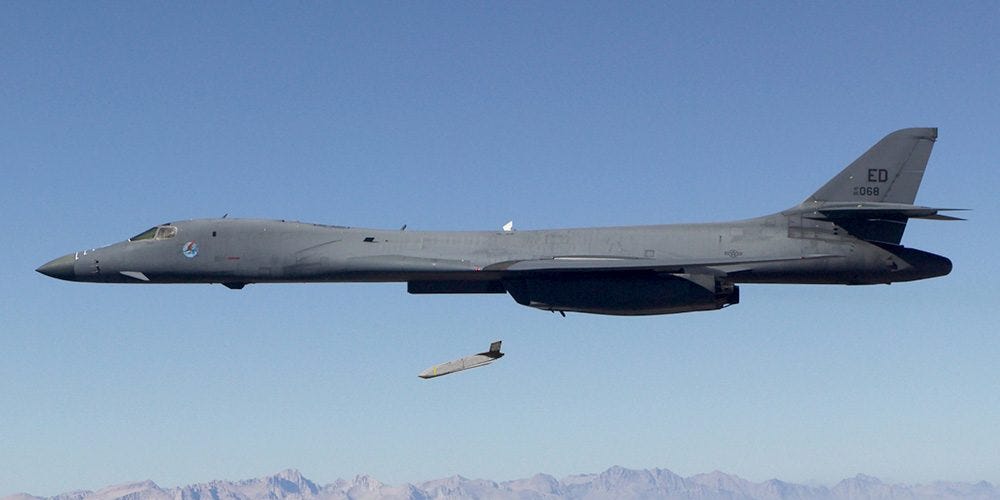
Sapo: The Joint Air-to-Surface Standoff Missile, better known as JASSM, stepped out of the test range and into history during the 2018 U.S.-led strike on Syrian chemical weapons facilities. The update matters: early reports pointed to the extended-range version, but officials later clarified that the missiles used were the original AGM-158A JASSM. Either way, the moment marked the first combat use of a weapon built for modern standoff warfare.
A New Chapter for an Older Kind of Problem
Military technology often arrives in public view with a strange kind of theater. For years, a weapon can live in budget documents, contractor brochures, test ranges, and Pentagon briefings. Then, suddenly, it appears in a real operation, and everyone asks the same question: “Wait, what exactly is this thing?” That was the case when the Pentagon’s Joint Air-to-Surface Standoff Missile, or JASSM, saw its first combat use during the April 2018 strikes against Syrian chemical weapons-related facilities.
The operation was carried out by the United States, the United Kingdom, and France after the chemical attack in Douma, Syria. The allied strike involved a large package of precision weapons aimed at three publicly identified sites tied by Western officials to Syria’s chemical weapons program. Among those weapons were 19 JASSMs launched by U.S. Air Force B-1B Lancer bombers toward the Barzah Research and Development Center near Damascus.
That detail made the mission more than another headline in the long, painful story of the Syrian civil war. It also marked the operational debut of a missile designed for a specific modern problem: how to hit a heavily defended target without forcing aircraft to fly directly over the danger zone. In plain English, JASSM was built so pilots do not have to knock on the front door when the front door is guarded by radar, missiles, and a very bad attitude.
What Is JASSM?
JASSM stands for Joint Air-to-Surface Standoff Missile. It is an air-launched cruise missile developed by Lockheed Martin for the U.S. military. The name is not exactly poetry, but defense acronyms rarely are. Somewhere in a Pentagon basement, a committee probably celebrated “JASSM” as a branding triumph and then went back to naming things with seven syllables.
The missile was designed to give bombers and fighter aircraft a precision-strike option from standoff distance. “Standoff” simply means the launching aircraft can remain away from the immediate target area rather than flying directly above it. That matters because modern air defenses can make the sky around high-value targets extremely dangerous. JASSM’s low-observable design, autonomous navigation, and precision-guided approach were meant to improve the chance of reaching a target while reducing risk to aircrews.
The missile family includes the original AGM-158A JASSM and later extended-range variants. Early public reporting after the Syria strike said the extended-range version had been used. The update corrected that: the missiles fired in the April 2018 operation were the original AGM-158A version, not JASSM-ER. Still, the larger historical point remained the same. This was the first time any JASSM variant had been used in combat.
Why the “Updated” Part Matters
In military reporting, small corrections can carry big meaning. Saying “JASSM-ER” instead of “JASSM” is not like confusing regular fries with curly fries. The variants belong to the same family, but they have different capabilities and procurement histories. The corrected record matters for accuracy, for analysts tracking weapons use, and for readers trying to understand what the Pentagon actually demonstrated in Syria.
The combat debut was not the extended-range missile’s big reveal. It was the original JASSM’s first real-world employment. That distinction keeps the story honest. It also reminds readers that modern defense news often develops in layers: first the initial briefing, then the correction, then the deeper analysis after the smoke clears and everyone has had enough coffee to read the footnotes.
The Syria Strike: What Happened in April 2018?
On April 14, 2018, U.S., British, and French forces launched strikes against Syrian targets associated with chemical weapons research, storage, or command infrastructure. The strike followed the April 7 chemical attack in Douma, which international investigators later linked to chlorine gas dropped from helicopters. Western leaders framed the military response as limited and focused: punish the use of chemical weapons, reduce related capabilities, and signal that such attacks would bring consequences.
The Pentagon said the coalition launched 105 weapons. The U.S. contribution included sea-launched and air-launched precision munitions. The JASSMs were fired by two B-1B Lancer bombers. According to later U.S. Air Force accounts, those 19 AGM-158A missiles were used against the Barzah site and represented the JASSM’s first combat employment.
Barzah became the center of the JASSM story because all 19 missiles were assigned to that location. The larger strike package also included weapons from ships, submarines, and allied aircraft. From a military-technology perspective, the operation showed how multiple platforms and different precision weapons could be combined in one coordinated strike. From a political perspective, it was meant to send a message about chemical weapons. From a headline-writing perspective, it gave editors the rare gift of a missile debut, a correction, and an acronym that sounds like a jazz festival typo.
Why B-1B Bombers Were Part of the Story
The B-1B Lancer has had a long and complicated career. Originally associated with Cold War-era strategic missions, it later became a major conventional strike aircraft. Its speed, payload capacity, and ability to carry modern precision weapons made it an important platform for operations where distance, flexibility, and payload mattered.
In the 2018 Syria strike, the B-1B’s role highlighted the value of pairing a long-range aircraft with a standoff missile. The aircraft did not need to behave like a movie hero flying straight through every threat for dramatic effect. The whole point of a standoff weapon is to reduce that kind of exposure. Hollywood may love a canyon run. Military planners generally prefer a lower-risk plan with fewer dramatic explosions near the aircraft.
Why the First Combat Use Was a Big Deal
A weapon’s first combat use is not just a technical milestone. It is a moment when theory meets reality. Test ranges can simulate many things, but they cannot fully reproduce the political pressure, operational complexity, intelligence uncertainty, and global scrutiny of an actual strike. When JASSM was used in Syria, it moved from “advanced weapon in the inventory” to “combat-proven missile,” a phrase that carries weight inside defense planning, procurement, and allied military discussions.
The mission also came at a time when the Pentagon was increasingly focused on contested environments. In simple terms, the U.S. military was preparing for situations where aircraft might face sophisticated radar networks and air defense systems. A standoff missile like JASSM fits into that planning because it gives commanders another way to hold targets at risk without placing aircraft directly over them.
That does not make the weapon magical. No missile is a silver bullet, and every military tool exists inside a larger chain of intelligence, planning, command decisions, law, logistics, and consequences. But JASSM’s combat debut showed why the Pentagon had invested in this category of weapon: precision from distance, with reduced exposure for pilots and aircraft.
Precision Does Not Remove the Politics
One easy mistake in defense writing is to treat precision weapons as if they solve political problems by themselves. They do not. A missile can strike a target; it cannot create a peace agreement, rebuild a city, verify a treaty, or convince rival governments to trust one another. Precision can limit some risks, but it cannot erase the moral and strategic weight of using force.
The Syria strike was a limited military operation with a narrow stated purpose. Supporters argued that it was necessary to deter chemical weapons use. Critics questioned the legal basis, the long-term strategy, and whether limited strikes could meaningfully change the behavior of the Syrian government. Both debates matter. Technology may explain how a strike is carried out, but policy explains why it happens and whether it works.
What the Combat Debut Says About Modern Warfare
JASSM’s first combat use fits into a broader trend: modern militaries increasingly want weapons that can be launched from beyond the most dangerous parts of an enemy’s defensive zone. This is not only about protecting aircraft. It is also about giving commanders more options during crises, especially when targets are distant, defended, or politically sensitive.
Standoff weapons also reflect a changing view of deterrence. A military does not always need to move large numbers of forces close to a target to signal capability. Long-range precision weapons can communicate reach. That can be stabilizing in some situations and escalatory in others, depending on the context. As usual, the technology is impressive; the human decision-making around it is where things get messy.
The 2018 strike also demonstrated the importance of inventory. Precision weapons are not abstract capabilities; they are physical items that must be produced, stored, maintained, and replaced. Every time one is used, military planners think not only about whether the mission succeeded but also about what remains available for future contingencies. A missile can be sophisticated and still be subject to the most ordinary problem in the world: supply.
The Message to Allies and Rivals
Combat debuts are watched closely by allies, rivals, defense contractors, military analysts, and governments thinking about their own future purchases. Allies may see proof that a shared operational concept works. Rivals may study the event to understand U.S. capabilities and adjust their own defenses. Contractors may see validation for years of development. Budget officials may see another line item getting ready to knock politely on the funding door.
In that sense, the first use of JASSM was not only a battlefield event. It was also a demonstration, a data point, and a signal. The U.S. showed that the missile could be integrated into a real coalition operation and used from a bomber platform as part of a larger strike package. That matters in defense circles because credibility is built not only by possessing advanced systems but by showing they can work in the real world.
The Human Side Behind the Hardware
It is easy to write about missiles as if they appear out of a cloud labeled “technology.” In reality, a weapon like JASSM involves engineers, maintainers, aircrews, mission planners, intelligence teams, logistics specialists, and commanders. The public sees the launch footage or the aftermath. The operation itself is the final visible step in a long chain of decisions and labor.
Air Force accounts from the 2018 mission later emphasized that the event had significance for the crews and units involved. That makes sense. For years, personnel train with systems that may never be used in combat. When a mission finally happens, it becomes part of unit history. It is remembered not only for the technology but for the preparation, pressure, and responsibility attached to it.
This is where serious defense analysis should slow down. A missile’s success is not just a statistic. It is connected to people on every side of the event: the crews who carry out the mission, the civilians near the target area, the policymakers who authorize force, the investigators documenting chemical attacks, and the communities living with the consequences of war. The hardware may be the headline, but humans are always the story.
Experience-Based Reflections: Reading the JASSM Story Beyond the Acronym
For readers who follow military technology, the JASSM debut is one of those stories that teaches a useful habit: never stop at the first headline. The original news cycle moved quickly. A strike happened, officials briefed reporters, early articles identified the missile variant, and then the record was corrected. That is normal in fast-moving defense news. It is also a reminder that accuracy is not boring. Accuracy is the part that keeps analysis from turning into a very confident wrong answer wearing sunglasses.
The first experience many readers have with a story like this is confusion. There are acronyms everywhere: JASSM, JASSM-ER, AGM-158A, B-1B, CENTCOM, OPCW. It can feel like someone spilled alphabet soup onto a map of the Middle East. The best way to understand it is to separate the layers. First, there was the political event: a response to chemical weapons use in Syria. Second, there was the military operation: a coalition strike on selected facilities. Third, there was the technology milestone: the first combat use of the original JASSM. Once those layers are separated, the story becomes much easier to follow.
Another useful takeaway is that “new” does not always mean brand-new. JASSM had existed for years before its first combat employment. Many advanced systems spend a long time in development, testing, integration, and quiet service before they appear in a real-world mission. So when headlines call a missile “new,” they often mean new to combat, newly visible to the public, or newly relevant in a specific operation. That distinction matters because it prevents readers from assuming the Pentagon pulled a shiny gadget out of a drawer the night before the strike.
The story also shows why standoff weapons receive so much attention in U.S. defense planning. The experience of modern conflict has pushed militaries to think hard about risk: risk to pilots, risk to civilians, risk of escalation, risk of failure, and risk of sending the wrong signal. A standoff missile does not eliminate those risks, but it changes the calculation. It gives leaders a way to act at distance, which can be useful, controversial, or both at the same time. That is the uncomfortable truth of military technology: the same feature that makes a weapon attractive to planners can also raise serious questions about when and how it should be used.
For writers, students, and general readers, the most important experience is learning to read beyond the hardware. A missile is not just a machine with wings and a guidance system. It is a policy instrument, a budget priority, a technical achievement, and a moral burden. The 2018 JASSM debut sits at the intersection of all those things. It tells us about U.S. airpower, but it also tells us about how modern states try to punish prohibited weapons use without sliding into a larger war. That balance is delicate. It deserves more than a dramatic headline and a stock photo of a bomber looking moody at sunset.
Finally, the update itself is part of the lesson. Good reporting corrects the record. Good analysis remembers the correction. And good readers keep enough curiosity to ask, “Which variant? Which mission? Which claim? Which evidence?” In a world where defense news can move faster than a briefing slide, that habit is worth keeping.
Conclusion
The Pentagon’s new strike missile did indeed see its first combat use in Syria, but the updated record matters: the weapons used were original AGM-158A JASSMs, not the extended-range JASSM-ER. That correction does not shrink the significance of the event. If anything, it sharpens it. The April 2018 strike marked the moment JASSM moved from inventory item to combat-used standoff weapon, proving its relevance in a real operation and adding a new chapter to U.S. precision-strike history.
The larger lesson is not simply that America has another advanced missile. The lesson is that modern military power is increasingly built around distance, precision, survivability, and signaling. JASSM’s debut showed why the Pentagon values standoff strike options, but it also showed why military technology must always be discussed alongside law, policy, evidence, and human consequences. The missile may have made the headline, but the story is bigger than the hardware.
SEO Tags
Note: This article is written as a high-level historical and policy overview for publication. It avoids operational guidance and omits source links as requested.