October 2024 was a surprisingly busy month for anyone who gets excited about smarter cleaning machines, better batteries, clever workshop tools, electric lawn equipment, and home technology that solves an actual problem instead of merely adding another app to your phone.
The month’s best new releases and innovations shared a common theme: convenience without sacrificing capability. Dyson attacked the eternal problem of messy hard floors. Bissell focused on the furry chaos created by pets. Milwaukee pushed cordless battery performance harder. Ryobi made cutting everyday materials easier. Meanwhile, 3M found a way to keep hearing protection powered by light, John Deere expanded its electric mowing lineup, and nutribullet gave the humble blender a little more decision-making ability.
Some of these products are major investments, while others are relatively small additions to a toolbox or kitchen. What makes them interesting is not novelty for novelty’s sake. The best October product releases aimed to remove friction from everyday jobsand, ideally, save us from muttering unprintable things while cleaning a muddy floor or waiting for a battery to recharge.
Why October’s New Product Releases Stood Out
Product innovation often arrives in small steps. A longer runtime here, a smarter sensor there, or a redesigned tool that turns a two-step job into a one-step task can matter more in daily life than a futuristic feature nobody asked for.
The standout October innovations covered several major trends in the home-improvement market: cordless power, smarter automation, electrification, multifunctional products, and designs intended to reduce maintenance. Manufacturers are increasingly competing not only on raw performance but also on how much time, effort, and frustration their products can eliminate.
1. Dyson WashG1 Takes a New Approach to Hard-Floor Cleaning
Dyson is famous for turning ordinary household chores into engineering projects that look as though they may have escaped from a laboratory. The WashG1 wet floor cleaner continues that tradition, but its purpose is refreshingly practical.
Designed for hard floors, the WashG1 handles wet spills and dry debris while washing the surface. Dyson says the machine can cover more than 3,000 square feet on a charge and operate for up to 35 minutes. That makes it suitable for larger kitchens, open-plan living areas, and homes where muddy footprints seem to reproduce when nobody is looking.
Why the WashG1 is an interesting innovation
The real appeal is its attempt to streamline floor care. Instead of sweeping or vacuuming first and mopping afterward, the system is designed to collect debris while cleaning the floor. It separates wet and dry waste, which can make disposal less unpleasant than dealing with one mysterious bucket of gray sludge.
A self-cleaning cycle also flushes the system after use. That does not eliminate all maintenancesadly, no appliance has yet volunteered to clean the entire house and then wash itself in the garagebut it can reduce the mess associated with maintaining a wet floor cleaner.
2. Bissell Makes Pet-Mess Performance Easier to Identify
Pet owners know that “adorable companion” and “mobile stain generator” can describe the same animal. Bissell’s Pet Proven program was created to make it easier for shoppers to identify machines designed and tested specifically for pet-related messes.
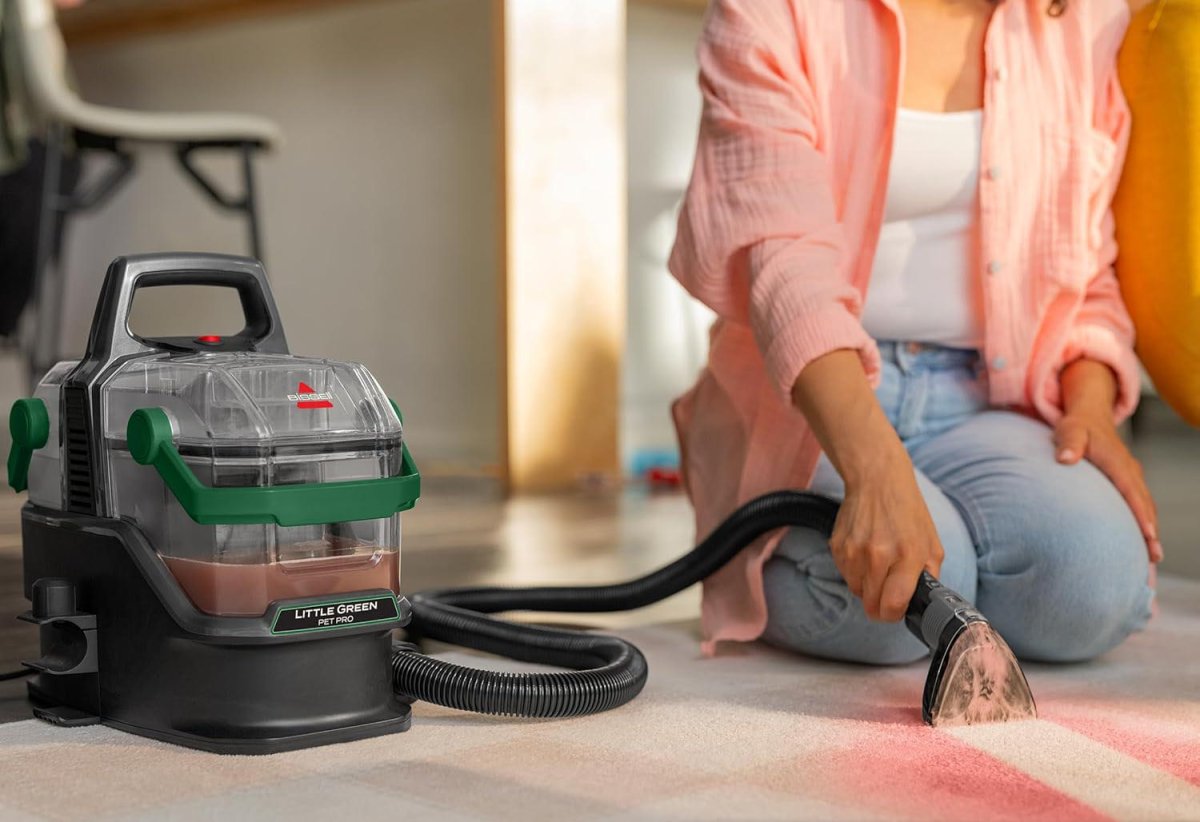
The Little Green Pet Pro became a notable part of that effort. The portable cleaner is built for carpets, rugs, upholstery, vehicle interiors, and other soft surfaces where stains tend to become permanent residents if ignored for too long.
Its combination of strong suction, a large tank for a portable machine, and specialized cleaning tools makes it especially relevant for homes with dogs and cats. More importantly, the certification approach helps consumers understand which products are intended for serious pet cleanup rather than simply featuring a picture of a golden retriever on the box.
A practical innovation rather than a flashy one
Not every useful product development requires a new motor or artificial intelligence. Better performance standards and clearer labeling can also improve the buying experience. For consumers comparing several nearly identical-looking carpet cleaners, knowing that a product has been evaluated for tougher pet messes can be genuinely useful.
3. Milwaukee’s M18 REDLITHIUM FORGE Batteries Raise the Cordless Ceiling
Cordless tools are only as convenient as the batteries powering them. A brilliant saw with a dead battery is simply an expensive object occupying a workbench.
Milwaukee expanded its M18 REDLITHIUM FORGE lineup with the HD12.0 and XC8.0 battery packs, emphasizing higher output, faster charging, cooling, and durability. The HD12.0 is designed for demanding applications, with Milwaukee stating that it can deliver substantially more power than its earlier M18 High Output 12.0 battery.
With compatible supercharging equipment, both new FORGE packs can reach 80 percent charge in about 35 minutes. The XC8.0 is especially interesting because it aims to provide high power in a smaller and lighter package than some larger-capacity alternatives.
Why faster charging matters
Battery performance is no longer merely a specification-sheet battle. On a jobsite, less charging downtime can affect productivity. For a homeowner with one afternoon to finish a deck, fence, or landscaping project, waiting for a battery can be equally annoyingalthough the financial consequences are usually lower and the snack breaks considerably better.
The broader innovation is the continued maturation of cordless platforms. As batteries become more powerful and charging becomes faster, more demanding equipment can move away from cords and gas engines.
4. Ryobi’s USB Lithium Power Cutter Makes Small Cutting Jobs Easier
Not every cutting task needs a utility knife, heavy-duty shears, or the sort of power tool that makes the neighbors wonder whether you are secretly building a submarine.
Ryobi’s USB Lithium Power Cutter targets everyday materials including cardboard, plastic, carpet, rubber, and leather. It uses a self-sharpening blade and includes an integrated guide intended to help users make straighter cuts.
The tool belongs to Ryobi’s USB Lithium battery platform, giving it the portability expected from a compact cordless device. For people who frequently open and break down shipping boxes, work with craft materials, install carpet, or cut flexible sheet goods, the powered cutter offers a useful middle ground between manual tools and larger equipment.
Small tools can solve surprisingly big annoyances
The appeal here is simple: repetitive cutting is tiring. A compact power cutter can make the task faster while reducing the amount of force required. It is not the most dramatic innovation of October, but it may be the one that earns the most grateful nods from anyone facing a garage full of cardboard after moving day.
5. 3M WorkTunes Connect + Solar Turns Light Into Listening Time
One of October’s most inventive launches came from 3M. The WorkTunes Connect + Solar Wireless Hearing Protector combines hearing protection, Bluetooth connectivity, and continuous light-based charging.
The headset uses Powerfoyle solar-cell technology to collect energy from both outdoor and indoor light. That means users can potentially spend less time plugging in the headset or worrying about a battery dying halfway through a long workday.
The hearing protector carries a Noise Reduction Rating of 26 decibels and supports wireless audio for music and calls. For people working around lawn equipment, power tools, or other noisy environments, the combination of protection and entertainment is already useful. Adding light-based charging makes the concept considerably more interesting.
Innovation that reduces battery anxiety
Solar charging is especially compelling in a product frequently used outdoors. Instead of attaching a decorative solar panel to something simply because the marketing department had an exciting Tuesday, 3M integrated energy harvesting into a device that naturally spends time in the light.
The result is one of the clearest examples from October of technology serving the product rather than becoming the product.
6. Craftsman Expands Its V20 Brushless RP Tool Family
Craftsman continued expanding its V20 Brushless RP lineup with a new quarter-inch cordless impact driver aimed at balancing power, runtime, and control.
The brushless motor delivers up to 23 percent more maximum torque than the comparison model cited by the manufacturer, while the tool can drive up to 150 fasteners per charge under specified testing conditions. A three-speed gearbox and variable-speed trigger allow speeds of up to 3,200 no-load RPM.
Those numbers matter, but the more practical story is versatility. Multiple speed settings give users more control when moving between delicate fastening work and jobs that require greater force. An onboard LED helps illuminate work areas, while the cordless V20 platform keeps the tool familiar for people already invested in Craftsman batteries.
Platform expansion is a major buying consideration
Modern cordless tools are increasingly purchased as ecosystems rather than isolated products. Once a homeowner or professional owns several compatible batteries, staying within the same platform can reduce cost and clutter. A stronger impact driver therefore matters not only as an individual release but as another reason to remain within the V20 system.
7. Circulon Adds a Large ScratchDefense C1 Frying Pan
October’s innovations were not limited to garages and workshops. Circulon expanded its C1 ScratchDefense cookware family with a 12.5-inch nonstick frying pan with a lid.
The larger size is useful for family meals, one-pan dinners, searing multiple portions, and those mornings when one pancake is clearly not going to solve the problem. The C1 line combines stainless steel construction with Circulon’s durable nonstick cooking surface.
The key trend is longevity. Consumers increasingly expect nonstick cookware to offer easy food release without feeling disposable. A larger covered skillet with a more durable surface can serve as an everyday kitchen workhorse rather than a specialty pan that spends most of its life hiding behind the stockpot.
8. Arlo’s Wired Floodlight Combines Security and Serious Illumination
Outdoor security products continue to merge cameras, lighting, communication, and alerts into a single device. Arlo’s Wired Floodlight Camera is a strong example of that trend.
The system combines 2K HDR video with a 160-degree field of view, color night vision, two-way audio, an integrated siren, and independently adjustable lights. Its floodlight can produce up to 2,000 lumens, helping illuminate driveways, side yards, garages, and other outdoor areas.
Why wired power still makes sense
Battery-powered security cameras are convenient, but a hardwired floodlight does not need regular charging. For a device expected to provide bright lighting and continuous availability, permanent power can be a practical advantage.
Arlo’s design reflects the broader evolution of smart home security: fewer separate devices performing isolated jobs and more integrated products that monitor, illuminate, communicate, and deter.
9. John Deere Expands Electric Zero-Turn Mowing With the Z380R
Electrification continues to reshape outdoor power equipment, and John Deere added momentum with the Z380R Electric ZTrak mower.
Introduced with a 54-inch mowing deck, the Z380R expands the company’s electric residential zero-turn offerings with greater cutting capacity. The larger deck is particularly relevant for homeowners managing substantial lawns who want the maneuverability of a zero-turn mower without a conventional gasoline engine.
Electric riding mowers can offer several appealing characteristics, including quieter operation, reduced routine engine maintenance, and zero operating emissions at the machine. Battery-powered equipment also eliminates trips to the gas station with a fuel can that somehow always smells like gasoline forever afterward.
The bigger story is outdoor electrification
The significance of the Z380R goes beyond one mower. Battery-powered handheld lawn tools are already common. Larger equipment is the next frontier. As manufacturers improve battery capacity, charging, durability, and power delivery, electric technology is moving into machines once considered firmly gasoline territory.
10. The nutribullet SmartSense Blender Adds Load-Sensing Automation
Blenders have traditionally asked users to make several decisions: which speed, for how long, and whether the alarming noise currently coming from the pitcher is normal. The nutribullet SmartSense attempts to simplify part of that process.
The full-size blender uses a 1,400-watt motor, five variable speeds, and a smart automatic cycle. The system senses the ingredient load and adjusts speed, time, and function to optimize the blending process.
That does not mean the blender has achieved consciousness or will begin judging your smoothie ingredients. It simply uses sensing and automation to reduce guesswork.
Smart features are most useful when they disappear into the task
The SmartSense concept demonstrates what good appliance automation can look like. Users can still select manual settings when they want control, but the automatic cycle is available when convenience matters more.
This approach reflects a broader trend across home appliances: sensors are increasingly being used to adjust performance in real time rather than forcing consumers to master a growing collection of presets.
What October’s Best Innovations Tell Us About the Future
Looking across these releases, several themes become clear. Battery technology is improving not merely through additional capacity but through faster charging, cooling, and smarter power management. Household products are combining multiple jobs. Sensors are automating routine decisions. Electric equipment is expanding into larger applications. Even protective gear is finding new ways to stay powered.
Perhaps most importantly, useful innovation is becoming less about showing off. The strongest products from October are interesting because their technology solves recognizable problems.
A floor cleaner that handles several types of mess in one pass makes sense. A battery that spends less time on the charger makes sense. Hearing protection that collects energy while you work in the light makes sense. A blender that adjusts to what is inside the pitcher also makes sense.
That is a healthier direction for product development than adding a touchscreen to everything with a power cord and hoping consumers mistake additional menus for progress.
Experiences and Real-World Lessons From October’s New Innovations
The most revealing way to think about these October product releases is to imagine how they fit into an ordinary week. Specifications matter, but products earn their place in a home, garage, or yard by making repeated tasks noticeably easier.
Consider floor cleaning. A muddy entryway is rarely a scheduled event. It happens when the dog comes inside, children forget that shoes are not indoor landscaping equipment, or a grocery bag leaks at exactly the wrong moment. A dedicated wet floor cleaner such as the Dyson WashG1 is appealing because it reduces the number of tools involved. The practical experience users are seeking is not “advanced floor-care technology.” It is simply getting from mess to clean floor with fewer steps.
The same principle applies to Bissell’s pet-focused cleaners. Portable spot cleaners are most valuable when they are easy enough to grab immediately. Pet stains become harder to handle when cleaning equipment is buried in a closet, requires a complicated setup, or feels like a weekend project. Products designed around fast response can change behavior: people are more likely to clean a spill promptly when the tool itself is convenient.
In a workshop, battery improvements are felt differently. More power is useful, but interruptions often define the experience of cordless tools. Starting a job with one nearly empty battery can turn a simple project into an unplanned tour of the garage looking for a charger. Faster-charging systems such as Milwaukee’s FORGE platform are valuable because they reduce those dead periods. The benefit is less glamorous than a dramatic demonstration video, yet it may matter more after the hundredth charging cycle.
Compact tools also tend to become favorites for unexpected reasons. A small powered cutter may initially look specialized, then suddenly become the tool used for cardboard, packaging, carpet scraps, craft material, and dozens of jobs that previously involved hunting for a sharp utility knife. The best small innovations often succeed by being easy to reach and easy to understand.
3M’s solar-charging WorkTunes headset offers another useful lesson: removing maintenance can be as important as adding performance. A rechargeable device is convenient until it is forgotten on the chargeror forgotten off the charger. Allowing light to contribute to keeping a headset powered addresses a tiny recurring frustration. Those tiny frustrations add up, especially for equipment used daily.
Outdoor equipment presents a larger shift. An electric riding mower asks owners to think differently about fueling and maintenance. There is no gas tank to fill before mowing, but charging habits and available electrical infrastructure become part of ownership. For the right property and routine, quieter operation and reduced engine maintenance can improve the entire mowing experience. For other users, range and charging requirements may remain important considerations. Innovation works best when it matches the job rather than simply being the newest option.
Smart appliances such as the nutribullet SmartSense highlight a similar balance. Automation is useful when it shortens the path to a good result. It becomes irritating when it hides controls or makes a simple machine unnecessarily complicated. Giving users both automatic sensing and manual speed control is therefore a sensible model: let the machine help, but do not confiscate the steering wheel.
The broad lesson from October’s best new releases is that meaningful innovation often feels surprisingly ordinary after a while. A feature becomes truly successful when users stop thinking about the technology and simply notice that the task is easier. The floor gets cleaned faster. The battery is ready sooner. The work area is safer. The mower is quieter. The smoothie requires less guesswork.
That may not sound as dramatic as “the future has arrived,” but it is arguably better. The future is most useful when it quietly gets the job done.
Conclusion: A Strong Month for Practical Innovation
The best new releases and innovations we saw in October 2024 demonstrate that progress in home products, tools, appliances, security, and lawn equipment does not require science-fiction gimmicks. Sometimes innovation is a better battery. Sometimes it is a smarter cleaning system. Sometimes it is a pair of hearing protectors that politely charges itself while sitting in the light.
Dyson, Bissell, Milwaukee, Ryobi, 3M, Craftsman, Circulon, Arlo, John Deere, and nutribullet approached different problems, but their standout products shared a similar goal: reduce effort while maintaining or improving performance.
Consumers should still evaluate whether any new product fits their specific needs, existing battery platforms, property size, flooring, security setup, or budget. Newer does not automatically mean better for everyone. Still, October delivered an unusually diverse group of products that show where home and tool innovation is headingtoward smarter automation, stronger cordless systems, electrification, multifunctionality, and technology that increasingly works in the background.
Note: Product specifications, pricing, availability, compatible accessories, and software features may change over time. Confirm current manufacturer information before purchasing.