Some robots roll. Some robots fly. Some robots look like they were designed by a committee that deeply feared corners. And then there are soft robotic jellyfish: squishy, pulsing, ocean-friendly machines that drift through the Atlantic with all the drama of a tiny sea ghost on a research mission.
The idea sounds like science fiction with a splash of aquarium poetry, but it is very real. Researchers have spent years building jellyfish-inspired soft robots that use flexible materials, pumps, fluid pressure, and bioinspired motion to move through water without the spinning propellers, rigid frames, and clumsy bumping that make many underwater machines risky around fragile marine ecosystems. In the Atlantic, where coral reefs, sponges, fish nurseries, and coastal habitats face rising pressure from warming water, pollution, storms, and human activity, a gentler robot is more than a charming gadget. It could become a practical tool for ocean monitoring.
Soft robotic jellyfish are not trying to win a drag race against a tuna. Their appeal is different: quiet movement, body compliance, low-impact interaction, and the ability to squeeze into complex underwater spaces. They are robots that seem to understand the first rule of visiting a coral reef: do not arrive like a leaf blower in a china shop.
What Is a Soft Robotic Jellyfish?
A soft robotic jellyfish is an underwater robot modeled after the swimming motion, body shape, and fluid interaction of real jellyfish. Instead of relying on rigid motors and exposed propellers, these robots use flexible silicone bodies, pneumatic or hydraulic actuation, artificial muscles, magnetic materials, or other soft robotics technologies to create pulsing movement.
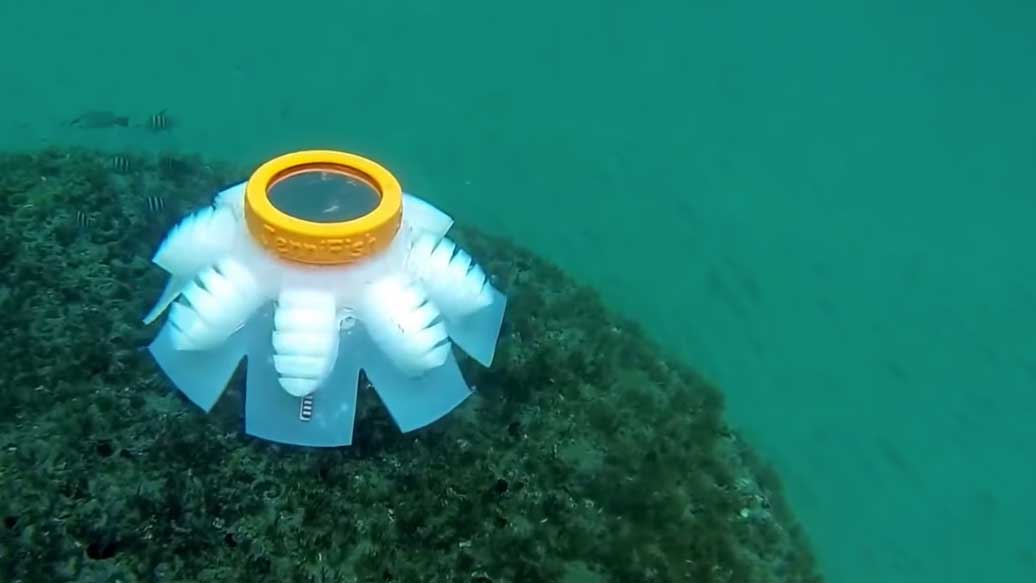
The Florida Atlantic University jellyfish robot that helped popularize the concept was inspired by the moon jellyfish, a simple but highly effective swimmer. The robot used soft tentacles and internal pumping to inflate and relax its limbs, creating a rhythmic stroke that moved it through the water. Researchers tested multiple versions and examined how tentacle stiffness, stroke frequency, and stroke amplitude affected swimming performance. In plain English: they changed how bendy the tentacles were, how fast the robot pulsed, and how big each pulse was, then watched what happened. This is the scientific method, but wetter.
Unlike many conventional underwater vehicles, soft robotic jellyfish are built to be physically forgiving. If one bumps a reef, a sponge, or a fish, the encounter is less likely to cause damage than a collision with a hard metal or plastic drone. That makes them especially interesting for coral reef monitoring, marine biology research, shallow-water inspection, and environmental sensing in tight or delicate habitats.
Why Jellyfish Are Such Brilliant Robot Teachers
Jellyfish may not have the public relations team of dolphins or the dramatic branding of sharks, but from an engineering point of view, they are magnificent. Real jellyfish have existed for hundreds of millions of years, and they swim with a deceptively simple motion: contract, push water, relax, repeat. No gears. No propellers. No software update that ruins the weekend.
Their bell-shaped bodies generate thrust by moving water. When a jellyfish contracts, it pushes water backward and moves forward. When it relaxes, its elastic body helps reset the shape for the next pulse. This cycle is efficient, quiet, and well suited for drifting through water without stirring up chaos. Engineers love that combination because underwater robots often struggle with energy use, maneuverability, waterproofing, and safe interaction with the environment.
Bioinspiration, Not Copy-Paste Nature
Soft robotic jellyfish are examples of bioinspired robotics. That does not mean engineers are copying a jellyfish cell by cell. They are borrowing useful principles: flexible movement, distributed force, low-impact contact, and propulsion through pulsing fluid motion. The goal is not to make the ocean believe it has met a new jellyfish cousin named Circuit Susan. The goal is to build machines that can work in places where rigid robots are too harsh, too noisy, or too awkward.
Bioinspired underwater robots include robotic fish, manta ray robots, octopus-inspired grippers, turtle-like vehicles, and jellyfish robots. Each design learns from an animal that already solved a specific movement problem. Jellyfish are especially useful because they are simple in form yet surprisingly effective in fluid environments.
How the Atlantic Tests Changed the Conversation
The Atlantic field tests were important because a robot that behaves beautifully in a laboratory tank can become a soggy disappointment in real water. Ocean currents, waves, salt, sand, biological debris, visibility problems, and pressure changes all make field work harder. A tank is polite. The Atlantic has opinions.
Researchers tested free-swimming soft robotic jellyfish off the coast of South Florida to understand how the design performed beyond the bench. The robot used pumps to move water into soft tentacles, causing them to bend and create a swimming stroke. When the pumps stopped, the tentacles relaxed. By controlling the timing and movement of the pumps, the robot could pulse through the water and steer to some degree.
These tests showed that soft-bodied robots could swim in real marine environments and potentially move through openings narrower than their own relaxed body diameter. That detail matters. Coral reefs, sponge beds, rocky crevices, and artificial reef structures are full of small gaps and complex geometry. A rigid underwater drone may avoid such areas or risk collision. A soft robot can deform, pass through, and keep working without acting like it owns the place.
The Pumped-Up Secret: Fluid Actuation
The phrase “get pumped” is not just a cute headline. Pumps are central to many soft robotic jellyfish designs. In the FAU-style approach, small pumps move water or air into flexible chambers. As pressure changes, the soft tentacles bend. That bending creates a stroke, and repeated strokes generate propulsion.
This is a major shift from traditional underwater propulsion. Most underwater drones use propellers or thrusters. They are powerful, controllable, and well understood, but they also create wash, noise, and collision hazards. Around delicate ecosystems, that can be a problem. A propeller near coral is like a blender near birthday cake: technically impressive, emotionally alarming.
Why Soft Actuators Matter
Soft actuators turn pressure, electricity, magnetic fields, heat, or other inputs into movement through flexible materials. In jellyfish-inspired robots, that movement often appears as bending, pulsing, or flapping. Because the materials are compliant, the robot can absorb contact and adapt to irregular environments.
Other research teams have explored jellyfish-like robots powered by dielectric elastomer actuators, fluid-electrode artificial muscles, magnetic composite elastomers, twisted-and-coiled polymer muscles, and hydraulic systems. Each method has strengths and trade-offs. Pumps can be straightforward and strong, but they require plumbing and waterproofing. Magnetic actuation can work beautifully at small scales, but it often needs external magnetic fields. Artificial muscles can be quiet and elegant, but power, durability, and control remain challenges.
The broader lesson is clear: underwater soft robotics is not a single invention. It is a growing toolbox.
Why the Atlantic Needs Gentle Ocean Robots
The ocean covers more than 70 percent of Earth’s surface, and much of it remains difficult to observe closely. Satellites can track sea surface temperatures, color, storms, and large-scale changes, but they cannot slip under a coral ledge or inspect a sponge garden at arm’s length. Human divers can gather rich detail, but diving is expensive, limited by time and safety, and not ideal for every site. Conventional remotely operated vehicles and autonomous underwater vehicles can go farther and deeper, but they are often too bulky or disruptive for fragile shallow habitats.
That gap is where soft robotic jellyfish could shine. They can carry sensors for temperature, salinity, depth, pressure, cameras, or water-quality measurements. In future versions, they may use sonar, onboard navigation, artificial intelligence, or swarm coordination to collect repeated data over time. Imagine a small group of robotic jellyfish drifting through a reef, quietly measuring conditions like a team of polite underwater librarians.
Coral Reefs Need Better Local Data
Coral reefs are living infrastructure. They provide habitat for fish and invertebrates, protect shorelines, support recreation and tourism, and help sustain coastal economies. They are also under severe stress. Marine heat waves, coral bleaching, ocean acidification, disease, sediment, overfishing, and coastal pollution all affect reef health.
Monitoring reefs requires more than occasional snapshots. Scientists need repeated, site-specific information: temperature trends, salinity shifts, dissolved oxygen changes, water clarity, biological activity, and visible signs of bleaching or disease. Soft robotic jellyfish could help gather those data in areas too tight, delicate, or awkward for traditional vehicles.
What Makes Soft Robotic Jellyfish Different from Regular Underwater Drones?
A regular underwater drone is usually built for control, speed, payload, and durability. Those are excellent qualities. But in fragile habitats, hard edges and spinning thrusters can become liabilities. Soft robotic jellyfish are designed around a different priority: compatibility with the environment.
1. They Move More Like Marine Life
Jellyfish-inspired robots use pulsing propulsion that resembles natural swimming. This may reduce disturbance compared with thruster-driven vehicles, especially in close quarters.
2. They Are Safer Around Fragile Structures
Soft materials can bend and compress. If the robot touches coral, sponge, seagrass, or rock, the contact is less aggressive than a rigid hull impact.
3. They Can Squeeze Through Tight Spaces
Because the body and tentacles are flexible, the robot can potentially pass through gaps smaller than its normal diameter. That makes it useful for reef crevices, artificial structures, and cluttered underwater landscapes.
4. They Are Quiet and Low Profile
Soft actuation can be quieter than propeller-driven systems. For wildlife observation, quiet is not a luxury. Fish are not known for signing media releases after being chased by machinery.
The Engineering Challenges Still Floating Around
Soft robotic jellyfish are promising, but they are not ready to replace every underwater robot. Several challenges remain before these machines become common tools for ocean research.
Power and Endurance
Small underwater robots have limited battery capacity. Pumps, sensors, cameras, processors, and communication systems all consume energy. A jellyfish robot designed for long-term monitoring must balance swimming performance with power efficiency.
Navigation and Control
Moving like a jellyfish is charming. Navigating like a jellyfish is less helpful if the goal is to inspect a specific reef outcrop and not accidentally tour the Bahamas. Future systems need better autonomous navigation, obstacle detection, current compensation, and mission planning.
Communication Underwater
Radio signals do not travel well underwater. Acoustic communication works, but it is slower and more complex than Wi-Fi or cellular signals. That makes real-time control and data transfer harder, especially for small robots.
Durability
Soft materials must survive saltwater, UV exposure, pressure, abrasion, biofouling, and repeated mechanical cycling. A robot that tears after a few missions is not much better than a very expensive pool noodle.
Payload Limits
Soft robotic jellyfish are typically small and lightweight. Adding sensors, cameras, lights, batteries, and processors increases weight and complexity. Engineers must design payloads carefully so the robot still swims properly.
Where This Technology Could Go Next
The future of soft robotic jellyfish is not limited to one Atlantic field test. The technology could grow in several directions.
Environmental Monitoring
Robotic jellyfish could monitor temperature, salinity, pH, dissolved oxygen, turbidity, pollutants, and biological indicators. Repeated measurements could help scientists detect changes earlier and respond faster.
Reef Inspection
Soft robots could inspect coral reefs, artificial reefs, oyster beds, mangrove roots, and sponge habitats with less risk of damage. Cameras and machine learning tools could help identify bleaching, disease, invasive species, or storm damage.
Swarm Research
A single robot is useful. A swarm of small, inexpensive soft robots could be transformative. Multiple robotic jellyfish could spread across a reef, collect distributed data, and build a richer picture of local ocean conditions.
Education and Citizen Science
Because jellyfish robots are visually intuitive and fun, they are excellent teaching tools. Students can learn about robotics, marine science, fluid dynamics, materials, sensors, and conservation through one floating project. It is STEM education with tentacles, which is objectively harder to ignore than another worksheet.
Medical and Micro-Robotics Inspiration
Some jellyfish-inspired robots are tiny and designed for laboratory or biomedical possibilities. The same principles that allow a small robot to move gently through water could someday influence medical micro-robots, drug delivery systems, or soft devices that navigate fluid-filled environments.
Why This Story Matters Beyond the Robot Itself
The soft robotic jellyfish story is not just about a cute machine swimming in the Atlantic. It represents a broader shift in engineering. For decades, many robots were designed to be harder, stronger, faster, and more precise. That approach gave the world industrial arms, drones, surgical robots, warehouse automation, and planetary rovers. But nature often solves problems differently. It uses flexibility, softness, redundancy, and adaptation.
In the ocean, softness is not weakness. It is strategy. A jellyfish survives without armor, wheels, or a dashboard full of angry warning lights. Its body works with water instead of fighting it. Soft roboticists are learning from that lesson.
As climate change and human activity place more pressure on marine ecosystems, the need for careful monitoring grows. Scientists need tools that can observe without harming, move without frightening, and collect data in places where humans and conventional machines struggle. Soft robotic jellyfish may not solve every ocean problem, but they point toward a more thoughtful kind of technology: one that enters nature with curiosity instead of conquest.
Field Notes: Experiences That Bring Soft Robotic Jellyfish to Life
To understand the appeal of a soft robotic jellyfish, picture a small research boat off the Atlantic coast on a morning when the water looks calm from above but complicated underneath. The surface glitters. The equipment cases are open. Someone is checking batteries. Someone else is holding the robot like it is both a scientific instrument and a slightly nervous dessert. That is the charm of soft robotics: even at its most technical, it still feels handmade, experimental, and just a little mischievous.
Lowering a soft robotic jellyfish into the water is different from launching a conventional drone. There is no aggressive buzz, no sharp propeller spin, no sense that the machine wants to dominate the environment. Instead, the robot settles in, pulses, and begins to move with a kind of slow confidence. It does not look fast. It looks intentional. That difference changes how observers respond to it. A rigid drone feels like equipment. A robotic jellyfish feels like a visitor.
In a reef setting, that matters. Anyone who has snorkeled over coral knows the strange combination of beauty and fragility. A reef can look solid from a distance, like underwater architecture, but up close it is alive, textured, and vulnerable. A careless fin kick can break what took years to grow. A hard-bodied robot with exposed thrusters can seem out of place in such a delicate setting. A soft robotic jellyfish, by contrast, feels designed for the etiquette of the reef. It still needs careful control, of course, but its body language is gentler.
There is also an educational experience that is hard to overstate. Show students a standard underwater sensor package, and some will lean in. Show them a squishy robot inspired by a moon jellyfish, powered by pumps, and built to protect coral reefs, and suddenly the room wakes up. The project connects biology, engineering, environmental science, and design in one memorable object. It answers the question students often ask silently: “Why does this matter?” It matters because the ocean is changing, and we need smarter ways to watch those changes happen.
For researchers, the experience is more practical but no less exciting. Every pulse of the robot reveals something: how soft materials deform, how water moves around tentacles, how control timing affects thrust, how currents interfere, and how sensors might be integrated without ruining buoyancy. Field testing is humbling. A robot that performs perfectly in a tank may drift sideways, stall, leak, or behave unpredictably in open water. But those failures are useful. They teach engineers what the ocean refuses to negotiate.
The most compelling experience, though, is the sense that this technology represents a better relationship between machines and the natural world. Soft robotic jellyfish do not arrive as metal invaders. They arrive as students of the ecosystem, borrowing ideas from ancient swimmers to protect modern seas. That is a rare and hopeful design philosophy. In a century when the ocean needs more attention and less damage, a small pulsing robot in the Atlantic feels like more than a clever invention. It feels like a polite knock on the door of the deep.
Conclusion
Soft robotic jellyfish show how engineering can become more ocean-aware, more adaptive, and frankly more elegant. By using flexible materials, pump-driven motion, and bioinspired design, these robots offer a gentler way to explore reefs, monitor water conditions, and study fragile marine habitats. The Atlantic tests proved that soft robots can move beyond the lab and into real marine environments, where currents, saltwater, and complex terrain quickly expose weak ideas.
The technology still has challenges, including battery life, autonomous navigation, underwater communication, durability, and payload capacity. Yet the direction is promising. As sensors shrink, materials improve, and control systems become smarter, soft robotic jellyfish could become part of the future ocean-monitoring toolkit. They may drift quietly through reefs, collect valuable data, and help scientists understand environmental change without adding more stress to the ecosystems they study.
In the end, the soft robotic jellyfish is a reminder that the best technology is not always the loudest, fastest, or hardest. Sometimes the future arrives softly, pulses twice, and disappears into blue water with a tiny pump-powered wiggle.
Note: This article synthesizes publicly reported information from robotics research, university project descriptions, ocean science resources, and reputable technology publications. It is written as original editorial content for web publishing.