Editorial note: This article is based on verified public product, artist, and design information from Slow Roads, Remodelista/Gardenista, V1 Gallery, Emma Kohlmann’s official archive, Silke Lindner, Coveteur, The Creative Independent, Vogue, Architectural Digest, Martha Stewart, Better Homes & Gardens, and Homes & Gardens. Product details, availability, and pricing may change over time.
A Lamp That Refuses to Behave Like a Regular Lamp
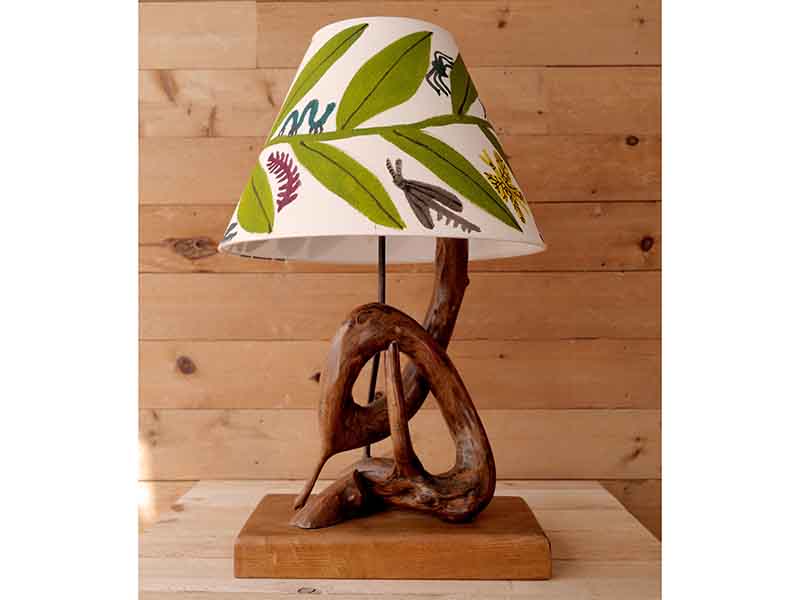
The Slow Roads x Emma Kohlmann, Lamp 4 is not the sort of table lamp that quietly sits in the corner and apologizes for taking up space. It has a presence. It has a personality. It might even have better taste than your coffee table. Part lighting object, part functional sculpture, and part miniature art exhibition, Lamp 4 belongs to a special collaboration between Slow Roads and artist Emma Kohlmann, pairing a one-of-a-kind hand-painted lampshade with a restored vintage wooden base.
On the product page, Slow Roads describes the collaboration as a series of hand-painted lampshades paired with vintage wooden bases, with imagery inspired by nature and featuring Kohlmann’s original depictions of faces, symbols, plants, and animals. The bases are crafted from tree roots and wood slices sourced from around the world, dating back to the 1960s and 1970s, and they retain vintage imperfections as part of their character. The listed price for Lamp 4 is $1,450.00.
That combination matters. This is not a mass-market lamp wearing a “designer” hat for the weekend. It is a layered object: old wood, new painting, artist-led storytelling, and contemporary slow-design thinking all glowing under one shade. In a home decor landscape full of anonymous objects, Lamp 4 feels unusually specific. It says, “Yes, I provide light, but I also have a mysterious forest dream I’d like to discuss.”
What Is Slow Roads?
Slow Roads describes itself as a design studio and curated home goods shop specializing in fine art, one-of-a-kind vintage pieces, and artful home goods. That identity is important because Lamp 4 fits neatly into the brand’s larger philosophy: objects should feel collected, not merely purchased; designed, not simply manufactured; and personal, not algorithmically bland.
Instead of treating vintage materials as background decoration, Slow Roads gives them a starring role. In this collaboration, the vintage bases are not just pedestals for painted shades. They are sculptural bodies, each with natural irregularities, patina, and age. That sense of time gives the lamp a depth that a brand-new factory-made base would struggle to imitate.
In an era when many interiors are built around fast furniture and instant visual trends, Slow Roads x Emma Kohlmann, Lamp 4 feels like a small protest. It favors texture over polish, story over sameness, and character over perfection. In plain English: this lamp has wrinkles, roots, brushstrokes, and charm. That is the point.
Who Is Emma Kohlmann?
Emma Kohlmann is an artist born in New York in 1989 who lives and works in Florence, Massachusetts. V1 Gallery notes that she holds a BA from Hampshire College in Amherst, Massachusetts, and her career includes exhibitions, works on paper, paintings, and other creative projects.
Kohlmann’s work often moves through watercolor, painting, zines, prints, digital art, books, and ceramics. Her official site presents an archive that includes works on paper, canvas, ceramics, zines, flyers, and exhibitions, showing how broad and restless her creative practice has been.
Silke Lindner describes Kohlmann’s practice as a universe where figures, flora, and fauna coexist in spiritual, non-hierarchical spaces, visually informed by mythology, modern painting, folk art, and DIY punk references. This explains why her work feels both ancient and fresh. A Kohlmann figure can look like it wandered out of a cave painting, a dream notebook, a mythology textbook, and a handmade zineall before breakfast.
That artistic background makes her collaboration with Slow Roads feel especially natural. A lamp shade is, technically, a surface. But in Kohlmann’s hands, it becomes a circular world. Instead of a flat painting on a wall, the viewer gets an illuminated object that can be encountered from multiple angles, at different times of day, and in different moods.
The Collaboration: Art Meets Vintage Lighting
Remodelista reported that the Emma Kohlmann lamp collection from Slow Roads debuted on March 11, 2024, with six one-of-a-kind lamps and prices starting at $1,450. The feature explains that Slow Roads founders Catherine Costanza and Evan Dublin supplied Kohlmann with custom canvas lampshades, sized to pair with restored vintage tree-root lamp bases found on road trips in Upstate New York, Seattle, and California.
Gardenista’s coverage describes the same collaboration as Kohlmann’s hand-painted lamp collection for Slow Roads and notes the careful pairing of custom shades with restored vintage tree-root bases. The result is a collection that feels less like a product line and more like a tiny gathering of luminous characters.
For Lamp 4 specifically, the appeal lies in the meeting of two visual languages. The wooden base brings earth, weight, age, and sculptural irregularity. The shade brings hand-painted imagery, color, softness, and movement. Together, they make the lamp feel grounded and enchanted at the same time. It is the decor equivalent of a woodland creature who also went to art school.
Design Analysis: Why Lamp 4 Works
1. It Has Real Material Contrast
Good design often comes from tension: hard and soft, old and new, raw and refined. Lamp 4 has all of that. The vintage wood base offers texture and organic form, while the painted shade provides a delicate, expressive surface. The lamp does not rely on a single trick. It balances sculpture, painting, and utility.
2. It Turns Lighting Into a Focal Point
Interior designers often talk about layered lighting: ambient light, task light, and accent light working together. Better Homes & Gardens notes that a strong lighting plan often combines ambient, task, and accent lighting to balance function and aesthetics. Lamp 4 lands firmly in the accent-lighting category, though it also works as a table lamp. Its job is not merely to brighten a room; it gives the room a visual heartbeat.
3. It Avoids the “Too Perfect” Problem
Many new interiors can feel over-staged, as if every object has been chosen by a committee of beige rectangles. Lamp 4 avoids that. The restored vintage base keeps its imperfections, and the hand-painted shade carries the human energy of brushwork. These details make the lamp feel alive, not showroom-stiff.
4. It Is Collectible Without Being Cold
Some collectible design objects can feel intimidating. They whisper, “Please admire me from a safe distance.” Lamp 4 feels different. It has art-world credibility, but it also has warmth. It can sit beside books, ceramics, flowers, or a slightly chaotic stack of magazines and still make sense. It is refined, but not snobby. Very important quality in a lamp. Nobody wants judgmental lighting.
Emma Kohlmann’s Visual Language on a Lampshade
One of the most interesting things about this collaboration is the shift in surface. Kohlmann is known for works that often involve watercolor, ink, symbolic figures, plants, animals, and dreamlike compositions. Coveteur’s 2024 interview around her book Emma Kohlmann: Watercolors notes that the book tracks her progression from earlier grayscale work through experimentation and toward a strong command of color.
On a lampshade, that language changes. The artwork is no longer viewed as a single rectangle on a wall. It wraps around a form. The light from inside the shade alters the color and mood. In daytime, the painted surface can read as an art object. At night, the lamp becomes more atmospheric, with the shade glowing softly and the imagery feeling more intimate.
Vogue has described Kohlmann’s paintings as carrying otherworldly qualities and playful humor, noting her interest in creating an inclusive, ambiguous space for viewers. That spirit fits lighting beautifully. A lamp already changes the emotional temperature of a room. Add Kohlmann’s symbols and figures, and the lamp becomes less like equipment and more like a small domestic myth.
How to Style Slow Roads x Emma Kohlmann, Lamp 4
Use It Where It Can Be Seen
Lamp 4 should not be hidden behind a plant, a stack of unopened mail, or that one candle you keep meaning to use but never do. Place it on a side table, console, nightstand, or low cabinet where the sculptural base and painted shade can both be appreciated. It is a conversation piece, so let it join the conversation.
Pair It With Natural Materials
The vintage wood base makes Lamp 4 a natural match for linen, wool, stoneware, handmade ceramics, rattan, raw wood, and antique textiles. It would look especially strong near a plaster wall, a warm-toned sofa, a vintage rug, or a rustic table with visible grain. The goal is not to make everything match. The goal is to create a room where the lamp feels like it has always belonged there.
Let It Contrast With Clean Modern Pieces
Lamp 4 can also work beautifully in a cleaner, more modern interior. Against a simple white wall, a minimalist shelf, or a sleek side table, the lamp’s organic base and hand-painted shade become even more expressive. This is a useful design trick: place the most character-rich object in a calm setting, and suddenly the room has depth without becoming visually noisy.
Use Warm, Soft Lighting
For a lamp like this, harsh lighting would be a crime against ambiance. Martha Stewart’s living room lighting advice emphasizes balance and mixing lighting types for a layered, dynamic look. A warm bulb can help Lamp 4 create a cozy glow while keeping the shade’s painted details inviting rather than washed out.
Why This Lamp Matters in Today’s Interior Design
The popularity of sculptural and artistic lighting reflects a broader change in how people think about their homes. Lighting is no longer just the thing you switch on when you cannot find your keys. It is part of mood, storytelling, and identity. Homes & Gardens notes that rooms benefit from layered lighting that includes ambient, accent, and task sources, including sculptural fixtures and cozy reading lamps.
Slow Roads x Emma Kohlmann, Lamp 4 sits directly inside this shift. It is functional, yes, but it is also expressive. It brings art into everyday life without requiring a museum wall, a spotlight, or an intimidating label printed in tiny type. You can live with it. You can turn it on. You can let it make the room feel softer, stranger, and more personal.
It also taps into the growing appreciation for one-of-a-kind vintage and handmade objects. The base has a past. The shade has an artist’s hand. The complete object has a sense of narrative. In a world where many products arrive looking identical, that kind of individuality feels luxurious.
Who Is Lamp 4 Best For?
Lamp 4 is best for collectors, design lovers, and homeowners who want a statement piece that still feels warm. It is ideal for someone who appreciates contemporary art but does not want every object in the room to behave like a gallery installation. It is also a strong fit for interiors that mix vintage furniture, handmade decor, books, art, plants, and natural textures.
It may not be the best choice for someone who wants invisible lighting or a perfectly symmetrical pair of matching lamps. Lamp 4 is not trying to disappear. It is not trying to be a polite background object. It wants to be noticed, but in a poetic way rather than a loud one.
That makes it especially appealing for spaces that need one memorable design anchor. A living room with neutral furniture? Lamp 4 can add soul. A reading corner that feels a little sleepy? Lamp 4 can wake it up gently. A bedroom that needs character but not clutter? Lamp 4 can bring atmosphere without requiring six more accessories and a decorative tray shaped like a leaf.
Buying Considerations
Because Lamp 4 is one of a kind, buyers should approach it differently from a standard table lamp purchase. The decision is not just about dimensions, brightness, or whether it matches the curtains. It is about whether the object resonates. Does the painted shade feel like something you want to see every day? Does the vintage base suit your room’s mood? Does the lamp feel like a long-term companion rather than a temporary trend?
The official Slow Roads product description notes that the lamps have been restored and rewired, with necessary updates made to preserve vintage charm. That is an important detail for anyone considering a vintage-based lighting object. Restoration can help make an older piece more practical while keeping its original character intact.
At $1,450, Lamp 4 sits in collectible design territory. That price reflects more than illumination. It reflects the one-of-a-kind artwork, the restored vintage base, the artist collaboration, and the rarity of the object. In other words, you are not buying “a lamp.” You are buying a hand-painted, functional sculpture that happens to make the room glow.
Experience Notes: Living With a Lamp Like Slow Roads x Emma Kohlmann, Lamp 4
Living with a lamp like Slow Roads x Emma Kohlmann, Lamp 4 is different from living with ordinary lighting. A regular lamp performs a task. It brightens a corner, helps you read a book, keeps you from stepping on a stray charger cable, and then quietly retires from public attention. Lamp 4 does all of that, but it also changes how the room feels. It creates a small destination inside the home.
The first experience is visual curiosity. From across the room, the lamp reads as a sculptural object: an organic wooden base supporting a painted shade. Up close, the details become more intimate. The brushwork, figures, symbols, plant forms, and colors encourage slow looking. This is where the lamp lives up to the Slow Roads name. It asks you to pause. It rewards attention. It does not give away everything in one glance.
The second experience is atmosphere. During the day, Lamp 4 can behave almost like a small artwork or decorative sculpture. It adds shape and personality even when switched off. At night, the relationship changes. The painted shade becomes warmer and more mysterious. The wooden base gains shadow. The whole object feels less like decor and more like a quiet companion. It is the kind of lamp that can make a corner feel intentional rather than abandoned.
Imagine it on a side table beside a deep chair, a stack of art books, and a ceramic cup that may or may not still contain tea from three hours ago. The lamp does not need much styling support. In fact, too many surrounding objects could compete with it. A few carefully chosen piecesa small vase, a natural tray, a textured book coverare enough. Lamp 4 already brings plenty of visual interest, so the rest of the arrangement can breathe.
There is also an emotional experience connected to handmade and vintage objects. A new mass-produced lamp often feels clean and efficient, but rarely memorable. Lamp 4 feels like it has lived several lives: one in the vintage wood base, another in Kohlmann’s painted imagery, and a third in the home of whoever chooses it. That layered feeling gives it depth. It is not just “nice.” It is particular.
For people who enjoy interiors that feel collected over time, this matters. Lamp 4 can help a room avoid the dreaded catalog effect, where everything looks good but nothing feels personal. Its irregularities and artful surface introduce a human note. It suggests travel, studio work, restoration, drawing, nature, and domestic warmth. That is a lot for one lamp to carry, but Lamp 4 seems up for the job.
The best experience may come from how it changes daily routines. Turning it on in the evening can become a small ritual. Instead of flooding the room with overhead light, you get a softer glow and a more thoughtful mood. Reading feels calmer. Conversation feels warmer. Even cleaning up the coffee table feels slightly more elegant, which is impressive because coffee table clutter is famously resistant to elegance.
Ultimately, living with Slow Roads x Emma Kohlmann, Lamp 4 would be less about owning a decorative object and more about sharing space with a piece of functional art. It is useful, but it is not merely useful. It is beautiful, but not sterile. It is artistic, but still domestic. That balance is exactly what makes it compelling.
Conclusion
Slow Roads x Emma Kohlmann, Lamp 4 is a rare kind of home object: practical enough to use, expressive enough to collect, and personal enough to shape the mood of a room. Its restored vintage wooden base gives it history and physical presence, while Emma Kohlmann’s hand-painted shade brings imagination, symbolism, and warmth. Together, they create a lamp that feels less like an accessory and more like a small illuminated world.
For collectors, art lovers, and design-minded homeowners, Lamp 4 offers a strong example of how contemporary art and vintage home decor can meet without feeling forced. It proves that lighting can be functional and poetic at the same time. It also proves that a lamp can have more personality than some dinner guests, which is not technically a design principle, but perhaps it should be.