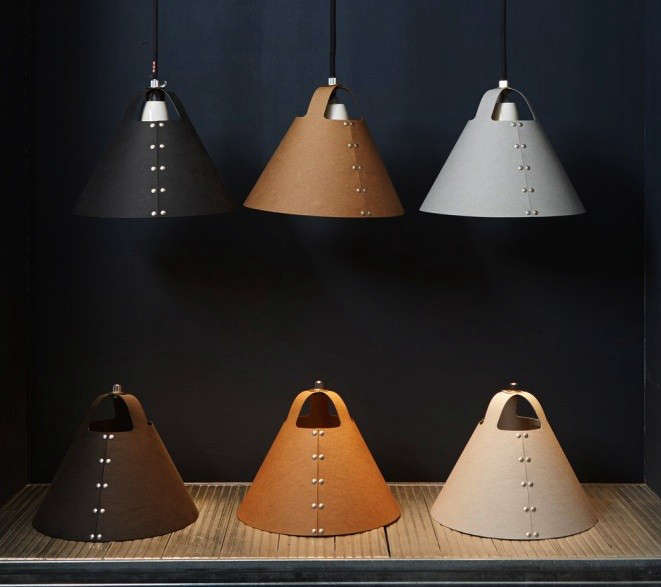
Some lamps enter a room like they own the place. Others politely glow in the corner and try not to interrupt dinner. Shigeki Fujishiro’s Rivet Lampshades do something better: they make a quiet object feel unexpectedly clever. At first glance, the Rivet Lamp looks almost too simplea conical shade, a clean silhouette, a few visible rivets. But look again and the trick reveals itself. This is not just a lampshade wearing industrial jewelry. It is a small masterclass in material intelligence, Japanese product design, and the art of making one sheet do the work of many parts.
The Rivet Lampshade is associated with Japanese designer Shigeki Fujishiro, whose work often explores familiar materials in unfamiliar ways. Instead of dressing a lamp in decorative flourishes, Fujishiro lets structure become the decoration. The shade is rolled from vulcanized fiber, a durable cellulose-based material made from wood pulp and cotton, then fixed with rivets. No dramatic chandelier arms. No crystal droplets trying to impersonate a wedding cake. Just a flexible sheet, careful geometry, and a glow that feels warm without shouting for applause.
For anyone interested in Japanese lighting design, minimalist pendant lights, or small-space interiors, the Rivet Lamp is a design worth studying. It is practical enough for daily use and poetic enough to make design lovers lean closer and say, “Wait, how is that made?” That is usually a good sign. Lamps that start conversations without flickering are doing their job.
Who Is Shigeki Fujishiro?
Shigeki Fujishiro is a Japanese product designer known for interior products, furniture, installations, and self-initiated design projects. After working at IDÉE, the influential Japanese furniture and lifestyle company, he established Shigeki Fujishiro Design in 2005. His portfolio reaches beyond lamps, including stools, baskets, mirrors, mobiles, ceramics, and collaborations with well-known brands such as Hermès, Adidas, Camper, Kvadrat, Arita ware projects, and other material-focused initiatives.
What makes Fujishiro’s work especially compelling is not only the finished object but the thinking behind it. He tends to begin with humble materials and basic structures, then asks how far they can go. Paper becomes a stool. Rope becomes a basket. Vulcanized fiber becomes a lampshade. It is the design version of looking at pantry leftovers and somehow producing a meal that makes guests ask for the recipe.
His approach fits into a broader tradition of thoughtful Japanese design: useful, restrained, attentive to material behavior, and quietly humorous. Fujishiro’s objects rarely scream for attention. They invite attention by being precise, tactile, and slightly surprising. The Rivet Lampshade is one of the clearest examples of this attitude because it turns a simple construction method into the entire visual identity of the lamp.
What Are Shigeki Fujishiro’s Rivet Lampshades?
Shigeki Fujishiro’s Rivet Lampshades, often referred to as the Rivet Lamp, are conical pendant-style shades made from vulcanized fiber. The design is shaped from a single flexible sheet that is rolled into form and fastened with rivets. The visible rivets are not afterthoughts; they are the point. They hold the shade together while giving the lamp its signature industrial-craft character.
The standard Rivet Lamp has been listed at approximately 240 millimeters in diameter and 200 millimeters in height, with a 1000-millimeter cord and an E17 socket in Japanese shop listings. A larger version has also appeared, measuring about 340 millimeters in diameter and 260 millimeters high, with an E26 bulb size. Retail descriptions have also noted dimensions around 20 centimeters high and 23.5 centimeters in diameter for the lampshade version, depending on listing and market. In other words, check the exact listing before buying, because lighting specifications love tiny details the way cats love sitting on keyboards.
Colors have included restrained, interior-friendly tones such as black, gray, and brown. These are not “look at me from across the furniture showroom” colors. They are quiet colors, which is exactly why they work. Black feels graphic and architectural. Gray emphasizes the material quality. Brown gives the shade a warmer, paper-like presence that pairs well with wood, linen, ceramics, and natural surfaces.
The Material: Why Vulcanized Fiber Matters
The most important part of the Rivet Lampshade is not the rivet, oddly enough. It is the material being riveted. Vulcanized fiber is a dense cellulose-based material made from plant-derived fibers such as wood pulp, cotton, paper, or fabric. Historically, it has been used in industrial and electrical applications because it can offer strength, flexibility, abrasion resistance, and insulating properties.
That material choice is the soul of the Rivet Lamp. A typical lampshade might use fabric stretched over a frame, metal spun into a cone, glass molded into a globe, or plastic shaped for mass production. Fujishiro chooses a sheet material that behaves somewhere between paper, board, and industrial component. It bends, but not limply. It holds shape, but not like a rigid metal shell. It has memory, tension, and a slight natural irregularity.
This is where the lamp becomes more than a shade. The material does not hide behind paint or ornament. It announces its own logic. The surface carries a subtle matte quality. The edges feel crisp. The riveted seam gives the shade a handmade-industrial line. In a home full of shiny devices, glossy appliances, and aggressively perfect surfaces, the Rivet Lamp offers something calmer: a designed object that still feels close to material reality.
How One Sheet Becomes a Lampshade
The Rivet Lamp is shaped from a single sheet of vulcanized fiber. The sheet is rolled into a cone, then riveted to keep the form. At the top, three cut-out bands help connect the shade to the light fitting while leaving space around the bulb area. This is not just a styling choice; it is structural thinking. The shade is not assembled from a complicated skeleton of hidden hardware. The sheet itself carries the form.
That makes the lamp easy to understand. You can look at it and mentally reverse-engineer it in seconds: sheet, roll, rivet, hang. Yet the result does not feel crude. The proportions are carefully handled, and the construction looks deliberate rather than improvised. It is the difference between “I made this in a garage because I had five minutes” and “I made this in a studio after thinking very hard about the behavior of a sheet.”
The design also allows for slight distortion, which is part of the material’s character. Some listings note that the shape can be adjusted by loosening the top fitting and shifting the bands. That small imperfection is not a defect in the design language; it is a reminder that the shade is made from a real material under tension. Perfect symmetry is nice, but a little human wobble can be charming. Lamps, like people, do not always need to pass a geometry exam.
Why the Rivets Are More Than Decoration
The word “rivet” gives the lamp its name, and for good reason. Rivets are mechanical fasteners associated with bridges, aircraft, machinery, and old factory objects. On the Rivet Lampshade, they create a small line of industrial punctuation. They say, “This is how I am held together,” which is refreshingly honest in a world where many products hide their assembly behind plastic caps and marketing poetry.
In design terms, the rivets do three jobs at once. First, they perform a structural task by securing the sheet. Second, they create a visual rhythm along the seam. Third, they give the shade a tactile identity. Without the rivets, the lamp might read as a simple cone. With them, it becomes a cone with attitude.
This is a classic move in good product design: let the necessary part become the beautiful part. The Rivet Lamp does not add decoration after solving the engineering problem. It turns the engineering solution into the decorative language. That is why the shade feels so satisfying. Nothing appears wasted, yet nothing feels cold.
The Light Quality: Soft, Focused, and Atmospheric
Because the Rivet Lampshade is conical and relatively compact, it works especially well as a localized atmospheric light. It can hang over a small table, bedside area, reading nook, counter, or cluster of dining lights. One shade creates an intimate pool of light. Multiple shades over a longer table can create rhythm and repetition without visual clutter.
The material itself helps shape the mood. Vulcanized fiber is not transparent, so the shade directs light downward and allows the exterior surface to remain visually calm. This is different from a paper lantern that glows all around or a glass pendant that scatters highlights. The Rivet Lamp has more of a focused presence. It is cozy, but not sleepy. Minimal, but not sterile.
For modern interiors, that balance matters. Many homes now combine work, dining, relaxing, and doom-scrolling into the same few rooms. Lighting has to work harder than ever. A Rivet Lampshade can help define a zone without adding bulk. It gives a table or corner a visual anchor, especially when paired with warm LED bulbs and dimmable controls where compatible.
Practical Lighting Tips for Using a Rivet Lampshade
Choose the right bulb
Always follow the lamp or retailer’s wattage and socket recommendations. Older retailer listings have referenced a maximum 60-watt bulb for the shade, while Japanese shop listings describe specific socket sizes such as E17 for the standard version and E26 for the larger version. LEDs are usually a smart choice because quality LED bulbs use significantly less energy and emit far less heat than incandescent bulbs. That said, the bulb still needs to fit safely and suit the fixture.
Use warm color temperature for atmosphere
A warm white bulb, roughly in the 2700K to 3000K range, tends to suit the Rivet Lamp’s material character. Cooler bulbs can make the shade feel more technical and less inviting. Unless your dining table doubles as a dental clinic, warmer is usually better.
Hang it with intention
Over a dining table, pendant lights are commonly hung low enough to create intimacy but high enough to avoid blocking faces. The Rivet Lamp’s compact form makes it especially good in multiples. Try two or three over a rectangular table, or one over a small round table, entry bench, or reading corner.
Let the seam show
The riveted seam is part of the design, so do not automatically hide it against the wall. Turning the seam slightly toward the room can make the object more interesting. It is like letting a tailored jacket show its stitching. The detail is the charm.
Where It Works Best in the Home
The Rivet Lampshade is most at home in interiors that appreciate texture, restraint, and material honesty. It pairs beautifully with natural wood, raw ceramics, linen curtains, matte black hardware, concrete, stainless steel, and quiet painted walls. It also works in Japandi interiors, modern rustic rooms, compact apartments, studios, and homes where the furniture is simple but the details are considered.
In a bedroom, one Rivet Lamp can replace a standard bedside pendant and create a calm, focused glow. In a kitchen, a small group can soften an island without looking overly decorative. In a workspace, the shade’s graphic cone can bring warmth to a desk area while still feeling disciplined. In a dining space, multiple Rivet Lampshades create a row of small architectural forms overhead. They are not loud, but they do make the ceiling more interesting than a blank surface with commitment issues.
Because the design is compact, it is also friendly to small spaces. Oversized lighting can overwhelm a room, especially apartments with modest ceiling heights. The Rivet Lamp gives you design presence without visual heaviness. It occupies space politely, which is a rare and underrated skill.
Why Designers and Collectors Appreciate It
Design lovers are drawn to the Rivet Lampshade because it solves several problems elegantly. It is economical in parts. It uses a material with history. It makes construction visible. It balances industrial logic with handmade warmth. And it feels like a product that came from curiosity rather than trend-chasing.
That last point matters. Many lamps are designed to match a market category: Scandinavian pendant, industrial fixture, farmhouse shade, mid-century orb, and so on. Fujishiro’s Rivet Lamp feels more independent. It is not trying to cosplay as a factory lamp or a craft object. It borrows from both worlds and becomes its own thing.
There is also a delightful contradiction in the lamp. It is simple, but not generic. Industrial, but not harsh. Natural, but not rustic. Japanese, but not cliché. Minimal, but not empty. That combination gives it staying power. It does not rely on a passing color trend or an exaggerated shape. It relies on proportion, material, and a construction detail you can understand at a glance.
Buying Notes and Care Considerations
If you are shopping for Shigeki Fujishiro’s Rivet Lampshades, read the product listing carefully. Different retailers and markets may describe the item as a shade, a pendant lamp, or a lamp with a Japanese ceiling rosette. Confirm whether the cable, socket, ceiling hardware, and bulb are included. Also check socket type, voltage compatibility, maximum wattage, and whether the product is intended for your region’s electrical standards.
For care, treat the shade like a design object made from a durable but natural-feeling sheet material. Dust it gently with a soft cloth. Avoid soaking it, bending it unnecessarily, or placing it in damp areas. Because vulcanized fiber can have slight dimensional character, do not expect it to behave like molded plastic. That is part of the appeal. It is precise enough to be refined and imperfect enough to feel alive.
Experience Notes: What It Feels Like to Live With a Rivet Lampshade
The real pleasure of a Rivet Lampshade is not only seeing it in a product photograph. It is imagining how it behaves in an ordinary room at 7:30 p.m., when the day has finally stopped sending emails. The shade does not flood the space with dramatic brightness. Instead, it creates a small, deliberate glow. The room feels calmer because the light has boundaries. A tabletop becomes the center of attention. A mug, a book, a bowl of noodles, or a half-finished sketch suddenly looks like it deserves its own exhibition label.
During the day, the lamp reads as an object. You notice the cone, the matte surface, the riveted seam, and the small tension in the material. It has the presence of a tool rather than a sculpture, but a tool made by someone with unusually good taste. In sunlight, the shade’s surface can look quiet and papery. At night, it becomes more architectural. The underside glows, the upper cone darkens, and the rivets catch tiny highlights. It is a modest transformation, which is exactly why it feels satisfying.
One of the best experiences related to this lampshade is the way it changes how you notice construction. After spending time with the Rivet Lamp, you may start looking at other objects differently. How is that chair joined? Why is that handle shaped that way? Why does this storage basket need twelve parts when one clever fold might do? Fujishiro’s design encourages a kind of everyday design literacy. It makes you pay attention without turning your living room into a lecture hall.
It also works well emotionally because it does not try too hard. Some statement lights arrive with the energy of a celebrity guest at a dinner party. They demand compliments, block the conversation, and make everyone slightly nervous about touching anything. The Rivet Lampshade is more like the guest who brings excellent bread, sits comfortably, and says something quietly brilliant halfway through the evening. You remember it because it is useful, warm, and unforced.
For people who enjoy slow interiors, the lamp offers a daily reminder that good design does not always need complexity. A single sheet, a few rivets, and a thoughtful relationship with light can be enough. That idea is surprisingly comforting. In a consumer world that constantly asks us to upgrade, replace, and add more features, the Rivet Lamp whispers a better suggestion: reduce the parts, respect the material, and let the object breathe. Not every lampshade can offer a small philosophy with dinner, but this one comes close.
Conclusion: A Small Lamp With a Big Design Lesson
Shigeki Fujishiro’s Rivet Lampshades prove that memorable lighting does not need extravagance. Their beauty comes from clarity: one sheet of vulcanized fiber, a rolled conical form, visible rivets, and a calm relationship with light. The design feels industrial and natural at the same time, which is not an easy balance to achieve. It is practical enough for bedside tables and dining spaces, but thoughtful enough to reward close attention.
In the end, the Rivet Lampshade is more than a good-looking pendant. It is a reminder that design can be intelligent without becoming complicated. It celebrates material behavior, honest assembly, and the quiet drama of a well-made everyday object. If your home needs a lamp that glows softly and has a brain, this is the kind of shade that makes simplicity look very, very smart.
Note: This article is written for clean web publishing in American English. Source links are not embedded in the article body so the HTML can be copied directly into a CMS without citation artifacts.