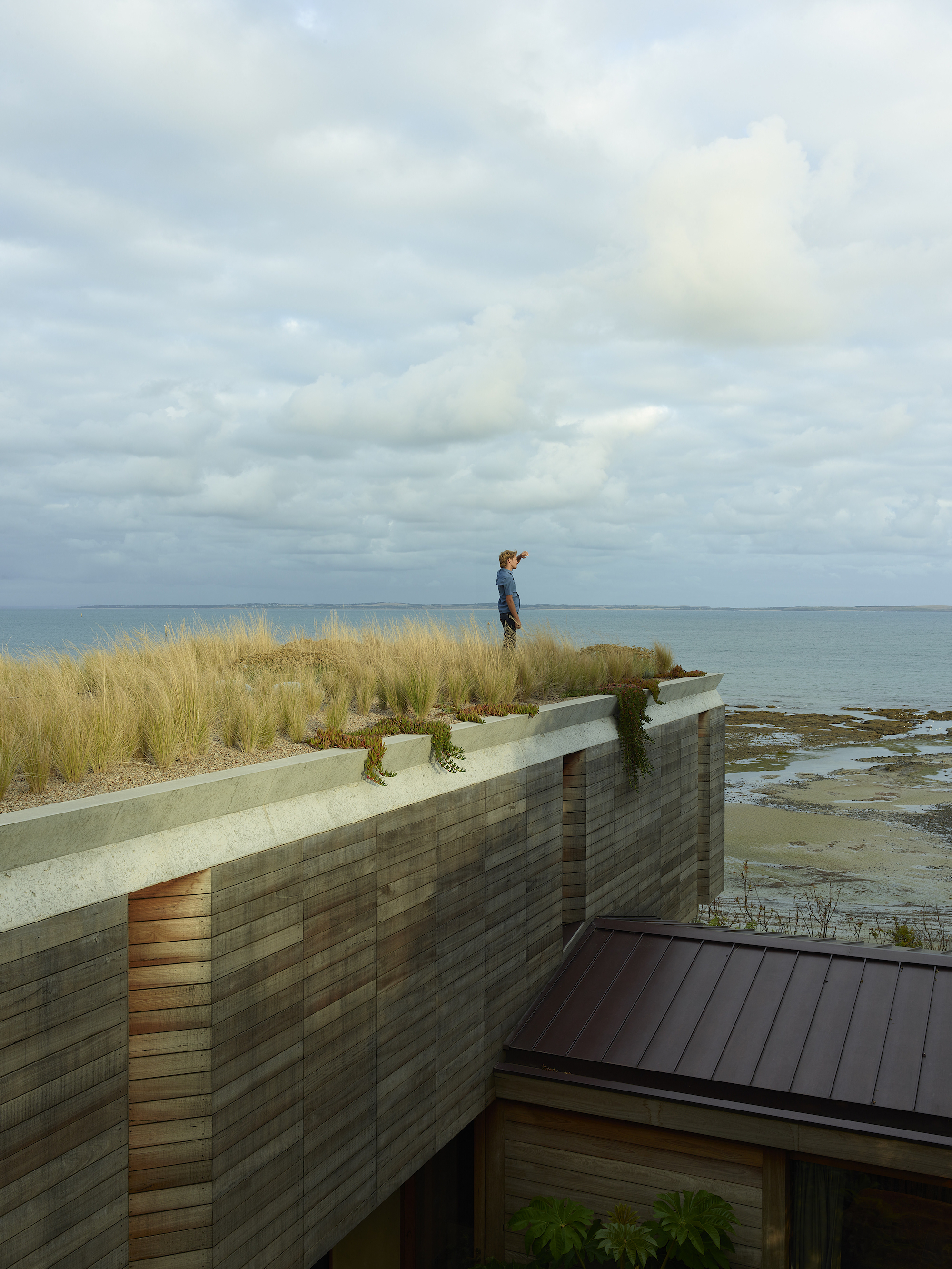
A great coastal home has a tricky job. It must admire the ocean without acting like a glass trophy case, survive salt, wind, sun, and storms, and still feel like the place where someone can curl up with a book while the weather performs dramatic theater outside. That is the magic behind the idea of prospect and refuge: a home that offers wide-open views, but also protected, intimate spaces that make the body exhale.
The phrase sounds a little academic, as if it should be wearing tweed and carrying a clipboard, but the feeling is wonderfully human. Prospect is the thrill of seeing far: the coastline, the horizon, the cliff, the changing light. Refuge is the comfort of being held: a warm corner, a shaded courtyard, a lower ceiling, a timber-lined room, a fireplace, a wall at your back. When these two instincts meet, a coastal house becomes more than beautiful. It becomes deeply livable.
One spectacular example is the Always House by Kennedy Nolan, a coastal residence on Victoria’s Mornington Peninsula. Although it sits in Australia, its design lessons translate beautifully to American coastal living, from Maine and Cape Cod to California, Oregon, the Carolinas, and the Gulf Coast. The home shows how coastal home design can be wild and cozy at once: open to the sea, protected from exposure, and grounded in landscape, memory, and material warmth.
What “Prospect and Refuge” Means in Home Design
Prospect-refuge theory is rooted in the idea that people are drawn to places where they can observe their surroundings while still feeling protected. In plain English: we like a view, but we do not want to feel like a lighthouse keeper during a hurricane. This is why people love window seats, covered porches, balconies with railings, dining booths, deep eaves, fireplaces, and bedrooms tucked away from the social action.
In architecture, prospect often appears as long sightlines, elevated viewpoints, large windows, open-plan living areas, terraces, and framed views toward water, trees, or sky. Refuge appears through enclosure: alcoves, courtyards, shaded entries, timber interiors, stone walls, canopies, lower ceilings, soft lighting, and rooms that feel sheltered without becoming cave-like. The goal is not to choose between drama and comfort. The goal is to let them politely share the same dinner table.
Why It Works So Well Near the Coast
Coastal sites naturally offer prospect. There is the horizon, the rhythm of waves, the sweep of weather, the theater of clouds, and the kind of sunset that makes people suddenly become poets. But coastal sites also bring exposure. Wind can be relentless. Salt air can punish materials. Strong sun can overheat interiors. Stormwater must be handled carefully. In flood-prone or erosion-prone areas, site planning and structure matter as much as style.
That is why the best spectacular coastal homes are rarely just glass boxes pointed at the view. A glass box may photograph well, but everyday life asks for more: shade, privacy, thermal comfort, protected outdoor rooms, durable finishes, and places where people can retreat when the weather gets moody. The smartest homes turn the coastline into a partner, not a boss.
The Always House: A Coastal Home with Memory and Muscle
Always House began with a dramatic cliffside site and an existing midcentury home originally associated with Chancellor and Patrick, an important Australian architectural practice. The intention was to restore the older structure, but the site’s instability made that impossible. Rather than erase the past completely, Kennedy Nolan designed a new home that “remembers” the earlier house through its general form, arrangement, and relationship to the land.
That decision matters. Many coastal homes behave as if they arrived by helicopter, landed on the prettiest spot, and immediately began posing. Always House feels different because it recognizes that a site has history. It does not simply chase the ocean view. It balances view with shelter, exposure with enclosure, and new construction with memory. That makes the design feel rooted rather than decorative.
Not Just One Big Window
The architects understood a common coastal design trap: when a site has a breathtaking view, everything gets arranged toward that single view. The result can be a one-directional house, beautiful in photographs but surprisingly flat in real life. Always House avoids this by creating a dialogue between the ocean-facing prospect and a more protected inner courtyard. The home looks outward to the wild coastline, but it also turns inward to a calmer outdoor room.
This is the heart of the design. The ocean gives drama. The courtyard gives pause. One says, “Look at the world!” The other says, “Take your shoes off and breathe.” Together they create the emotional range that makes a house memorable.
Arrival as a Design Experience
A strong coastal home does not reveal everything at once. It lets the site unfold. At Always House, the sequence of arrival is part of the architecture. Paths, steps, gates, changes in light, and moments of compression and release create a sense of anticipation. Instead of entering through a grand “look at me” front door, visitors are slowed down and invited to notice the terrain.
This approach is valuable for any coastal retreat design. The best entrances make people shift gears. A gravel path, a planted roofline, a sheltered wall, a timber gate, or a view that appears only after a turn can create mystery. The house becomes a short journey rather than a box with rooms attached. And frankly, a little journey is good. It gives everyone time to stop thinking about email.
The Power of Thresholds
Thresholds are the in-between moments of a home: entry courts, covered porches, breezeways, stair landings, mudrooms, garden paths, and shaded terraces. In coastal architecture, thresholds are especially important because they mediate between wild weather and domestic comfort. They are where sandy feet, wet jackets, salty air, and human expectations negotiate a peace treaty.
A well-designed threshold says, “Yes, the sea is right there, but the sofa is safe.” It helps the home feel relaxed rather than fragile. That is essential for a house meant to be lived in, not tiptoed through like a museum where the main exhibit is expensive upholstery.
Materials That Make a Wild Site Feel Cozy
One of the reasons Always House feels so compelling is its material palette. Timber, stone, earthy render, muted colors, tactile surfaces, and shadow-rich interiors counterbalance the brightness and vastness of the coast. Natural materials are not used as rustic decoration; they are used as emotional architecture.
Wood brings warmth. Stone brings weight. Slate, tile, brass, and textured surfaces add depth. Darker, quieter interiors can make ocean views feel even more powerful because the eye moves from shelter to brightness. This contrast is a classic prospect-and-refuge move: the home gives you the wide world, but from a place that feels protected.
Why Darker Interiors Can Work Near the Water
Many people assume every coastal home must be white, bright, and decorated with enough navy stripes to qualify as a small maritime nation. But darker coastal interiors can be incredibly effective. They reduce glare, create intimacy, and make the outside view appear almost cinematic. A dim timber-lined room facing a bright sea is like a theater with the curtain permanently open.
This does not mean a coastal home should feel gloomy. The trick is balance: warm wood, layered lighting, reflective accents, soft textiles, and carefully framed daylight. The goal is a room that feels calm during the day and glowing at night. Add a good chair, and suddenly everyone in the house claims they have “always loved reading.”
Biophilic Design: Bringing Nature In Without Turning the Living Room into a Fern Jungle
Biophilic design focuses on strengthening the connection between people and nature. In a coastal home, that connection can come through views, natural materials, daylight, airflow, native planting, water awareness, seasonal change, and sensory experiences such as the sound of wind or the smell of timber after rain.
Always House uses biophilic thinking in a sophisticated way. The green roof helps the home recede into the landscape. Native planting softens the building’s presence. The courtyard creates a protected microclimate. Interior materials echo the tones of the land. Views are not simply presented; they are framed, delayed, and intensified.
Green Roofs, Native Plants, and Living Shoreline Thinking
Green roofs and native landscapes can do more than look charming. In coastal regions, planting can help manage stormwater, reduce heat, support habitat, and soften the transition between building and land. For American coastal homes, this principle can translate into dune-friendly planting, rain gardens, permeable paving, native grasses, salt-tolerant shrubs, and landscape strategies that reduce runoff rather than sending it downhill like an overcaffeinated river.
Not every home needs a green roof, but every coastal home benefits from landscape thinking. The site should not be treated as leftover space after the house is drawn. It should be part of the architecture. The best coastal landscapes look easy, but they are often doing serious work quietly in the background, like the responsible adult at a beach barbecue.
Resilient Coastal Home Design: Beauty Needs a Backbone
A coastal home can be poetic, but it also needs engineering common sense. Coastal resilience involves understanding wind, flooding, erosion, drainage, salt exposure, sun, humidity, and long-term maintenance. In vulnerable locations, building elevation, foundation type, setbacks, corrosion-resistant materials, impact-rated openings, drainage planning, and local flood requirements are not optional details. They are the difference between “timeless retreat” and “insurance claim with a view.”
Always House had to respond to an unstable cliff edge, which shaped its structural strategy. In U.S. coastal regions, the same mindset applies even when the hazards differ. A home in the Outer Banks may face flood and wind risks. A California cliffside house may need to consider erosion, wildfire-adjacent landscapes, and seismic design. A Gulf Coast residence may need hurricane-resistant assemblies and elevated living spaces. The lesson is simple: design for the actual place, not for a fantasy postcard.
Natural Ventilation and Passive Comfort
Coastal homes often have access to breezes, and good design can use that gift. Operable windows, cross-ventilation, stack effect, shaded openings, ceiling fans, and carefully planned landscaping can reduce reliance on mechanical cooling in suitable climates. But natural ventilation must be designed thoughtfully. Humidity, pollen, smoke, wildfire conditions, and outdoor air quality all affect when and how a house should breathe.
Passive comfort is not about rejecting technology. It is about making the house smarter before the mechanical systems ever turn on. Deep overhangs, shaded glass, thermal mass, insulation, orientation, and ventilation all help create a home that feels comfortable with less effort. Basically, the house does some of the work so the air conditioner does not have to become a full-time employee.
How to Borrow the Look and Feeling
You do not need a cliffside site or an architect-designed masterpiece to use prospect-and-refuge principles. These ideas can improve a beach cottage, a lake house, a suburban home, or even a small apartment with one heroic window and a houseplant doing its best.
1. Frame Views Instead of Exposing Everything
A view becomes more powerful when it is framed. Use window placement, partial walls, built-in seating, curtains, shutters, or landscaping to create moments of reveal. Instead of turning the entire wall into glass, ask where the eye should go and what the body needs to feel comfortable.
2. Create at Least One True Refuge
Every home needs a small protected spot. It might be a reading nook, a covered porch, a window seat, a snug media room, a banquette, or a bedroom corner with lower lighting and tactile materials. The best refuge spaces have a back, a side, a sense of overhead protection, and a view outward.
3. Use Materials That Can Age Gracefully
Coastal homes should not depend on perfection. Salt, sand, sun, and damp air will leave their signature. Choose materials that develop character: durable timber, stone, limewash, mineral finishes, quality tile, stainless or marine-grade hardware where appropriate, and fabrics that can handle real life. A coastal home should be able to host bare feet, wet towels, and someone saying, “I only brought a little sand in,” while standing on what appears to be a small dune.
4. Make the Courtyard Your Secret Weapon
A courtyard can turn a harsh coastal site into a comfortable retreat. It blocks wind, offers privacy, creates a sun trap in cooler months, and provides a safe outdoor room when the exposed deck is too gusty. Even a small courtyard or walled patio can create the refuge half of the prospect-refuge equation.
5. Let Landscape Do Real Work
Planting should guide movement, filter views, slow runoff, support pollinators, and protect outdoor rooms. Native and climate-appropriate plants usually perform better and require less fuss. They also help the home belong to its place, which is far better than making every coast look like the same catalog photo with different zip codes.
Common Mistakes in Coastal Home Design
The first mistake is over-glazing. Too much glass can create glare, heat gain, bird collision risks, privacy problems, and an exposed feeling that undermines comfort. The second mistake is ignoring maintenance. Coastal environments are tough on metals, coatings, fasteners, decking, and exterior finishes. The third mistake is designing only for summer. A truly good coastal home works in fog, rain, wind, winter, shoulder seasons, and quiet weekdays when nobody is wearing linen.
Another mistake is confusing “coastal style” with themed decor. Shells, rope, anchors, and blue stripes have their place, but they cannot replace architecture. Real coastal character comes from light, air, view, proportion, material, landscape, and the way a room feels when the weather changes.
Experience Section: Living in a Wild-and-Cozy Coastal Home
Imagine waking up in a coastal home designed around prospect and refuge. The first thing you notice is not a giant view shouting at you from across the room. It is quieter than that. A soft strip of morning light slips across timber boards. Somewhere outside, wind moves through grasses. The ocean is present, but not rude. It waits until you step toward the window.
In the kitchen, the day begins with a small ritual: coffee, bare feet, a cool countertop, and a view that opens gradually beyond the courtyard. The courtyard is still, protected from the stronger wind coming off the water. It holds the morning sun like a cup. Herbs lean toward the light. A chair sits under an overhang, already looking smug because it knows it is the best chair in the house.
By midday, the home changes personality. The living area becomes the place of prospect. Large openings frame the sea, the cliff, the sky, or the dune line. You can watch weather forming at a distance. Boats become tiny punctuation marks. Gulls make unnecessary comments. The room feels open, but because the materials are warm and the ceiling has weight, you never feel stranded in the view.
In the afternoon, the wind rises. This is when the refuge spaces prove their worth. The exposed deck may be too lively for lunch unless you enjoy eating salad one leaf at a time as it flies toward the next county. So the courtyard takes over. It becomes the outdoor room that saves the day: sheltered, bright, and social. The architecture has not fought the weather. It has simply created options.
Evening brings the best transformation. The ocean darkens. Interior lights warm the timber and stone. The house no longer feels like a lookout; it feels like a lantern. People drift toward the most protected corners: the window seat, the sofa near the wall, the nook beside the fire, the bedroom with the smallest lamp. The wild landscape is still visible, but now it is framed by comfort. That emotional contrast is the whole point.
Guests often remember homes like this not because every finish was expensive, but because the house gave them a sequence of feelings. Arrival slowed them down. The view lifted them up. The courtyard calmed them. The materials grounded them. The small corners restored them. A prospect-and-refuge home understands that people are not always in the same mood. Sometimes we want the horizon. Sometimes we want a blanket. The best coastal houses, being wiser than they look, give us both.
Conclusion: The Best Coastal Homes Are Brave and Tender
Prospect & Refuge: A Spectacular Coastal Home Both Wild and Cozy is more than a beautiful title. It is a design philosophy for living well at the edge of land and water. A great coastal home should not merely point at the view. It should choreograph how the view is discovered, balanced, softened, and lived with every day.
Always House shows how powerful that balance can be. It respects history, responds to a difficult site, uses natural materials with emotional intelligence, and avoids the predictable glass-box solution. It proves that a home can be dramatic without being cold, sheltered without being closed, and luxurious without shouting across the beach in designer sunglasses.
For homeowners, designers, and dreamers, the lesson is clear: build with the landscape, not against it. Let the sea be seen, but give people a place to retreat. Use materials that age with dignity. Create outdoor rooms that work when the wind misbehaves. Design for comfort, resilience, and wonder. That is how a coastal house becomes both wild and cozyand how architecture becomes a place the heart recognizes as home.
Note: This publish-ready article synthesizes real architectural project information, prospect-refuge theory, biophilic design principles, passive comfort strategies, and coastal resilience guidance. It has been fully rewritten in original language for web publication.